
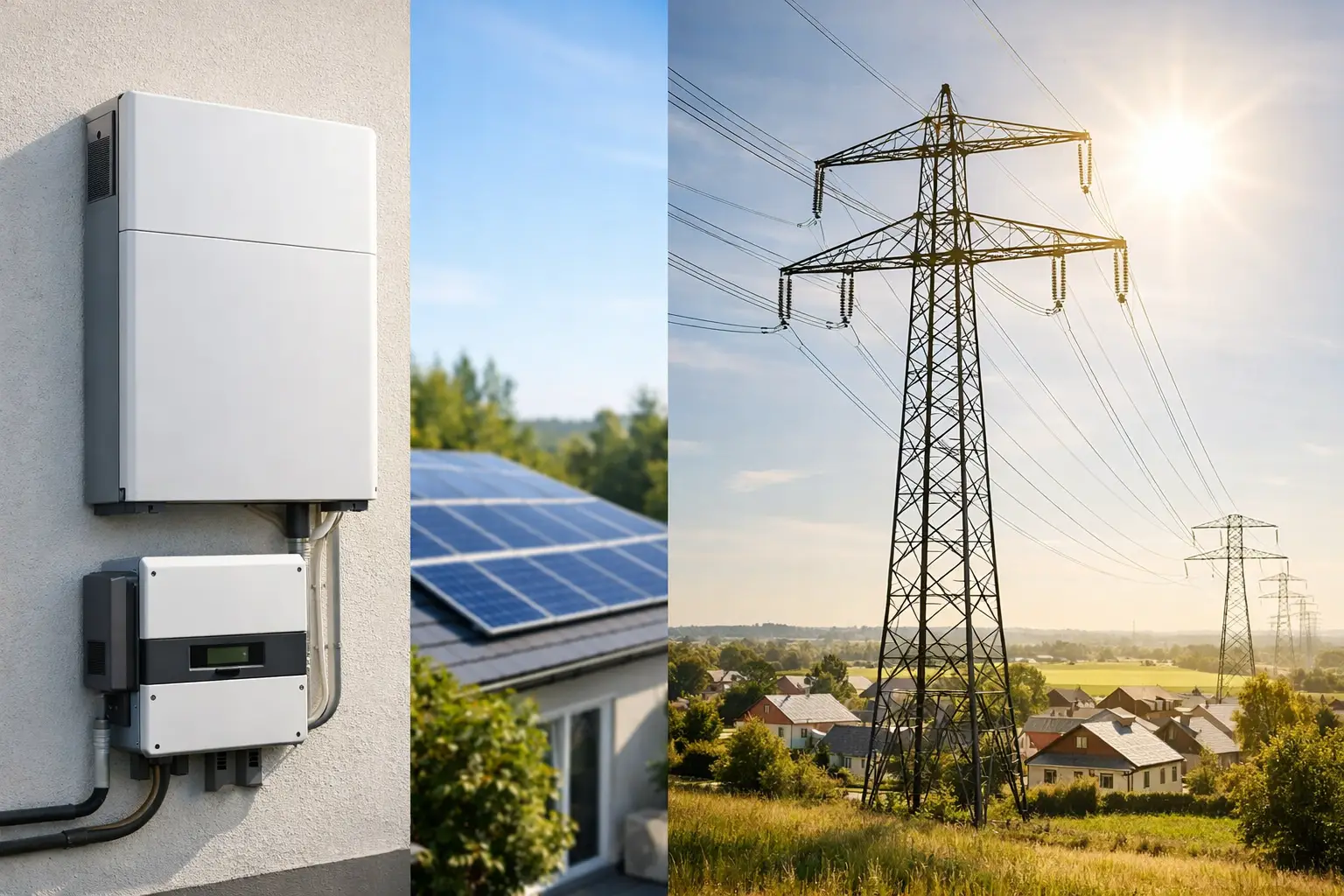
Your solar panels may produce their strongest output in the middle of the day, just when many homes are quiet. Then, when the family arrives home, the air conditioner, cooking and appliances start drawing power as the sun goes down. That timing gap sits at the heart of the solar battery versus feed-in tariff decision.
Exporting surplus solar can still earn a credit, but feed-in tariffs are commonly far lower than the price you pay to buy electricity from the grid. A battery gives you another option: keep more of the energy you generate and use it later. The right choice depends on your household load, electricity plan, budget and whether energy resilience matters to you.
Solar battery versus feed in tariff: the key difference
A feed-in tariff is the credit your electricity retailer pays for solar energy exported to the grid. If your panels generate more than your property uses at that moment, the excess flows out and appears as a credit on your bill.
A solar battery stores some of that excess energy on site. Instead of exporting it during the day, you can use it in the evening, overnight or during a high-priced tariff period. This is known as increasing solar self-consumption.
The comparison is not simply about whether one option is “better”. It is about the value of each kilowatt-hour. If you export one kilowatt-hour for a modest feed-in credit, then buy one kilowatt-hour back later at a much higher retail rate, there is a clear opportunity for a battery to reduce that gap. Batteries do have an upfront cost, limited capacity and small energy losses during charging and discharging, so the numbers need to be assessed for your property rather than assumed.
Why feed-in tariffs alone often leave savings on the table
Feed-in tariffs helped make early solar systems attractive, but rates and electricity plans have changed substantially over time. In many parts of Australia, exported solar energy is worth much less than grid electricity purchased in the morning and evening.
For example, a household may receive a credit of 5 to 10 cents for exported solar, while paying 25 to 45 cents or more for imported electricity, depending on the plan and time of use. Exact rates vary by retailer, state and tariff, but the principle remains the same: using your own solar is usually more valuable than selling it cheaply and buying power back later.
This does not make exporting worthless. Your household can only use or store so much energy. Once the battery is full and daytime loads are covered, exporting surplus power is still beneficial. The aim is not to eliminate exports at all costs. It is to avoid exporting valuable energy during the day only to purchase expensive grid energy after sunset.
A feed-in tariff may also be the more practical choice where daytime energy use is already high. A home business, workshop, pool pump, electric hot water system or daytime air conditioning can consume a large share of solar production directly. In that situation, battery savings may be lower because there is less excess generation available to store.
When a battery can make financial sense
A battery tends to be most valuable for homes that export plenty of solar during the day and import significant electricity at night. It can also suit properties on time-of-use tariffs, where electricity is especially expensive during evening peak periods.
A well-sized system can charge from surplus solar, then supply the home after the panels stop producing. Smart monitoring helps ensure the battery responds to your real usage pattern rather than working to a generic schedule.
Battery value can improve when your household has one or more of these conditions:
- high evening consumption from cooking, heating, cooling or family routines
- a low feed-in tariff compared with the retail price of imported electricity
- an electric vehicle that can be charged strategically
- time-of-use pricing with costly peak periods
- interest in joining a suitable virtual power plant program
- a need for selected backup power during grid outages
The final point deserves attention. A standard solar system usually shuts down during a blackout for safety reasons, even if the sun is shining. A battery system with correctly designed backup capability can keep nominated essential circuits running, such as lights, refrigeration, internet and selected power points. Full-home backup may be possible for some properties, but it requires careful design around battery size, switchboard capacity and large electrical loads.
Battery size matters more than the biggest number
Buying the largest battery available is not automatically the best investment. An oversized battery may sit partly unused through much of the year. An undersized battery may fill quickly, leaving more solar to export and providing limited evening coverage.
The best starting point is your interval data, not a guess based on the number of people in the home. Half-hourly or smart-meter data shows when you consume electricity, how much solar you export and how much power you purchase after dark. Seasonal changes matter too. A system should account for summer cooling, winter heating, pool equipment, working from home and future plans such as an EV or electrified hot water.
Battery capacity is measured in kilowatt-hours, while its output is measured in kilowatts. Capacity tells you how much energy can be stored. Output tells you how many appliances it can support at once. A battery may have enough stored energy for an evening, but its power rating still needs to handle the likely simultaneous load. This is why system design matters as much as the battery brand on the quote.
Compare your real return, not just the battery price
A useful comparison looks at the full energy picture over time. This includes the installed battery cost, any available rebates or incentives, expected solar generation, consumption profile, retail import rate, feed-in tariff, battery efficiency, warranty conditions and likely future electricity price changes.
It should also account for the value you place on backup power and reduced grid dependence. These benefits do not always fit neatly into a simple payback calculation, but they are real. For a household that loses refrigerated food, internet access or the ability to work from home during outages, resilience has practical value.
Be cautious of savings estimates built on unusually high feed-in rates, flat electricity prices or assumptions that the battery will be fully charged and discharged every day. Solar production changes with weather and season, while household consumption changes with routines. A credible assessment uses your actual bills and meter data, explains its assumptions and shows where results may vary.
Government incentives can also change the outcome. Battery rebates, solar incentives and program eligibility differ across Australia and may have technical, product or installation requirements. Getting the paperwork and compliance details right is part of protecting the value of the system, not an afterthought.
Could a virtual power plant improve battery value?
A virtual power plant, or VPP, connects participating home batteries to a coordinated network. At certain times, the program may draw on stored energy or adjust battery behaviour to support the electricity grid. In return, customers may receive credits, payments or other plan benefits.
For some households, a VPP can improve the financial case for battery storage. For others, the trade-off may not suit their preference for retaining all stored energy for evening use or blackout protection. Program rules, minimum battery reserves, exit conditions and payment structures should be reviewed before joining.
The strongest approach is to choose a battery system that meets your day-to-day needs first, then assess VPP participation as an optional layer of value. Do not rely on a projected VPP payment alone to justify a system that otherwise does not fit your usage.
A practical way to make the decision
Start by reviewing 12 months of electricity bills and, where available, interval usage data. Look for the amount of solar you export and the amount of electricity you buy after sunset. Then compare your feed-in tariff with your import rates, including peak and off-peak periods.
Next, consider what is changing at your property. An EV, a growing family, a renovated home office, a pool or a switch from gas to electric appliances can all change the ideal battery size. It may be sensible to install solar with a battery-ready inverter, or to add storage to an existing solar system if the technical setup allows it.
A professional site assessment should also check switchboard suitability, panel generation, shade, electrical safety, backup requirements and internet connectivity for monitoring. GridFree Solar can help homeowners turn this information into a clear system design, while managing installation, rebate requirements and ongoing performance support.
The best outcome is not a home that chases the highest export credit. It is a home that puts more of its own solar to work when electricity is most valuable, while keeping the system sized for the life you actually live.