
Table of Contents
- Why Upgrade Your Solar Battery System
- How Solar Batteries Work and Store Your Energy
- AC-Coupled vs DC-Coupled Battery Upgrades
- Battery Chemistry Types: Lithium-Ion, Flow and Sodium
- Solar Battery Rebate Eligibility and Government Support
- Cost of Retrofitting Solar Batteries to Existing Systems
- Sizing Your Battery System and Maximising Returns
- Installation Safety and Compliance Standards
- Frequently Asked Questions
Last Updated: August 27, 2026
Why Upgrade Your Solar Battery System
Older solar setups installed more than five years ago use outdated battery technology. Modern systems outperform them by 20-30% in round-trip efficiency, translating to lower self-consumption rates and increased feed-in tariff revenue (peer-reviewed research).
The upgrade decision hinges on three factors: your existing solar PV system configuration, your current electricity consumption patterns, and your financial goals. GridFree Solar has helped Australian homeowners navigate this choice, identifying which upgrade path delivers the fastest payback period and lowest fire risk.
When you upgrade, your system can charge during off-peak grid windows (11am-2pm), earn 15¢/kWh exporting power during peak export windows (6-8pm), and claim an additional $1 daily bonus for avoiding grid use during peak demand hours.
Before upgrading, check whether your existing inverter supports battery integration. Many older hybrid inverters can’t handle modern lithium-ion modules. A quick [compatibility audit](/how-to-prepare-for-battery-installation/) saves thousands in unnecessary hardware replacement.
How Solar Batteries Work and Store Your Energy
A residential solar battery stores excess energy your panels generate during daylight hours, releasing it when you need power most. The battery captures DC (direct current) power from your panels, stores it chemically, and converts it back to AC (alternating current) when your home draws from it.
Round-trip efficiency measures how much usable energy you recover from every kilowatt-hour you store. Older lithium-ion batteries achieve 85-90% round-trip efficiency. Modern systems now reach 94-96%, meaning you waste less energy during the charge-discharge cycle. Over a decade, that 4-6% difference compounds into thousands of dollars in recovered energy.
Depth of discharge (DoD) defines how much of your battery’s total capacity you can safely use without shortening its lifespan. Older batteries operated at 80-85% DoD. Current technology safely operates at 90-95% DoD, giving you more usable capacity from the same physical battery size.
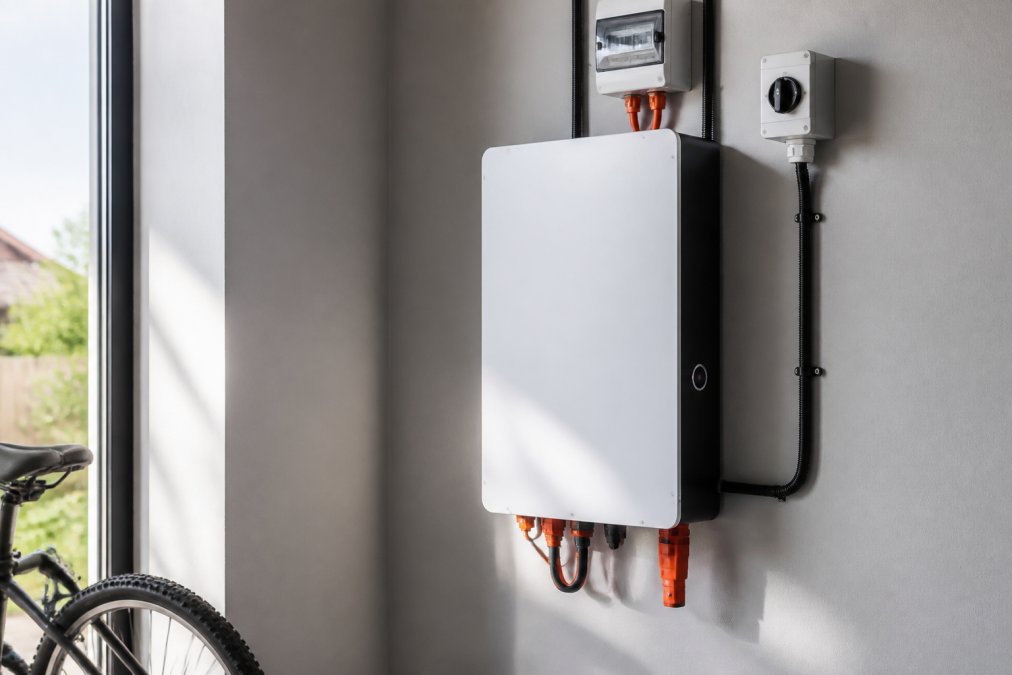
The inverter bridges your panels and home, handling DC-to-AC conversion and managing when energy flows to storage, your home, or the grid. Modern inverters include built-in energy management logic that optimises battery charging based on real-time pricing signals, weather forecasts, and consumption patterns.
AC-Coupled vs DC-Coupled Battery Upgrades
The coupling type determines how your battery integrates with your existing solar PV system, with major implications for cost, efficiency, and compatibility.
DC-coupled systems connect the battery directly to your solar panels via a shared charge controller and inverter. Energy flows as direct current throughout the storage and conversion process, achieving the highest round-trip efficiency (94-96%). They’re also the most cost-effective option when building from scratch because you need only one inverter.
The catch: DC-coupled retrofits are expensive if you already have an existing solar inverter. You’d typically need to replace your inverter entirely, which means labour costs, potential system downtime, and disposal of working equipment. DC-coupled upgrades make sense only if your current inverter is nearing end-of-life anyway.
AC-coupled systems connect the battery to your home’s AC circuit, downstream of your existing solar inverter. Your panels generate power, your current inverter converts it to AC, and then a separate battery inverter manages storage and discharge. This requires two inverters instead of one, adding cost and introducing an extra conversion step.
The advantage is flexibility. AC-coupled batteries work with virtually any existing solar setup, regardless of inverter age or brand. For most homeowners retrofitting an existing solar PV system, AC-coupling is the pragmatic choice. You pay a small efficiency penalty (91-93% round-trip efficiency vs. 94-96%) in exchange for avoiding a full system replacement.
GridFree Solar designs both architectures depending on your situation. If your inverter is original equipment from 2016 or earlier, we often recommend DC-coupled replacement as the long-term value play. For systems installed after 2018, AC-coupled retrofits typically deliver faster payback because they preserve your existing infrastructure.
Never assume your current inverter can handle battery integration. Many older hybrid inverters have firmware limitations that prevent them from working with [modern lithium-ion batteries](/tesla-powerwall-review-australia/). Incompatibility here means either replacing the inverter or choosing an AC-coupled battery system instead. A free compatibility audit prevents costly mistakes.
Battery Chemistry Types: Lithium-Ion, Flow and Sodium
Lithium-ion dominates residential solar storage for good reason: it’s proven, efficient, and cost-effective. But newer chemistries are emerging, and understanding the trade-offs helps you pick the right upgrade for your specific situation.
Lithium-ion batteries store energy through reversible chemical reactions between lithium ions and electrode materials. They achieve the highest energy density, the longest cycle life (8,000+ cycles before capacity degradation becomes significant), and the best round-trip efficiency. A modern lithium-ion battery rated for 8,000 cycles typically retains 80% of its original capacity after that point.
The downside is cost and heat generation. Lithium-ion requires active thermal management and safety monitoring under Clean Energy Council (CEC) accreditation standard AS/NZS 5139:2019 (cleanenergycouncil.org.au).
Flow batteries (vanadium redox or iron-based) store energy in liquid electrolyte tanks rather than solid electrode materials. They decouple energy capacity from power output and can cycle thousands of times with minimal degradation. They’re also safer with lower fire risk.
The trade-off is physical size and efficiency. Flow batteries require larger tanks and achieve lower round-trip efficiency (75-85%). For most Australian residential installations, flow batteries make sense only if you have space constraints that prevent lithium installation or if you prioritise safety over efficiency.
Sodium-ion batteries represent the newest chemistry entering residential markets. They use sodium ions instead of lithium, offering lower cost, better thermal stability, and simpler supply chains. Sodium-ion achieves 85-90% round-trip efficiency and can cycle 3,000-5,000 times before significant degradation.
The catch is maturity. Sodium-ion is still proving itself in residential applications. Warranty terms are shorter (typically 5-7 years vs. 10-15 years for lithium), and long-term performance data is limited. For risk-averse homeowners, lithium-ion remains the safer choice.
| Battery Chemistry | Round-Trip Efficiency | Cycle Life | Cost per kWh | Best For |
|---|---|---|---|---|
| Lithium-Ion | 94-96% | 8,000+ | Highest | Most residential upgrades |
| Flow (Vanadium) | 75-85% | 10,000+ | Very High | Space-unconstrained installations |
| Sodium-Ion | 85-90% | 3,000-5,000 | Lower | Cost-conscious early adopters |
Solar Battery Rebate Eligibility and Government Support
Multiple government schemes and utility incentives exist specifically to reduce your upgrade costs. Understanding eligibility rules prevents you from missing thousands in available support.
The Small-scale Renewable Energy Scheme (SRES) provides Renewable Energy Certificates (RECs) for battery installations. Your system generates one REC per megawatt-hour of renewable energy displaced. These certificates have resale value, typically 30-50 per certificate, which reduces your net installation cost. Eligibility requires that your battery system is paired with a solar PV system and meets CEC accreditation standards.
The Cheaper Home Batteries Program (now expanded in many states) offers direct rebates for battery installations in eligible postcodes. Rebate amounts vary by state and battery capacity, but many households receive $2,000-$6,000 in direct support. Check your postcode eligibility on the relevant state government website.
Many electricity retailers offer feed-in tariffs specifically designed to reward battery owners who export power during peak demand windows. These tariffs typically pay 15-25¢/kWh for exports between 6-8pm, compared to 10-12¢/kWh for standard exports. Some retailers also offer time-of-use discounts (charging your battery at 11am-2pm for 5-8¢/kWh) that make battery cycling economically attractive.
Your actual upgrade cost after rebates and incentives is typically 40-50% lower than the sticker price. The difference between a $15,000 system and a $7,500 net cost is the gap between “too expensive” and “payback in 6-8 years”. Always calculate your position after government and retailer support before deciding against an upgrade.
Cost of Retrofitting Solar Batteries to Existing Systems
The retrofit cost depends almost entirely on your existing system’s architecture. AC-coupled retrofits are straightforward. DC-coupled retrofits are complex.
An AC-coupled retrofit adds a battery inverter and battery module to your existing setup. Your current solar inverter stays in place. Labour typically involves running new AC cabling from your switchboard to the battery inverter, mounting the battery in a suitable location, and configuring the energy management system. This process takes 2-4 days for most installations. Because you’re preserving your existing inverter, AC-coupled retrofits avoid the largest cost component of a full system replacement.
A DC-coupled retrofit requires replacing your existing inverter with a new hybrid inverter that can manage both solar input and battery charging. Your solar array is temporarily disconnected, your old inverter is removed and disposed of, the new inverter is installed, and all DC and AC cabling is reconfigured. This process takes 3-5 days and involves more complex electrical work. The advantage is future-proofing and a fresh 10-year warranty, but the upfront cost is substantially higher.
GridFree Solar provides transparent cost breakdowns before any work begins. We assess your existing inverter’s condition, check compatibility with modern batteries, and recommend the upgrade path that balances cost, efficiency, and long-term reliability. In most cases, AC-coupled retrofits make financial sense.
Sizing Your Battery System and Maximising Returns
Your battery size should match the energy you can realistically use or export profitably, not your theoretical maximum demand. If you consume 20 kWh per day but generate only 12 kWh from solar, a 15 kWh battery makes sense. A 25 kWh battery would sit partially empty most days, wasting capital on unused capacity.
The real optimisation comes from understanding your retailer’s time-of-use tariffs and export incentives. If your retailer charges 45¢/kWh during peak demand (6-8pm) and pays 20¢/kWh for exports, your battery’s job is to shift energy from cheap charging windows (11am-2pm at 8¢/kWh) to expensive consumption windows. That spread makes battery cycling economically attractive.
A practical sizing method: multiply your average daily solar generation by 0.6, then round to the nearest whole number. If you generate 15 kWh daily on average, a 9 kWh battery is a reasonable starting point. Adjust based on your consumption patterns and export incentives.
Your battery’s real value isn’t its total capacity, it’s how many times per year it cycles at high depth of discharge. A 10 kWh battery cycling daily at 80% DoD generates more economic value than a 15 kWh battery cycling every other day. Optimise for cycle frequency, not raw capacity.
Installation Safety and Compliance Standards
A poorly installed battery system is a genuine fire hazard, and substandard installation voids your warranty and insurance coverage.
All residential battery installations in Australia must comply with AS/NZS 5139:2019 (Energy storage systems, Safety requirements for grid-connected and standalone power systems) (standards.org.au). This standard specifies electrical safety, thermal management, fire containment, and emergency shutdown procedures. It’s the legal baseline for any installation.
Your installer must also hold CEC accreditation, which requires passing technical exams, maintaining liability insurance, and following the Clean Energy Council’s Code of Conduct. A CEC-accredited installer has demonstrated they understand battery chemistry, electrical safety, grid interconnection rules, and Australian standards compliance. GridFree Solar’s accreditation means every installation meets these requirements before work begins.
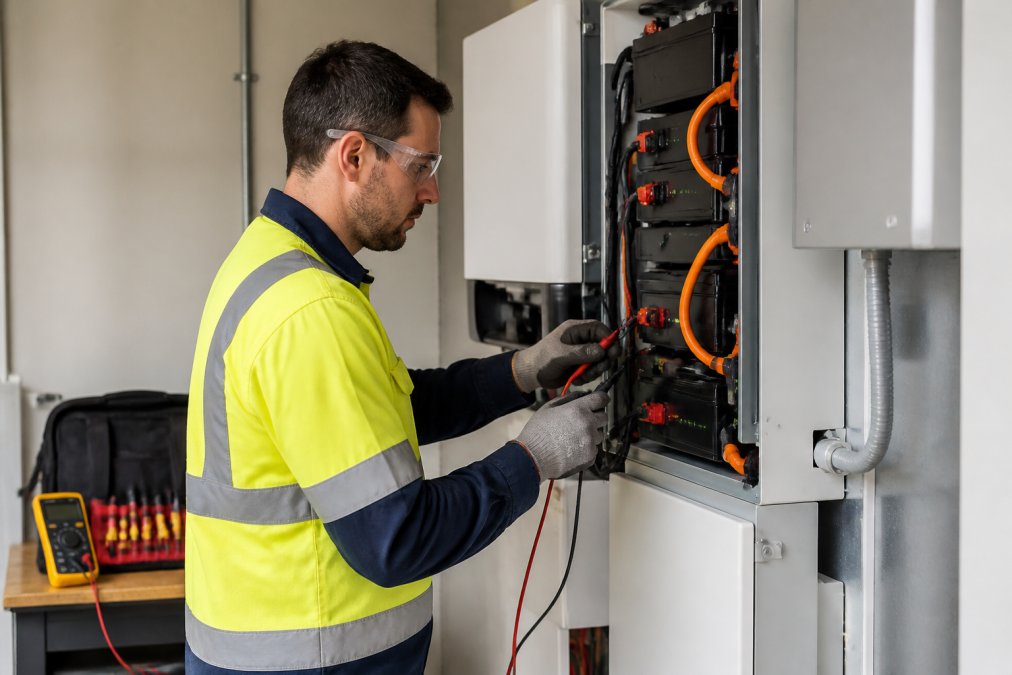
The installation process involves several critical steps: a site assessment determines whether your location is suitable for battery storage; electrical safety testing confirms your switchboard can handle additional loads; the battery inverter must be configured to interact safely with your solar inverter and grid connection; and system monitoring must be active from day one, with remote monitoring that tracks temperature, voltage, current, and state of charge.
Your installer should provide comprehensive documentation: a Certificate of Electrical Safety (CES), a copy of your system design, warranty paperwork, and a user manual. You should understand how to access your battery’s monitoring system and what to do if an alert appears.
The decision to upgrade your residential solar battery system ultimately comes down to three questions: How much of your current electricity bill is driven by peak demand charges? How much solar energy do you generate but fail to use? And how confident are you in your installer’s safety and compliance standards?
If peak demand charges exceed 30% of your bill, battery storage becomes economically attractive. If you’re exporting more than 30% of your solar generation to the grid, you’re leaving money on the table. And if your installer isn’t CEC-accredited or can’t explain AS/NZS 5139:2019 compliance, walk away, the fire risk and warranty exposure aren’t worth the savings.
GridFree Solar has guided Australian homeowners through this decision. We assess your existing system, calculate your realistic payback period, identify all available government rebates, and design an upgrade path that’s both safe and financially sound. Connect with our team to understand your specific situation and what a modern battery system could mean for your energy independence and electricity costs.
Frequently Asked Questions
What is the difference between AC-coupled and DC-coupled solar battery upgrades?
AC-coupled batteries connect to your existing solar inverter via the grid connection, making them easier to retrofit into established systems. DC-coupled systems connect directly to your solar panels and battery inverter, offering higher round-trip efficiency but requiring more complex installation. For most retrofits, AC-coupled is simpler and often more cost-effective; DC-coupled suits new installations or full system replacements where efficiency gains may justify the extra cost.
How do I check if I’m eligible for solar battery rebates?
Eligibility depends on your state and postcode. The Small-scale Renewable Energy Scheme (SRES) and Cheaper Home Batteries Program offer rebates for eligible households. Your solar PV system must be Clean Energy Council (CEC) accredited, and your installer must be CEC-accredited. Contact your state government or energy provider for specific eligibility criteria, or speak with a CEC-accredited installer who can assess your property and guide you through the application process.
How long will a residential solar battery last?
Most modern lithium-ion batteries are warranted for 10-15 years and retain 70-80% capacity after that period. High-quality batteries with 8,000+ cycle ratings can last 15-20 years in typical residential use. Lifespan depends on depth of discharge (DoD), temperature management, and usage patterns. Flow batteries and sodium-ion options may offer different longevity profiles. Your installer can recommend a battery matched to your expected system lifetime and usage.
Can I add a solar battery to my existing solar panel system?
Yes, retrofitting a battery to an existing solar PV system is common and usually straightforward with AC-coupled installation. Your inverter must be compatible, and your roof space and electrical setup must accommodate the new battery. The cost of retrofitting depends on your current system configuration, whether you need additional equipment, and your chosen battery size. A professional assessment will confirm compatibility and identify any upgrades needed for safe integration.
This article was written using GrandRanker