
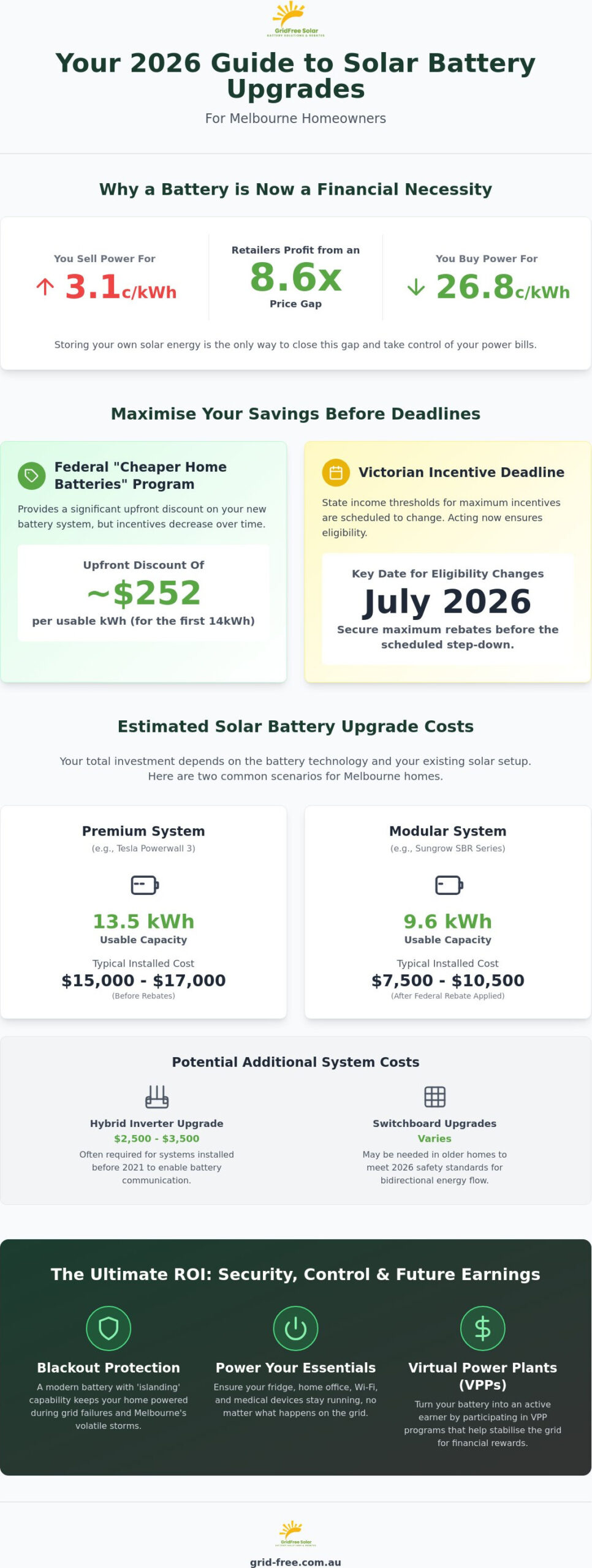
Feeding the grid for a measly 3.1 c/kWh while buying it back at 26.8 c/kWh isn’t just inefficient. It is a financial leak that costs Melbourne households hundreds every year. You likely installed solar to crush your power bills, yet those quarterly statements keep climbing despite the panels on your roof. It’s a common frustration. You’ve done the hard work of generating green energy, but without storage, you’re at the mercy of rising retail rates and unpredictable Melbourne storms. Understanding the solar battery upgrade cost Melbourne residents face is the first step toward reclaiming your energy independence.
This guide helps you master the storage market in 2026. We’ll cut through the confusion surrounding the new tiered Federal “Cheaper Home Batteries Program” and the tightening income caps for state incentives. You will learn how to identify if your current inverter is a technical bottleneck and how to secure your home against blackouts. We provide a clear breakdown of rebate stacking, Virtual Power Plant potential, and the hardware requirements for modern energy storage. It’s time to stop subsidising the retailers and start powering your own home on your own terms.
Key Takeaways
- Stop giving power away for 3.1c/kWh. Storing your own energy is the only way to beat Melbourne’s 26.8c/kWh retail rates in 2026.
- Get a realistic breakdown of the solar battery upgrade cost Melbourne homeowners can expect after applying the Federal “Cheaper Home Batteries” upfront discount.
- Identify your technical path. Learn if your current inverter is “battery-ready” or if an AC-coupled retrofit is your most efficient path forward.
- Beat the July 2026 deadline. Understand how the Victorian income threshold changes affect your eligibility for maximum incentives before they scheduled step-down.
- Maximise your ROI through Virtual Power Plants. Turn your storage system into an active earner while securing your home against storm-driven blackouts.
The 2026 Landscape: Why Melbourne Homeowners are Upgrading Storage Now
Melbourne’s energy market is undergoing a radical shift. High retail prices meet record-low export rewards. Many homeowners find their original solar investments aren’t performing as expected. The primary reason is a lack of storage. As of July 2026, the battery energy storage system (BESS) has moved from a luxury add-on to a financial necessity. The solar battery upgrade cost Melbourne residents are currently weighing is offset by a massive Federal push. The “Cheaper Home Batteries Program” changed the math on May 1, 2026. It offers an upfront discount of roughly $252 per usable kWh for the first 14 kWh. This incentive is scheduled to decrease every six months. Waiting is actually costing you money.
We are also seeing a wave of replacements across Victorian suburbs. Early adopters in areas like Glen Waverley or Brighton are finding their first-generation units are losing capacity. These older systems cannot keep up with modern household loads or Virtual Power Plant (VPP) requirements. Upgrading now ensures you capture the maximum rebate before the next scheduled step-down. It’s about securing your energy future while the incentives are at their peak.
The Death of the Feed-in Tariff
Exporting power to the grid is a losing game. The government-mandated minimum feed-in tariff in Victoria has plummeted to just 3.1 c/kWh as of July 2026. Meanwhile, you are likely paying an average of 26.8 c/kWh to pull power back during the evening peak. This massive 23.7-cent gap is pure profit for retailers. By understanding the solar battery upgrade cost Melbourne providers offer, you can stop being a supplier for pennies. You start being your own power station. You capture every kilowatt your panels produce. You use it when it is worth the most. It is the only way to achieve true energy independence in the current Victorian market.
Grid Reliability and Blackout Protection
Financials aside, Melbourne’s weather is becoming more volatile. Severe storms frequently disrupt the Victorian grid. A standard solar system without a battery shuts down during a blackout for safety reasons. A modern upgrade with “islanding” capabilities changes that. It allows your home to operate independently from the grid during a failure.
- Keep the fridge running during summer storms to prevent food spoilage.
- Maintain home security systems and Wi-Fi connectivity.
- Power essential medical equipment or home offices without interruption.
Peace of mind is the ultimate ROI. Knowing your family is protected during the next grid failure is invaluable. It is about more than just numbers. It is about control over your own home environment.
Breaking Down the Solar Battery Upgrade Cost in Melbourne
Hardware is only half the story. Calculating the solar battery upgrade cost Melbourne households face requires a look beyond the sticker price on a battery module. In 2026, your total investment is a combination of lithium-cell technology, inverter compatibility, and Victorian compliance standards. For a typical Melbourne home, a 10kWh system currently sits in a different price bracket than a premium 13.5kWh unit like the Tesla Powerwall 3. While the latter can range between $15,000 and $17,000 before rebates, smaller modular systems like the Sungrow SBR series offer a more entry-level path. A 9.6kWh Sungrow system often lands between $7,500 and $10,500 after the Federal rebate is applied. Precision in component selection is what separates a high-ROI investment from a budget-draining mistake.
Component Cost Analysis
Your existing solar setup dictates your upgrade path. If your current inverter is not “hybrid-ready,” you face a choice: replace it or go AC-coupled. Upgrading to a modern hybrid inverter typically adds $2,500 to $3,500 to your project total. This is a common requirement for systems installed before 2021. For those with aging Victorian homes, switchboard upgrades are a frequent “hidden” cost. Homes built pre-1990 often require RCD safety switches and mains cabling upgrades to handle the bidirectional flow of a modern Solar Victoria’s official buyers guide approved system. These electrical reinforcements ensure your home meets 2026 safety standards. Expert installers can audit your current electrical infrastructure to provide a fixed-price quote that avoids mid-install surprises.
Installation and Compliance Fees
Melbourne’s strict regulatory environment adds specific line items to your quote. Every battery installation in Victoria requires a Certificate of Electrical Safety (CES). You are also paying for independent inspection fees to verify the system meets the AS/NZS 5139:2019 standards. Don’t cut corners on mounting hardware. High-quality, fire-rated racking and heat-shielding are essential for outdoor installations in Melbourne’s variable climate. A complex install involving multi-storey cable runs or remote switchboard locations will naturally increase labour hours. Demand transparency on these fees. A professional quote should clearly separate hardware, labour, and mandatory Victorian compliance costs to show you exactly where your money is going.
Retrofitting vs. Replacement: Choosing Your Upgrade Path
Many Melbourne homeowners assume their existing solar setup is “plug and play” for storage. It rarely is. If your system was installed over five years ago, your inverter is likely a standard string unit. It lacks the intelligence to manage battery charging. This creates a fork in the road. You can retrofit an AC-coupled battery or overhaul the system with a hybrid inverter. The solar battery upgrade cost Melbourne families pay depends heavily on this technical choice. Deciding correctly now prevents expensive re-work in three years. You need a system that matches your current energy profile while allowing for future expansion.
The AC-Coupled Retrofit Process
AC-coupling is the path of least resistance for older systems. It works by adding a second, dedicated battery inverter alongside your existing solar inverter. You don’t need to touch your roof. You don’t need to replace your current hardware. It offers incredible brand flexibility. You can pair almost any battery with any solar array. However, there is a trade-off. Every time energy moves from your panels to your battery, it undergoes multiple conversions. DC to AC, then back to DC for storage. You lose roughly 5% to 10% of your energy in heat during this process. For systems installed before 2021, this is often the most cost-effective entry point despite the efficiency hit. It keeps the initial solar battery upgrade cost Melbourne installers quote lower by reducing labour hours on the roof.
The Hybrid Inverter Overhaul
A full hybrid overhaul is the superior choice for long-term ROI. You replace your old solar inverter with a modern hybrid unit that manages both panels and storage. This creates a DC-coupled system. Energy flows directly from the panels to the battery without unnecessary conversions. It is faster. It is more efficient. It also future-proofs your home for Virtual Power Plant (VPP) participation. While a new hybrid inverter typically adds $2,500 to $3,500 to your project, the Victorian Government solar battery loan provides an interest-free path to manage this upfront cost. You can access up to $8,800 to bridge the gap between a basic install and a high-performance hybrid system. This ensures your home is ready for the smart energy management demands of the late 2020s. Don’t settle for yesterday’s tech when the incentives are designed to help you leapfrog to the latest standards.
Scaling is your final consideration. Modular batteries allow you to start small. You can begin with a 9.6kWh stack and add modules as your budget grows. This flexibility is vital as Melbourne’s electricity prices continue to fluctuate. Build a system that grows with your needs. Secure your energy future today.
Maximising ROI: Rebates, VPPs, and Victorian Incentives
The gross solar battery upgrade cost Melbourne homeowners see on a quote is rarely the final figure. Stacking incentives is the only way to compress your payback period into the mid-single digits. In 2026, the financial landscape is dominated by the Federal “Cheaper Home Batteries Program.” Since its restructure on May 1, 2026, the rebate provides an upfront discount of approximately $252 per usable kWh for the first 14kWh of capacity. For a standard 14kWh system, this wipes over $3,500 off your initial investment instantly. This is an installer-applied discount. You don’t wait for a tax refund. You get the savings on day one. Efficiency is the priority here. Secure your allocation before the scheduled six-month step-down reduces your potential savings.
Stacking Your Incentives
Liquidity shouldn’t be a barrier to energy independence. While the Federal rebate slashes the price, the Solar Victoria interest-free loan provides the capital. You can access up to $8,800 to cover the remaining solar battery upgrade cost Melbourne providers charge. This loan is repaid over four years, meaning your monthly electricity savings often exceed the loan repayments. It is a cash-flow-positive move from the first billing cycle. Be aware of the June 30, 2026, deadline. The combined household income threshold for Victorian solar panel incentives is dropping from $210,000 to $150,000. If you are planning a full system overhaul, your window for maximum state support is closing fast. We manage the entire application process for GridFree Solar customers to ensure no paperwork errors delay your approval.
Virtual Power Plant (VPP) Income
Your battery shouldn’t just sit there. It should earn. Joining a Virtual Power Plant (VPP) in Victoria can generate between $150 and $600 in annual credits. Providers like Tesla Energy Plan and Amber Electric are currently leading the Melbourne market. They pay you for the right to briefly tap into your stored energy during grid stress events. In Victoria, these events typically occur 20 to 35 times per year. Most modern hardware is “VPP-ready,” which is a mandatory requirement for the Federal rebate. This participation effectively shaves two to three years off your total payback period. You transition from a passive consumer to an active grid participant. You can request a detailed VPP earnings forecast to see how your specific suburb and hardware choice will perform over the next decade.
The math is clear. Between the Federal discount, interest-free state financing, and ongoing VPP revenue, the “cost” of a battery is better viewed as a high-yield investment. Don’t leave money on the table. Maximise your margin by securing these incentives while they remain at their 2026 peaks.
The GridFree Solar Approach: Seamless Battery Upgrades in Melbourne
Melbourne’s energy transition is too complex for generalist contractors. Standardised solutions often fail to account for the specific regulatory hurdles and volatile weather patterns found in Victoria. Calculating your total solar battery upgrade cost Melbourne involves more than just a competitive quote. It requires a technical partner who understands the Victorian Service and Installation Rules inside out. GridFree Solar doesn’t just bolt hardware to your wall. We engineer a resilient energy ecosystem designed to thrive in the local climate. Our certified installers ensure every component meets AS/NZS 5139 standards. This precision protects your manufacturer warranties and secures your long-term ROI. Don’t risk your investment with “rough-in” experts who cut corners on compliance.
Expert System Design
One-size-fits-all battery bundles are a recipe for inefficiency. Your household energy profile is as unique as your postcode. We begin every project with a deep-dive analysis of your interval data. This allows us to size your storage perfectly. We don’t want you overpaying for capacity you won’t use; nor do we want you left short during a winter peak. Our team specialises in integrating new storage with your existing solar panel installation Melbourne infrastructure. We identify compatibility issues before they become expensive mid-install problems. Whether you need a high-discharge system for heavy appliances or a modular setup for future expansion, our designs are data-driven and outcome-focused.
Long-term Support and Monitoring
Post-install visibility is the difference between a high-performing asset and a black box. Our approach includes comprehensive monitoring via the GridFree Solar app. You get real-time insights into your self-consumption rates, battery health, and VPP performance. If a storm is approaching the bay, you can see exactly how much backup reserve you have. Monitoring isn’t just about data; it’s about empowerment. We provide local, Melbourne-based support for the life of your system. You aren’t calling a generic help desk. You’re speaking to specialists who know your system’s history. Start your journey toward energy autonomy with a tailored energy storage solution Melbourne today. The 2026 incentives are at their peak. The technology is proven. The path to grid independence is clear. Let’s build a smarter, more resilient home together.
Secure Your Energy Independence Today
The financials for 2026 are definitive. With the Federal rebate providing thousands in upfront discounts and the Solar Victoria interest-free loan covering the balance, the barrier to entry has never been lower. You now understand how shifting from a 3.1 c/kWh feed-in tariff to maximum self-consumption turns a technical necessity into a high-yield asset. Navigating the solar battery upgrade cost Melbourne families face is simple when you have a local specialist managing the technical hurdles and paperwork. Whether you opt for a seamless AC-coupled retrofit or a high-efficiency hybrid overhaul, the result is the same: total protection against rising retail rates and unpredictable grid failures.
Our CEC Accredited Installers are specialists in Victorian rebate applications, ensuring you capture every available incentive before the scheduled step-downs. Supported by our dedicated Melbourne-based team, we provide the expertise needed to future-proof your home. Don’t let your solar energy go to waste for another billing cycle. Get a Personalised Melbourne Battery Upgrade Quote and take command of your power today. Your journey toward a smarter, more resilient home starts here.
Frequently Asked Questions
How much does a 10kW solar battery cost in Melbourne in 2026?
Market prices for a 10kWh-class battery system in Melbourne typically start from $7,500 after the Federal rebate is applied. Premium 13.5kWh units usually range between $11,633 and $13,633 post-rebate. These figures fluctuate based on your existing switchboard condition and the specific complexity of your home’s electrical layout. Always ensure your quote includes the full upfront discount provided by the 2026 Federal program.
Can I add a battery to my existing solar system if it was installed 5 years ago?
You can certainly add storage to a five-year-old system. An AC-coupled retrofit is the most common method because it allows the battery to work alongside your current inverter without needing a full replacement. It’s a cost-effective way to modernise your setup without touching the panels on your roof. This approach provides the flexibility to choose almost any battery brand regardless of your original solar hardware.
Is the Victorian solar battery rebate still available in 2026?
The specific Solar Victoria state-level battery rebate and loan program is closed to new applicants as of 2026. Homeowners now access financial support through the Federal “Cheaper Home Batteries Program” instead. This Federal initiative provides the primary mechanism for lowering the solar battery upgrade cost Melbourne residents pay upfront. It’s important to act before the scheduled six-month rebate step-downs reduce the available funding.
What is the difference between AC and DC coupled battery upgrades?
AC-coupled upgrades use a separate battery inverter, making them the ideal choice for retrofitting older solar systems. DC-coupled upgrades use a single hybrid inverter to manage both your panels and the battery storage. While DC coupling is generally more efficient during the energy conversion process, AC coupling offers superior flexibility for households that don’t want to replace their existing solar inverter.
How long will a solar battery last in Melbourne’s climate?
Most high-quality lithium batteries are warranted for 10 years and typically last up to 15 years with proper care. Melbourne’s climate is well-suited for storage, provided the unit is installed in a shaded, well-ventilated area to manage summer temperature peaks. Using fire-rated mounting and following the latest Australian safety standards is essential for ensuring the maximum lifespan of your unit.
Will a solar battery upgrade actually protect my home during a blackout?
A battery will only protect your home during a blackout if it includes backup or “islanding” functionality. This feature allows the battery to safely disconnect from the grid and power your essential circuits independently. You must ensure your installer configures your switchboard specifically for this purpose during the upgrade. Without this technical configuration, your system will shut down during a power failure for safety reasons.
Is it worth upgrading my solar battery if I am on a low feed-in tariff?
Upgrading is highly effective when feed-in tariffs are low. With Victoria’s minimum tariff at 3.1 c/kWh and average usage rates at 26.8 c/kWh, every kilowatt you store and use at home saves you nearly 24 cents. The financial benefit comes from avoiding expensive grid imports during the evening peak. This shift in strategy ensures the solar battery upgrade cost Melbourne families invest is recovered through significantly lower quarterly bills.
How do I claim the 2026 Federal battery rebate for my Melbourne home?
You don’t need to lodge a manual application for the 2026 Federal rebate. The discount is applied automatically by your Clean Energy Council accredited installer at the point of sale. They verify your hardware’s eligibility and deduct the rebate amount directly from your final invoice. This process ensures you receive the financial benefit immediately rather than waiting for a government reimbursement or tax credit.