
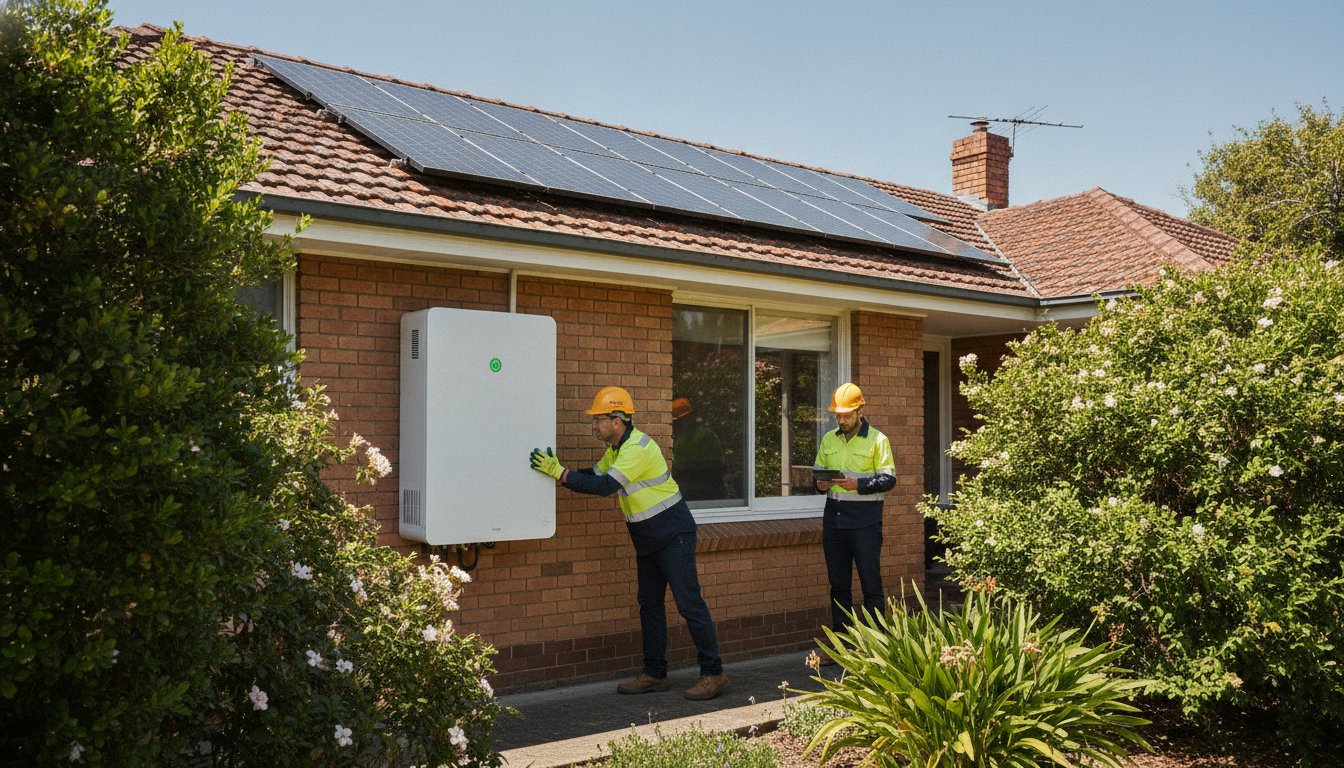
Your solar panels are still generating power, yet your electricity bills keep climbing. Sound familiar? If your battery is ageing, it’s not storing what your system produces, and you’re effectively paying the grid for energy you’ve already made. The question most Melbourne homeowners are asking right now is a practical one: what’s the real solar battery replacement cost Melbourne households should expect in 2026, and is it actually worth it?
You’re right to be cautious. The solar industry has its share of operators who’ll quote a premium price for a straightforward swap, leaving you none the wiser about rebates that could significantly offset the bill. That frustration is legitimate, and it’s exactly why clarity matters before you call anyone.
This guide cuts through the noise. You’ll walk away with a grounded understanding of what replacement genuinely involves, which Victorian rebates are on the table right now, how to check inverter compatibility before committing to a new unit, and what separates a trustworthy local installer from a solar cowboy. From real-world cost drivers to the latest Solar Victoria incentives, here’s everything you need to make a confident, well-informed decision in 2026.
Key Takeaways
- Once your battery drops below 70% of its original storage capacity, you’re haemorrhaging solar-generated energy back to the grid — and there are clear physical warning signs to watch for before it reaches that point.
- Understanding the real solar battery replacement cost Melbourne homeowners face in 2026 means separating hardware pricing by kWh capacity from Melbourne-specific labour rates charged by CEC-accredited installers.
- LiFePO4 chemistry and modular battery designs are reshaping what’s possible for Melbourne households — the technology you choose now will determine how well your system scales with your future energy needs.
- Victorian rebates and Virtual Power Plant programmes in 2026 can substantially reduce your out-of-pocket costs, but eligibility criteria — including whether you’ve previously claimed an incentive — will determine exactly what’s on the table for you.
- A structured audit-and-upgrade process, backed by full AS/NZS 5139 compliance, is the difference between a seamless battery transition and a costly installation headache down the track.
Signs Your Melbourne Solar Battery Needs Replacing
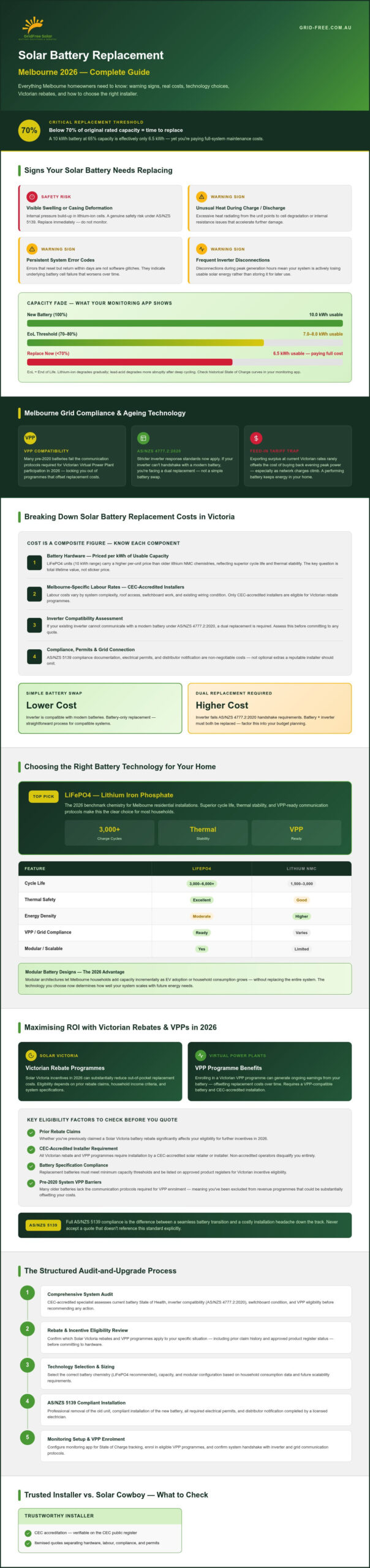
Your monitoring app doesn’t lie. When daily stored capacity starts trending downward despite consistent solar generation, your battery is telling you something most installers won’t say upfront: it’s approaching the end of its useful life. Catching these signals early is the difference between a planned, rebate-eligible upgrade and an emergency replacement that blows your budget.
The critical threshold to watch is 70% of original rated capacity. Drop below that, and you’re not just losing storage; you’re actively funding the grid with energy your panels produced. A 10kWh battery performing at 65% capacity is effectively a 6.5kWh unit, yet you’re maintaining it at full-system cost. That mismatch matters enormously when you’re trying to calculate the true solar battery replacement cost Melbourne households face in 2026.
Physical red flags are equally telling. Watch for:
- Visible swelling or casing deformation on the battery enclosure
- Unusual heat radiating from the unit during charge or discharge cycles
- Persistent system error codes that reset but return within days
- Frequent inverter disconnections during peak generation hours
These aren’t minor inconveniences. Swelling in lithium-ion cells signals internal pressure build-up, a genuine safety risk under AS/NZS 5139 guidelines. Don’t monitor it; replace it.
Capacity Fade vs. Total Failure
There’s an important distinction between gradual capacity fade and sudden total failure. End of Life (EoL) for lithium-ion batteries is typically defined as the point where usable capacity falls below 70-80% of the original rating, whereas lead-acid variants often degrade more abruptly after deep cycling. Depth of Discharge (DoD) degradation in 2026 terms refers to the progressive reduction in how deeply a battery can cycle before permanent cell damage accelerates, compressing your usable storage window cycle by cycle. Your monitoring app should display historical State of Charge curves; a flattening peak combined with a rising resting voltage points to failing cells, not a software glitch. This is precisely why battery energy storage systems at every scale, from residential to grid-level, are assessed against measurable capacity benchmarks rather than age alone.
Melbourne Grid Compliance and Ageing Tech
Older battery units are increasingly incompatible with Victoria’s evolving grid requirements. Many pre-2020 systems fail the communication protocols required for Virtual Power Plant participation in 2026, meaning you’re locked out of programmes that could offset replacement costs significantly. AS/NZS 4777.2:2020 also sets stricter inverter response standards; if your existing inverter can’t handshake with a modern battery, you’re looking at a dual replacement, not a simple swap. Understanding this compatibility gap early is essential, and a detailed assessment from a specialist in solar battery replacement Melbourne homeowners trust can clarify exactly where your system stands before you commit to anything.
Rising feed-in tariffs don’t justify keeping a degraded battery either. Exporting surplus power at current Victorian rates rarely offsets the cost of buying back evening peak power, particularly as network charges climb. A performing battery keeps that energy in your home, where its value is highest.
Breaking Down Solar Battery Replacement Costs in Victoria
Most national price guides will hand you a tidy range and call it done. That’s not good enough for Melbourne homeowners making a five-figure decision. The real solar battery replacement cost Melbourne households face in 2026 is a composite figure, and understanding each component is what separates a confident upgrade from an expensive surprise on invoice day.
Hardware vs. Installation Labour
Battery hardware pricing scales directly with usable capacity. Broadly speaking, LiFePO4 units in the 10kWh range carry a higher per-unit price than older lithium NMC chemistries, reflecting their superior cycle life and thermal stability. What the hardware price doesn’t include is equally important.
Melbourne labour rates for CEC-accredited installers aren’t uniform across the city. Eastern suburbs installs, particularly in areas with older wiring configurations or elevated switchboard complexity, typically attract higher labour rates than comparable jobs in the western corridors where newer housing stock means more standardised infrastructure. A straightforward wall-mount swap in a recently built Werribee home is a fundamentally different job to a retrofit in a Hawthorn period property with a cramped meter box.
Fire-rated backing boards add another layer. AS/NZS 5139 compliance requirements mean that many garage and laundry installations now require non-combustible substrate installation, particularly where the battery sits adjacent to timber framing. This isn’t optional, and any installer who quotes without assessing your wall substrate isn’t quoting accurately.
The Hidden Cost of Inverter Upgrades
This is where budgets quietly blow out. AC-coupled replacements, where the new battery connects through an inverter independent of your existing solar inverter, are often the more straightforward path for older systems. DC-coupled configurations integrate more tightly with your solar array but require full compatibility with your existing inverter firmware and hardware generation.
When your current inverter predates the AS/NZS 4777.2:2020 communication standards, a battery-only swap becomes a battery-plus-inverter replacement. That’s a materially different cost conversation. For a thorough breakdown of how these variables compound across different system configurations, the solar battery cost Australia guide covers the full picture in granular detail.
The Retrofit Premium and Disposal Costs
Modifying existing cable runs, upgrading DC isolators, or relocating a battery to a compliant position all attract what the industry informally calls a retrofit premium. These aren’t inflated charges; they reflect genuine additional labour and materials.
What’s rarely discussed is disposal. Lithium-ion battery decommissioning in Victoria must comply with EPA guidelines, and responsible recycling through accredited facilities carries a fee. Lead-acid units from pre-2018 systems attract separate handling requirements. Factor this into your total cost assessment from the outset rather than discovering it at the end of the quote.
Getting a line-itemised quote that separates hardware, labour, compliance work, and disposal is the baseline standard. If a quote doesn’t break these out, ask why before you sign anything.
Choosing the Right Technology for Your Melbourne Home
The battery you choose in 2026 will define your energy independence for the next decade. Not every unit on the market deserves that responsibility, and the gap between a well-matched technology choice and a cheap compromise becomes painfully clear within a few Melbourne summers.
LiFePO4: The Gold Standard for Safety
Lithium Iron Phosphate chemistry has earned its dominant position in residential storage for a straightforward reason: it doesn’t want to catch fire. Unlike older Nickel Manganese Cobalt (NMC) chemistries, LiFePO4 cells maintain thermal stability well beyond the temperatures Melbourne homes routinely experience during summer heatwaves. Under AS/NZS 5139, battery installations must meet strict requirements around thermal runaway risk; LiFePO4 units are significantly easier to certify compliantly, particularly in attached garages and internal laundry spaces where ventilation is limited.
Cycle life is where the economics become undeniable. LiFePO4 batteries typically deliver 3,000 to 6,000 full cycles before reaching end-of-life thresholds, compared to NMC chemistries that commonly plateau between 1,000 and 2,000 cycles under comparable conditions. A cheaper NMC unit might look attractive on the initial quote, but when you’re calculating the true solar battery replacement cost Melbourne households face over a full ownership period, the maths consistently favours LiFePO4. Pay more once, replace less often.
Temperature Tolerance in Melbourne’s Climate
Melbourne’s notorious temperature swings, from sub-10°C winter nights to 40°C-plus summer days, place real stress on battery cells. Thermal management systems matter here. Look for units with active thermal regulation rather than passive designs that rely solely on ambient airflow. Batteries installed without adequate thermal management in poorly ventilated spaces will degrade measurably faster, compressing the cycle life figures quoted in the warranty documentation.
Sizing Your Replacement for Maximum Independence
Bigger isn’t automatically better. The practical sweet spot for Melbourne residential storage in 2026 sits between 10kWh and 13.5kWh for a typical three-to-four-bedroom home. Below 10kWh, you’re unlikely to carry meaningful overnight reserves through Melbourne’s shorter winter days when solar generation dips. Above 13.5kWh, many households hit diminishing returns without a larger panel array to consistently fill that capacity.
Modular battery architectures deserve serious consideration here. Systems that allow capacity expansion in increments mean you’re not locked into today’s usage profile. As EV adoption grows and household consumption patterns shift, a modular unit scales with you rather than forcing another full replacement cycle. For a deeper look at how different configurations perform across Melbourne’s seasonal generation curve, the energy storage solutions Melbourne guide maps out the full picture with practical detail.
Reading Warranty Depth Honestly
A 10-year warranty isn’t a guarantee of 10 years at full capacity. Dig into the fine print. Most manufacturer warranties specify a minimum retained capacity at end of term, commonly 70% to 80% of original rated storage. Two batteries with identical 10-year warranties can have meaningfully different performance floors. Always compare the warranted end-of-life capacity figure, not just the headline term, before making any commitment.
Maximising ROI with Victorian Rebates and VPPs in 2026
Rebates don’t wait for you to get ready. The Solar Victoria Battery Incentive programme has evolved considerably since its initial rollout, and 2026 brings both genuine opportunity and tighter eligibility gates that catch unprepared homeowners off guard. Getting across the current rules before you engage an installer isn’t optional; it’s how you avoid leaving thousands of dollars on the table.
Current Solar Victoria Battery Incentives
The 2026 programme structure centres on a rebate applied directly at point of sale, reducing your upfront solar battery replacement cost Melbourne residents face rather than arriving as a delayed reimbursement. Eligibility hinges on several non-negotiable criteria:
- Combined household income below the current threshold (verify the exact cap at time of application via Solar Victoria’s portal, as this figure is indexed)
- Property must be owner-occupied in Victoria, not a rental or investment property
- An existing solar PV system of at least the minimum rated capacity must already be installed
- Previous incentive history matters: households that claimed a solar panel rebate under earlier rounds may still qualify for a battery incentive, but not vice versa in all cases
The application process runs through Solar Victoria’s online portal. You’ll need to confirm installer accreditation upfront; only CEC-accredited installers can lodge approved applications on your behalf. Choosing an installer who isn’t across the current portal requirements adds weeks of delay. For a complete breakdown of eligibility pathways and what’s changed since 2024, the Victorian battery rebate guide covers the full picture with current detail.
Interest-free loans are also available alongside the rebate for eligible households, spreading the remaining hardware and installation cost across manageable repayments. That combination, rebate plus interest-free finance, fundamentally changes the upfront maths for many Melbourne families sitting on the fence.
Boosting Returns Through Virtual Power Plants
A VPP doesn’t just reduce your bills; it turns your battery into an active revenue asset. Programmes operating in Victoria allow enrolled households to export stored energy during high-demand grid events, with Grid Support payments credited directly to your account. Over a full year, these payments can meaningfully compress your payback period.
Scrutinise the contract terms before signing up. Some VPP arrangements include exit fees or lock-in periods that limit your flexibility if a better programme emerges. Evaluate minimum battery capacity requirements too; not every unit qualifies for every programme. Amber Electric and AusNet-affiliated schemes are worth comparing directly against each other on payment rates and contract length before committing.
The practical upshot: a well-chosen VPP enrolment, paired with a current Solar Victoria incentive, can substantially reduce the effective net cost of your upgrade. Ready to see what your specific situation qualifies for? Talk to GridFree Solar about your rebate and VPP options before your next billing cycle arrives.
Seamless Solar Battery Upgrades with GridFree Solar
Knowing what your upgrade should cost is only half the equation. The other half is choosing an installer who won’t cut corners on compliance, leave you guessing about rebate eligibility, or disappear when a warranty issue surfaces six months later. That’s where local specialisation genuinely separates the field.
GridFree Solar’s approach to battery replacement isn’t a generic swap-and-go service. It’s a structured Audit and Upgrade process built around your specific system, your property’s infrastructure, and Victoria’s current compliance obligations. Every step is designed to eliminate the retrofit surprises that quietly inflate the real solar battery replacement cost Melbourne homeowners end up paying when they go with a generalist.
Our Professional Replacement and Commissioning Process
Every job starts with a pre-installation site inspection. Not a quick visual check; a thorough assessment of your existing wiring configuration, switchboard capacity, battery mounting position, and wall substrate compliance under AS/NZS 5139. Wiring bottlenecks get identified before a single cable is touched, not discovered mid-install when the clock is running.
From there, the process follows a clear sequence:
- Safe decommissioning of your existing unit, handled in accordance with Victorian EPA requirements for lithium-ion or lead-acid disposal
- Certified recycling through accredited facilities, with documentation provided for your records
- Installation and commissioning of your new battery to full AS/NZS 5139 and Victorian Service and Installation Rules standards
- Final system testing across charge, discharge, and grid-interaction scenarios before sign-off
- VPP integration setup where eligible, so your battery is earning from day one rather than sitting idle
Post-installation, you’ll have access to real-time monitoring so you can track your new system’s ROI directly, watching storage performance, export behaviour, and any VPP grid support credits accumulate against your original investment.
Why Local Melbourne Expertise Matters
Victoria’s distribution network isn’t uniform. United Energy, Jemena, and AusNet each operate distinct technical requirements for battery system connections, and an installer without hands-on experience across all three will hit compliance delays that cost you time and money. GridFree Solar’s local presence means those requirements aren’t a learning curve; they’re standard operating procedure.
Local expertise also means faster warranty response. When a firmware issue or cell fault arises, you’re not waiting on a national call centre to dispatch someone from interstate. That proximity matters when your storage system is your buffer against peak-rate grid power.
Don’t let an ageing battery keep bleeding value from your solar investment. Get a custom solar battery replacement quote from GridFree Solar today and find out exactly what your upgrade will cost, what rebates you qualify for, and how quickly your new system pays for itself.
Your Next Step Toward Real Energy Independence
An ageing battery isn’t a minor inconvenience; it’s a daily drain on the investment your solar system was built to deliver. The key insights from this guide come down to three practical realities: recognise the warning signs before capacity fade becomes an emergency, understand every line item that shapes the true solar battery replacement cost Melbourne households face in 2026, and use Victorian rebates alongside VPP enrolment to compress your payback period significantly.
The technology and incentives available right now make 2026 a genuinely strong time to act. LiFePO4 chemistry, modular architectures, and Solar Victoria’s current programme all align in your favour. What matters next is getting accurate, site-specific advice from installers who know Victoria’s compliance landscape inside out.
GridFree Solar brings CEC-accredited expertise, deep specialisation in Victorian rebate claims, and a local Melbourne support team that’s accountable long after installation day. Don’t leave rebate eligibility to chance or let another billing cycle pass on a degraded system. Upgrade your energy storage with Melbourne’s replacement specialists and get a quote from GridFree Solar today.
Frequently Asked Questions
How much does a solar battery replacement cost in Melbourne in 2026?
The total solar battery replacement cost Melbourne homeowners pay is determined by your chosen storage capacity, battery chemistry, and the complexity of your existing electrical switchboard. Hardware prices for high-performance LiFePO4 units scale with kWh ratings, while local labour rates vary based on whether you require a simple swap or a full compliance upgrade. Getting a line-itemised quote is the only way to confirm your specific investment.
Can I replace my old lead-acid battery with a new lithium-ion one?
Yes, transitioning from ageing lead-acid technology to modern lithium-ion storage is a common and highly effective upgrade. Lithium-ion units offer significantly higher energy density and deeper discharge capabilities in a much smaller physical footprint. This transition requires a technical audit to ensure your current mounting location and wiring meet the stricter thermal and safety standards required for lithium installations in Victoria.
Are there still battery rebates available in Victoria for 2026?
Solar Victoria continues to offer battery incentives for eligible households in 2026. These programmes are designed as point-of-sale rebates that reduce your upfront costs immediately rather than requiring a long wait for reimbursement. Eligibility typically hinges on household income thresholds and property status, so you should verify your current standing through an authorised installer before committing to a new system.
Does a replacement battery require a new inverter?
Your existing inverter’s age and communication protocols determine if a replacement is necessary. If you have an older AC-coupled system, you can often retain your solar inverter while adding a separate battery inverter. However, many modern integrated solutions require a hybrid inverter that complies with AS/NZS 4777.2:2020 standards to ensure full grid compatibility and Virtual Power Plant functionality.
How do I dispose of my old solar battery in Melbourne?
Old solar batteries must be decommissioned and recycled through EPA-accredited facilities to prevent environmental contamination. Professional installers handle this process as part of the replacement service, ensuring that lithium or lead-acid components are safely transported to specialised recycling centres. Never dispose of solar batteries in general waste or standard recycling bins, as they pose significant fire and chemical risks.
Will a new battery work with my 10-year-old solar panels?
New battery technology is generally compatible with older solar panels, provided your inverter can manage the energy flow between them. While your panels may have experienced some minor degradation over a decade, they can still effectively charge a modern storage unit. The focus of the upgrade is usually on the “handshake” between the battery and the inverter rather than the panels themselves.
How long does the replacement installation take?
Most solar battery replacements in Melbourne are completed within a single day. The process involves decommissioning your old unit, preparing the mounting site to meet current fire-safety standards, and installing the new hardware. Final commissioning and VPP integration setup usually take an additional hour or two at the end of the day to ensure your monitoring software is reporting data accurately.
Is it worth joining a VPP after replacing my battery?
Enrolling in a Virtual Power Plant is a high-impact strategy for shortening your payback period. By allowing the grid to occasionally access your stored energy during peak demand events, you receive grid support payments or higher export credits. This turns your battery into an active revenue stream, making the technology much more financially viable compared to simply using it for basic self-consumption.