
Table of Contents
- What Makes Up Your Solar Battery Installation Cost
- System Sizing and Battery Chemistry: How They Affect Total Cost
- Solar Battery Rebate 2026 and Government Incentives
- Is a Solar Battery Worth It 2026: ROI and Payback Analysis
- Solar Battery Installation Process and Hidden Costs
- Disposal, Recycling, Insurance, and Compliance Requirements
- Making Your Decision: Cost-Benefit Framework
- Conclusion
- Frequently Asked Questions
Last Updated: August 30, 2026
What Makes Up Your Solar Battery Installation Cost
Your solar battery installation cost breaks down into five distinct components: the battery unit, inverter and balance-of-system components, installation labour, compliance and permits, and monitoring software.
The battery unit represents the largest single expense. A residential lithium-ion battery stores electrical energy for peak demand periods or grid outages, with costs scaling by usable capacity measured in kilowatt-hours (kWh). Typical residential installations range from 5kWh to 15kWh systems.
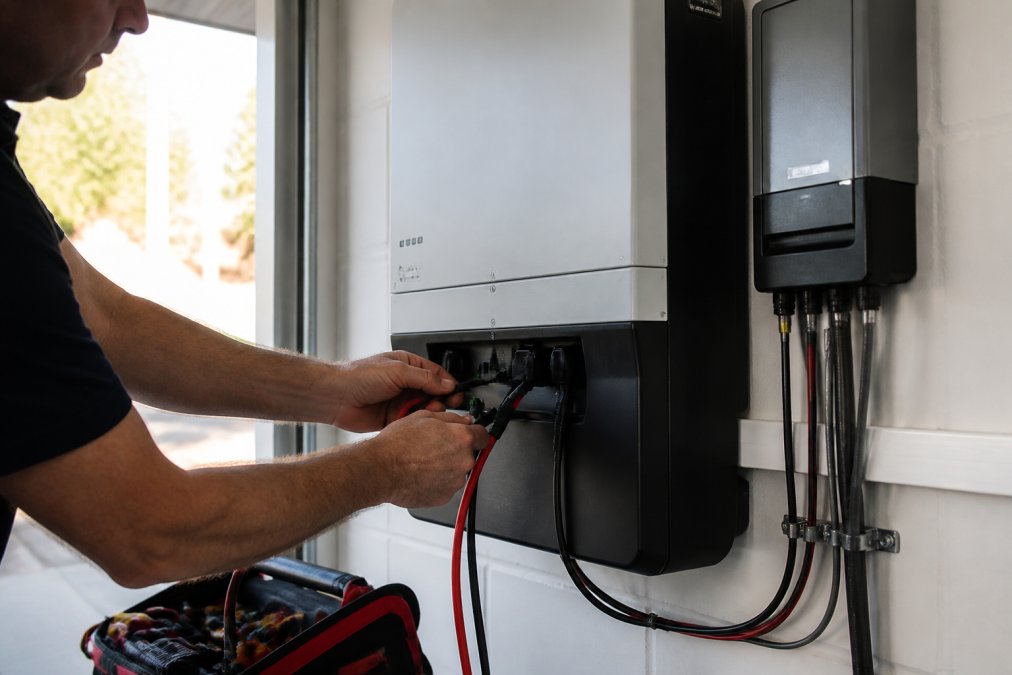
The inverter converts stored DC energy into AC power your home uses. Hybrid inverters managing both solar generation and battery storage typically cost more than simpler models. Balance-of-system components, mounting hardware, disconnects, monitoring equipment, and safety switches, ensure safe integration with your existing electrical infrastructure and compliance with Australian standards AS/NZS 3000 and AS/NZS 5139:2019 (standards.org.au).
Installation labour depends on your home’s electrical complexity, roof access, and whether you’re retrofitting an existing solar system or installing a new battery with fresh panels. Retrofitting typically costs more because electricians must integrate the battery into existing infrastructure.
Compliance, permits, and safety certification form the fourth cost layer. Your installation requires electrical safety inspection and a Certificate of Electrical Safety (CES) from a licensed electrician. Depending on your local council area, you may need planning permits, though many battery-only installations avoid this.
Most modern battery systems include cloud-based monitoring that tracks real-time generation, storage, and consumption. Some providers charge monthly subscriptions for advanced features like automated load shifting. GridFree Solar’s approach includes comprehensive monitoring integration, allowing you to optimise your system’s performance and track feed-in tariff earnings in real time.
System Sizing and Battery Chemistry: How They Affect Total Cost
System size and battery chemistry are the two biggest cost drivers after labour.
Usable capacity versus total capacity creates the first pricing complexity. A battery’s total capacity is its maximum storage potential, but usable capacity, the amount you can actually draw down, is typically 80-90% of that figure. A 10kWh battery might have only 8-9kWh of usable energy. For example, a 6.6kW solar system paired with a 10kWh battery with 80% depth of discharge gives you 8kWh of usable storage, sufficient for most Victorian households to shift morning solar generation to evening peak demand.
Lithium-ion chemistry dominates the residential market. These batteries offer 90-95% round-trip efficiency, support thousands of charge cycles (many warrantied for 8,000-10,000 cycles), and perform reliably across wide temperature ranges (peer-reviewed research). The trade-off is upfront cost; lithium-ion commands a premium compared to alternatives like lead-acid or sodium-ion. However, their longer cycle life and superior efficiency usually justify the investment over a 10-15 year ownership period.
System sizing hinges on your household load profile and self-consumption goals. A 6.6kW solar array paired with a 5-6kWh battery suits homes with moderate afternoon usage and good evening solar offset. A 10kW system with 10-15kWh storage targets homes with higher peak demand or air conditioning loads. Larger systems cost more upfront but generate greater long-term savings if your consumption patterns justify the capacity. GridFree Solar’s site assessment process matches your specific load profile to an appropriately sized system, avoiding both under-investment and wasteful over-specification.
The relationship between system size and total cost is not linear. A 10kW system doesn’t cost twice as much as a 6.6kW system because many costs scale partially rather than proportionally. However, larger systems may require upgraded switchboard capacity, adding unexpected costs.
Solar Battery Rebate 2026 and Government Incentives
Navigating Australian government support requires understanding two distinct schemes: the Small-scale Technology Certificates (STCs) program and state-based initiatives like the Cheaper Home Batteries Program.
The Small-scale Technology Certificates scheme provides federal support for small-scale renewable energy systems, including solar batteries (cleanenergyregulator.gov.au). When you install a battery, you’re eligible to create STCs based on expected energy generation over 15 years. These certificates can be sold to liable entities, reducing your upfront cost. Most installers handle STC assignment on your behalf, passing the value through as a rebate at point of sale.
State-based schemes vary significantly. The Cheaper Home Batteries Program, available in select jurisdictions, provides direct rebates toward battery installation costs. These programs typically cap the rebate at a percentage of total system cost or a fixed dollar amount per kWh of usable capacity. Eligibility often depends on income thresholds and property ownership status.
GridFree Solar specialises in rebate guidance, helping you identify which schemes you qualify for and ensuring your system design maximises eligible capacity. Many homeowners leave money on the table simply because they don’t understand which incentives apply to their situation.
Feed-in tariff arrangements affect your long-term economics. Most grid-connected systems allow you to export excess solar generation back to the grid, earning a credit per kWh exported. GridFree Solar’s systems support the 15¢/kWh export rate during peak evening hours (6-8pm), turning your battery into an income-generating asset.
Is a Solar Battery Worth It 2026: ROI and Payback Analysis
Whether a solar battery makes financial sense depends on your electricity consumption pattern, local electricity rates, and system size.
Calculating your payback period requires comparing annual energy savings against your net installation cost after rebates. Annual savings come from avoided peak-rate consumption and feed-in tariff earnings. A household with high afternoon usage and moderate evening peak demand might save £1,200-1,800 annually through self-consumption alone. Adding feed-in tariff earnings during 6-8pm export windows could push total annual benefit to £2,000-2,500.
Divide your net installation cost by annual savings to estimate payback period. A system costing £8,000 after rebates with £2,000 in annual benefits achieves payback in four years. Over a typical 10-15 year battery warranty period, you’d realise six to eleven years of pure financial benefit. This calculation improves when you factor in electricity price inflation, which typically runs 3-5% annually.
Feed-in tariff earnings deserve careful scrutiny. Exporting during peak demand (6-8pm) earns 15¢/kWh with most retailers, but midday exports might earn only 5-8¢/kWh. GridFree Solar’s monitoring software includes load-shifting algorithms that automatically charge your battery during low-cost periods and discharge during peak-rate windows, maximising feed-in tariff earnings without manual intervention.
From a purely economic standpoint, a battery system should deliver positive cash flow within 5-7 years to justify the investment.
Solar Battery Installation Process and Hidden Costs
The installation process typically unfolds across four phases: site assessment and design, equipment procurement, physical installation, and testing and certification.

Site assessment and design establishes your system specifications and identifies potential complications. A CEC accredited designer visits your home to evaluate roof space, structural integrity, electrical panel capacity, and consumption patterns. This phase typically takes 1-2 weeks and should be free or included in your final quote. The assessment identifies whether your switchboard requires upgrading, a hidden cost that can range from £500-2,000.
Retrofit versus new-build installation complexity significantly impacts labour costs. A retrofit installation integrates the battery into your existing solar system, requiring careful electrical integration. New-build installations, where solar panels and battery are designed together, typically cost 15-25% less in labour because the entire system is engineered as a cohesive unit from the start.
Physical installation spans 1-3 days depending on system size and complexity. The battery unit is mounted, the inverter is installed, wiring is connected, and safety systems are integrated. Your home will experience a brief power interruption as the new system is connected to your switchboard.
Post-installation monitoring software and maintenance represent an ongoing cost often overlooked in initial budgeting. Most systems include cloud-based monitoring at no extra charge, but advanced features may incur monthly subscription fees of £5-15. Annual maintenance is typically minimal and often covered under warranty.
Hidden costs frequently emerge during the assessment phase. Switchboard upgrades, additional safety disconnects, roof reinforcement, or asbestos remediation can add £1,000-5,000 to your project cost. GridFree Solar’s assessment process identifies these potential costs upfront, preventing budget shock during installation.
Disposal, Recycling, Insurance, and Compliance Requirements
Battery end-of-life management is an emerging regulatory requirement in Australia. Lithium-ion batteries contain valuable materials and pose environmental and safety risks if disposed improperly. Most quality battery manufacturers have established recycling partnerships, ensuring your battery is processed responsibly at end of life.
Insurance considerations often catch homeowners off guard. Your home and contents insurance may require notification of a battery system installation, and some policies impose additional premiums. More importantly, your solar battery system itself should be covered under a dedicated insurance policy. A battery system failure could represent a £10,000-15,000 loss if uninsured. Discuss insurance implications with your provider before installation.
Electrical safety standards govern every aspect of your installation. AS/NZS 3000 (the Australian electrical safety standard) and AS/NZS 5139:2019 (the battery energy storage systems standard) establish requirements for system design, installation, and certification. Your installer must hold appropriate CEC accreditation and provide a Certificate of Electrical Safety upon completion. GridFree Solar’s accreditation ensures compliance with these standards throughout the installation process, protecting both your safety and your warranty coverage.
The Certificate of Electrical Safety (CES) is your proof that the installation meets all regulatory requirements. This document is essential for insurance claims, future system modifications, and property sale disclosure. Additionally, your system must be registered with your local distribution network service provider (DNSP) if it’s grid-connected.
Making Your Decision: Cost-Benefit Framework
Deciding whether to install a solar battery requires matching your specific household situation to system specifications and financial realities.
Start by understanding your load profile, the pattern of your household’s electricity consumption throughout the day. Households with high afternoon usage and moderate evening peak demand are ideal battery candidates. You’ll shift more solar generation to self-consumption, directly reducing peak-rate purchases.
Your local electricity rates and feed-in tariff structure matter enormously. Higher peak-rate differentials increase your annual savings from self-consumption. Premium feed-in tariffs during peak export windows turn your battery into an active income generator. If your retailer offers time-of-use pricing with a 2:1 or greater peak-to-off-peak rate ratio, battery economics improve significantly.
A cost-benefit framework should include these questions:
- Can I afford the upfront cost after rebates?
- Will my system achieve payback within 5-7 years?
- Does my consumption pattern support battery economics?
- Am I planning to stay in this home for at least 10 years?
- Do I value energy independence and grid resilience?
GridFree Solar’s assessment process walks through each of these questions, helping you make an informed decision. A battery system is a significant investment, and the right decision depends entirely on your specific situation.
Conclusion
Solar battery installation costs vary widely based on system size, chemistry, your home’s electrical complexity, and available government incentives. The investment typically pays for itself within 4-7 years through avoided peak-rate consumption and feed-in tariff earnings, delivering 6-11 years of pure financial benefit over a standard warranty period.
GridFree Solar helps Australian homeowners navigate this decision with expert site assessments, transparent rebate guidance, and CEC-accredited installation that ensures full compliance with AS/NZS 3000 and AS/NZS 5139:2019 standards. Our monitoring systems automatically optimise your battery’s performance, maximising the 15¢/kWh export rate during peak evening hours and the $1 daily bonus for avoiding grid use during peak times. Connect Now to arrange a free assessment and discover your system’s specific payback timeline and financial benefit.
| Component | Cost Driver | Typical Impact on Total Cost |
|---|---|---|
| Battery unit | Usable capacity (kWh) | 35-45% of total |
| Inverter & balance-of-system | System size and complexity | 15-20% of total |
| Installation labour | Retrofit vs. new-build, electrical complexity | 20-30% of total |
| Compliance & permits | Location and council requirements | 5-10% of total |
| Monitoring software & maintenance | Subscription tier and warranty terms | 2-5% of total |
Frequently Asked Questions
What is the typical cost range for solar battery installation in Australia?
Installation costs depend on system capacity, battery chemistry, your home’s electrical setup, and your location. Pricing depends on quantity, dates, and delivery. Contact GridFree Solar for a personalised quote that reflects your specific requirements and eligibility for rebates under the Cheaper Home Batteries Program or state-based schemes.
What solar battery rebate is available in 2026?
The Cheaper Home Batteries Program continues to support eligible households, and Small-scale Technology Certificates (STCs) provide federal incentives based on system size. Many states offer additional rebates and interest-free loans. Eligibility and rebate amounts vary by location and household income. GridFree Solar’s rebate guidance service helps you identify all available incentives and maximise your savings.
Is a solar battery worth it in 2026?
A solar battery is worth it if your payback period aligns with your financial goals and energy usage. Key factors include your feed-in tariff rate, peak demand charges, self-consumption patterns, and available rebates. Homes with high daytime solar generation and evening peak usage see faster ROI. GridFree Solar’s cost-benefit analysis helps you determine whether battery storage suits your load profile and financial timeline.
What happens during the solar battery installation process?
Installation begins with a site assessment to evaluate your roof, electrical panel, and load profile. The installer designs a system matching your usable capacity needs, obtains permits, and performs electrical work to integrate the battery with your inverter and grid connection. Final steps include safety certification (Certificate of Electrical Safety) and system commissioning. GridFree Solar handles all compliance with AS/NZS 5139:2019 and AS/NZS 3000 standards.
How much does installation labour cost separately?
Labour costs vary based on retrofit complexity, your home’s electrical setup, and local conditions. New-build installations typically cost less than retrofits into existing homes. Factors include trenching, panel repositioning, and inverter compatibility work. GridFree Solar provides transparent labour cost breakdowns in your quote, ensuring no hidden charges once work begins.
What’s the difference between usable capacity and total capacity?
Total capacity is the battery’s full energy storage (e.g., 13.5kWh). Usable capacity is the amount you can actually draw without damaging the battery (typically 80-90% of total, depending on depth of discharge limits). This protects battery cycle life and longevity. When sizing your system, focus on usable capacity to ensure you get the energy storage you truly need.
What compliance and safety requirements apply to battery installation?
Your battery system must comply with AS/NZS 5139:2019 (energy storage systems), AS/NZS 3000 (electrical safety), and IEC 62040-1 standards. A Certificate of Electrical Safety (CES) is required after installation. GridFree Solar’s CEC-accredited installers ensure all work meets these standards, protecting your home from fire risk and electrical hazards.
This article was written using GrandRanker