
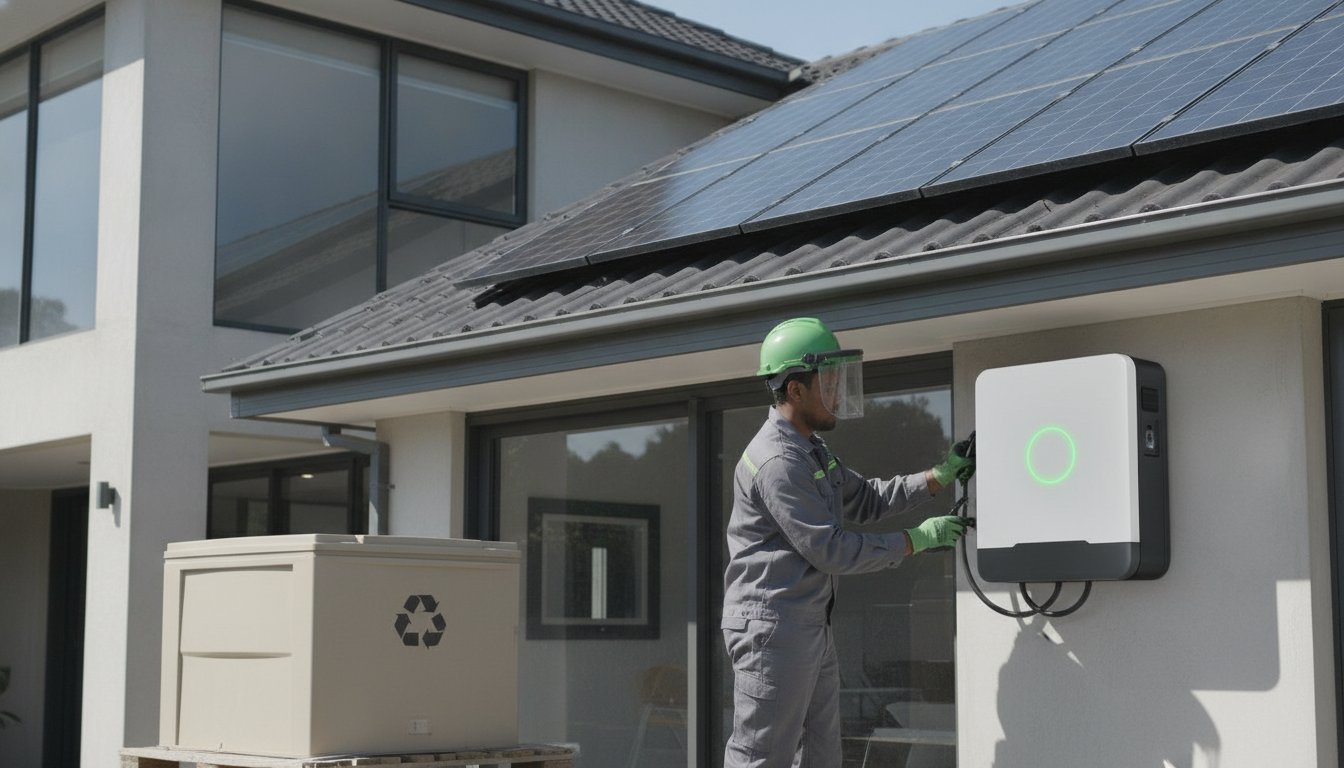
Your aging solar battery isn’t just losing capacity; it’s actively draining your potential savings in an era of 3-6c Victorian feed-in tariffs. Most Australian households with first-generation storage now face the reality of “vampire drain” and outdated chemistry. Mastering the solar battery replacement process Australia requires more than just a simple hardware swap. It’s a strategic move to reset your energy ROI. You’ve likely noticed your system no longer lasts through the peak evening period. You’re probably also confused by the 2026 shift where Victorian battery loans have closed, leaving the federal Cheaper Home Batteries Program as the primary driver for your upgrade.
We understand that moving to modern LiFePO4 technology feels like a technical minefield. This guide simplifies the journey. You’ll learn how to secure the federal rebate, currently worth about $3,528 for a 14kWh system, and comply with the new mandatory photo documentation rules. We’ll outline the path from choosing SAA-accredited installers to meeting the AS/NZS 5139:2019 safety standards. We also address the latest 2026 recycling mandates to ensure your old unit is disposed of responsibly. Prepare for a seamless transition to a smarter, more profitable energy future.
Key Takeaways
- Identify critical signs of storage failure, from reduced depth of discharge to persistent inverter error codes, to determine when your aging unit becomes a liability.
- Master the solar battery replacement process Australia by navigating 2026 STC incentives and federal rebates to ensure you secure the maximum available financial support.
- Ensure a seamless transition through professional site audits and safe de-energisation protocols that comply with the latest 2026 safety standards and photo documentation rules.
- Mitigate fire risks and meet evolving e-waste regulations by utilising certified recycling pathways for your legacy lithium or lead-acid battery units.
- Future-proof your investment by integrating modern LiFePO4 technology with Virtual Power Plants to turn your storage into an active, high-yield financial asset.
Signs Your Storage is Failing: When to Replace Your Solar Battery
Your solar battery is a silent worker. It sits in your garage or on an external wall, dutifully cycling energy every single day. But hardware has a shelf life. As solar power in Australia enters its second decade of mass adoption, many early adopters are finding their original storage units are no longer fit for purpose. Identifying the right time to start the solar battery replacement process Australia is critical to maintaining your energy independence. You don’t want to wait for a total blackout to realise your storage has failed. You need to act when the data shows a clear decline in ROI.
Watch for these definitive red flags in your system’s performance:
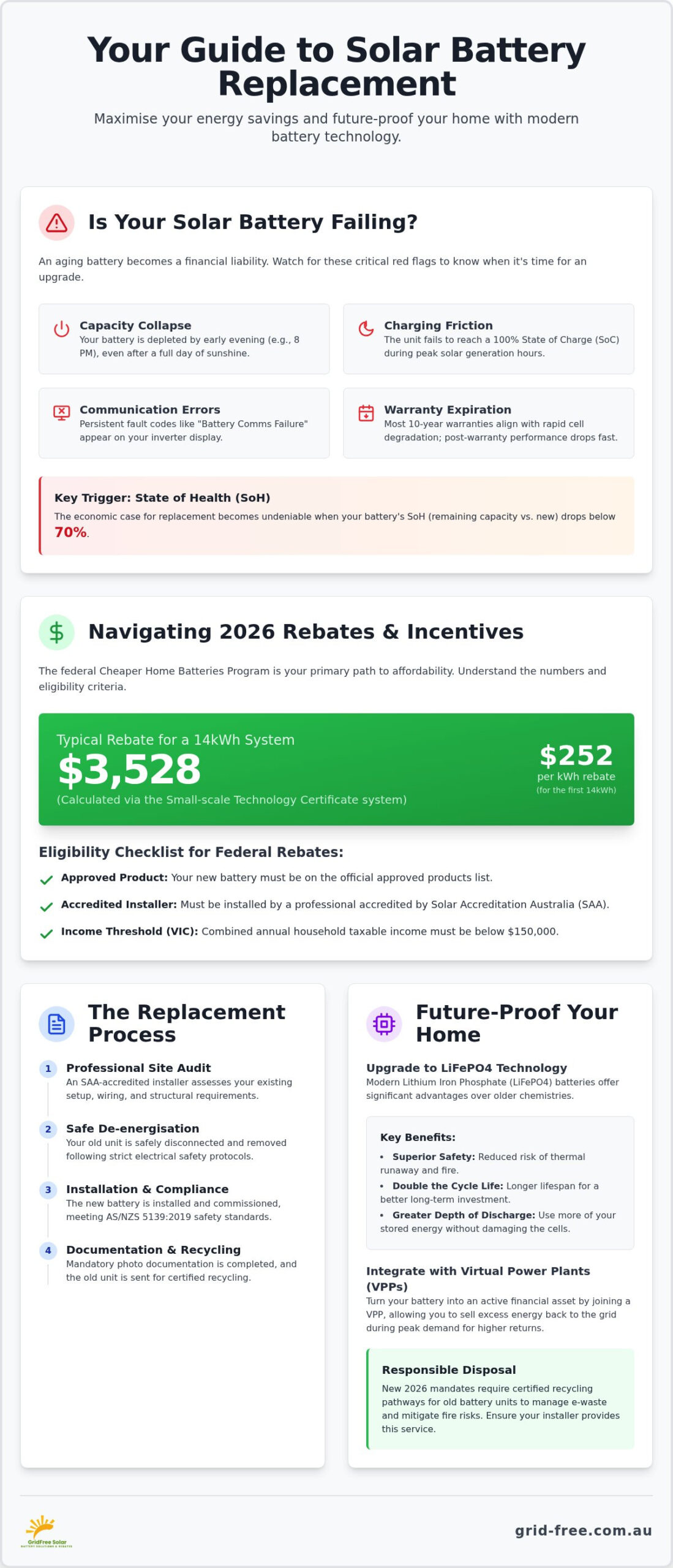
- Capacity collapse: Your battery hits 0% by 8 PM despite a full day of Melbourne sunshine.
- Charging friction: The unit fails to reach 100% State of Charge (SoC) even during peak generation hours.
- Communication errors: Persistent “Battery Comms Failure” or “Internal Fault” codes appear on your inverter interface.
- Warranty expiration: Most premium lithium units carry a 10-year warranty; if you’ve passed this milestone, your cells are likely in a state of rapid degradation.
The Performance Gap: Capacity vs. Efficiency
There’s a massive difference between a battery that “works” and one that is “efficient”. An aging unit might show a 100% charge on your app, but it lacks the depth of discharge to power your heavy appliances. It’s a hollow capacity. Check your monitoring software for the “round-trip efficiency” metric. If you’re losing more than 15% of your energy during the conversion process, your hardware is costing you money. In 2026, we define the State of Health (SOH) as the percentage of a battery’s original energy storage capacity that remains available compared to its factory-new specifications. When your SOH drops below 70%, the economic case for replacement becomes undeniable.
Safety First: Warning Signs of Battery Failure
Physical degradation is a non-negotiable trigger for immediate replacement. Inspect your unit for any signs of casing distortion, swelling, or “pillowing”. These are indicators of internal gas buildup and represent a serious thermal risk. Excessive heat during discharge cycles is another warning sign. If the unit is hot to the touch, the internal resistance is too high. Older units can also become “zombie” batteries. These are failing systems that draw power from your solar panels just to keep their internal management systems running, without ever providing usable electricity to your home. At this stage, a repair is rarely viable. Modern LiFePO4 replacements offer superior safety and double the cycle life of legacy technology.
Navigating 2026 Rebates: STCs and Victorian Incentives
The financial landscape for the solar battery replacement process Australia has shifted significantly in 2026. You shouldn’t leave money on the table. The federal Cheaper Home Batteries Program is now your primary lever for affordability. This scheme provides an upfront discount through the Small-scale Technology Certificate (STC) system. As of August 2026, the spot price for an STC remains steady at $39.65. This translates to a rebate of approximately $252 per usable kWh for the first 14kWh of your new battery. For a standard 14kWh upgrade, that’s a direct discount of roughly $3,528 applied at the point of sale.
Eligibility for Melbourne households is strictly enforced. To access these incentives, your system must appear on the approved products list and be installed by a professional accredited by Solar Accreditation Australia (SAA). This body has replaced the previous Clean Energy Council (CEC) framework. You must also ensure your property meets the updated income threshold. As of July 1, 2026, the combined annual household taxable income limit for Victorian solar incentives was reduced to $150,000. Staying within these bounds is the only way to guarantee your upgrade remains cost-effective.
Stacking Incentives for Maximum ROI
Maximising your return requires a two-tiered strategy. While the specific Victorian battery loan program closed to new applicants in August 2026, you can still stack federal support with the Victorian Solar Homes rebate if you are upgrading your panels simultaneously. This state rebate offers up to $1,400 for eligible households. Choosing an SAA-accredited installer isn’t just a safety preference; it’s a mandatory requirement for rebate success. For a deep dive into these local nuances, see our Victorian Battery Rebate 2024 to 2026: The Complete Guide to Storage Savings.
The 2026 Administrative Landscape
The paperwork is more rigorous than it was three years ago. You’ll need your National Metering Identifier (NMI), which is the unique 10 or 11-digit number found on your electricity bill, to prove your property hasn’t already exhausted its rebate quota for that specific connection point. Since March 1, 2026, mandatory photo documentation is also required for every installation to release government funds. Your installer must submit geotagged, timestamped images of the critical components and labelling to the Clean Energy Regulator. Most rebates are applied as an upfront discount on your quote. It’s a seamless way to offset the initial cost of your battery upgrade and replacement.
The Professional Replacement Process: Step-by-Step
The actual execution of the solar battery replacement process Australia is a high-stakes technical operation. It isn’t a simple “plug and play” task. Your installation day involves a meticulous sequence designed to protect your home’s electrical integrity. A licensed solar electrician must lead the project. They begin by de-energising your existing system. This step is critical. Safely removing a legacy unit, especially older lead-acid or early lithium models, requires strict adherence to safety protocols to prevent arcing or thermal events. Installers isolate the entire DC string to ensure a zero-voltage environment before the old hardware is disconnected.
Phase 1: The Technical Audit
Success starts before a single bolt is turned. Our specialists perform a deep-dive audit of your current infrastructure. Evaluating whether your existing inverter can communicate with modern LiFePO4 charging profiles is the first priority. Older inverters often lack the sophisticated firmware required for 2026 battery management systems. Checking the physical mounting centre for AS/NZS 5139:2019 compliance is equally vital. This standard mandates specific clearances from windows, doors, and vents. If your switchboard is outdated, we’ll identify necessary upgrades to ensure it can handle the higher discharge rates of modern storage technology. This audit prevents costly delays and ensures your system is legal and insurable.
Phase 2: Installation and Commissioning
Once the audit is clear, the physical swap begins. This stage of the solar battery replacement process Australia involves replacing aging wiring with high-spec cabling to minimise voltage drop across the system. Correct DC isolator placement is paramount during this phase. After the new unit is mounted and secured, the team moves to system commissioning. This isn’t just about turning it on. Configuring the software for optimal “self-consumption” modes ensures your home uses stored solar power before drawing from the grid during expensive peak periods. The final step involves rigorous testing of the backup circuit. Simulating a grid failure confirms your blackout protection triggers instantly. This level of precision guarantees your battery upgrade and replacement delivers the reliability you expect from day one.
Responsible Disposal: Recycling Your Old Battery
Completing the solar battery replacement process Australia involves a critical final stage: the safe decommissioning and recycling of your legacy unit. You cannot simply leave an old lithium or lead-acid battery in a shed or, worse, toss it into a standard skip. These units are classified as hazardous e-waste. Australian regulations are tightening. By October 2026, mandatory stewardship schemes will be the national standard. Improper disposal isn’t just illegal; it’s a massive fire risk. Damaged cells can enter “thermal runaway,” leading to intense fires that are nearly impossible for standard extinguishers to douse. Professional handling is the only way to mitigate this risk while ensuring compliance with Victorian environmental laws.
The environmental stakes are high. Recovering lithium, cobalt, and nickel from your old unit reduces the need for destructive primary mining. This makes your upgrade a truly circular investment. By ensuring your old cells are processed correctly, you contribute to a sustainable supply chain for future renewable technology. We don’t just swap hardware; we manage the toxic liability of your previous system so you don’t have to.
The Recycling Chain in Victoria
Melbourne has established itself as a hub for advanced battery recovery. Local processing centres now use sophisticated mechanical and chemical methods to harvest valuable materials. Placing a solar battery in a kerbside bin is a catastrophic error that endangers waste management workers. Instead, we utilise the B-cycle scheme, Australia’s government-backed battery stewardship program. This framework ensures that the majority of battery components are diverted from landfill. It’s a structured, transparent process that turns your old waste into raw materials for new manufacturing.
GridFree Solar’s Commitment to Sustainability
We manage the entire “cradle-to-grave” lifecycle for our clients. Our team takes full responsibility for the hazardous units we remove. We follow strict transport protocols to move decommissioned batteries to certified Melbourne recycling facilities. This ensures your project leaves zero environmental footprint. If you’re unsure if your current system has reached this critical end-of-life stage, check our guide on Solar Battery Melbourne: Federal Battery Rebate. We provide the expertise to transition you from a failing asset to a high-efficiency solution without the headache of waste management. Secure your battery upgrade and replacement with a team that prioritises safety and the environment.
Post-Replacement: Optimising for VPPs and Independence
Replacing your battery isn’t just about restoring lost capacity. It’s about evolving your entire energy strategy. In 2026, the solar battery replacement process Australia culminates in shifting from a passive backup unit to an intelligent grid-participant. Modern LiFePO4 batteries offer deeper discharge cycles and faster response times than legacy technology. This agility allows you to capitalise on volatile energy markets where Victorian feed-in tariffs have plummeted to a range of 3-6c/kWh. Your new system provides the foundation for true grid independence by ensuring you use every kilowatt you generate rather than selling it back for a pittance.
The transition to modern storage also introduces sophisticated monitoring capabilities. You can now track your ROI in real-time via dedicated mobile apps. This data allows you to adjust your energy habits, such as timing heavy appliance use to coincide with peak solar production. By aligning your consumption with your new battery’s high-efficiency discharge profile, you minimise grid reliance during expensive evening peaks. This is the strategic “reset” that makes the replacement process financially viable over the next decade.
Joining the Melbourne VPP Network
Virtual Power Plants (VPPs) are the most significant value-add for modern battery owners in Victoria. A VPP aggregates thousands of home batteries to support the grid during peak demand events. Participating in a VPP can further offset your replacement costs, with some programs offering over $1.00/kWh for energy exported during specific grid events. Annual earnings from VPP participation in 2026 typically range from $400 to $1,000. For Australian homes, VPP logic works like “cloud storage” for energy; you contribute your excess capacity to a shared network when the grid is stressed and receive premium financial credits in return. Ensure your replacement hardware is VPP-ready to unlock these high-yield revenue streams.
Maximising the Life of Your New Battery
Your upgrade is a long-term investment. Protecting it requires proactive management. Best practices for modern lithium units include maintaining stable ambient temperatures. Avoid installing batteries in areas that catch the direct afternoon sun. You should also configure your discharge cycles to stay within the manufacturer’s recommended depth of discharge to prevent premature cell wear. Regular software and firmware updates are non-negotiable for 2026 systems. These updates often include critical patches that optimise charging algorithms and grid communication. Ready to upgrade? Get a professional replacement quote from GridFree Solar and secure your energy future today.
Secure Your 2026 Energy Independence
Your journey toward a high-efficiency home doesn’t end with a simple hardware swap. It begins with a strategic reset. Upgrading to modern LiFePO4 technology allows you to reclaim control over your energy bills while capitalising on lucrative VPP opportunities. We’ve simplified the solar battery replacement process Australia by combining technical precision with specialist Victorian rebate guidance. You can now transition away from failing storage without the stress of administrative hurdles or environmental guilt. Our team ensures every project meets the highest standards of safety and compliance. We provide CEC-accredited Melbourne installers and include full e-waste recycling as standard. Don’t let your aging battery dictate your energy costs for another season. The opportunity to stack federal incentives with modern efficiency is a time-sensitive advantage you should seize now. Take the first step toward a smarter, more resilient home system today. Upgrade your storage with GridFree Solar today and experience the peak of Australian energy innovation.
Frequently Asked Questions
How much does it cost to replace a solar battery in Australia in 2026?
Costs vary based on usable capacity and the specific chemistry of the unit. While technology prices have stabilised, the total investment depends on your home’s existing wiring and whether you require a hybrid inverter upgrade. Government incentives like the federal STC scheme significantly offset the final figure. We recommend a professional site audit to determine the most efficient system size for your property’s unique energy profile and peak evening demand.
Can I swap my old battery for a different brand?
You can transition to a different brand during the solar battery replacement process Australia. Most modern units are designed for broad compatibility; however, your installer must verify that the new battery’s management system communicates correctly with your existing inverter. Switching brands often allows homeowners to access superior LiFePO4 technology or better Virtual Power Plant integration. A technical compatibility check is the first step in ensuring a seamless hardware transition.
Will my existing solar panels work with a new battery?
Your existing solar panels are almost always compatible with a new storage unit. The panels generate raw DC power; the critical interface is actually between the battery and the inverter. If you have an older AC-coupled system, adding a new battery is straightforward. For DC-coupled setups, we ensure the new storage unit matches the voltage requirements of your current solar array to maintain maximum charging efficiency throughout the day.
How long does the actual replacement process take?
A standard residential battery swap typically takes between four and eight hours to complete. This timeframe includes the safe de-energisation of your old system, physical mounting of the new unit, and mandatory commissioning. Our Melbourne teams also perform rigorous backup testing and software integration during this window. You should expect a brief power outage of approximately one to two hours while the final switchboard connections and safety checks are finalised.
What happens to my old solar battery once it is removed?
Old batteries are classified as hazardous e-waste and must never enter landfill. Once removed, your legacy unit is transported to a specialised Melbourne processing facility. These centres utilise the national B-cycle stewardship scheme to safely recover valuable materials like lithium, cobalt, and nickel. This process mitigates fire risks and ensures that up to 95% of the battery components are recycled into raw materials for new manufacturing, supporting a circular energy economy.
Do I need a new inverter when I replace my battery?
A new inverter is not always mandatory, but it is often recommended for older systems. Many first-generation inverters cannot communicate with the sophisticated firmware found in 2026 battery models. If your current inverter is over seven years old, upgrading to a modern hybrid model ensures you can access advanced features like VPP participation and rapid blackout protection. We evaluate your existing hardware during the initial site audit to determine the most cost-effective path.
Are there still rebates available for battery replacements in Victoria?
The primary financial support in 2026 comes from the federal Cheaper Home Batteries Program via the STC system. While the specific Victorian interest-free battery loan closed to new applicants in August 2026, Melbourne residents can still access the Victorian Solar Homes rebate if they are upgrading their panels at the same time. These incentives are applied as an upfront discount, provided you use an installer accredited by Solar Accreditation Australia (SAA).
Is a 10kWh battery enough for a standard Melbourne home?
A 10kWh battery is generally sufficient for a medium-sized Melbourne household with average evening electricity usage. This capacity typically covers essential loads like lighting, refrigeration, and entertainment through the peak period. However, if you plan to join a Virtual Power Plant or have high-draw appliances like induction cooktops and split-systems, a larger 13kWh or 14kWh unit may offer a better return. We help you calculate your exact depth of discharge needs before installation.