
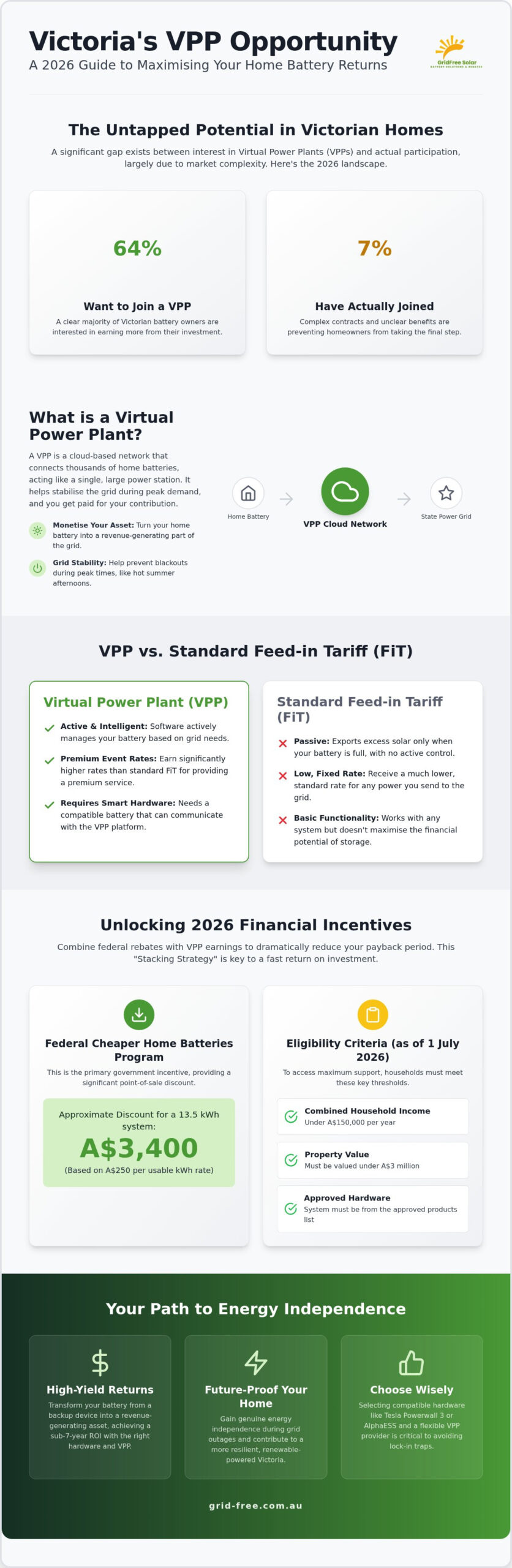
Did you know that while 64% of Victorian battery owners want to join a Virtual Power Plant, only 7% have actually made the move in 2026? This massive gap exists because the market is flooded with complex jargon and confusing provider contracts. You’ve likely felt the same hesitation. High upfront costs are a valid concern, and nobody wants to risk premature battery wear for pennies in return. It’s frustrating to own world-class technology while still feeling tethered to rising grid costs.
This VPP comparison Victoria guide cuts through the noise to show you exactly how to slash your energy bills. We’ll demonstrate how to leverage the Federal Cheaper Home Batteries Program rebate, which provides a point-of-sale discount of roughly A$3,400 for a standard 13.5 kWh system. It’s the most effective way to shrink your payback period and achieve genuine energy independence during grid outages.
We’ll compare the latest 2026 offers from major players like AGL, Origin, and Simply Energy. You’ll discover which providers offer the highest export rates and how to match your hardware to the most lucrative incentive schemes currently available across the state.
Key Takeaways
- Understand how modern Victorian Virtual Power Plants have evolved into high-yield networks that transform your home battery into a revenue-generating asset.
- Navigate the 2026 incentive landscape with a detailed VPP comparison Victoria to identify which providers offer the highest export rates and most flexible contract terms.
- Learn why selecting the right hardware, such as the Tesla Powerwall 3 or AlphaESS, is critical for achieving a sub-7-year return on investment.
- Identify the common “lock-in traps” in retailer-led contracts and evaluate whether independent VPP models better suit your energy independence goals.
- Discover how professional Melbourne-based installation and expert rebate management ensure you maximise your financial returns while protecting your system’s long-term health.
What is a Solar Battery VPP in Victoria?
A What is a Virtual Power Plant (VPP) is essentially a decentralised, cloud-based power station. It aggregates the spare capacity of thousands of individual household batteries to support the grid. In 2026, Victoria’s energy landscape has shifted significantly. What began as a Solar Victoria pilot program has evolved into a sophisticated, high-yield market. It is no longer just a trial; it’s a proven method for households to monetise their solar investment while stabilising the state’s power supply.
Participation is the new standard for savvy homeowners. During Melbourne’s peak demand periods, such as those sweltering February afternoons, the grid feels the strain. VPP operators draw small amounts of power from your system to prevent voltage fluctuations or blackouts. You get paid a premium for this service. It is a strategic way to maximise the value of your energy storage solutions Melbourne. By 2026, these networks have become essential for grid stability, ensuring that renewable energy is used efficiently across the entire community.
How VPPs Benefit Victorian Homeowners
The primary draw is the accelerated financial return. Beyond your daily solar savings, you receive direct bill credits for every kilowatt-hour exported during a VPP event. Many Victorian providers also offer substantial sign-on bonuses or bill credits to entice new participants. These upfront incentives help lower the initial cost of battery storage. You’re also contributing to Victoria’s ambitious renewable energy targets. By sharing your stored power, you reduce the state’s reliance on carbon-heavy “peaker” plants. It is about building a resilient, local energy network that benefits everyone.
The Difference Between a VPP and a Standard Feed-in Tariff
Don’t confuse a VPP with a traditional Feed-in Tariff (FiT). A FiT is passive. You export excess solar whenever your battery is full, usually for a low, fixed rate. A VPP is active and intelligent. It uses advanced software to manage your battery’s charge and discharge cycles based on real-time grid needs. This active management is why a VPP comparison Victoria is so vital for modern buyers. You need to know which operators offer the best event rates and how often they “call” on your battery.
Because you’re providing a premium service to the grid, VPP event rates are often significantly higher than standard FiTs. However, this functionality requires smart hardware. Your battery must be compatible with the operator’s platform to communicate effectively. Choosing a system that integrates seamlessly with multiple Victorian providers is the best way to future-proof your investment and ensure you aren’t locked into a single retailer’s ecosystem.
Victorian Battery Rebates and VPP Incentives in 2026
Securing a solar battery in 2026 requires a strategic approach to government incentives. While the Victorian Solar Homes Program battery loan has closed to new applicants, the Federal Cheaper Home Batteries Program has stepped in as the primary driver for storage adoption. This shift means your VPP comparison Victoria must account for point-of-sale discounts that significantly lower the entry barrier. For a standard 10kWh system, you can expect a discount of approximately A$2,500 based on the current A$250 per usable kWh rate. It’s a massive win for early adopters looking to stabilise their energy costs.
The real power lies in the “Stacking Strategy.” This involves combining federal discounts with specific retailer incentives. By choosing a VPP-ready system, you unlock ongoing financial rewards that traditional solar setups simply cannot match. You aren’t just saving on the purchase; you’re creating a secondary revenue stream from day one. Understanding How VPPs work is the first step toward masterfully navigating these financial layers. It’s about turning a passive asset into an active, intelligent energy manager.
Solar Victoria Eligibility Criteria
To access the maximum available support, Melbourne households must meet revised thresholds. As of 1 July 2026, the combined household income limit for solar-related rebates stands at A$150,000 per year. Properties must also be valued under A$3 million to qualify. Crucially, your hardware must be selected from a list of eligible batteries for Victorian rebate schemes. If your system isn’t VPP-compatible, you risk leaving thousands of dollars on the table. Precision matters during the application process. Professional guidance is essential here to ensure your paperwork is flawless and your hardware is compliant.
Financial Breakdown: Upfront Savings vs Ongoing Credits
The 2026 market offers a two-pronged financial benefit. First, the upfront rebate slashes your initial investment. Second, retailers provide immediate “thank you” credits just for signing up. For example, Origin Loop currently offers an A$200 bill credit for new VPP participants. Once active, your system generates ongoing value. Most Victorian households earn between A$150 and A$600 annually through VPP participation. When you factor in these credits alongside your reduced daily power bills, the payback period for a high-quality battery often drops below seven years. If you want to see how these numbers apply to your specific home, it’s worth having a local expert assess your Victorian rebate eligibility today.
Best Solar Batteries for VPP Participation in Victoria
Selecting hardware isn’t just about storage capacity. It’s about communication speed. A VPP comparison Victoria must prioritise batteries that respond to grid signals in milliseconds. Slow systems miss peak pricing windows. Fast systems capture them. In 2026, the “VPP-ready” label is often used loosely. True readiness means your inverter can handle rapid-fire commands from a remote operator without overheating or lagging. It’s the difference between earning cents and earning dollars during a grid event.
Top 3 VPP Batteries Compared
Tesla Powerwall 3 remains the gold standard. Its integrated inverter and advanced software allow for sustained high-power output during critical discharge windows. It integrates natively with almost every major Victorian provider. If you want a system that “just works” with the grid, this is it.
For those prioritising value, the AlphaESS Smile series provides exceptional returns. These systems are engineered for high cycle life, making them ideal for the frequent demands of a Virtual Power Plant. They are a top choice for homeowners focused on reducing their solar battery cost Australia while still maintaining high performance.
The Sungrow SBR stands out as a versatile workhorse. It is widely compatible with providers like Amber and AGL. Its modular design allows you to start small and expand your capacity as your energy needs grow. It’s a reliable, cost-effective solution for those entering the VPP market in 2026, frequently recommended by the specialist team at GridFree Solar for its high compatibility and ease of installation.
Hardware Requirements for VPP Connectivity
Connectivity is the backbone of any VPP. You need a compatible smart meter and a high-speed gateway installed at your premises. This hardware acts as the primary interface between your home and the VPP operator. It ensures data flows accurately and commands are executed instantly. Without robust gateway hardware, even the best battery remains a passive storage unit.
Battery chemistry is equally vital for long-term ROI. VPP participation involves more frequent cycling than standard solar storage. Lithium Iron Phosphate (LiFePO4) is the industry preference. It offers superior thermal stability and a much longer cycle life compared to other lithium variants. This ensures your battery survives the extra workload of grid support without losing capacity prematurely. Always ensure your chosen inverter and battery combination appears on the 2026 Solar Victoria approved products list. Compliance is non-negotiable for safety and rebate eligibility.
Evaluating VPP Providers: What Victorians Must Know
Hardware is only half the battle. Your choice of provider determines your actual earnings and daily experience. A thorough VPP comparison Victoria reveals a market split between retailer-led programs and independent operators. Giants like AGL and Origin offer simplicity but often require you to switch your entire energy plan. In contrast, independent providers like Amber Electric allow for more flexibility. They focus on the technology rather than the retail bill. You need to decide if you value a fixed credit or the potential of high-stakes wholesale market exposure.
Transparency is the new benchmark for 2026. You should never be left wondering why your battery is suddenly discharging. Modern VPP apps now provide real-time notifications and granular data logs. This allows you to track every event and verify that your credits match the energy exported. Operators are also becoming more sophisticated in managing battery health. They distribute the load across the network to prevent excessive wear on any single unit. This ensures your system stays within warranty guidelines while still contributing to the grid.
Retailer Lock-in vs. Retailer Independent
Retailer-led VPPs often come with lock-in terms that can limit your freedom. While sign-on bonuses are attractive, some contracts in the 2026 market, such as AGL’s premium rates, require a 24-month commitment. If energy prices drop elsewhere, you’re stuck. Independent VPPs are different. They generally offer no-lock-in contracts. This allows you to keep your preferred energy retailer while still sharing your battery capacity. This decoupling is ideal for households that want to chase the best usage rates without sacrificing VPP revenue. Always check the fine print for exit fees before signing.
Managing Your Backup Reserve
The biggest fear for Melbourne homeowners is being left in the dark. You don’t want a VPP event to drain your battery right before a storm hits. Fortunately, 2026 technology gives you total control. You can set a “Backup Reserve” via your battery’s app. This is a hard floor that the VPP operator cannot touch. For Melbourne’s unpredictable storm seasons, we recommend a minimum reserve of 20%. This ensures you have enough power for essential appliances if the grid fails. It’s about finding the balance between earning credits and maintaining total home security. If you’re unsure how to configure these settings, contact GridFree Solar for professional VPP setup advice and local Melbourne support.
Future-Proof Your Home with GridFree Solar
Hardware and software choices are only as effective as the physical installation behind them. A successful VPP comparison Victoria is the first step toward energy independence, but the physical integration of your battery into the Melbourne grid requires technical precision. GridFree Solar specialises in this exact transition. We ensure your system is configured for maximum responsiveness and total warranty protection. Without professional calibration, even the most advanced battery can suffer from lag or inefficient discharge cycles, costing you money during peak events.
Our team acts as your trusted advisor throughout the entire process. We don’t just bolt hardware to your wall. We design a solution that aligns with your specific financial goals. Whether you’re looking to eliminate your bill entirely or generate a steady stream of VPP credits, the right system sizing is critical. If you already have an older solar array, you don’t need a complete overhaul. We specialise in battery upgrades and replacements, turning legacy systems into high-performance, VPP-ready assets that qualify for the latest 2026 incentives.
The GridFree Advantage in Victoria
Local expertise is non-negotiable when dealing with Melbourne’s unique energy infrastructure and Victorian regulations. GridFree Solar provides a seamless, end-to-end service that takes the complexity out of the transition. We handle the heavy lifting, including:
- Expert Rebate Management: We navigate the administrative requirements for Federal and Victorian incentives to ensure you claim every dollar available.
- Tier 1 Hardware Selection: We only install VPP-compatible technology from world-leading brands like Tesla, AlphaESS, and Sungrow.
- Melbourne-Centric Design: Our systems are engineered to withstand local climate conditions while maximising solar harvest and storage efficiency.
Next Steps: Get Your VPP Assessment
The path to a sub-7-year ROI begins with an accurate site assessment. Every home is different. Your switchboard capacity, roof orientation, and existing wiring all play a role in determining which VPP plan will perform best for you. A site visit from a GridFree specialist ensures there are no hidden surprises or compatibility issues during installation. We provide a clear, data-backed roadmap that shows exactly how your new or upgraded system will perform in the current VPP comparison Victoria landscape.
Don’t let your solar energy go to waste or settle for low feed-in tariffs. The 2026 market offers unprecedented opportunities for Victorian homeowners to take control of their energy future. Take the first step toward a smarter, more profitable home today. Book your Victorian battery rebate assessment today!
Secure Your Energy Independence in 2026
The Victorian energy landscape has shifted. Passive solar is no longer enough to offset rising costs. By 2026, the most successful households are those that treat their battery storage as an active, income-generating asset. You’ve seen how a strategic VPP comparison Victoria and the right hardware choices, like the Tesla Powerwall 3 or AlphaESS Smile, can slash your payback period to under seven years. The A$3,400 federal rebate is a powerful catalyst for this change, but it requires professional execution to maximise your returns.
GridFree Solar stands as Melbourne’s leading solar battery upgrade specialist. As an Authorised Solar Victoria Retailer, we provide the technical expertise needed for complex Tesla, AlphaESS, and Sungrow VPP setups. We handle the paperwork and the precision engineering so you don’t have to. Don’t let your energy independence wait another year. Take the lead and join the thousands of Victorians already profiting from a smarter grid. Claim Your Victorian Battery Rebate with GridFree Solar and start your journey toward a zero-bill future today. Your resilient, modern home is just one assessment away.
Frequently Asked Questions
Is a VPP worth it for Victorian households in 2026?
Yes, VPP participation is the most effective way to achieve a sub-7-year ROI in the current market. By combining the A$250 per kWh point-of-sale discount with ongoing export credits, you turn a passive storage unit into an active revenue stream. Households on the Victorian Default Offer see direct bill reductions, but VPP participants go further by monetising their excess capacity during peak demand. It’s a vital strategy for maximising financial performance.
Which solar battery is best for VPPs in Victoria?
The Tesla Powerwall 3 is currently the gold standard due to its high discharge capacity and native integration with major networks. However, a comprehensive VPP comparison Victoria also highlights AlphaESS and Sungrow as top-tier contenders. These brands offer the Lithium Iron Phosphate (LiFePO4) chemistry required for frequent cycling. Your choice should depend on your existing inverter setup and your specific goals for backup power during Melbourne’s storm seasons.
Can I still get a battery rebate in Victoria if I join a VPP?
Yes, joining a VPP is often a requirement to unlock the highest available 2026 incentives. The Federal Cheaper Home Batteries Program provides a point-of-sale discount of approximately A$3,400 for a standard 13.5 kWh system. While the old Solar Victoria battery loan has closed, this new discount is widely available to eligible Melbourne households. Using an authorised retailer like GridFree Solar ensures your system meets all compliance standards for these significant savings.
Does joining a VPP void my solar battery warranty?
No, provided you use Tier 1 hardware and an authorised VPP operator. Manufacturers like Tesla, Sungrow, and AlphaESS design their systems specifically for grid support. VPP software manages discharge cycles intelligently to ensure your battery stays within its warrantied throughput limits. Professional installation is key; we ensure your system is configured to balance revenue generation with long-term cell health, protecting your 10-year manufacturer warranty while you earn credits.
How much can I earn from a VPP in Melbourne annually?
Most Victorian households earn between A$150 and A$600 per year through VPP participation. These earnings come from a combination of sign-on bonuses, such as Origin’s A$200 credit, and high-rate export events. During peak demand periods in Melbourne, some providers offer export rates as high as A$1.00 per kWh. When added to your daily solar savings, these credits significantly reduce your annual electricity spend and speed up your system’s overall payback period.
What happens to my VPP battery during a blackout?
Your battery will automatically switch to backup mode to power your essential appliances. To ensure you aren’t caught with an empty battery, you can set a “Backup Reserve” via your system’s app. We recommend a 20% minimum reserve for Melbourne homes. This ensures the VPP operator never drains your storage below a level that guarantees security during a grid failure. You maintain total control over your home’s energy safety at all times.
Can I leave a VPP contract if I am not happy?
Yes, though the terms vary significantly between providers. Independent VPPs like Amber Electric typically offer no-lock-in contracts, giving you the freedom to leave at any time. However, some retailer-led plans may include a 24-month commitment in exchange for higher upfront bonuses. A detailed VPP comparison Victoria is vital before signing. Always check for exit fees or the requirement to pay back a portion of your sign-on credit if you leave early.
Do I need to upgrade my solar panels to join a VPP?
Not necessarily. Most VPP requirements focus on the battery and inverter technology rather than the panels themselves. If your existing solar array is in good condition, we can often perform a battery upgrade or replacement to make your system VPP-ready. The critical factor is ensuring your inverter can communicate with the VPP network. A site assessment will determine if your current switchboard and solar capacity are sufficient to meet the operator’s performance standards.