
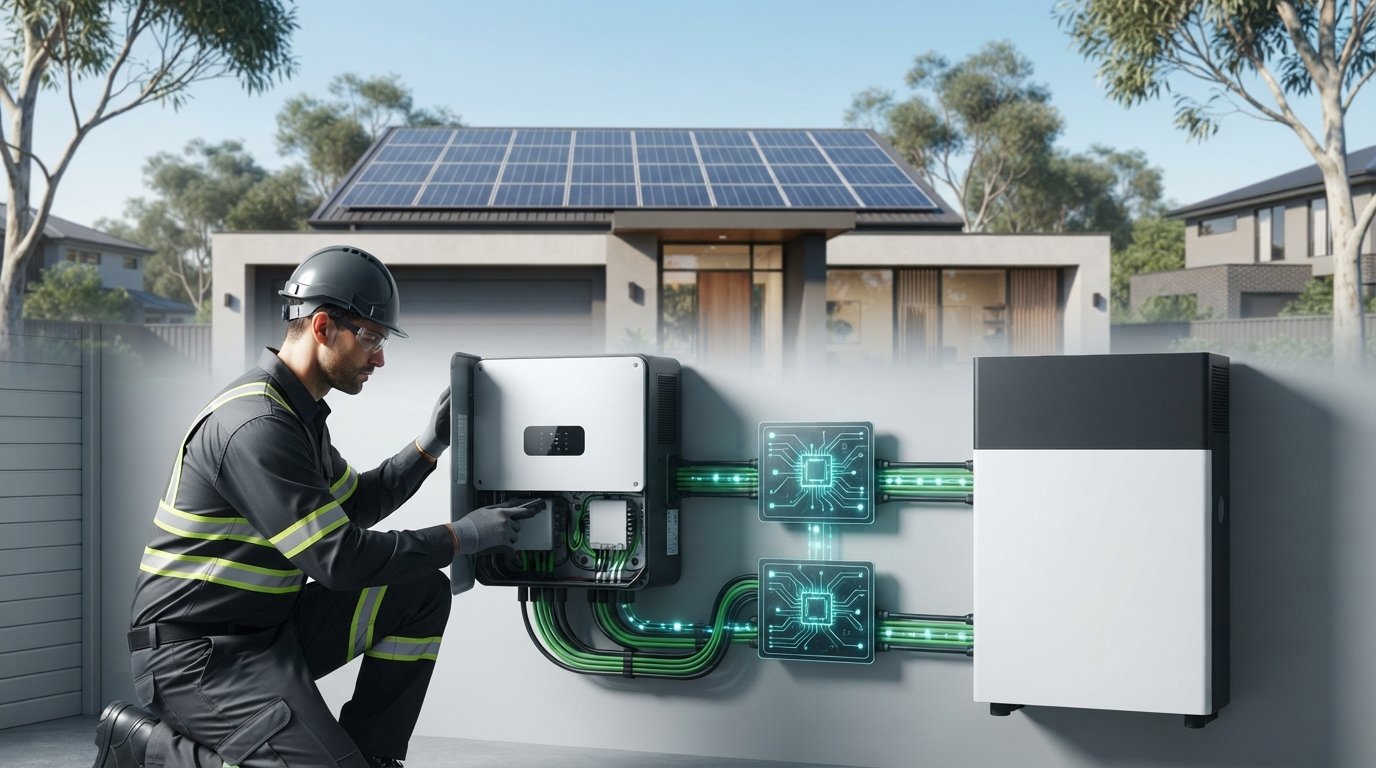
Your current solar inverter and your new battery are two sophisticated computers. If they don’t speak the exact same digital language, you’re not buying a storage solution; you’re buying an expensive wall ornament. Many Melbourne homeowners assume a “battery-ready” label guarantees a plug-and-play experience, but the reality of solar battery compatibility with my inverter is far more technical. It’s about closed-loop communication protocols and matching high-voltage DC architectures. Getting this wrong doesn’t just impact performance. It risks your safety and can instantly void your existing manufacturer warranties.
We understand the frustration of sorting through conflicting advice about AC versus DC coupling or the latest AS/NZS 5139 safety standards. You want a system that works from day one. This 2026 integration guide provides the technical essentials to ensure your storage upgrade is seamless and high-performing. We’ll give you a clear framework to determine if your existing hardware fits the bill or if a hybrid upgrade is your smartest financial move. You’ll also learn how to maximise your Victorian rebate eligibility while meeting the strict 2026 compliance rules for Australian installations.
Key Takeaways
- Stop guessing and learn why a “battery-ready” label doesn’t always guarantee a seamless connection between your existing hardware and new storage.
- Master the essentials of solar battery compatibility with my inverter to avoid the costly mistake of buying a “brick” that won’t communicate with your system.
- Secure your 10-year warranty by ensuring your Battery Management System (BMS) utilises mandatory closed-loop digital protocols.
- Navigate the 2026 AS/NZS 5139 safety mandates and Victorian rebate rules to guarantee your installation is both legal and financially optimised.
- Follow our professional audit framework to decide if a high-efficiency DC hybrid upgrade or a universal AC retrofit is the right move for your Melbourne property.
The Compatibility Challenge: Is Your Inverter Battery-Ready?
Your solar inverter is the brain of your energy system. If that brain was manufactured before 2020, it likely lacks the cognitive ability to manage modern energy storage. Many Melbourne homeowners assume that adding a battery is a simple plug-and-play task. It isn’t. The reality of solar battery compatibility with my inverter depends entirely on the unit’s internal architecture and its ability to execute high-speed digital handshakes. If your hardware is outdated, you aren’t just looking at poor performance; you’re looking at a system that physically cannot function.
String Inverters vs. Hybrid Inverters
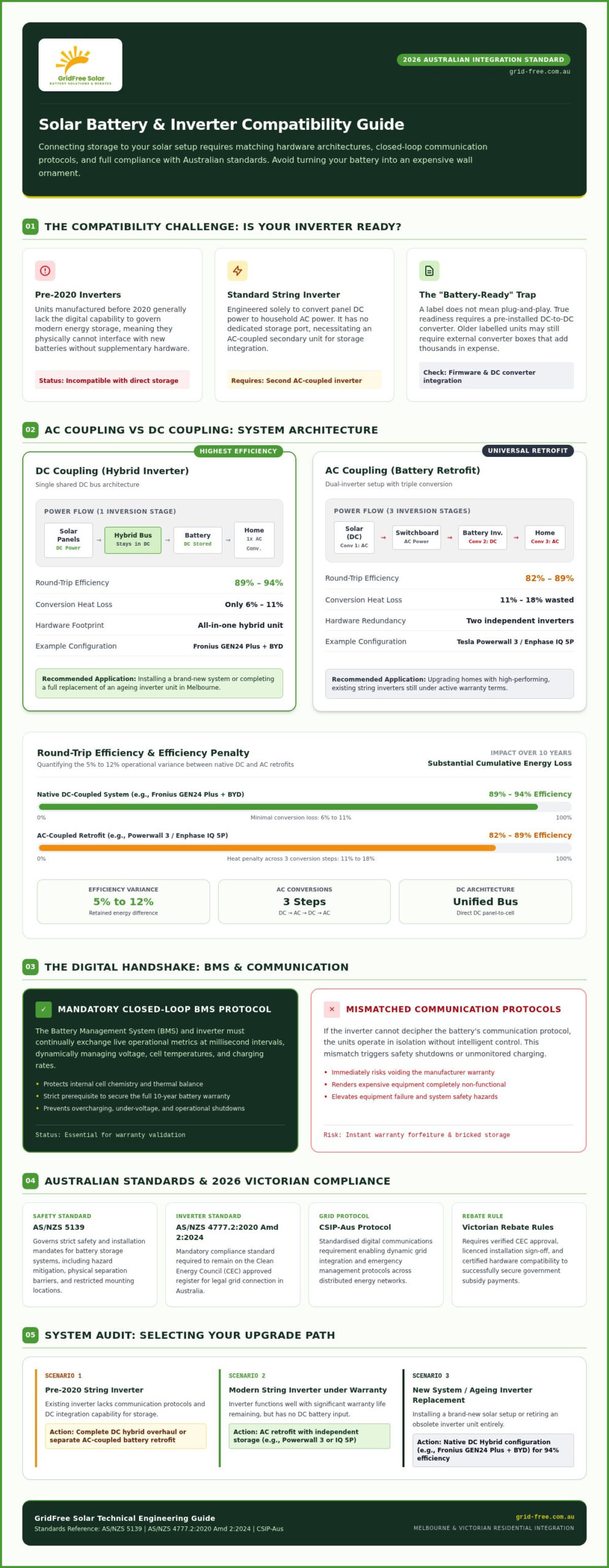
A standard string inverter is a reliable workhorse designed for one job: converting DC power from your panels into AC power for your home. It does not have a dedicated port for a battery. To add storage to this setup, you must use an AC-coupled solution, which essentially adds a second inverter to your wall. This creates multiple energy conversion steps that can lower your round-trip efficiency to between 82% and 89%.
In contrast, a hybrid inverter is an all-in-one solution. It manages both your solar panels and your battery through a single DC bus. This streamlined approach to solar inverter architectures eliminates unnecessary conversion stages, often pushing efficiency as high as 94%. If you are installing a new system in Victoria, starting with a hybrid unit is the only way to ensure future-proof solar battery compatibility with my inverter without requiring a total hardware overhaul later.
The ‘Battery-Ready’ Marketing Trap
Don’t let a “Battery-Ready” sticker on your inverter casing give you a false sense of security. In the 2026 market, this term is often used loosely by manufacturers to describe units that still require expensive external interfaces or specific high-voltage battery stacks to actually function. Many older “ready” units from common brands require a separate DC-to-DC converter box that can add thousands to your installation costs. Battery-Ready is an inverter with a pre-installed DC-to-DC converter.
Before you commit to a purchase, you must verify your inverter’s firmware version and manufacturing date. Inverters must comply with AS/NZS 4777.2:2020 Amd 2:2024 to remain on the Clean Energy Council approved register. If your unit was installed before these standards took effect, it might lack the CSIP-Aus communication capabilities required for modern grid integration. For older Melbourne systems, “retrofitting” via an AC-coupled battery like the Tesla Powerwall 3 or Enphase IQ 5P is often the most cost-effective path forward, as it bypasses the compatibility limitations of your existing solar inverter entirely.
AC Coupling vs. DC Coupling: Choosing Your Path
The architecture you select defines your system’s long-term ROI. When investigating solar battery compatibility with my inverter, you’ll face two distinct engineering paths: AC coupling and DC coupling. The choice isn’t merely about personal preference. It’s about technical physics. Your existing hardware dictates which configuration will deliver the highest efficiency and the shortest payback period for your Melbourne home.
Efficiency matters. Every time power changes format, you lose energy to heat. Native DC-coupled configurations, such as a Fronius GEN24 Plus paired with BYD batteries, deliver a solar-to-battery round-trip efficiency of 89% to 94%. This is because the power stays in DC format from the panels to the cells. In contrast, AC-coupled retrofits operate at lower efficiencies between 82% and 89%. The power undergoes three separate conversions: DC to AC at the solar inverter, AC back to DC for the battery, and DC to AC again for your household loads. Over a decade, that 5% to 12% difference represents a massive amount of “lost” free energy.
When to Choose AC Coupling
If your current inverter is a premium unit with significant warranty life remaining, AC coupling is your universal solution. It allows you to keep your existing solar setup exactly as it is. The Tesla Powerwall 3, while natively a DC hybrid unit, is frequently used in AC-coupled retrofits via its integrated inverter. It integrates seamlessly with almost any existing string inverter system. Choosing AC and DC coupling configurations based on a retrofit model provides independent operation. If one inverter fails, the other can often continue to function, providing a layer of redundancy.
The Case for DC (Hybrid) Upgrades
For those with ageing hardware, a full hybrid upgrade is the superior financial move. Maximising your energy harvest requires keeping electricity in DC format for as long as possible. Many homeowners find that solar battery replacement Melbourne services are the perfect time to swap an old string inverter for a modern hybrid unit. This transition doesn’t just improve efficiency; it future-proofs your home for Virtual Power Plant (VPP) participation. Modern hybrids offer the high-speed communication needed for VPPs to manage grid stability in Victoria.
Determining the best path requires a precise technical audit of your current hardware. You can request a professional assessment to see which coupling method maximises your specific roof’s potential.
The Digital Handshake: BMS and Communication Protocols
Physical wiring is only half the battle. In 2026, solar battery compatibility with my inverter is primarily a software challenge. Your inverter and battery must perform a high-speed digital handshake every few milliseconds to share critical data. If this conversation fails, the system will shut down to protect its internal components. This communication happens through specific physical ports, usually CANbus or RS485, but the software language, known as the protocol, must match perfectly. Using a battery that doesn’t talk to your inverter is like trying to run a modern app on an obsolete operating system. It won’t work.
Why BMS Integration is Non-Negotiable
The BMS is the digital brain that prevents battery degradation. It monitors individual cell voltages, internal temperatures, and state of charge in real time. Without active BMS integration, your inverter is flying blind. It can’t know when to throttle the charging current to prevent thermal runaway or when to stop discharging to protect the cells from permanent damage. Modern lithium iron phosphate (LiFePO4) batteries rely on this closed-loop communication to maintain their 10-year warranty. In an open-loop system, the inverter only guesses the battery status based on voltage. This is inaccurate, inefficient, and potentially dangerous for your home.
Approved Product Lists (APL)
Don’t assume that two premium brands will work together by default. Every reputable manufacturer publishes a compatibility matrix or Approved Product List (APL). This document is your primary resource for verification. It confirms that the manufacturer has tested the specific firmware versions of both devices to ensure they sync correctly. Following Clean Energy Council approved battery guidelines is essential for safety and compliance.
In Victoria, using a non-approved combination will instantly disqualify you from the Solar Homes Program battery rebate. You must avoid ‘Frankenstein’ systems where an unaccredited installer tries to force two incompatible units to work together. These setups often lead to intermittent faults and “ghost” errors that leave you without backup power during a blackout. Always demand to see the APL for your specific inverter model before paying a deposit on a new battery stack. This simple check ensures your storage upgrade is a high-performing asset rather than a technical headache.
Australian Standards and Local Compliance (AS/NZS 5139)
Compliance in the Australian solar landscape is a legal minefield. The AS/NZS 5139:2019 Amendment 1:2025, which became mandatory across the country by mid-2026, sets the benchmark for every Victorian installation. This standard dictates that solar battery compatibility with my inverter is not just a performance metric; it is a safety requirement. If your inverter cannot communicate its thermal state to the battery, you risk violating strict fire safety protocols. Every installation must now account for specific clearance zones, particularly around garage doors and habitable rooms, to mitigate thermal runaway risks.
Fire-rated enclosures are a critical part of this equation. If you install a battery on an external wall with a bedroom on the opposite side, 16mm fire-rated plasterboard or masonry shielding is strictly mandatory. These regulations ensure that even in the rare event of a cell failure, your home remains protected. CEC-accredited installers must sign off on the compatibility of your system, verifying that the inverter’s protection settings align perfectly with the battery’s discharge limits. Failure to meet these standards doesn’t just risk your safety; it makes your system uninsurable.
Victorian Specific Safety Mandates
Melbourne homeowners face additional scrutiny through the Solar Victoria audit program. To qualify for the eligible batteries for Victorian rebate, your system must meet VPP-readiness standards. This requires an inverter that supports CSIP-Aus v1.2 communication protocols, which became mandatory on 23 August 2025. Choosing a pre-approved pairing isn’t just about safety; it’s about securing your financial incentives. Systems that fail a Solar Victoria audit can lead to rebate clawbacks and mandatory rectification work at the owner’s expense.
Warranty Protection
Risking an incompatible pairing is a gamble with your consumer rights. If a fault occurs and the manufacturer discovers you’ve ignored their Approved Product List, both your inverter and battery warranties can be voided instantly. This leaves you with a five-figure repair bill and no legal recourse. We eliminate this risk by only installing manufacturer-approved pairings. This “Single Point of Accountability” ensures that if something goes wrong, you have a clear path to a resolution without brands blaming each other for integration failures. We never compromise on these pairings because your long-term security depends on factory-certified engineering.
Protect your investment by choosing a compliant, high-performing system. You can book a Victorian compliance audit with our specialist team today to ensure your home meets the 2026 standards.
Next Steps: Auditing Your System for Storage
Taking control of your energy future starts with a rigorous hardware audit. You cannot select a storage solution based on price alone. You must select it based on the physical and digital realities of your current setup. Mastering solar battery compatibility with my inverter requires a methodical approach to ensure your system remains safe and high-performing for the next decade. Follow these four critical steps to prepare for your upgrade and avoid the risk of buying incompatible hardware.
- Step 1: Identify your hardware. Locate the compliance plate on the side of your inverter. Record the exact make, model number, and year of manufacture. If the unit was installed before 2020, it likely requires a firmware update or a full hybrid replacement to meet 2026 standards.
- Step 2: Analyse your consumption. Log into your energy retailer’s portal to download your smart meter data. Knowing your average overnight base load in kWh is essential for sizing your battery stack correctly.
- Step 3: Evaluate coupling feasibility. Determine if your existing inverter is premium enough to justify an AC-coupled retrofit or if you should pivot to a high-efficiency DC hybrid system for better long-term ROI.
- Step 4: Review financial outcomes. Explore your Melbourne solar battery upgrade options to calculate your projected savings and payback period.
Professional Compatibility Assessment
A remote desktop audit is often insufficient for older Melbourne properties. While satellite imagery can see your roof, it cannot see the state of your switchboard or the gauge of your existing solar wiring. A professional on-site assessment identifies hidden technical bottlenecks that lead to system failure. This includes checking for AS/NZS 5139 compliant installation zones and ensuring your main switchboard has the physical space for additional battery circuit breakers. You should always request a professional solar panel installation Melbourne quote that incorporates a comprehensive storage readiness audit to avoid unexpected costs during the installation phase.
The GridFree Integration Advantage
We specialise in solving the complex integration headaches that leave other installers confused. Our team matches modern storage technology with your existing Melbourne solar grid to ensure 100% rebate compliance and maximum round-trip efficiency. We don’t just bolt a battery to your wall; we program the digital handshake between your devices to guarantee long-term reliability. Don’t leave your energy security to chance with unverified hardware combinations. Book your battery compatibility audit with GridFree Solar today to secure a future-proof energy solution for your home.
Secure Your Energy Independence
The path to a successful storage upgrade requires more than just buying a reputable brand. It demands a perfect digital handshake between your inverter and your battery cells. You now understand that efficiency losses, communication protocols, and strict AS/NZS 5139 compliance are the pillars of a safe installation. Getting the technical details of solar battery compatibility with my inverter right today prevents expensive hardware bricking tomorrow. It’s about protecting your warranty and your home’s safety simultaneously.
As a Melbourne-owned and operated team of Victorian rebate specialists, we take the complexity out of your transition. Our CEC accredited installers ensure your system meets every 2026 safety mandate while maximising your financial returns. We provide the technical certainty you need to move forward with confidence. Don’t let technical confusion stall your progress toward grid independence or risk missing out on available incentives.
Maximise your storage ROI—get a GridFree compatibility audit now
Your home is ready for the next generation of intelligent energy storage. We’re here to ensure your system performs at its peak from day one.
Frequently Asked Questions
Can I add a battery to any existing solar inverter?
Yes, you can add storage to almost any system, but the connection method depends on your current hardware. Standard string inverters require an AC-coupled battery like the Tesla Powerwall 3, which operates with its own internal inverter. Hybrid models allow for direct DC coupling. The technical solar battery compatibility with my inverter determines whether the two units can communicate effectively to manage energy flow and protect your home’s power supply.
What is the difference between a battery-ready and a hybrid inverter?
A hybrid inverter is a complete, all-in-one unit designed to manage panels and batteries through a single DC bus. “Battery-ready” is often a marketing term for a standard inverter that requires additional hardware, such as a DC-to-DC converter or a high-voltage interface, to function with storage. True hybrids are more efficient for Melbourne installations because they eliminate extra conversion stages and simplify the digital handshake between devices.
Will adding a battery void my existing solar panel warranty?
Adding a battery won’t void your solar panel warranty if the work is performed by a CEC accredited installer. However, using an incompatible battery can void your inverter’s warranty if it causes electrical stress or software faults. This is why we prioritising manufacturer-approved pairings. Verifying the solar battery compatibility with my inverter protects your existing investment while ensuring your new storage system operates within safe factory parameters.
Do I need to upgrade my switchboard for a new solar battery?
Many older Melbourne homes require a switchboard refresh to meet 2026 Australian standards. Modern regulations like AS/NZS 5139 mandate specific circuit breakers and dedicated space for battery isolators that older boards simply don’t have. If your board still uses ceramic fuses or is physically full, an upgrade is essential for safety. Our team assesses your electrical infrastructure during our initial audit to ensure your home is fully compliant and storage-ready.
How do I know if my battery is compatible with the Victorian rebate?
Your system must appear on the Solar Victoria Approved Product List to qualify for any financial incentives. This list requires that both the battery and inverter are certified for VPP-readiness and meet the latest AS/NZS 4777.2 grid standards. We specialise in navigating these rebate requirements for local families. We only supply hardware combinations that guarantee your eligibility, ensuring you don’t miss out on thousands in available government savings.
What happens if my inverter and battery don’t communicate?
The system will fail to charge or discharge, often resulting in a permanent “Communication Fault” error. Without a digital handshake via CANbus or RS485 protocols, the inverter cannot monitor the battery’s state of charge or internal temperature. This prevents the system from providing backup power during blackouts and can lead to cell degradation. Professional programming is mandatory to ensure the Battery Management System (BMS) and inverter are perfectly synced for daily operation.
Is AC coupling less efficient than DC coupling?
AC coupling is generally 5% to 12% less efficient than DC coupling due to multiple energy conversion steps. In an AC system, power converts from DC to AC, back to DC for storage, and then back to AC for your appliances. DC-coupled hybrid systems keep the energy in DC format longer, reducing heat loss. While AC coupling is an excellent retrofit solution for existing Melbourne solar, DC coupling provides the best ROI for new upgrades.
Which battery brands are most compatible with popular Australian inverters?
Leading brands like BYD and Sungrow offer the broadest compatibility across the Australian market. BYD Battery-Box units are factory-certified to work seamlessly with Fronius and SMA inverters through high-voltage DC architectures. For homeowners with older string systems, the Tesla Powerwall 3 remains the most versatile AC-coupled option. We recommend choosing a pairing from a single manufacturer’s ecosystem where possible to ensure seamless software updates and a single point of warranty accountability.