

A solar company’s reliability is tested after the panels are on your roof. A polished quote and confident sales claims can look reassuring, but they don’t show whether the installation is compliant or what support is available once the system is switched on. If you’re comparing reliable solar companies Melbourne, look for clear evidence of how the company designs, installs and supports its systems.
For homeowners and businesses, practical signs matter most: accredited workmanship, clear written documentation and guidance on solar and battery decisions. A straightforward process can also help you understand rebate requirements without having to manage every step alone.
This guide explains what to look for in a Melbourne installation, including relevant electrical standards, a Certificate of Electrical Safety, Grid Connection Approval and the documentation consumers should receive. It also covers the requirement for geotagged, timestamped installation photos of key labels and signage from 1 March 2026. You’ll see how GridFree Solar supports customers across Melbourne and Victoria with solar and battery installation, rebate assistance, remote monitoring and 24×7 support, so reliability doesn’t end on installation day.
Key Takeaways
- Learn why reliable solar companies Melbourne should be assessed on installation processes and ongoing support, not rankings or confident sales claims alone.
- Understand how AS/NZS 5139:2019, AS/NZS 3000, UN38.3 and IEC 62040-1 relate to a compliant solar and battery installation.
- Recognise the value of a clear written scope, compliance documents and practical rebate assistance when comparing an installation proposal.
- See what support after commissioning can involve, including lifetime remote monitoring and 24×7 support.
- Explore how GridFree Solar brings solar panel installation, solar battery installation and battery upgrades or replacements together for Melbourne and Victoria customers.
What makes a solar company reliable in Melbourne?
Rankings and confident sales claims can make reliability difficult to judge. A company’s position on a list, polished marketing or a collection of positive reviews doesn’t show how its team designs, installs and documents a system. Look for processes you can understand and evidence you can keep.
A reliable solar company can explain its installer credentials, how the installation follows applicable standards, what written documentation you’ll receive and what support continues after commissioning. These are practical indicators, not a promise that every system will perform identically. Your roof, energy use, equipment and installation all affect the result.
Reviews can help you understand how customers describe communication and their experience, but they’re individual accounts, not a substitute for checking credentials and understanding what the installation process includes. A consistent comparison is more useful than an unsubstantiated league table. The overview of solar power in Australia provides broader market context, but your decision should come down to the company’s approach to your project.
Which signs of reliability matter before installation?
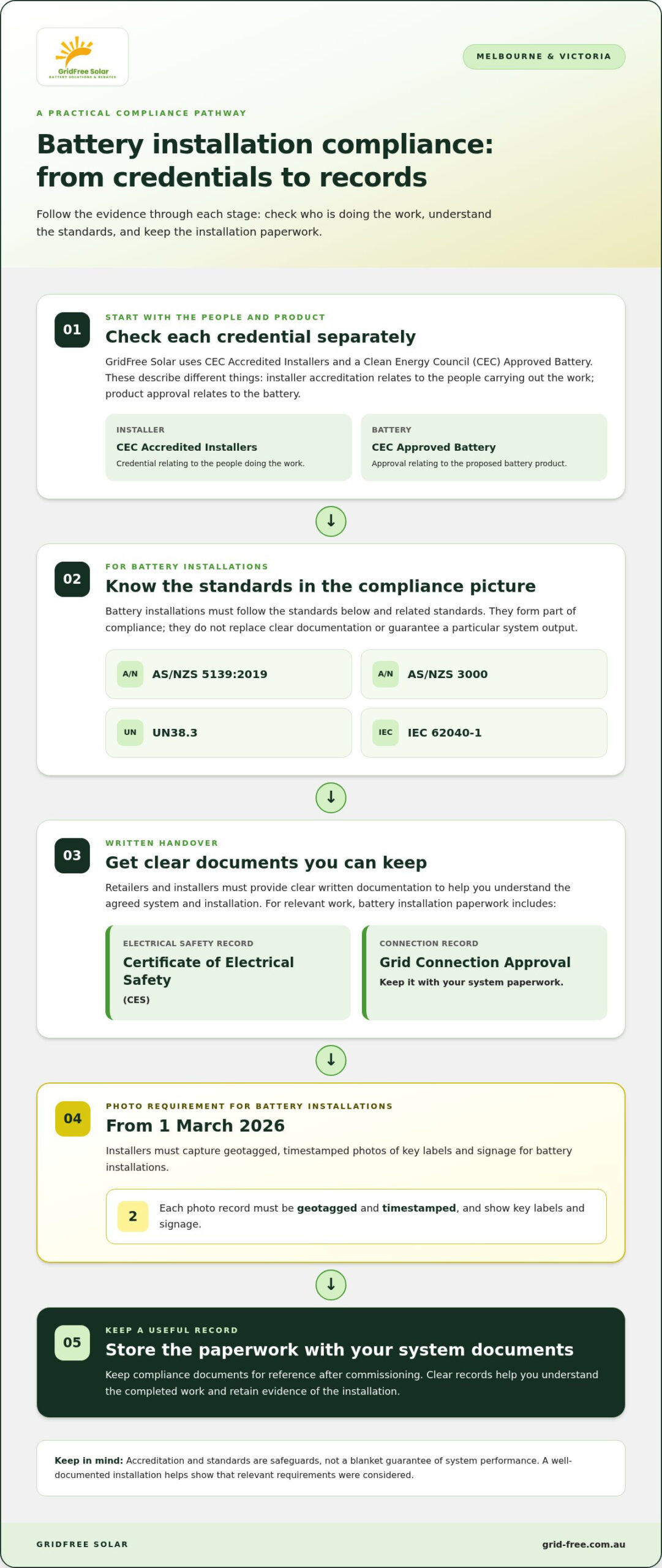
Start by checking the installer credentials and product information relevant to the work. GridFree Solar uses CEC Accredited Installers and a Clean Energy Council (CEC) Approved Battery. These refer to different things: installer accreditation relates to the people carrying out the work, while product approval relates to the battery. Ask for the proposal to explain the system design, equipment, installation scope and paperwork in plain language.
Clear documentation makes it easier to understand what’s included and keep a record of the completed work. For a battery installation, relevant paperwork includes a Certificate of Electrical Safety and Grid Connection Approval. GridFree Solar supports Melbourne and Victorian customers with solar and battery installation, battery upgrades and replacements, and assistance with rebate requirements and paperwork.
Why does local Victorian service matter?
A local focus can make it easier to discuss the practical requirements of a project in Melbourne or elsewhere in Victoria. It also gives customers a clear regional point of reference when considering solar, adding a battery or planning an upgrade. Look for a company that explains how the proposed system and installation process fit your property, rather than relying on broad promises.
For a closer look at the installation journey, explore this Melbourne solar panel installation guide. It complements the checks here by outlining steps involved in a residential solar project.
Use the same practical test for every proposal. Can you understand the design? Are relevant credentials and compliance processes explained? Will you receive clear paperwork, and what support is available after commissioning? These observable details offer a stronger basis for comparing reliable solar companies Melbourne than promotional claims alone.
How accreditation and compliance build confidence in a Melbourne solar installation
Accreditation and standards give customers practical ways to understand how an installation is planned and carried out. They’re safeguards, not a blanket guarantee of system performance. A well-documented installation helps show that relevant requirements were considered and gives you records to refer to after commissioning.
Compliance builds confidence when appropriately accredited installation is matched by clear evidence of the work completed. That evidence matters for solar and battery projects, particularly when you’re reviewing a proposal, understanding rebate paperwork or keeping records for future system needs.
What do the standards and credentials cover?
GridFree Solar uses CEC Accredited Installers and a Clean Energy Council (CEC) Approved Battery. Installer accreditation and battery approval are separate credentials, so check that each is relevant to the part of the project it describes. The company’s installation credentials form part of the information customers can use to understand who is carrying out the work and what equipment is proposed.
Battery installations must follow AS/NZS 5139:2019, AS/NZS 3000, UN38.3, IEC 62040-1 and related standards. These requirements form part of the compliance picture; they don’t replace clear documentation or guarantee a particular system output. GridFree Solar’s installation process accounts for these requirements and provides relevant consumer paperwork.
What documentation should customers receive in 2026?
Retailers and installers must provide consumers with clear written documentation. It should help you understand the agreed system and installation, and give you a useful record to retain. For relevant work, installation paperwork includes a Certificate of Electrical Safety (CES) and Grid Connection Approval. Keep these with your system documents rather than relying on verbal explanations or promotional claims.
There’s also a specific photo requirement to understand. From 1 March 2026, installers must capture geotagged, timestamped photos of key labels and signage for battery installations. The photos must show labelling on the meter box, switchboard and battery unit. Keep these records with the written documentation as evidence of critical installation details.
Rebate paperwork is another part of the process. GridFree Solar assists customers with rebate requirements and related claims, helping connect the installation details with the documentation needed for the process. For general Victorian programme information, the Victorian government solar energy initiatives resource is a useful reference. Eligibility and scheme details can change, so use current guidance.
For customers comparing reliable solar companies Melbourne, these details make the process more transparent: understand the relevant standards, know what the credentials refer to and keep a clear record of the completed work. GridFree Solar’s solar and battery installation support brings compliant installation and rebate assistance together for Melbourne and Victorian customers.
How to assess solar companies in Melbourne beyond rankings and reviews
A ranked list can offer a starting point, but it won’t give you a consistent way to compare how companies plan, document and support their work. Use the same service and evidence checklist for each proposal. That shifts the focus from promotional claims to what’s included and how the process is handled.
| Comparison point | What to look for | GridFree Solar’s approach |
|---|---|---|
| Installer accreditation | Clear information about the installer credentials relevant to the work. | Uses accredited installers for solar and battery installations. |
| Compliance | A clear explanation of applicable requirements and how the installation is documented. | Focuses on compliant installation and relevant consumer paperwork. |
| Written scope | A proposal that distinguishes the system design, equipment and installation work included. | Provides clear consumer documentation for the installation. |
| Rebate assistance | Practical help understanding and progressing relevant paperwork and claims. | Assists customers with solar and battery rebate requirements and claims. |
| Aftercare | Defined support after commissioning, not just communication before installation. | Provides lifetime remote monitoring and 24×7 support. |
Which service details make a comparison more useful?
Compare like with like. A solar-only proposal and a solar-plus-battery proposal cover different scopes, so don’t assume their equipment or inclusions are equivalent. Check that each document explains the proposed work in a way you can understand, rather than relying on a package label to tell the whole story.
GridFree Solar brings solar panels, batteries and smart energy monitoring into its solar and battery offering. Its battery systems use AI-optimized, high-capacity LiFePO₄ batteries with an integrated BMS. The modular design can be stacked for larger systems and is compatible with 99% of common hybrid inverters. Rebate assistance helps customers work through relevant paperwork and claims. For background on the Clean Energy Council’s role and approved product information, see its clean energy industry resources.
How should reviews fit into a reliability assessment?
Reviews can add context about communication, installation experiences or the way a company handled customer support. Give more weight to specific descriptions than broad statements that a provider is “the best”. Customer feedback is still a personal account; it can’t establish that a particular installation meets applicable requirements or that the paperwork is complete.
Reviews describe experiences; credentials, installation records and follow-up help show how the service is delivered. Use both kinds of information, but don’t treat one as a substitute for the other.
For a practical comparison, mark each criterion as clearly documented, partly explained or not addressed in the proposal. Then compare your notes, not just the star ratings. This helps people searching for reliable solar companies Melbourne identify where a provider’s process is specific and where important details need explanation, without relying on unsupported claims of superior results.
What reliable solar support looks like after installation in Victoria
Reliability shouldn’t end when the installation is complete. Useful support continues from commissioning into everyday system use, with access to monitoring and help as your energy needs change. For Melbourne and Victorian customers, it can also mean considering how a battery might fit later, or whether an existing battery may need an upgrade or replacement.
GridFree Solar provides lifetime remote monitoring and 24×7 support. Monitoring lets customers follow system performance over time. Ongoing support provides an avenue for assistance, but neither is a promise that every issue will be identified automatically or fixed remotely.
How can monitoring support system confidence?
Smart energy monitoring helps you keep track of how your system is performing over time. That information can make it easier to discuss changes in system use or energy needs with a support team. Keep your installation documents together with system information, so you can refer to them if you need assistance.
GridFree Solar’s lifetime remote monitoring and 24×7 support are part of its after-installation offering. These are practical continuity measures, not a guarantee of savings, fault detection, alerts or automatic repairs. Monitoring provides visibility, while support gives you access to assistance.
How do solar batteries and VPP participation fit in?
Battery needs can evolve after solar is installed. GridFree Solar provides battery installation, upgrades and replacement in Melbourne and Victoria, helping customers consider their next step as household or business requirements change. Rebate assistance is also available to help with relevant paperwork and claims.
Some customers may also consider Virtual Power Plant (VPP) participation as part of their battery plans. GridFree Solar’s stated VPP rewards include a $1 daily bonus for avoiding grid use during peak hours, a 15¢/kWh export credit for exporting power from 6-8 pm, and free grid charging from 11 am-2 pm. These are the programme’s stated reward terms, not a promise of guaranteed earnings. Actual participation depends on the applicable programme conditions.
When assessing reliable solar companies Melbourne, include the support pathway in your comparison: what monitoring is provided, what ongoing support means and how future battery requirements can be addressed. GridFree Solar brings solar and battery installation, upgrades and replacement, rebate assistance, remote monitoring and ongoing support together for customers across Melbourne and Victoria.
Explore GridFree Solar’s solar and battery support to consider how monitoring and battery options can fit your energy plans.
Why Melbourne customers choose GridFree Solar for reliable solar and battery service
Reliability takes more than a careful installation. It involves accredited professionals, work planned around applicable requirements, clear consumer documentation and support after commissioning. GridFree Solar brings these parts together for homeowners and businesses in Melbourne and Victoria, with solar and battery options shaped around each project.
The services include Solar Panel Installation, Solar Battery Installation and Battery Upgrade & Replacement. Whether you’re planning a new solar system, considering storage or looking at an existing battery, the focus is on explaining the work and its paperwork clearly. Customers receive relevant installation documentation, including a Certificate of Electrical Safety and Grid Connection Approval where applicable, alongside support with rebate requirements and claims.
How GridFree Solar supports Melbourne and Victorian customers
GridFree Solar focuses on the needs of customers across Melbourne and Victoria. The company connects installation with smart energy monitoring and ongoing support, so system information remains accessible after commissioning. Rebate assistance makes paperwork and claims part of the customer journey, with guidance through the relevant steps.
Battery STC eligibility has specific conditions: the battery must be installed with a solar PV system and have a capacity between 5 kWh and 100 kWh. Eligibility rules and rebate programmes can change, so understand the current requirements before making a decision. The Victorian battery rebate guide offers further context on battery support in Victoria.
After installation, lifetime remote monitoring and 24×7 support provide ongoing access to monitoring and assistance. They don’t guarantee a particular system outcome, but support remains part of the service beyond installation. If your energy needs shift, battery installation, upgrades and replacement offer a way to consider storage as part of a broader solar setup.
What is the next step for a reliable solar solution?
Start with your priorities. A household may be looking to install solar or explore adding a battery; a business may need a solar and battery solution suited to its site. Sharing those needs with GridFree Solar’s team helps frame the discussion around the proposed work, relevant documentation and rebate assistance. Not every project needs the same setup.
For another perspective on planning, the solar battery cost and ROI guide explains considerations that can inform a battery decision. Use it alongside your energy needs and the details of the proposed installation.
If you’re comparing reliable solar companies Melbourne, look for a process that joins accredited workmanship with compliance, clear paperwork and support after commissioning. Explore solar and battery options with GridFree Solar for your home or business in Melbourne and Victoria.
Take the next step towards confident solar
Your next move doesn’t need to be a quick decision. Use your household or business priorities to shape a conversation about solar and battery options, then take time to understand the proposed system and its documentation. A suitable choice should fit your needs and make clear what happens beyond installation day.
For Melbourne and Victoria customers, GridFree Solar brings accredited installers, a Clean Energy Council (CEC) Approved Battery, rebate assistance and clear paperwork into the service journey. Lifetime remote monitoring and 24×7 support continue after commissioning. These are practical indicators to consider as you compare reliable solar companies Melbourne, not promises of a particular system outcome.
Explore the options at your own pace. Explore solar and battery solutions for Melbourne and take a clear first step towards a setup that suits your property and energy plans.
Frequently Asked Questions
How can I tell if a solar company in Melbourne is reliable?
Look for verifiable credentials, relevant standards, clear paperwork and an explained support process. Reviews can help you understand customers’ experiences, but they don’t prove how an installation was carried out. As you compare reliable solar companies Melbourne, check that the proposed work and handover are documented, and that you know what support is available afterwards. GridFree Solar serves Melbourne and Victoria with solar and battery installation, rebate assistance, monitoring and support.
What does CEC-accredited mean for a solar installation?
GridFree Solar uses CEC Accredited Installers. Treat installer accreditation as one part of your assessment, not a promise of a particular bill saving or system result. The company also identifies its battery as a Clean Energy Council (CEC) Approved Battery. Keep the installer and equipment details with your system records so you can refer to them when discussing future changes or support.
Can a solar battery qualify for STCs without solar panels?
No. For STC eligibility, the battery must be installed with a solar PV system, either new or existing, and have a capacity between 5 kWh and 100 kWh. If you already have solar, that existing system may meet the solar PV condition, subject to applicable programme rules. GridFree Solar provides rebate assistance for solar and battery services in Melbourne and Victoria, helping customers work through relevant claims and paperwork.
What paperwork should I receive after a solar battery installation?
Retailers and installers must provide clear written documentation to consumers. Keep the installation records together, including the Certificate of Electrical Safety and Grid Connection Approval where applicable. Relevant requirements include AS/NZS 5139:2019, AS/NZS 3000, UN38.3, IEC 62040-1 and related standards. From 1 March 2026, installers must capture geotagged, timestamped photos of key labels and signage. Store these records with your system information for future reference.
Will GridFree Solar batteries work with an existing hybrid inverter?
GridFree Solar states compatibility with 99% of common hybrid inverters, not every inverter. The company describes its battery design as modular and scalable, with an integrated BMS. Compatibility for a particular property depends on the existing equipment and project requirements. Having the inverter’s make and model available can help inform a discussion about how the proposed battery system may fit your current setup.
How does GridFree Solar’s VPP reward programme work?
GridFree Solar states the programme includes a $1 daily bonus for avoiding grid use during peak hours, 15¢/kWh export credit for exporting power from 6-8 pm, and free grid charging from 11 am-2 pm. These are programme terms, not guaranteed savings or earnings. Consider how the programme conditions may work alongside your household’s or business’s energy use and battery plans.