

Searching for questions to ask a solar installer Melbourne homeowners can use? Start by looking beyond panel count. A quote can seem complete while leaving out details about your roof, household energy use, installation scope or plans for a battery.
Quotes can be difficult to compare when equipment, installation work and rebate assistance differ. The right questions can reveal what’s included, how the system has been designed and what happens before and after installation.
This 2026 checklist helps you assess a proposal with confidence. You’ll learn what to ask about roof suitability, system sizing, product choices, installation work, grid connection, compliance documents and rebates. If you’re considering a battery now or later, you’ll also know how to discuss compatibility as part of the overall design.
GridFree Solar brings system design, installation and rebate assistance together for Melbourne households. Its CEC accredited installers and written compliance documentation give you practical details to consider as you review a proposal. Use the checklist to compare proposals on a like-for-like basis and decide on a clear next step for your home.
Key Takeaways
- Use these questions to compare system designs and quote inclusions more clearly.
- Check how the proposed system responds to your household energy use and roof, rather than relying on panel count alone.
- Look for written product details, battery options and warranty information in the proposal.
- Understand how installer credentials, grid connection requirements, compliance and handover documents fit into the project.
- Review the design, installation scope, rebate assistance and future energy needs in a consistent order.
What Should a Melbourne Solar Installer Explain Before Quoting?
A quote is useful when you can see what it’s based on. Two proposals may recommend different system sizes, equipment or installation work because they make different assumptions about your home. Compare the reasoning, not just the panel count. A clear first discussion should connect your household’s energy use with your roof, existing electrical setup, proposed equipment and included work.
Start with three questions: What information shaped the design? What’s included in the quoted scope? What will be documented? Good answers are specific, easy to follow and reflected in the written proposal. GridFree Solar combines system design, installation and rebate assistance, so you can discuss the project as a whole.
Which details about your Melbourne property shape the discussion?
Your property and routines are the starting point, not a standard panel count. Explain how many people live at home, when you typically use electricity and whether you’re planning to add battery storage or other electrical loads. These details help make the design discussion relevant to how you expect to use energy.
Roof space, orientation, shading and switchboard details are also important site assessment inputs. Existing solar can affect how a proposed system is planned, and a future battery may shape the design discussion too. Understanding how panels convert sunlight into electricity can help you follow the equipment discussion. Understanding Solar Panels offers helpful background.
What should a clear solar proposal put in writing?
Ask for a proposal that describes the system and work in plain language. It should identify what is being installed, explain how the recommended capacity relates to your property and show the assumptions behind any performance estimates. If an estimate depends on shading, roof layout or household use, those assumptions should be visible in the proposal rather than left as a verbal explanation.
- Components and capacity: Identify the proposed solar system components and overall capacity.
- Installation scope: Describe the work included and distinguish it from work outside the quoted scope.
- Design assumptions: Explain the information used for performance estimates, including relevant roof and usage factors.
- Approvals and rebates: Set out the proposed grid connection approval process and what rebate assistance covers.
- Handover and support: Clarify which written compliance documents are provided and what ongoing support is included.
These details give you a practical basis for comparing proposals and resolving unanswered questions before you commit. GridFree Solar provides written compliance documentation and rebate assistance alongside solar and battery installation for Melbourne homes. Ask for explanations in everyday language, then check that the final proposal reflects the answers. If an assumption or part of the scope is unclear, have it resolved in writing before moving to the next step.
What Questions Reveal Whether a Solar Design Suits Your Melbourne Home?
A sound solar design starts with your property and energy use, not a standard panel count. Prioritise questions that reveal how the recommendation was developed and what the estimate depends on.
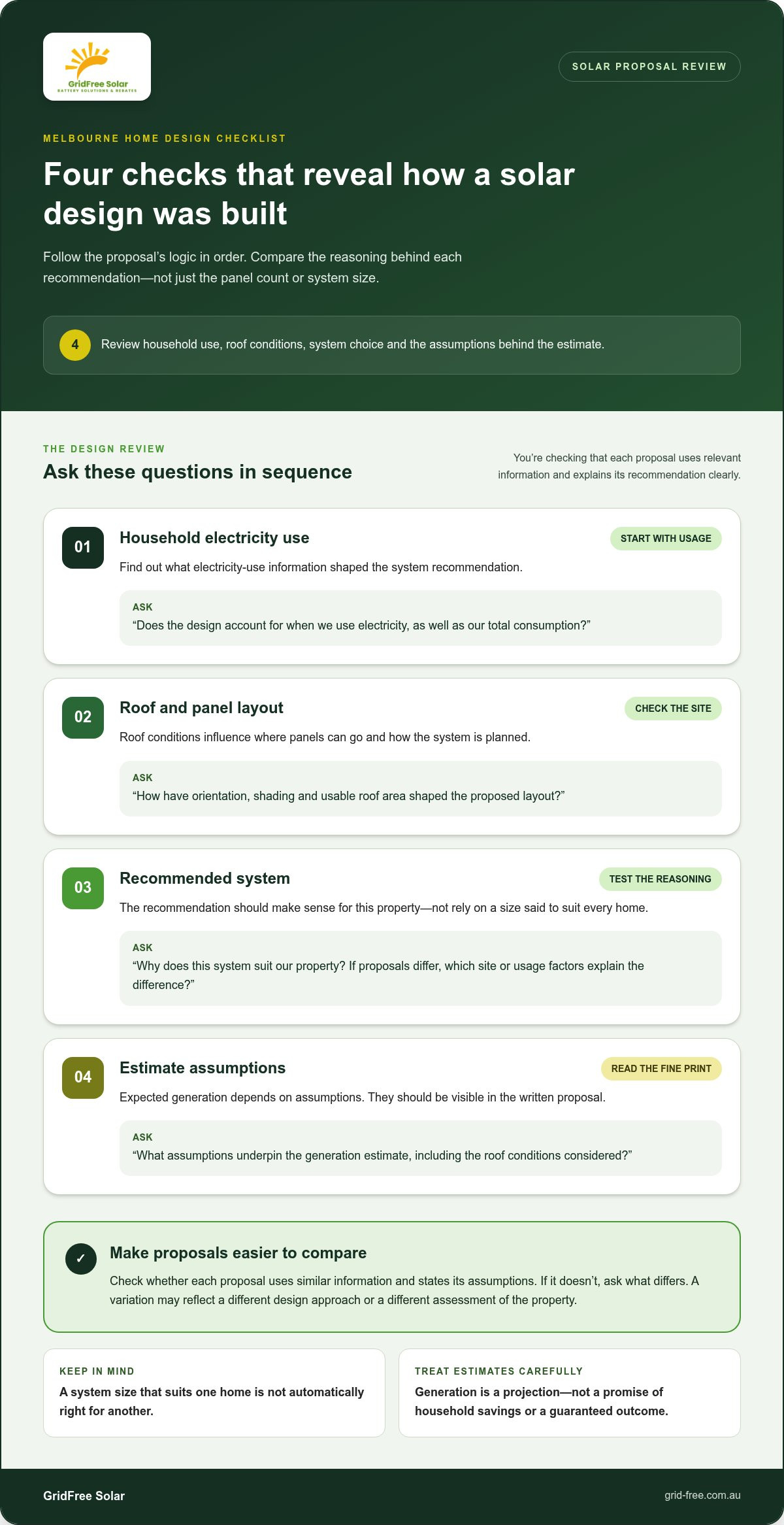
Use this four step review to follow the logic of a proposal. You’re not looking for identical designs across different homes. You’re checking whether each recommendation is explained consistently and uses information relevant to your household and site.
- Usage: What electricity use information informed the system recommendation? Does it account for when your household uses energy as well as total consumption?
- Roof: How have orientation, shading and usable roof area shaped the proposed panel layout?
- System: Why does the recommended system suit this property? If proposals differ, what site or usage factors explain the difference?
- Assumptions: What assumptions underpin the generation estimate, and are they stated clearly in the proposal?
Compare the reasoning behind each proposal rather than treating one system size as automatically right for every home. This Melbourne solar panel installation guide provides further context on how a site specific installation can fit into a household’s energy plans.
How should the installer explain system size and expected generation?
Ask how the proposed capacity relates to your electricity use information. The installer should explain the reasoning in plain language instead of relying on a broad claim that a certain size suits every home. Ask what assumptions shape the expected generation estimate, including the roof conditions considered in the design. Treat the estimate as a projection, not a promise of household savings or a guaranteed outcome.
For a useful comparison, check whether proposals use similar information and make their assumptions visible. If they don’t, ask what differs. A clear explanation helps you understand whether a variation comes from a different design approach or a different assessment of the property.
How do roof conditions and future plans change the design?
Orientation, shading and usable roof area influence where panels can be placed and how the system is planned. Ask how the proposal accounts for your roof layout and any property specific constraints. If you’re considering a battery in future, raise that during the design discussion. Solar PV can be planned with battery integration in mind, while the design still needs to suit your current needs. The Clean Energy Council Guidelines are a useful reference for broader clean energy and installer information.
GridFree Solar designs and installs solar and battery systems for Melbourne homes. To explore a site specific design, learn about Melbourne solar installation and how a project can be shaped around your home and future energy plans.
What Should You Ask About Solar Products, Batteries and Warranties?
Product names and headline figures only tell part of the story. Ask how each component fits the proposed system, what its stated function is, and where its warranty terms and supporting documents appear in the proposal. That makes it easier to compare what’s being offered without assuming different products have the same capabilities.
GridFree Solar batteries use Proven LiFePO₄ Chemistry, with lower fire risk and better heat tolerance. They are compatible with 99% of common hybrid inverters and have a modular, scalable design. Ask how the proposed battery fits your system and where its specifications and installation details are set out in writing.
| Component | Stated function | Warranty information | Proposal documentation |
|---|---|---|---|
| Solar panels | Generate electricity from sunlight as part of the solar PV system. | Review the warranty terms stated for the proposed panels, including what each warranty covers. | Look for the panel details, system design and relevant product documents. |
| Inverter | Works with the solar PV system to convert its electricity for household use. | Check the inverter warranty information and any conditions written in the proposal. | Confirm the proposed inverter details and how it relates to the system design. |
| Battery | Stores energy as part of an integrated solar and battery system. | Check the stated warranty terms alongside the specified cycle and design life figures. | Look for battery details, compatibility information and relevant compliance documents. |
What should a homeowner understand about battery compatibility?
Ask how compatibility is determined for the proposed system, especially if you already have a hybrid inverter or plan to add storage later. GridFree Solar batteries are compatible with 99% of common hybrid inverters, but your proposal should identify the components being designed together. Modular and scalable describes the battery design; it doesn’t replace a project specific explanation of how the system will work.
For STC eligibility, the battery must be installed with a solar PV system, new or existing, and have a capacity between 5 kWh and 100 kWh. A standalone battery installation does not meet this pairing requirement. If you’re comparing the financial side separately, the Australian solar battery cost and ROI guide provides a dedicated discussion.
How should warranty, monitoring and performance claims be presented?
GridFree Solar’s battery figures are 8,000+ cycles and a 15+ year design life. Ask for these figures and the applicable product warranty terms in writing, and keep them distinct: cycle count, design life and warranty are not interchangeable. GridFree Solar also provides lifetime remote monitoring and 24×7 support. These services don’t guarantee a particular saving or household outcome.
If a proposal includes a usable efficiency figure, check that it identifies the relevant product and explains what the figure describes. GridFree Solar’s stated battery efficiency is 99.6%. Clear product context matters. Check that the proposal connects component claims with the actual system being offered instead of leaving important details as verbal assurances.
What Melbourne Installation, Rebate and Compliance Details Need Clear Answers?
A well designed system needs more than suitable panels and a clear installation scope. Before proceeding, understand who is responsible for grid connection approval, which safety standards apply, what rebate assistance covers and which records you’ll receive at handover. These questions help make responsibilities and project documentation clear from the outset.
GridFree Solar uses CEC Accredited Installers and provides rebate assistance. Ask how the process and documentation will apply to your project, and keep eligibility and approval decisions distinct from the assistance provided.
Which approvals, standards and records belong in the installation discussion?
Ask how grid connection approval will be handled for your project, including who coordinates the application and how its status will be communicated. Confirm that the handover includes the Certificate of Electrical Safety and written compliance records relevant to the work. Grid connection requirements can vary by project, so the proposal should explain the process without implying approval is automatic.
For battery installations, ask how the design and installation address applicable requirements, including AS/NZS 5139:2019, AS/NZS 3000, UN38.3, IEC 62040-1 and related standards. From 1 Mar 2026, installers must capture geotagged, timestamped photos of key labels and signage. Retailers and installers must provide clear written documentation to consumers.
- Credentials: Confirm who is completing the installation and their relevant accreditation.
- Grid connection: Establish who coordinates approval and how project specific requirements will be documented.
- Standards: Ask which standards apply to the solar and battery work in your proposal.
- Handover: Identify the Certificate of Electrical Safety, compliance records and required installation photos you’ll receive.
How should rebate assistance and VPP terms be explained?
Keep three things separate: eligibility, paperwork and participation in a Virtual Power Plant (VPP). GridFree Solar provides rebate assistance, including help with paperwork and claims, but assistance is not a promise that an application will be approved. For STC eligibility, a battery must be installed with a solar PV system and have a capacity between 5 kWh and 100 kWh. A standalone battery installation does not meet that pairing requirement.
When comparing a rebate offer, ask what system configuration it applies to and how eligibility is assessed. GridFree Solar states a government rebate of up to $16,800 when installing a 42 kWh battery system, with customers paying as little as $5,500. These figures relate to the stated system and rebate offer, not a guaranteed outcome for every household.
If a VPP is part of the proposal, review its terms separately from rebate eligibility. GridFree Solar’s VPP rewards are a $1 daily bonus, 15¢/kWh export credit, and free grid charging from 11 am-2 pm. These terms describe the offer, not guaranteed earnings or approval. Consider what participation involves before deciding whether it suits your household.
For a broader explanation of eligibility and the Victorian context, read the Victorian battery rebate guide. To discuss installation, rebate assistance and compliance documentation together, explore GridFree Solar’s Melbourne solar and battery solutions.
How Can Melbourne Homeowners Turn Installer Answers into a Clear Next Step?
Good answers should leave you with a proposal you can understand, not pressure to decide on the spot. Use the questions in this checklist to check that the design, installation scope and supporting details fit your property and priorities.
Before approving a proposal, review these elements together. A gap in one can affect how well you understand the whole project.
- Design: Check that the proposed capacity and components suit your household’s needs, and that the site assumptions behind the recommendation are clear.
- Scope: Confirm what installation work is included and how the solar system and any battery option fit together.
- Approvals: Make sure the proposal explains grid connection approval responsibilities and the steps involved for your project.
- Documentation: Check which compliance records and handover documents you’ll receive, and how rebate assistance is handled.
- Support: Understand what remote monitoring and ongoing support are provided after installation.
Compare proposals based on their explanations, not a single headline figure. If something important is missing or unclear, ask for the answer to be reflected in the written proposal before making your decision. This gives you a more reliable basis for assessing the design and scope without relying on assumptions or unsupported promises.
What should homeowners compare before approving a proposal?
Put each proposal beside your priorities: how you use electricity, what you expect from solar and whether a battery is part of your plans. Check that the recommended capacity, components and site assumptions are explained, then review the installation scope and approval responsibilities. Finally, confirm the written compliance records, handover information, monitoring and support. The aim isn’t to make every proposal identical, but to understand why they differ.
What does a supported GridFree Solar next step look like?
GridFree Solar provides residential solar panel and battery installation in Melbourne and across Victoria. CEC Accredited Installers connect system design with installation, battery options and smart energy monitoring. Rebate assistance includes support with paperwork and claims, while eligibility and approval remain subject to the applicable requirements. You can discuss how these elements relate to your home and the proposal in front of you.
Bring your household energy use information, questions and any proposals you’re comparing. A clear discussion can identify which details need to be resolved and what a suitable next step looks like for your property. Choose based on the written design, scope, approvals and support, not pressure or a promise of guaranteed savings.
Discuss your Melbourne solar project with GridFree Solar and take the next step with a plan grounded in your home and energy needs.
Make Your Solar Decision with Confidence
The next step isn’t rushing to sign. It’s turning what you’ve learned into a project brief that reflects your home, energy priorities and longer term plans. Keep your checklist of questions to ask a solar installer in Melbourne handy, along with your electricity bill and any proposal you’re reviewing. This gives the conversation a clear starting point and helps you focus on the details that matter to your decision.
GridFree Solar reports more than 230 installations completed and 543+ happy families. Its credentials include CEC Accredited Installer and CEC Approved Battery, with lifetime remote monitoring and 24×7 support available as part of its offering.
Bring your priorities to a Melbourne solar discussion and take the time you need to understand the proposed path. A system should make sense for your property, not just look compelling on paper. Start a conversation about your Melbourne solar project and move forward with greater clarity.
Frequently Asked Questions
Can I add a battery to my existing solar panels in Melbourne?
Yes. A battery can be added to an existing solar system if the equipment and site are suitable. Have your current system paperwork ready, including panel and inverter details, and note any changes to the system since installation. The installer can use this information to assess compatibility and explain how a battery could fit with your existing solar. If you can’t find the documents, mention that early in the discussion.
Is a solar battery eligible for STCs if it is installed on its own?
No. A battery installed on its own doesn’t meet the stated STC eligibility requirement. The battery must be installed with a solar PV system, new or existing, and have a capacity between 5 kWh and 100 kWh. If you’re considering storage for a home that already has solar, make sure the proposal explains how the battery is paired with that PV system. Eligibility and any associated claim still depend on applicable program requirements.
What happens if my solar system needs grid connection approval?
The installer should explain the approval steps for your specific project and who is responsible for coordinating them. Requirements can depend on the property and relevant distributor, so ask how the application’s progress and outcome will be communicated. Keep written records of approval related correspondence with your proposal. Before treating the system as ready to connect, make sure you understand what approval has been obtained and whether any project requirements remain outstanding.
Do Melbourne solar installers need to provide written installation documents?
Yes. Retailers and installers must provide consumers with clear written documentation. Keep the final proposal, relevant compliance documents and Certificate of Electrical Safety together, and check that the handover explains the installed system. From 1 Mar 2026, installers must capture geotagged, timestamped photos of key labels and signage. These records help you identify what was installed and retain useful information for future system discussions.
Can solar panels and a battery be installed as one system?
Yes. Solar panels and a battery can be designed and installed as an integrated system, with the proposal showing how the components work together. This can be useful if you want to plan generation and storage as part of the same project rather than treat them as unrelated purchases. Ask for the system configuration and component details in writing. If a battery is included, its STC eligibility depends on the applicable pairing and capacity requirements.
What information should I have ready before discussing a solar quote?
Bring a recent electricity bill, your usual occupancy patterns and any plans that could change household energy use. Ask how the design uses those details. If available, also gather existing solar or inverter paperwork and note roof areas affected by shade. A clear picture of your current setup helps make the first design discussion more specific.