
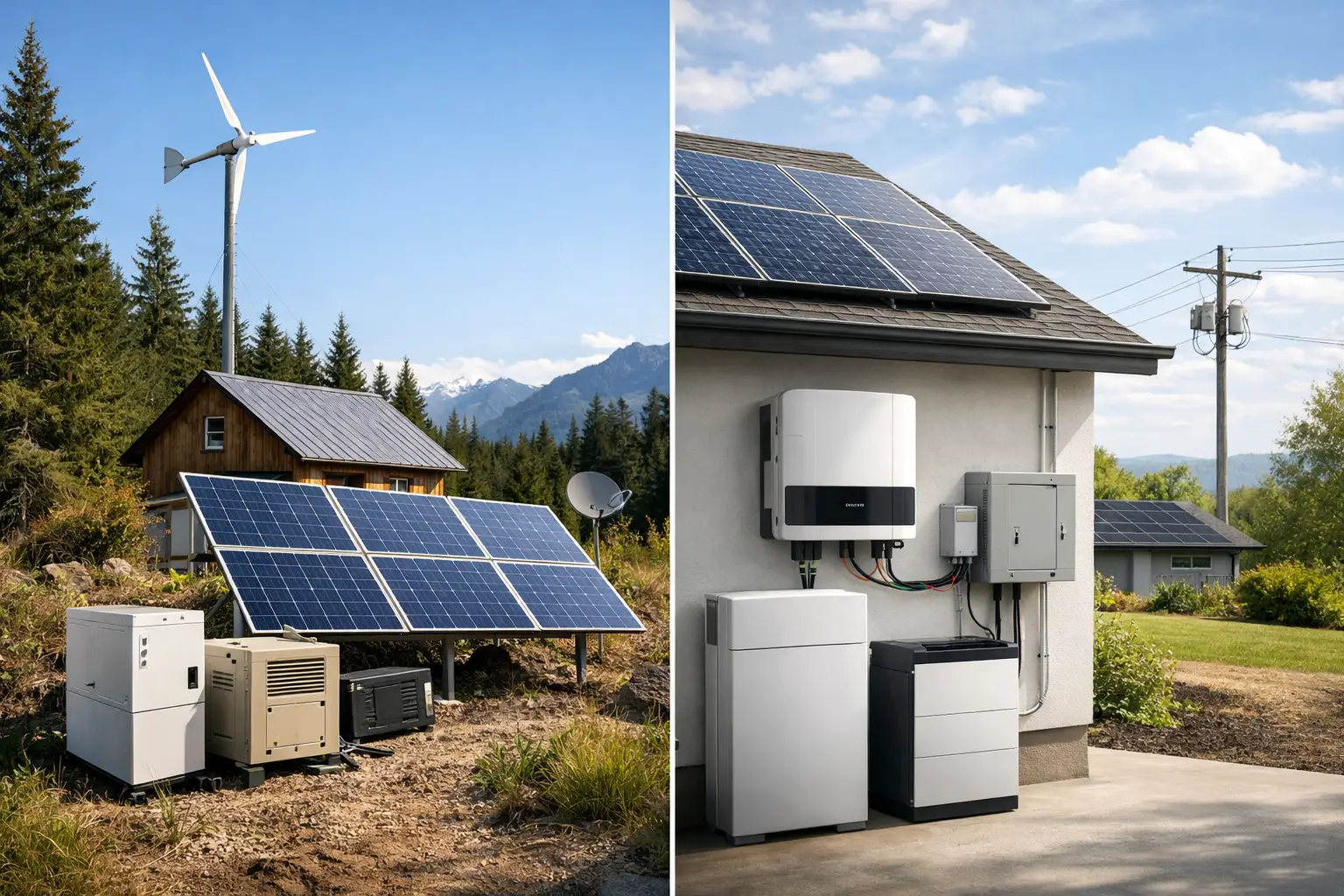
A solar system can look excellent on paper and still be the wrong fit for your property. The key decision in off grid versus hybrid solar is not simply how many panels you can install. It is how much certainty you need when the sun is down, the grid goes out, or your energy use changes over time.
For many Australian households and small businesses, a hybrid system delivers the strongest balance of lower bills, battery-backed power and grid security. Fully off-grid solar can be the right answer too, particularly where connecting to the network is impractical or expensive. The difference comes down to location, consumption patterns, budget and how much energy independence you genuinely need.
What off-grid solar actually means
An off-grid solar system operates independently from the electricity network. Solar panels generate power during the day, while a battery bank stores enough energy to run the property at night and through periods of poor weather. A suitably sized inverter manages the available power, and many systems include a generator as a backup for extended cloudy conditions or unusually high demand.
There is no grid power to fall back on. That is the appeal for remote homes, farms, sheds, workshops and properties where the cost of bringing in poles, wires and a new connection can exceed the cost of a self-contained energy system.
But independence requires careful design. An off-grid system must be built for the worst realistic period of energy production, not just an average sunny day. That often means more panels and considerably more battery capacity than a grid-connected household would otherwise require. Loads such as ducted air conditioning, electric hot water, pool pumps, EV charging and commercial refrigeration need particular attention because they can quickly drain stored energy.
Off-grid solar is not a set-and-forget promise that every appliance can run without limits. It works best when the system is designed around your actual usage and when the property has sensible energy habits, such as shifting high-demand tasks into daylight hours.
How hybrid solar works
A hybrid solar system remains connected to the grid while adding battery storage to a solar PV system. Your panels power the home or business first. Surplus solar can charge the battery, and any remaining energy may be exported to the grid. When solar production drops, the battery can supply the property before grid electricity is needed, depending on the system settings and tariff structure.
The grid acts as a practical safety net. You do not need to install enough storage to cover every possible weather event because mains electricity remains available when the battery is depleted. This usually makes hybrid solar more affordable and easier to scale than a fully off-grid setup.
A properly configured hybrid system can also provide backup power during a blackout. However, backup capability is not automatic with every battery installation. The system needs the right inverter, switchgear and backup configuration. Some systems support selected essential circuits only, such as lighting, refrigeration, internet, power points and a garage door. Others can be designed for broader whole-home backup, subject to battery size and the property’s electrical requirements.
For businesses, this distinction matters. Keeping EFTPOS, internet equipment, lighting or essential refrigeration operating can protect revenue during an outage. The goal is to define what must stay on, then design backup capacity around it.
Off grid versus hybrid solar: the practical differences
The clearest difference is the grid connection. Off-grid systems replace it entirely. Hybrid systems use solar and batteries to reduce grid reliance while retaining access to mains power when required.
That affects system size and upfront cost. Off-grid systems usually need larger battery banks, additional solar capacity and often a generator provision. They also require more conservative planning because there is less room for design errors. Hybrid systems can be sized in stages, allowing homeowners to begin with solar and a battery that suits current needs, then add storage later if consumption, tariffs or family circumstances change.
Reliability looks different in each model. Off-grid power can be highly reliable when engineered properly, but it depends on adequate generation and storage. A run of wet winter weather, unexpected guests, a new appliance or a faulty pump can put pressure on the system. Hybrid customers have the reassurance of grid supply while still using their battery to avoid expensive evening electricity and improve blackout resilience.
There is also a difference in how you manage energy. With an off-grid system, monitoring is essential because every kilowatt-hour comes from your own generation or storage. With hybrid solar, smart monitoring still helps maximise savings, but the grid fills gaps automatically. That is often better suited to busy households and commercial operators who want control without having to continually manage their electricity use.
When off-grid solar makes financial sense
Off-grid solar is usually most compelling where a grid connection is unavailable, unreliable or costly to establish. If a rural block requires a long network extension, transformer work or other major infrastructure, a complete solar and battery system may offer a more sensible long-term path.
It can also suit owners who value genuine self-sufficiency and are prepared to invest in a larger, carefully designed system. The right approach begins with a detailed load assessment. Rather than estimating from a few power bills, consider how power is used across seasons, including water pumps, heating and cooling, machinery, cooking, guest accommodation and future EV charging.
A good design includes headroom. Batteries should not be planned around perfect weather and ideal behaviour. Allowance is needed for seasonal variation, battery reserve, household growth and equipment that may be added later. Generator backup may still be a sensible insurance policy, even for a strong off-grid system.
When hybrid solar is the smarter choice
For most suburban homes, hybrid solar is the practical route to lower bills and better energy security. It lets you use more of the solar power you produce rather than exporting it at a low feed-in tariff and buying electricity back after sunset at a higher retail rate.
Battery storage is especially valuable for households with evening demand. If people arrive home, cook dinner, run appliances and use heating or cooling after solar production falls, stored daytime energy can cover more of those expensive hours. Smart controls can also prioritise battery charging, schedule flexible loads and respond to time-of-use tariffs.
Hybrid systems can be a strong fit for small businesses too. Businesses that consume energy through the day may gain substantial value from solar panels alone, while a battery can reduce late-afternoon peak demand, protect key circuits during outages and improve control over operating costs.
The financial outcome depends on your usage, local tariff, roof layout, battery size and available incentives. Government rebates and programs can reduce upfront costs, but eligibility and requirements vary. The important step is to assess the complete system, including installation, compliance, warranties, monitoring and future expandability, rather than comparing battery prices in isolation.
Choosing the right battery capacity
A battery should be sized for your goals, not chosen because it is the biggest unit in a brochure. If the priority is bill reduction, the ideal capacity may be enough to absorb typical daytime excess solar and carry key evening loads. If blackout protection is the priority, the design needs to account for the circuits you want to run and how long you want them available.
For example, a household that only needs lights, fridge, internet and a few power points during an outage can use a different backup design from a home aiming to operate air conditioning, induction cooking and EV charging. Bigger loads require more battery capacity and, just as importantly, an inverter capable of delivering sufficient output at one time.
Ask for a clear explanation of usable battery capacity, backup power limits, expansion options, warranty terms and how the monitoring platform reports system performance. These details affect day-to-day value long after installation day.
Get a design based on your property, not a generic package
The best solar decision starts with a realistic picture of your energy use and the level of independence you want. A quality assessment should consider electricity bills, interval data where available, roof orientation, shading, switchboard capacity, future appliances, backup priorities and applicable rebates.
GridFree Solar takes this system-first approach, pairing solar panels with battery storage and clear monitoring so customers can make an informed investment rather than chase a one-size-fits-all package. Certified installation and properly managed rebate paperwork matter because performance, compliance and warranty support all depend on getting the foundations right.
If full independence is essential, invest in the larger off-grid design needed to support it. If your priority is lower power bills with reliable backup and room to grow, hybrid solar will often deliver more value for the investment. Start by identifying the moments when electricity matters most at your property, then build the system around those moments.