
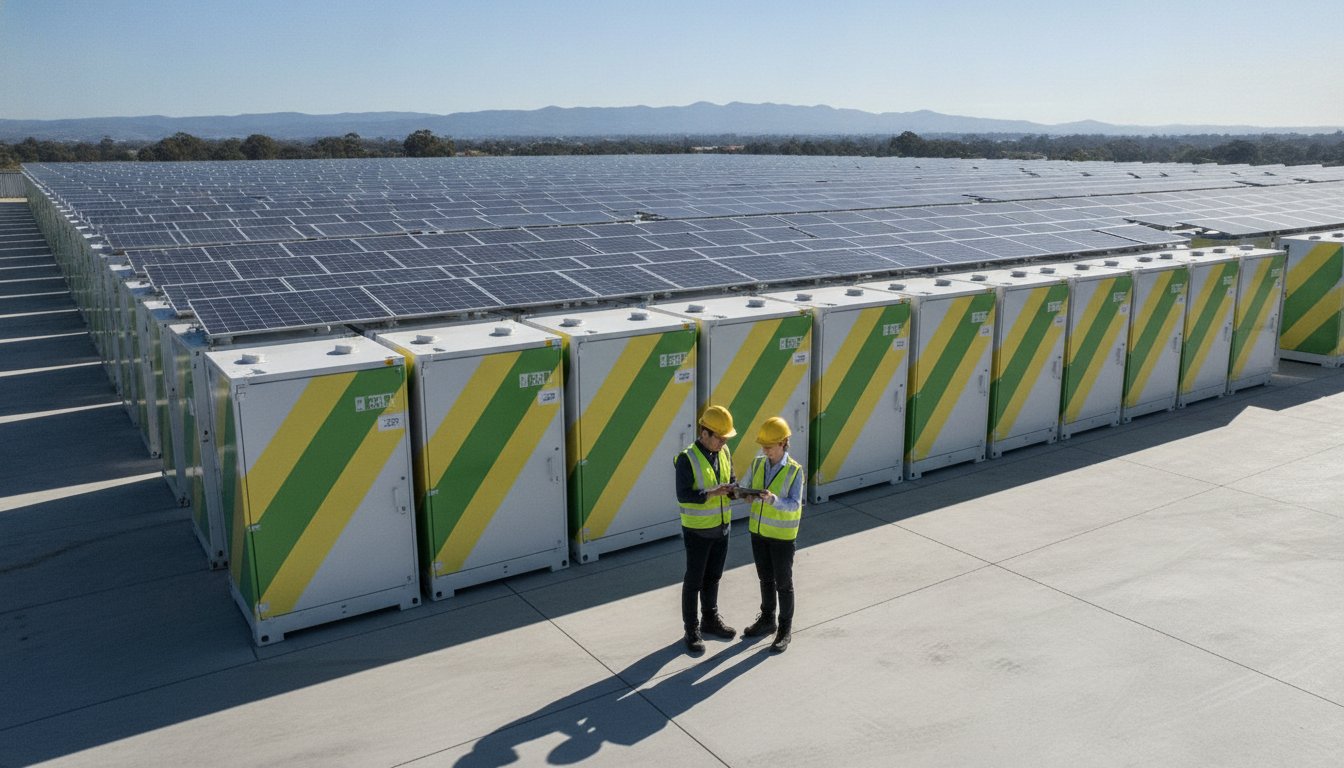
Your next power bill isn’t a fixed overhead; it’s a strategic liability you can no longer afford to ignore. For many Victorian manufacturers and heavy industrial sites, peak demand charges have become a relentless tax on growth. You’ve likely felt the sting of exorbitant retailer rates and the looming threat of grid instability during our harsh summer peaks. It’s a frustrating cycle of rising costs and diminishing control that makes long-term planning nearly impossible.
There’s a smarter way to operate. We’ll show you exactly how leading firms are deploying large scale battery storage solutions Victoria to reclaim their energy sovereignty and crush operational costs. By leveraging the latest federal incentives and high-capacity technology, these businesses are turning energy from a volatile expense into a predictable asset. This article provides a definitive look at a 2026 industrial case study. We’ll explore the real-world ROI, navigate the transition from state to federal support, and outline how you can secure your facility’s future against an unpredictable grid.
Key Takeaways
- Neutralise grid price volatility and eliminate peak demand penalties from Victorian distributors by shifting heavy loads to off-peak periods.
- Identify why LiFePO4 technology is the superior choice for industrial safety and thermal stability within the unique Victorian climate.
- See how a Melbourne manufacturer maximised a 500kW solar array to slash network charges and secure total operational independence.
- Leverage Victorian Energy Upgrades (VEU) and federal LGCs to accelerate the ROI of large scale battery storage solutions Victoria.
- Discover the benefits of an engineering-led approach to ensure your commercial solar and battery installation meets all local regulatory and network requirements.
The Rise of Industrial Energy Storage in Victoria
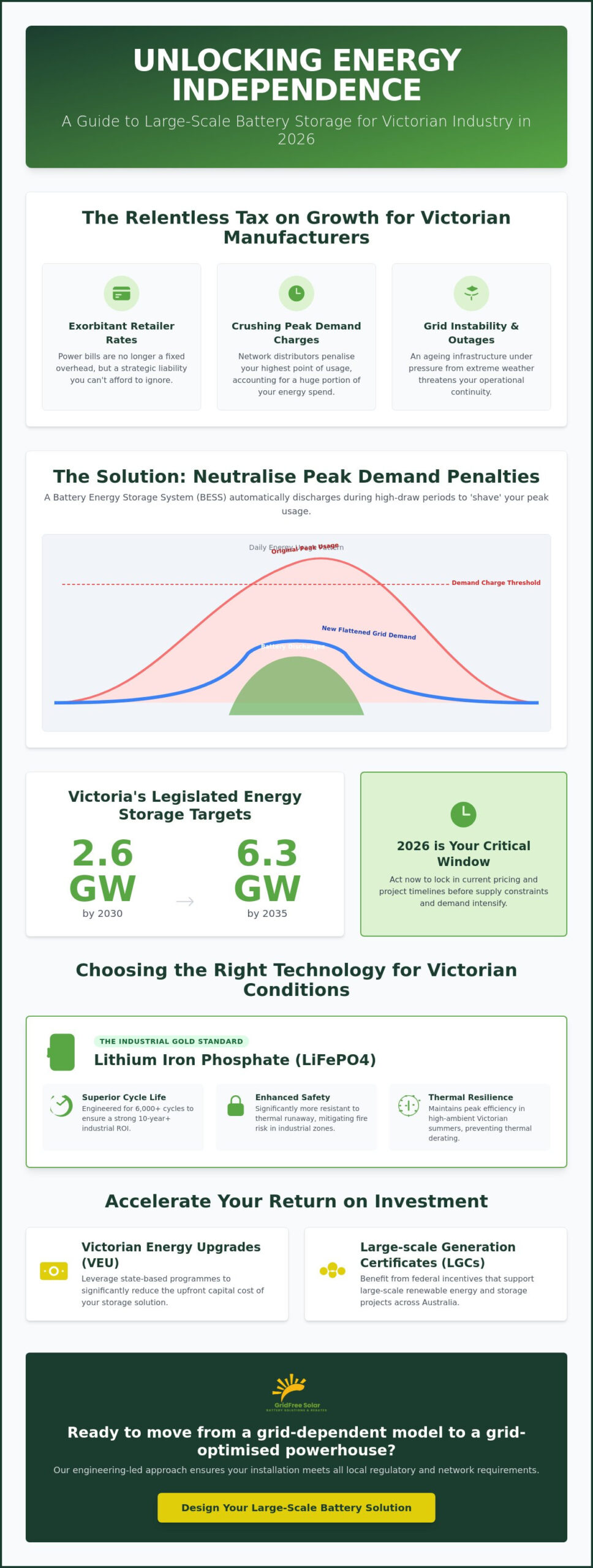
Victoria’s energy landscape is undergoing a radical shift. The state has legislated ambitious targets: 2.6 GW of energy storage capacity by 2030 and a massive 6.3 GW by 2035. While these figures might seem like utility-scale concerns, they signal a fundamental change in how your business interacts with the grid. As coal-fired power exits the market, Victorian industry faces unprecedented spot price volatility. Relying on the grid alone is no longer a viable financial strategy. It’s a gamble.
2026 represents a critical window for action. Businesses that secure large scale battery storage solutions Victoria now are positioning themselves ahead of the inevitable rush. As more industrial players move to decarbonise, the demand for high-capacity hardware and expert installation teams will only intensify. Waiting until 2027 or 2028 could mean facing longer lead times and higher procurement costs. Proactive investment is the only way to lock in current pricing and project timelines before supply constraints tighten.
Addressing the Peak Demand Problem
Industrial facilities across Melbourne and regional Victoria are often penalised for their intensity, not just their consumption. Network distributors like AusNet and United Energy apply heavy kVA demand charges based on your highest point of usage. This “peak” can account for a significant portion of your total energy spend. By implementing “peak shaving,” a battery system discharges during these high-draw periods to keep your grid demand low. It’s a precise, automated way to slash fixed costs. To see how this fits into a broader energy plan, explore our comprehensive guide on commercial solar battery storage.
Grid Reliability and Business Continuity
For a manufacturing plant or cold storage facility, a momentary outage isn’t just an inconvenience. It’s a catastrophic loss of revenue. Recent Victorian grid stress events have proven that the network is under pressure during extreme weather. Modern BESS (Battery Energy Storage Systems) act as the ultimate insurance policy. They provide seamless backup, ensuring critical processes remain online when the grid falters. Understanding the variety of Grid energy storage technologies available is the first step toward moving from a grid-dependent model to a grid-optimised powerhouse. Local storage is the only true protection against an ageing infrastructure. This isn’t just about saving money; it’s about securing your operational future.
Comparing Large-Scale Battery Technologies for Victorian Industry
Selecting the right hardware for your facility is a high-stakes decision. It isn’t just about total capacity; it’s about how that capacity performs under the specific thermal and regulatory conditions of the Victorian grid. Most generic advice focuses on massive utility-scale “Big Batteries” or small residential units. This leaves a significant gap for the industrial middle market, specifically systems ranging from 500kWh to 5MWh. Success in this sector requires a chemistry that balances safety with long-term financial performance.
Your choice of technology directly impacts your insurance premiums and site safety protocols. While traditional Lithium-ion (NMC) chemistry is common in lighter applications, the industrial sector has moved decisively toward Lithium Iron Phosphate. Implementing large scale battery storage solutions Victoria necessitates this shift to ensure your asset remains a benefit rather than a liability. These systems must also integrate seamlessly with a high-performance commercial solar installation Melbourne to maximise the value of every generated kilowatt.
Lithium Iron Phosphate (LiFePO4) Dominance
LiFePO4 has become the gold standard for Victorian industrial sites for one primary reason: safety. Unlike other chemistries, LiFePO4 is significantly more resistant to thermal runaway, making it the superior choice for fire mitigation in dense industrial zones. It also offers a superior cycle life. To achieve a 10-year industrial ROI, your system needs to handle 6,000+ cycles while maintaining high depth-of-discharge. LiFePO4 chemistry maintains peak operating efficiency even during high-ambient temperature Victorian summers, preventing the thermal derating common in lesser systems. This resilience ensures your storage asset performs when the grid is most stressed.
Inverter Technology and Grid Interaction
The “brain” of your storage system is the bi-directional inverter. In an industrial context, these units must offer sub-second response times. This “instant response” capability is vital for protecting sensitive machinery from voltage sags and grid transients. Modern systems are also designed for Virtual Power Plant (VPP) readiness. This allows you to trade energy back to the grid during peak pricing events, turning your battery into a revenue generator. The Australian Renewable Energy Agency has highlighted how these intelligent grid interactions are essential for a stabilised national network.
Scalability is the final piece of the puzzle. You can choose between modular BESS units that grow with your business or bespoke containerised solutions for immediate high-load requirements. Both options require precise engineering to manage Victoria’s unique network constraints. If you are ready to move beyond generic hardware and invest in a system tailored to your specific load profile, you should request a technical site assessment to determine the optimal configuration for your facility.
Industrial Case Study: Achieving Energy Autonomy in Victoria
Theory is valuable, but for a precision engineering firm in Melbourne’s south-east, the reality of rising energy costs required a concrete solution. This facility operated a high-output production line with heavy energy requirements spanning from early morning until late evening. Despite having a 500kW solar array, they remained at the mercy of the grid. Their solar production peaked at midday, yet their most energy-intensive processes continued well into the evening when solar output plummeted and retailer rates surged.
The challenge was clear. They needed to bridge the gap between generation and consumption while neutralising the aggressive kVA demand charges imposed by their network distributor. By implementing large scale battery storage solutions Victoria, this facility transformed its energy profile from a strategic liability into a competitive advantage. They deployed a 1MWh modular BESS (Battery Energy Storage System) equipped with an intelligent energy management system to orchestrate their power flow with surgical precision.
The Financial Breakdown
The results were immediate and measurable. Before the battery installation, the facility’s evening operations were powered entirely by expensive grid electricity, often during peak demand windows. Post-installation, the site achieved a 70% reduction in grid reliance. They used the stored solar energy to “shave” their peak demand, effectively lowering their fixed network charges for the entire billing period. This project also qualified for Large-scale Generation Certificates (LGCs), which provided an ongoing revenue stream that significantly offset the initial capital expenditure. While a solar-only system offers significant daytime savings, the addition of integrated storage dramatically accelerates the total project ROI by eliminating the most expensive evening peak charges that solar alone cannot reach. This strategic move resulted in a verified 4.5-year payback period.
Operational Impact
Beyond the balance sheet, the battery provided a level of operational security that the grid couldn’t guarantee. During a localised network outage in mid-2026, the BESS transitioned to backup mode instantly. Production didn’t stop. The facility’s sensitive CNC equipment, which requires stable voltage to prevent micro-stuttering and tool breakage, benefited from the battery’s superior voltage regulation. This “clean” power reduced equipment wear and tear and prevented the catastrophic costs of unplanned downtime. The project also resonated with the firm’s tier-one clients. Demonstrating a tangible commitment to energy autonomy and sustainability has become a prerequisite for securing high-value industrial contracts in the current market. This case study illustrates why large scale battery storage solutions Victoria are no longer optional for high-output manufacturing; they are the foundation of modern industrial resilience.
Navigating Victorian Rebates and Large-Scale Incentives
The financial landscape for industrial energy in Victoria has matured rapidly. While the Solar Victoria battery loan program closed in May 2025, the incentives for 2026 have shifted toward sophisticated market-based mechanisms and federal tax benefits. For businesses operating at scale, the focus isn’t on a simple upfront discount but on long-term certificate revenue and strategic tax optimisation. Securing large scale battery storage solutions Victoria requires a calculated approach to these incentives to ensure your project hits its ROI targets without delay.
If your operation sits on the smaller side of the industrial spectrum, you can still leverage a solar energy for small business Victoria application for targeted storage subsidies. However, once your system exceeds the 100kW threshold, the rules of the game change. You move from the world of small-scale certificates (STCs) into the more lucrative, though administratively complex, world of Large-scale Generation Certificates (LGCs) and the Victorian Energy Upgrades (VEU) program. For a broader strategic framework on how solar and storage work together to reduce business energy costs, our 2026 strategic guide provides the complete picture on tariffs, incentives, and ROI optimisation.
Victorian Energy Upgrades (VEU) for Storage
The VEU program remains a cornerstone for commercial energy efficiency across the state. It operates on a certificate model where Victorian Energy Efficiency Certificates (VEECs) are generated based on the carbon savings your storage system provides. For industrial sites in Melbourne and regional areas, this can significantly reduce the net capital cost of the project. Eligibility is strict. You must ensure your site meets the current energy profile requirements and, crucially, you must engage an Accredited Provider for the installation. If you bypass this step, you disqualify your business from claiming these valuable certificates.
Maximising LGC Revenue
Large-scale Generation Certificates are the primary financial driver for systems over 100kW. Unlike the one-off payment of smaller systems, LGCs provide ongoing revenue based on your system’s performance. Large-scale batteries allow you to “time-shift” your generation with surgical precision. You can store energy when LGC prices are low and report generation or discharge when the market value peaks. This adds a secondary layer of profit to your energy savings.
The administrative process of registering a large-scale system with the Clean Energy Regulator is precise and data-heavy. The typical administrative timeline for LGC registration in Victoria involves a rigorous four-to-six week process through the Clean Energy Regulator’s REC Registry once the system is commissioned. Beyond certificates, the 2026 instant asset write-off provisions for industrial energy equipment remain a powerful tool for immediate tax relief. To navigate these complexities and ensure you aren’t leaving money on the table, you should book an incentive eligibility audit with our commercial engineering team today.
Designing Your Large-Scale Battery Solution with GridFree Solar
Implementation is where strategy meets reality. Transitioning your facility to energy autonomy requires more than just procurement. It demands an engineering-led approach. We don’t just sell components; we design integrated power systems. Every industrial site has a unique load signature. Our job is to capture that data and translate it into a high-performance asset. Securing large scale battery storage solutions Victoria involves a rigorous technical journey from initial audit to final grid commissioning.
Our process is methodical and transparent. We begin with a deep-dive energy audit. We map your 24-hour load curve. We identify the specific peaks that trigger your highest demand charges. From there, we specify the storage capacity and discharge rates required to flatten those peaks. Once the design is finalised, our team manages the entire administrative and technical rollout. This includes local network approvals, safety certifications, and seamless integration with your existing infrastructure. We ensure your system is commissioned correctly the first time.
Why a Local Victorian Partner Matters
Proximity is a strategic advantage. Victorian network distributors like AusNet, Jemena, and CitiPower each have distinct technical standards and connection protocols. Navigating these requirements without local expertise leads to delays and cost overruns. We understand the Victorian regulatory landscape because we live in it. Our track record in industrial solar installation Victoria provides us with the field data needed to anticipate challenges before they arise. If a technical issue occurs, we offer rapid on-site support. You aren’t waiting for a technician from interstate. You’re supported by Melbourne-based specialists who prioritise your business continuity.
Next Steps for Your Facility
Your energy future starts with data. Before you commit to hardware, you need a comprehensive load profile analysis. This ensures your battery is sized for ROI, not just capacity. We customise every storage solution to match your specific operational requirements. Whether you are looking to arbitrage energy prices or secure a reliable backup for critical machinery, the configuration must be precise. Long-term performance is guaranteed through our proactive O&M (Operations and Maintenance) programs, which include real-time monitoring and regular health checks.
The window for securing 2026 incentives and equipment is closing. Don’t leave your facility’s energy security to chance. Ready to secure your energy future? Contact our industrial solar experts today to book your technical site assessment and take the first step toward total energy independence.
Secure Your Energy Independence Today
The transition toward industrial energy autonomy isn’t a future prospect. It’s a current necessity for Victorian manufacturers. By integrating large scale battery storage solutions Victoria, your facility can effectively neutralise the rising cost of peak demand while securing a stabilised power supply. You now understand how smart engineering and high-capacity LiFePO4 technology deliver a verified ROI, often achieving a payback period of under five years. Energy is no longer just a volatile overhead. It’s a predictable asset.
Our local Melbourne-based engineering team is ready to help you navigate the technicalities of VEU and LGC rebate maximisation. We specialise in high-capacity LiFePO4 industrial enclosures designed specifically for the Victorian climate. Don’t let grid volatility dictate your operational margins. Take control of your facility’s future and lead the way in Victoria’s industrial energy transition.
Enquire about a custom Industrial Energy Audit for your Victorian facility
Frequently Asked Questions
What is the typical lifespan of a large-scale industrial battery in Victoria?
A high-quality industrial battery system typically lasts between 10 and 15 years. This lifespan is largely dictated by the cycle life of the cells; premium Lithium Iron Phosphate (LiFePO4) units are designed to handle 6,000 or more full charge-discharge cycles. Maintaining optimal thermal conditions through active cooling ensures the system reaches its maximum operational life without significant degradation. Regular software updates and cell balancing are also essential to preserve capacity over the decade.
How much space is required for a 1MWh battery storage system?
A 1MWh system generally fits within a standard 20-foot shipping container footprint, which is approximately 15 square metres. You must also account for mandatory clearance zones for ventilation, maintenance access, and fire safety protocols. Total site allocation often reaches 30 to 40 square metres once these safety buffers and inverter housing are included in the final layout. Precise site planning is required to ensure compliance with Victorian industrial zoning laws.
Can I add a large-scale battery to my existing commercial solar array?
You can absolutely integrate a battery with your existing commercial solar array. Most industrial retrofits use an AC-coupled configuration. This allows the battery to work alongside your current inverters without requiring a full system overhaul. It is the most efficient way to deploy large scale battery storage solutions Victoria for facilities that have already invested in significant solar capacity but need to manage expensive evening peaks. Your existing solar production data will help determine the optimal battery size.
What are the fire safety requirements for industrial battery installations in Melbourne?
Industrial installations must comply with AS/NZS 5139 standards and local CFA requirements. This includes using fire-rated enclosures, maintaining specific separation distances from buildings, and installing automated fire suppression systems. Choosing LiFePO4 chemistry is a proactive safety move. It offers much higher thermal stability compared to traditional lithium-ion alternatives. This significantly reduces the risk of thermal runaway in dense industrial zones where safety is a non-negotiable priority.
Do I need council approval for a containerised battery storage solution?
Most containerised solutions in Melbourne and regional Victoria require a planning permit from your local council. This process ensures the installation meets zoning laws, safety standards, and aesthetic requirements for your specific industrial precinct. It is vital to engage with a specialist who understands the Victorian planning landscape. This streamlines the approvals process and avoids costly delays during the site preparation phase. Some smaller systems may fall under different categories, so a professional assessment is mandatory.
How does a Virtual Power Plant (VPP) benefit Victorian industrial energy users?
A Virtual Power Plant (VPP) allows you to trade your stored energy back to the grid during periods of high demand and price spikes. For industrial users, this transforms a passive storage asset into an active revenue stream. By participating in a VPP, you can access Frequency Control Ancillary Services (FCAS) markets. You help stabilise the Victorian grid while earning significant credits. These credits further accelerate your system’s ROI and provide a hedge against volatile energy markets.
What is the difference between “Behind-the-Meter” and “Front-of-the-Meter” storage?
“Behind-the-Meter” storage is installed on your side of the utility meter. It is primarily used to reduce your facility’s demand and consumption costs. “Front-of-the-Meter” systems are utility-scale assets connected directly to the distribution network to support the grid at large. For most Victorian businesses, a behind-the-meter solution is the most effective way to directly slash electricity bills. It gives you total control over how and when you use your stored energy.
How long is the typical payback period for industrial storage in 2026?
The typical payback period for industrial storage in 2026 ranges from 4 to 6 years. This timeline depends on your specific load profile and the successful capture of VEU and LGC incentives. As shown in our recent case study, a Melbourne-based manufacturer achieved a verified 4.5-year payback. They strategically used large scale battery storage solutions Victoria to bridge the gap between solar generation and evening production. Aggressive reduction of kVA demand charges is the primary driver of these rapid returns.