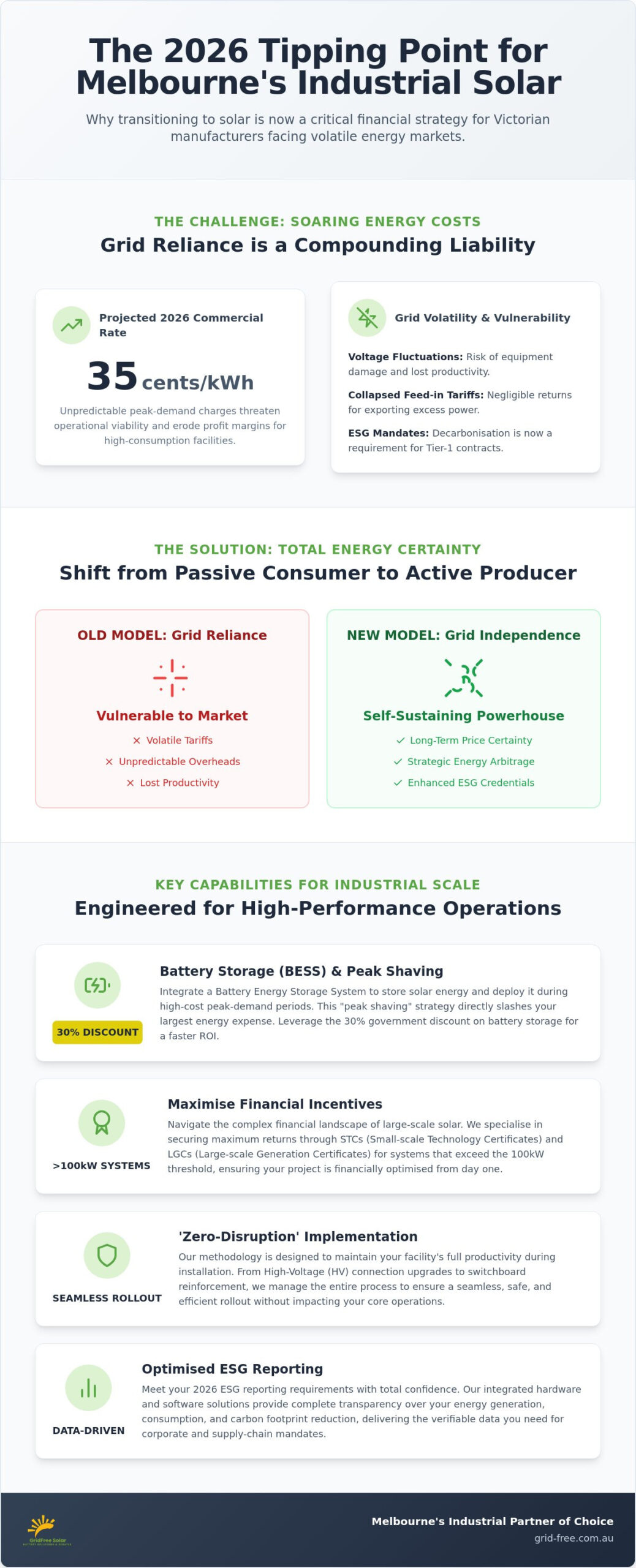
With Victorian commercial electricity rates averaging up to 35 cents per kWh in 2026, your facility’s bottom line is likely suffering from unpredictable peak-demand charges. Transitioning to a high-capacity industrial solar installation Melbourne wide is no longer a choice for the distant future; it is a critical financial defensive strategy for right now. You realise that relying on the grid leaves your operations vulnerable to volatile retailers and rising overheads that eat into your margins.
We understand the pressure to modernise without disrupting production or blowing your CAPEX budget. This article shows you how to slash those energy costs and achieve genuine grid independence with Melbourne’s leading large-scale solar and battery specialists. You will discover how to leverage the 30% discount on battery storage, integrate high-voltage infrastructure seamlessly, and secure the data needed for your 2026 ESG reporting. It is time to turn your roof into a high-performance asset that delivers total energy certainty.
Key Takeaways
- Identify why 2026 marks the critical tipping point for Victorian manufacturers to hedge against volatile peak-demand tariffs.
- Learn how high-capacity Battery Energy Storage Systems (BESS) enable strategic energy arbitrage for high-voltage industrial facilities.
- Navigate the complexities of STCs and LGCs to secure maximum financial incentives for systems exceeding the 100kW threshold.
- Discover the “Zero-Disruption” methodology for industrial solar installation Melbourne, allowing your facility to maintain full productivity during the rollout.
- Optimise your ESG reporting with integrated hardware and software solutions that provide total transparency over your carbon footprint reduction.
The Shifting Landscape of Industrial Solar Installation in Melbourne
2026 marks the year the financial scales finally tipped for Victorian manufacturers. For over a decade, Melbourne’s industrial sector viewed renewable energy as a secondary sustainability goal. That era of complacency is over. With average commercial electricity rates now climbing as high as 35 cents per kWh, energy costs have transitioned from a manageable overhead into a primary threat to operational viability. Facilities in heavy-duty hubs like Dandenong and Laverton are no longer just looking at panels; they are investing in high-performance industrial solar installation Melbourne systems to protect their margins.
The broader context of Solar power in Australia reveals a record-breaking acceleration in capacity, yet the Victorian grid remains notoriously volatile. For a high-output factory floor, even a minor voltage fluctuation or a peak-demand surge can result in thousands of dollars in lost productivity and potential equipment damage. Relying on a passive energy model is a gamble you can no longer afford to take. Modern industrial energy management requires a shift from simply “buying better” to “generating smarter.”
Rising Tariffs and the 2026 Energy Outlook
Victorian retailers have effectively dismantled the safety net for large-scale consumers. Since the mandate for minimum feed-in tariffs was removed, the financial logic of selling excess power back to the grid has collapsed. Business as usual now means absorbing relentless price hikes while receiving negligible returns for your exported energy. Simultaneously, corporate ESG mandates have become a non-negotiable requirement for securing Tier-1 contracts. Decarbonising your supply chain through a robust solar strategy is now a prerequisite for commercial growth in the Victorian landscape.
Grid Independence: Beyond the Buzzword
True energy autonomy for a 24/7 facility means more than just having panels on the roof. It requires a total decoupling from the volatile wholesale market. The cost of doing nothing is a compounding liability that grows with every billing cycle. Melbourne businesses are now utilising integrated solar and battery storage to bypass peak-demand charges entirely. This isn’t a speculative future; it’s a strategic energy arbitrage play. By generating, storing, and deploying your own power, you eliminate the uncertainty of the Victorian grid and lock in long-term price certainty. Immediate action is the only way to transform your facility from a victim of the market into a self-sustaining powerhouse.
Engineering for Scale: High-Voltage Systems and Industrial Storage
Deploying a large-scale industrial solar installation Melbourne wide requires more than just mounting panels. It is a complex infrastructure project. Industrial machinery creates unique electrical loads that residential-grade systems simply cannot handle. For a facility operating heavy-duty plant equipment, your solar array must be engineered to withstand massive inrush currents and voltage fluctuations. In 2026, the integration of Battery Energy Storage Systems (BESS) has become the non-negotiable standard for maintaining site stability and ensuring your production line never falters.
Technical precision extends to your roof’s structural integrity and digital ecosystem. Melbourne’s industrial zones feature a mix of legacy warehouses and modern logistics hubs. We optimise these spaces by selecting between lightweight flexible arrays for older structures and high-efficiency bifacial panels for newer builds. To achieve true intelligence, these systems must speak to your existing SCADA or building management systems. This connectivity allows for real-time adjustments, ensuring every kilowatt generated is used where it delivers the most value. Many businesses are now utilising the Victorian Energy Upgrades program to offset the initial engineering costs of these sophisticated integrations.
High-Voltage (HV) Requirements and Transformer Upgrades
Scaling beyond 200kW often triggers a need for High-Voltage connection upgrades. Navigating the protocols of Victorian distributors like AusNet or United Energy is a specialized task. If your current transformer or switchboard is at capacity, a multi-hundred kW solar system will require a staged hardware overhaul. We manage the entire grid connection process, ensuring your switchboard is reinforced to handle the increased bidirectional flow of power without risking a site-wide blackout.
Peak Shaving: The Secret to Slashing Industrial Bills
Peak shaving is the strategic discharge of stored battery energy to reduce power consumption from the grid during intervals of high demand, thereby lowering peak-demand charges. For Melbourne manufacturers, these demand charges can account for up to 50% of a monthly bill. By discharging your BESS during these expensive windows, you effectively “shave” the top off your consumption profile. One Melbourne-based plastic extrusion factory recently utilised this strategy to reduce their demand charges by 40%. This immediate impact on cash flow is why smart operators are prioritising integrated solar and battery solutions as their primary financial hedge. Don’t let your retailer dictate your operational costs; take control of your load profile today.
Navigating the Financials: STCs, LGCs, and Victorian Incentives
The financial architecture of a large-scale industrial solar installation Melbourne system is defined by a single number: 100kW. This capacity threshold determines whether your facility qualifies for upfront certificates or ongoing revenue streams. For systems under 100kW, Small-scale Technology Certificates (STCs) provide an immediate reduction in capital expenditure. As of July 2026, the STC market remains stable at approximately $39.90 per certificate. This can translate to an upfront rebate of up to $30,000 for a 100kW system, effectively acting as a direct discount on your hardware and labour costs.
Beyond the upfront savings, the 2026 tax landscape offers aggressive incentives for manufacturers. Instant asset write-offs and accelerated depreciation schedules allow you to move the cost of your solar infrastructure from a long-term liability to an immediate tax benefit. While some businesses prefer a direct capital outlay to maximise long-term ROI, others are opting for Power Purchase Agreements (PPAs). These agreements allow you to secure a lower energy rate with zero upfront cost, transferring the operational risk to the provider while you reap the benefits of immediate overhead reduction.
LGCs Explained: Ongoing Revenue for Large Systems
Once your array exceeds 100kW, you transition into the Large-scale Generation Certificate (LGC) market. Unlike STCs, LGCs are created annually based on the actual clean energy your facility generates. While the spot price for LGCs in July 2026 has been trading below $5.00, they remain a vital component of a long-term energy strategy. We automate the entire certificate creation and sale process for our industrial clients. This ensures your facility receives a consistent secondary income stream for every megawatt-hour of renewable energy produced, further shortening your payback period.
Victorian Government Incentives for 2026
Victoria remains the most aggressive state for renewable support. The Solar Victoria incentives currently offer significant discounts for systems between 30kW and 200kW through the Victorian Energy Upgrades (VEU) program. This can provide an upfront discount of up to $34,300 for eligible installations. To achieve the best possible financial outcome, you should look at stacking these benefits with the Victorian Battery Rebate. This program provides a discount of approximately 30% on the upfront cost of battery storage up to 100kWh. By combining VEU discounts, STCs, and battery rebates, Melbourne industries are currently seeing the lowest net entry costs in the history of the Victorian market.
Seamless Implementation: Minimising Operational Downtime
Operational downtime is the enemy of industrial efficiency. For a Melbourne manufacturing facility, every hour the production line remains idle represents a direct hit to the bottom line. We recognise that the primary barrier to adopting a large-scale industrial solar installation Melbourne system is often the fear of disruption. The GridFree Solar “Zero-Disruption” methodology is engineered specifically to eliminate this risk. By utilising staged rollouts and off-site pre-assembly, we ensure your facility remains fully operational while we transform your energy profile.
Integration with existing high-voltage infrastructure requires surgical precision. We coordinate closely with your facility managers to schedule work around your most critical production cycles. This proactive approach allows us to manage the complex logistics of crane access and equipment delivery without clogging your site’s loading bays or thoroughfares. Our local Melbourne-based team provides rapid response times, ensuring that every milestone is met with minimal on-site presence and maximum technical accuracy.
The 5-Step Industrial Installation Roadmap
We follow a methodical progression to move your site from assessment to autonomy without missing a beat:
- Phase 1: Feasibility and Structural Assessment. We verify your roof’s load-bearing capacity and electrical compatibility before a single panel is ordered.
- Phase 2: Network Distributor (DNSP) Approval. Our experts manage the entire application process with AusNet or United Energy to secure your grid connection.
- Phase 3: Off-Site Pre-Assembly. We assemble key components in our controlled facility to slash the time spent on your roof by up to 40%.
- Phase 4: Commissioning and G99 Testing. Rigorous testing protocols ensure your system integrates perfectly with the Victorian grid.
- Phase 5: Training and Monitoring. We provide your team with a custom dashboard to track real-time performance and savings.
Safety and Compliance in the Industrial Sector
Industrial environments demand the highest safety standards. We strictly adhere to AS/NZS 5033 and CEC industrial regulations to ensure every component of your array is fire-safe and compliant. Managing crane logistics in busy industrial parks requires expert coordination. We handle the permits and site access protocols, ensuring that safety exclusion zones are maintained without impeding your logistics flow. This commitment to safety extends to post-installation, where our comprehensive performance monitoring identifies potential maintenance needs before they become operational issues. Secure your facility’s future with a high-performance industrial solar and battery solution today.
Why GridFree Solar is Melbourne’s Industrial Partner of Choice
GridFree Solar stands as a definitive leader in the Victorian energy sector. We don’t just install panels; we engineer financial security. Our 2026 commitment to Victorian manufacturing is built on a foundation of technical superiority and localised reliability. While others offer generic solutions, we provide a sophisticated industrial solar installation Melbourne service tailored to the specific administrative and electrical landscape of our region. We understand the nuances of the local grid better than anyone. From AusNet to United Energy, we navigate the red tape so you don’t have to.
The GridFree Advantage lies in our integrated hardware and software ecosystem. This isn’t a “set and forget” system. It’s an intelligent, active asset that continuously optimises your energy consumption. You join an elite group of Melbourne businesses that have successfully decoupled from the volatile wholesale market. Total grid independence is the only logical conclusion for a forward-thinking facility. We act as your trusted advisor, taking the complexity out of high-voltage transitions and delivering a seamless path to energy autonomy.
Expertise in Complex Battery Upgrades
Maintaining a competitive edge requires modern storage solutions. We are the primary choice for solar battery replacement in Melbourne. Many legacy systems installed in the early 2020s are now underperforming or reaching their end-of-life. We specialise in upgrading these aging assets to 2026 LiFePO4 standards. These modern lithium iron phosphate batteries offer superior safety profiles and deeper discharge cycles. By replacing outdated storage, you maximise the ROI of your existing industrial solar installation Melbourne while ensuring your facility remains a high-performance asset for the next decade.
The Path Forward: Request Your Feasibility Study
Precision is paramount in industrial energy transitions. We don’t guess; we calculate. Our comprehensive feasibility studies provide a granular breakdown of your projected ROI and exact payback period. We conduct no-obligation site audits for Melbourne industrial facilities to identify the most efficient integration points with your existing infrastructure. This data-backed approach removes the complexity from the decision-making process. It’s time to stop reacting to energy price hikes and start dictating your own overheads. Future-proof your business with a Commercial Solar Installation and secure your facility’s operational certainty today.
Secure Your Energy Autonomy Today
The window for securing peak financial incentives while insulating your facility from the volatile energy market is narrowing. You’ve seen how integrating high-capacity storage allows for strategic energy arbitrage, effectively neutralising the threat of peak-demand charges. By navigating the current landscape of STCs, LGCs, and Victorian rebates now, you transform your roof into a high-yield financial asset. Waiting for further price hikes from retailers is a liability your margins simply can’t afford to carry.
Implementing a large-scale industrial solar installation Melbourne wide doesn’t have to compromise your production schedule. As CEC Accredited Designers and Installers with a proven track record in complex high-voltage environments, we specialise in seamless, zero-disruption transitions. We are the specialists in Melbourne industrial energy arbitrage, ensuring every megawatt generated serves your bottom line rather than the grid. It’s time to move beyond passive consumption and adopt a proactive energy strategy that delivers long-term certainty.
Secure your 2026 industrial solar feasibility study with GridFree Solar. Take the first step toward total grid independence and lead your industry into a cleaner, more profitable future.
Frequently Asked Questions
How much roof space is required for a 100kW industrial solar installation?
A 100kW industrial solar installation Melbourne wide typically requires between 500 and 700 square metres of clear, unshaded roof space. This footprint depends on the specific wattage of the high-efficiency panels selected and the presence of roof obstructions like HVAC units or skylights. We conduct a structural assessment to ensure your facility can support the array while maximising every available square metre for generation.
Can our industrial facility stay operational during the solar installation?
Your facility remains fully operational throughout the entire process. We utilise a staged rollout strategy and off-site pre-assembly to minimise our on-site footprint and reduce installation time. Critical electrical changeovers are scheduled during your existing maintenance windows or low-production periods to ensure zero disruption to your manufacturing line or logistics flow.
What is the typical payback period for industrial solar in Melbourne in 2026?
Most Melbourne industrial sites see a full return on investment within 3 to 5 years as of 2026. This rapid payback is driven by volatile commercial electricity rates and the strategic use of Victorian Energy Upgrades (VEU) discounts. Once the system has paid for itself, your facility benefits from decades of near-zero energy costs and total price certainty.
Are there specific Victorian rebates for industrial-scale battery storage?
Victorian businesses can access a discount of approximately 30% on the upfront cost of solar battery storage with a capacity up to 100kWh. This incentive is part of the state’s push for grid stability and works alongside the VEU programme. Stacking these rebates with federal certificates significantly reduces the initial capital outlay for high-capacity industrial storage solutions.
How do LGCs differ from STCs for large-scale solar systems?
STCs provide an immediate upfront discount for systems under 100kW, whereas LGCs offer an ongoing revenue stream for larger arrays. LGCs are created annually based on the actual megawatt-hours your system generates. We automate the certificate creation and sale process to ensure your industrial solar installation Melbourne delivers consistent financial returns throughout its operational life.
What maintenance is required for a large-scale industrial solar array?
Large-scale arrays require annual electrical health checks and performance data analysis to ensure peak efficiency. While the panels have no moving parts, your inverters and high-voltage switchgear need regular inspections to comply with Australian safety standards. Our intelligent monitoring dashboards allow us to identify and rectify minor voltage issues remotely before they impact your production output.
Does solar work during a Melbourne winter for high-demand facilities?
Solar remains highly effective during a Melbourne winter because panels operate more efficiently in cooler temperatures. High-efficiency bifacial panels capture diffused light even on overcast days common to Victoria. When paired with a battery, your facility can store energy during clear intervals to bridge the gap during high-demand winter peaks and maintain grid independence.
How do we integrate solar with our existing industrial backup generators?
We integrate solar and battery systems with your existing backup generators using intelligent microgrid controllers. These controllers manage the load transition seamlessly, ensuring your solar array continues to support the site during a grid outage. This hybrid approach provides a dual layer of energy security for facilities with critical 24/7 power requirements and sensitive machinery.