
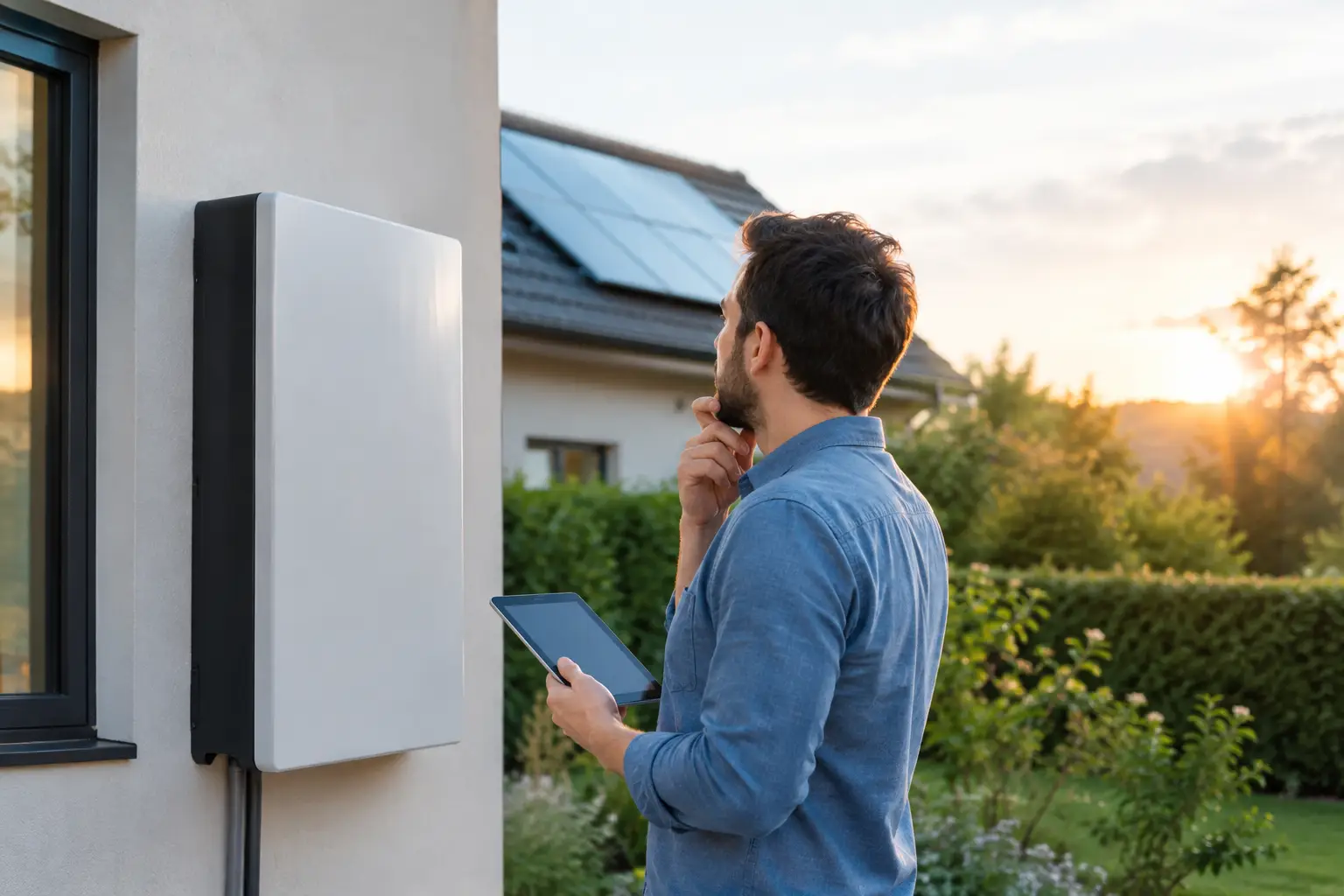
A battery that is too small can be empty before the evening peak ends. A battery that is too large can tie up money in capacity your household rarely uses. When people ask how to size home battery storage, the right answer is not a single number. It comes from your energy habits, solar production, electricity tariff and the level of backup you expect when the grid goes down.
For most Australian households, the goal is straightforward: keep more of your own solar power, buy less expensive electricity after sunset and protect the appliances that matter most. Getting the size right turns that goal into measurable savings rather than an expensive guess.
Start with the outcome you want
Before looking at battery models, decide what the system must achieve. Some households mainly want to shift surplus daytime solar into the evening. Others want backup during outages, while some want both, plus the option to join a virtual power plant.
A solar self-consumption battery can be sized around your typical afternoon-to-morning energy gap. A backup-focused battery needs a closer look at essential appliances and how long you want them to run. These are related goals, but they do not always produce the same battery recommendation.
For example, a household that is usually empty during the day may export a large amount of solar, then use substantial power between 5 pm and 10 pm. Storage can reduce that evening grid import effectively. A family working from home may use more solar as it is generated, so battery capacity may be less valuable than additional panel capacity, load shifting or smarter energy controls.
How to size home battery capacity
Battery capacity is measured in kilowatt-hours, or kWh. Think of it as the size of the energy tank. The starting point is the amount of electricity your property uses after solar production falls away.
Check your electricity bill, retailer app or solar monitoring portal for at least a few months of interval data if it is available. Look beyond average daily consumption. A household using 20 kWh per day does not automatically need a 20 kWh battery, because some of that power is used directly from solar during daylight hours and some may be inexpensive to buy from the grid overnight.
A useful first calculation is:
Night-time and early-morning usage – the solar energy you can realistically store = target usable battery capacity.
If your home uses around 10 kWh from late afternoon until the next morning, a battery with about 10 kWh of usable capacity may be a sensible starting point. If your evening use is closer to 18 kWh, a larger system or a modular battery that can be expanded later could be better value.
Usable capacity matters more than the number printed on the battery. Batteries reserve a small portion of their total capacity to protect their cells and extend service life. A quoted 13.5 kWh battery, for instance, may not deliver every last kilowatt-hour to the home. Compare the warranted usable capacity, not just the headline figure.
Capacity and power are different
A battery also has a power rating, measured in kilowatts, or kW. This tells you how much electricity it can supply at one time. Capacity determines how long the battery can run. Power determines whether it can handle several appliances running together.
A 10 kWh battery with a 5 kW output can theoretically supply 5 kW for about two hours, subject to operating conditions and reserve settings. It could also supply 1 kW for much longer. If your household turns on an induction cooktop, kettle, air conditioner and pool pump at once, a low power rating can still leave you drawing electricity from the grid even when the battery has stored energy available.
For many homes, a continuous output of around 5 kW suits normal evening demand. Larger households, all-electric homes and small businesses may need more. High-starting-load equipment such as pumps and some air conditioners needs particular attention, especially where backup operation is required.
Use your consumption pattern, not a sales brochure
Your usage pattern is the most valuable sizing tool. Start by identifying three things: your total daily electricity use, the amount of solar you export on a typical day and your consumption after sunset.
Solar exports show the potential energy available to charge a battery. But do not assume every exported kWh can be stored. Solar production changes with weather, seasons, panel orientation and shading. In winter, a battery may not fully charge every day. In summer, it may fill early and leave additional solar exports unused. The best design balances these seasonal realities rather than being based on one perfect sunny day.
Also consider planned changes to the property. An electric vehicle, pool, electric hot water system, reverse-cycle air conditioning or induction cooking can significantly alter demand. If an EV will usually charge overnight, a battery may not be the cheapest way to cover all of that load. A controlled charging schedule or an electricity plan with low off-peak rates can make more financial sense.
On the other hand, switching from gas to electric appliances may increase evening use and strengthen the case for more storage. A good system design considers where your energy use is heading over the next five to 10 years, not only where it has been.
Match the battery to your tariff and solar system
Battery value depends on the difference between what you receive for exported solar and what you pay to import electricity later. When feed-in tariffs are low and evening electricity rates are high, storing solar can be more valuable than exporting it.
Time-of-use tariffs add another layer. A battery can be programmed to avoid buying power during peak periods, charge from surplus solar and, where appropriate, charge from the grid at lower off-peak rates. Whether grid charging is worthwhile depends on your tariff, battery warranty conditions and the way your system is configured.
Your existing solar system matters too. A battery cannot store solar you do not have. If your panels are older, undersized or heavily shaded, adding solar capacity may deliver better results than installing an oversized battery. Conversely, a home with a large solar array and high exports may have a strong case for storage.
The inverter arrangement is equally important. Some batteries work with a hybrid inverter as part of a new solar installation, while others can be AC-coupled to many existing systems. Both approaches can work well. The right choice depends on your current equipment, switchboard capacity, backup requirements and future expansion plans.
Size backup around essential loads
Backup power is not automatically whole-home power. During an outage, many battery systems supply selected circuits such as lights, the fridge, internet, power points and a small air conditioner. This approach keeps the battery working longer and can reduce the cost of the backup setup.
Whole-home backup can be worthwhile, but it needs careful load management. Electric ovens, ducted air conditioning, hot water systems, pool pumps and EV chargers can drain a battery quickly or exceed its output rating. Some systems can manage these loads intelligently, while others require specific circuits to be excluded from backup.
Think in terms of priorities. If keeping the fridge cold, phones charged, the internet connected and a few lights on for an evening is the goal, a modest battery and essential-load backup board may be enough. If your property needs to operate through a full day or longer outage, you may need more battery capacity, more solar generation and a disciplined approach to heavy appliances.
Remember that backup duration is weather dependent. A battery may carry essential loads overnight, but extended cloudy conditions limit solar recharge. A professional assessment should account for this rather than promising unlimited off-grid operation from a standard grid-connected system.
Avoid the two common sizing mistakes
The first mistake is buying the biggest battery available because more capacity sounds safer. Extra storage only earns its keep when it cycles regularly or provides backup value you genuinely need. If it sits partly full for long periods, the return on investment may be weaker.
The second is choosing the smallest battery to reduce the upfront price without considering evening demand and power output. A battery that reaches empty during peak pricing, or cannot support the loads you want, can leave savings and comfort on the table.
Virtual power plant participation also deserves a clear conversation. It can create additional value in some circumstances, but the program may draw on stored energy at certain times. Check how it affects your reserve level, exit terms and access to backup power during an outage.
Get a design based on your property
The most reliable way to size a battery is to combine interval consumption data, solar production figures, tariff details and a site assessment. This reveals the difference between a battery that looks good on paper and one that suits your roof, switchboard, appliances and daily routine.
GridFree Solar can assess these details, explain your battery and backup options in plain language, and help manage applicable rebate and compliance requirements. The result should be a system with clear expected savings, appropriate warranty coverage and room to grow where it makes financial sense.
The best home battery is not the largest one. It is the one that reliably covers the energy you value most, works with the way you live and gives you greater control every time electricity prices rise.