
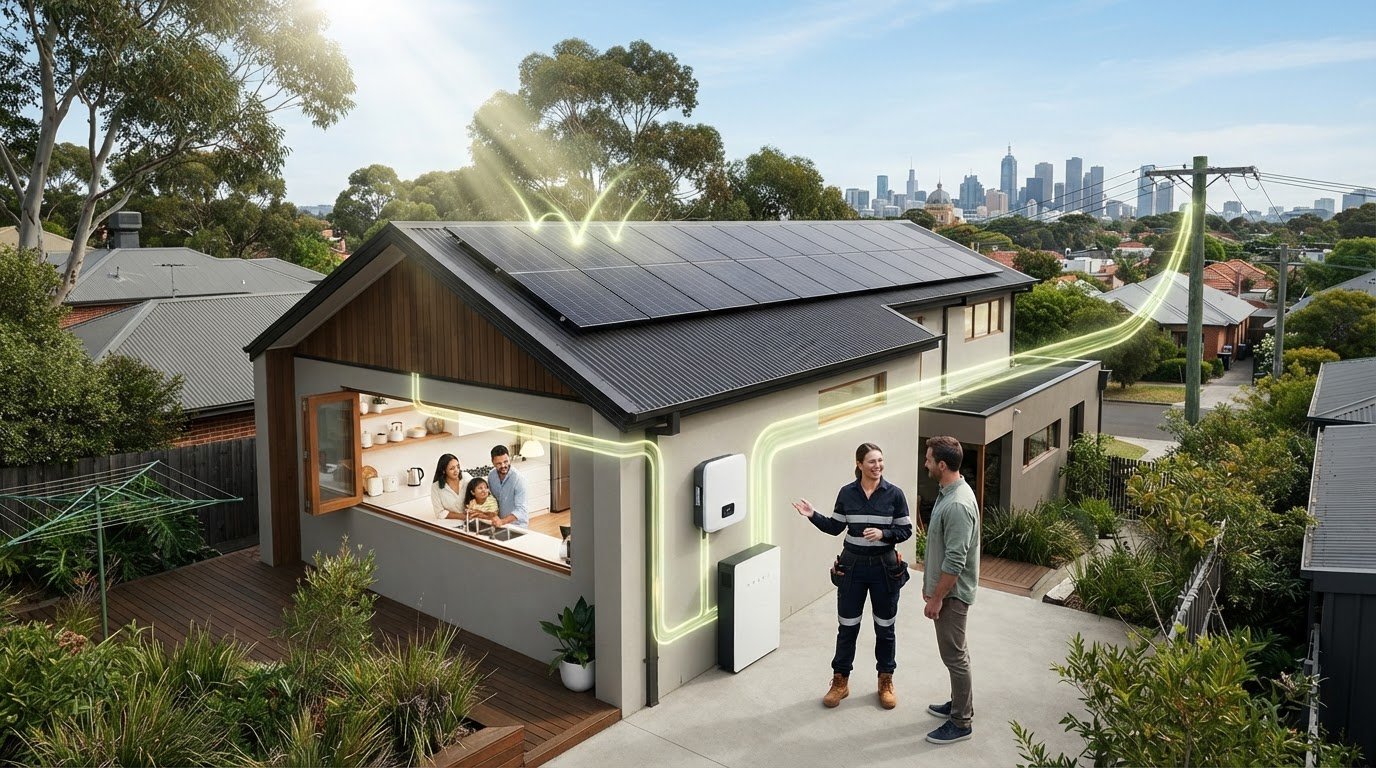
Your solar panels can be producing electricity on a sunny day while your home still draws power from the grid. That doesn’t necessarily mean there’s a fault: solar generation and household demand change from moment to moment.
You might wonder which source is powering your appliances, where surplus solar goes, or whether your system will keep running during a blackout. This guide explains how solar panels work with the grid in Victoria, following electricity from your panels through the inverter to your home, then to the grid when you generate more than you use, or from the grid when demand is higher.
You’ll also learn what to check on your retailer bill, smart meter and system monitoring app, including how exported electricity and feed-in tariffs are recorded. We’ll cover why a standard grid-connected system may shut down during an outage, when a battery could be relevant, and why export limits depend on your local network distributor. By the end, you’ll have a clearer picture of how your system operates and what to check if the numbers don’t add up.
Key Takeaways
- Understand how solar panels work with the grid in Victoria, and when your home uses solar generation, exports surplus or imports electricity.
- Learn how electricity flows from panels through the inverter to household appliances, and why surplus power may be sent to the grid.
- See how retailer plans affect feed-in credits and import charges, and why a standard grid-connected system may not operate during a power outage.
- Use your bill, smart meter data and inverter monitoring to check energy flows. Direct plan questions to your retailer and connection queries to your distributor.
- Compare solar without storage and solar with a battery, then consider whether your property, usage patterns and connection requirements call for an installer assessment.
How solar panels work with the grid in Victoria: the simple explanation
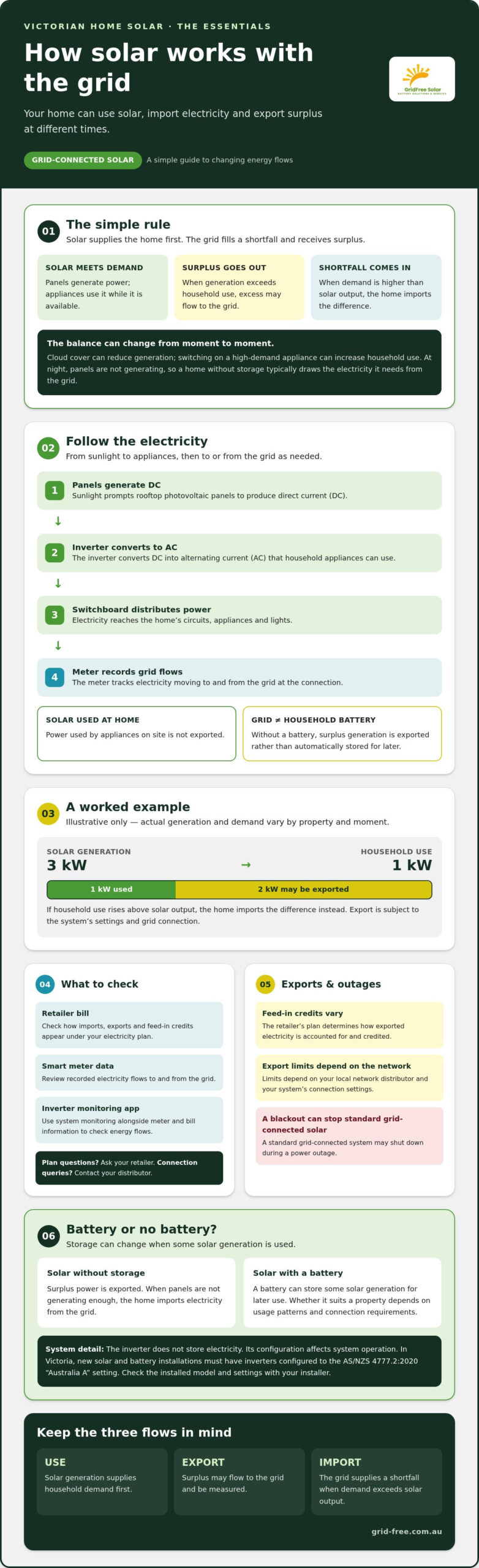
Grid-connected solar generates electricity for your home, with the local electricity grid supplying any shortfall and receiving surplus power when generation exceeds household demand.
That’s the basic process behind how solar panels work with the grid in Victoria: your home can use solar, import electricity and export excess energy at different times. The grid isn’t a household battery. Exported electricity is measured and accounted for under your electricity retailer’s plan, with the terms and credits depending on that arrangement.
What does grid-connected solar mean for a Victorian home?
The electricity grid carries power between generators and connected properties. At home, rooftop panels generate direct current (DC) electricity. An inverter converts it into alternating current (AC), which household appliances can use. The switchboard distributes electricity around the home, while the meter records electricity flows to and from the grid.
Together, these components form a photovoltaic system. The panels, inverter, switchboard and meter work as part of a home that remains connected to its local electricity network while the system is operating. Being connected to the grid doesn’t mean all solar generation is exported. When solar power is available, household demand is supplied first.
Does the home use solar power before grid electricity?
In everyday terms, yes. Solar generation supplies appliances running in the home, such as a fridge, lights or washing machine, as long as the system is producing enough power. If solar output exceeds demand, the surplus can flow through the meter to the grid.
If the home needs more electricity than the panels are producing, the shortfall is imported from the grid. Without a battery, surplus generation isn’t automatically stored for later use. It is exported instead, and the meter records the flow.
The balance can shift from moment to moment. A cloud passing over the panels may reduce generation, while switching on a high-demand appliance may increase household use. At night, panels aren’t generating, so a home without storage typically draws the electricity it needs from the grid. The meter tracks imports and exports, while the retailer’s plan determines how they appear as charges or credits on the bill.
How electricity moves between Victorian solar panels, your home and the grid
Following the electricity from roof to switchboard makes the changing balance easier to picture. Sunlight prompts the photovoltaic panels to produce direct current (DC). The inverter converts that output into alternating current (AC), synchronises it with the grid, and supplies the home’s electrical system. From the switchboard, electricity reaches the circuits serving appliances and lights.
Household demand and solar output are matched continuously. The meter records electricity moving in either direction at the grid connection. Solar used by appliances on site isn’t exported; only excess generation flows to the network. If the home needs more power than the panels are producing, the shortfall comes from the grid.
What does the inverter do in a grid-connected system?
The inverter converts panel-generated DC into household-usable AC and manages the system’s connection to the grid. It doesn’t store electricity. Its configuration affects how the system operates, so check the installed model and settings with your installer. In Victoria, new solar and battery installations must have inverters configured to the AS/NZS 4777.2:2020 “Australia A” setting.
What changes when solar generation rises or falls?
Consider an illustrative example: if panels are producing 3 kilowatts while household appliances are using 1 kilowatt, the remaining 2 kilowatts may be exported, subject to the system’s settings and grid connection. If appliance use rises above solar output, the home imports the difference instead. These figures show the principle only; actual generation and demand vary by property and moment.
Cloud cover can reduce panel output, while a kettle, oven or other appliance can quickly increase demand. Later, when panels aren’t generating enough to meet evening use, the home may draw power from the grid. A battery can change that pattern by storing some solar generation for later. Without storage, exported electricity isn’t held for the household to use after sunset.
That’s the practical answer to how solar panels work with the grid in Victoria: power flows respond to generation, household use and system configuration, rather than following a fixed daily schedule. If you’re planning a system for your Melbourne home, professional design can consider the property, usage patterns and grid connection requirements together. Explore residential solar system design to learn about the factors involved.
Solar exports, feed-in tariffs and power outages: what Victorian households should know
Solar exports, grid imports and blackout behaviour are separate parts of the picture. Knowing which applies can help you read your bill and set realistic expectations about backup power. In Victoria, feed-in tariff credits and electricity import rates depend on your retailer plan. They’re separate rates, so don’t assume exported power earns the same rate you pay to import electricity.
| Situation | What happens | What to check |
|---|---|---|
| Surplus solar | Generation beyond household demand may flow to the grid and be recorded by the meter. | Your retailer’s feed-in tariff and how export credits appear on your bill. |
| Grid import | If the home needs more power than solar is supplying, electricity is drawn from the grid. | Your plan’s import rates and bill usage data. |
| Grid outage | Ordinary grid-connected solar generally shuts down, even if the sun is shining. | Whether your system has battery backup configured for outages. |
What happens to excess solar power in Victoria?
When panels produce more electricity than the home is using, surplus may be exported through the meter. The meter records the flow, but the retailer’s plan determines whether and how that export earns a bill credit. Since 1 July 2025, Victoria’s Essential Services Commission no longer sets a minimum feed-in tariff; retailers set their own terms. Check your current plan rather than relying on an old quote or assuming the export credit offsets import charges one-for-one.
Export arrangements can also be affected by your local electricity distributor’s connection requirements and system settings. Limits may vary by network and connection, so confirm the requirements for your property with your distributor and installer.
Will grid-connected solar work during a blackout?
Usually, no. A standard grid-connected inverter uses anti-islanding protection: if the network supply fails, it disconnects from the grid to avoid sending electricity into lines that may be under repair. This means panels alone generally won’t keep household circuits running during an outage.
A battery may provide backup only if the system includes compatible equipment and has been designed and configured for that purpose. Backup may supply selected circuits rather than the whole home. Don’t infer backup capability from the presence of a battery: ask a qualified installer to check your specific inverter, battery and configuration. This distinction matters when considering how solar panels work with the grid in Victoria, especially if you’re planning for outages as well as everyday exports.
How to check your solar grid connection and export settings in Victoria
A few practical checks can help you make sense of your solar data and identify who can answer a connection question. Keep a recent electricity bill and your inverter monitoring details handy. The figures may not line up perfectly, but together they can help explain how solar panels work with the grid at your Melbourne property.
What should you check on your bill and monitoring app?
- Check the bill period. Note the start and end dates, then look for separate readings or totals for electricity imported from the grid and solar exported to it.
- Review your meter data. Check whether your smart meter is recording both import and export. If expected data is missing or unclear, ask your retailer or metering provider who can investigate.
- Compare your inverter app. Review solar generation for the same dates, but don’t expect its totals to match the bill exactly. The app may measure generation at the inverter, while the meter records energy crossing the grid connection. Reporting periods can differ too.
- Ask your retailer about the plan. Confirm how export credits are calculated, which import rates apply, and whether time-based pricing or other plan conditions affect your bill.
- Confirm your connection settings. Ask your installer which distributor serves your property, what export settings apply, and whether your system’s approved connection details match its current configuration.
Who manages your Victorian solar grid connection?
Each party has a distinct role. Your retailer sets your electricity plan and explains import charges and export credits. Your local distribution network service provider (DNSP) manages the network and sets property-specific connection requirements. Your installer designs and configures the solar system, and can clarify its settings and connection documentation.
Don’t assume there’s one export limit for all Victorian homes. Requirements can vary by distributor, property and system. Ask your installer to identify your DNSP and confirm the applicable requirements with it. For current safety and solar-program information, check guidance from Energy Safe Victoria and Solar Victoria, and verify it’s up to date before acting on it.
For more system-design and installation context, see the 2026 Melbourne solar installation guide. If you’re considering residential solar installation, discuss your system requirements with GridFree Solar.
When a battery or installer assessment can improve how solar works with the grid
A battery changes when you use some of your solar electricity, not how much sunlight reaches the panels. It can store some surplus generation for later use, subject to the system’s design and operating settings. Whether that makes sense depends on your household’s usage pattern, existing equipment and connection requirements.
When might a home battery be worth assessing?
Start by looking at your evening use. If household demand continues after solar generation drops, a battery may store some daytime surplus for later. Without storage, surplus may be exported and the home may import electricity when solar output can’t meet demand. With storage, some surplus can charge the battery first, then be used in the home later. The system may still export or import at other times.
Consider blackout backup separately. A battery doesn’t automatically keep the home powered during an outage. That depends on compatible equipment and a backup configuration designed for the property. Ask an installer to confirm what your specific inverter and battery can support. Don’t assume a battery means grid independence or a particular bill outcome.
What information should you prepare before seeking advice?
Bring these details to an assessment so the discussion can focus on your actual needs:
- Recent electricity bills, including the billing periods and import and export information.
- Your current solar system details, including inverter make and model, if available.
- Monitoring app data showing when your system generates power and how much you use, where available.
- A note of major daytime and evening electricity uses, plus appliances you may add in future.
- Your priorities, such as using more solar after sunset or checking whether backup during outages is feasible.
This information helps an installer assess the property, usage pattern, existing equipment and grid connection together. For a broader overview of storage options, read the Melbourne energy storage solutions guide.
There’s no single setup that suits every home. Grid-connected solar without a battery can supply daytime demand and export surplus; adding storage may let a household use some solar generation later, depending on system design. The right arrangement comes down to your priorities and circumstances. GridFree Solar installs residential solar systems and batteries, and can assess your property, usage pattern and existing equipment.
Make your solar setup work for your household
Understanding how solar panels work with the grid in Victoria means knowing that energy flows shift with sunlight and household demand. Your home uses available solar generation first, exports surplus under your retailer’s plan, and imports electricity when solar output can’t meet demand. A standard grid-connected system generally won’t provide power during an outage unless it has compatible, configured backup equipment.
Check your bill, meter data and inverter monitoring to understand those flows. For connection limits and system settings, confirm the requirements for your property with your distributor and installer. A battery may help store some solar generation for later, but whether it suits your home depends on your usage, equipment and priorities.
GridFree Solar installs residential solar systems and battery storage, and helps customers navigate solar and battery rebate processes. Check current eligibility and terms. Talk with GridFree Solar about a solar system designed for your Melbourne home.
Frequently Asked Questions
Do solar panels send excess electricity back to the grid in Victoria?
Yes, surplus solar electricity can be exported when your panels produce more than your home is using, subject to your system settings and connection requirements. Your meter records electricity flowing to the grid, and your retailer handles any export credits under your plan. Export limits can vary by property and distributor, so confirm your approved settings with your installer or local distribution network service provider (DNSP).
Do I still use grid electricity if I have solar panels?
Yes. Solar generation supplies household demand while it’s available, but the grid provides electricity when your home needs more than the panels are producing. That can happen during cloudy periods or at night. Without a battery, surplus daytime generation isn’t automatically stored for later. Understanding how solar panels work with the grid in Victoria means recognising that your home may use solar and grid electricity at different times.
Will my solar panels work during a power outage?
Usually, a standard grid-connected solar system shuts down during a network outage. Its inverter uses anti-islanding protection to prevent electricity flowing into grid lines while supply is interrupted. A battery may provide backup only if the system has compatible equipment and is configured for that purpose. Ask a qualified installer to check your specific inverter, battery and backup circuits rather than assuming panels or a battery will keep the whole home powered.
How does a Victorian feed-in tariff work with solar exports?
A feed-in tariff is the credit your retailer applies for eligible solar electricity exported to the grid. The rate and how credits appear on your bill depend on your electricity plan, and the export credit isn’t necessarily the same as the rate you pay to import power. Since 1 July 2025, Victoria’s Essential Services Commission no longer sets a minimum feed-in tariff. Check your current retailer terms, including any plan conditions.
Can I use solar power at night without a battery?
No. Solar panels don’t generate electricity at night, and without a battery your home can’t use solar power exported earlier in the day. It will generally draw the electricity it needs from the grid instead. A battery can store some solar generation for later use, depending on system design and settings. Whether storage suits your Melbourne home depends on your usage pattern, existing equipment and priorities.
Who approves a grid-connected solar system in Victoria?
Your local distribution network service provider (DNSP) sets the network connection requirements and considers the connection application, usually before installation. Your retailer manages your electricity plan, while your installer designs the system and can explain the application process. After installation, the system must be inspected by a Licensed Electrical Inspector, and a Certificate of Electrical Safety issued before it can be turned on. Confirm the current steps for your property with your installer and DNSP.