Leaving $2,800 on the table isn’t just a missed opportunity. It’s a strategic error for your household budget in 2026. You’ve likely seen the headlines about shifting eligibility rules and wondered if you’ve already missed the boat on government solar incentives Victoria. It’s frustrating to watch rebate windows narrow while energy prices refuse to budge. We understand the hesitation caused by complex paperwork and the fear of choosing a system that doesn’t qualify.
This guide cuts through the administrative noise. You’ll discover exactly how to stack Victorian state rebates, federal STCs, and interest-free loans to secure a high-performance system for a fraction of the retail price. We provide a clear financial roadmap that accounts for the new $150,000 income threshold and the tiered battery rebate structure. From navigating the Solar Homes Program to mastering the application process, we’ll ensure you claim every cent available before the 2027 all-electric mandates transform the market landscape forever. Efficiency starts here. Let’s maximise your savings.
Key Takeaways
- Identify why 2026 is the final “Goldilocks” window to secure maximum funding. The 2027 all-electric mandates will soon shift the market landscape.
- Stack government solar incentives Victoria to your advantage. Combine the $1,400 state rebate with interest-free loans and federal STC discounts.
- Master the updated 2026 eligibility rules. We break down the $150,000 income cap and the $3 million property value limit for you.
- Future-proof your home with new tiered battery rebates. Learn how Virtual Power Plant (VPP) participation adds another layer of long-term savings.
- Simplify the transition. Discover how expert installers manage the complex paperwork and ensure your system meets every strict compliance standard.
The 2026 Victorian Solar Landscape: Why Now is the Time
2026 isn’t just another year for renewables. It’s the final strategic window for Victorian homeowners to capitalise on a maturing incentive market before regulatory shifts redefine the industry. As the state accelerates toward a gas-free future, the demand for high-capacity systems is surging. Waiting until 2027 is a high-risk gamble. By acting now, you secure current pricing and guaranteed rebate slots that may face increased competition as mandates take effect. Grid independence isn’t just a trend. It’s a financial necessity.
The 2026 market has shifted. We’re moving beyond simple PV arrays. Intelligent, integrated solar and battery storage solutions are now the standard for energy-savvy Victorians. A battery doesn’t just store power; it provides a buffer against the grid’s volatility. With the new tiered battery rebates active as of May 2026, the financial barrier to high-quality storage has never been lower. This is the year to transition from a passive consumer to an active energy producer. You have the chance to stack government solar incentives Victoria to drastically reduce your capital outlay.
Understanding the 2027 All-Electric Mandate
The Victorian Government has set a clear trajectory. By 2027, all new homes will be required to operate entirely on electricity. This policy isn’t just for developers. It’s a signal to existing homeowners that gas infrastructure is being phased out. Integrating solar PV today prepares your property for the mandatory transition of heating, cooking, and hot water systems. It’s about protecting your asset value. Houses with robust solar and battery configurations will command a premium in a market where energy efficiency is no longer optional. Don’t wait for the mandate to drive up installation lead times. Secure your system while the 2026 rebates are still readily accessible.
Melbourne Energy Market Trends in 2026
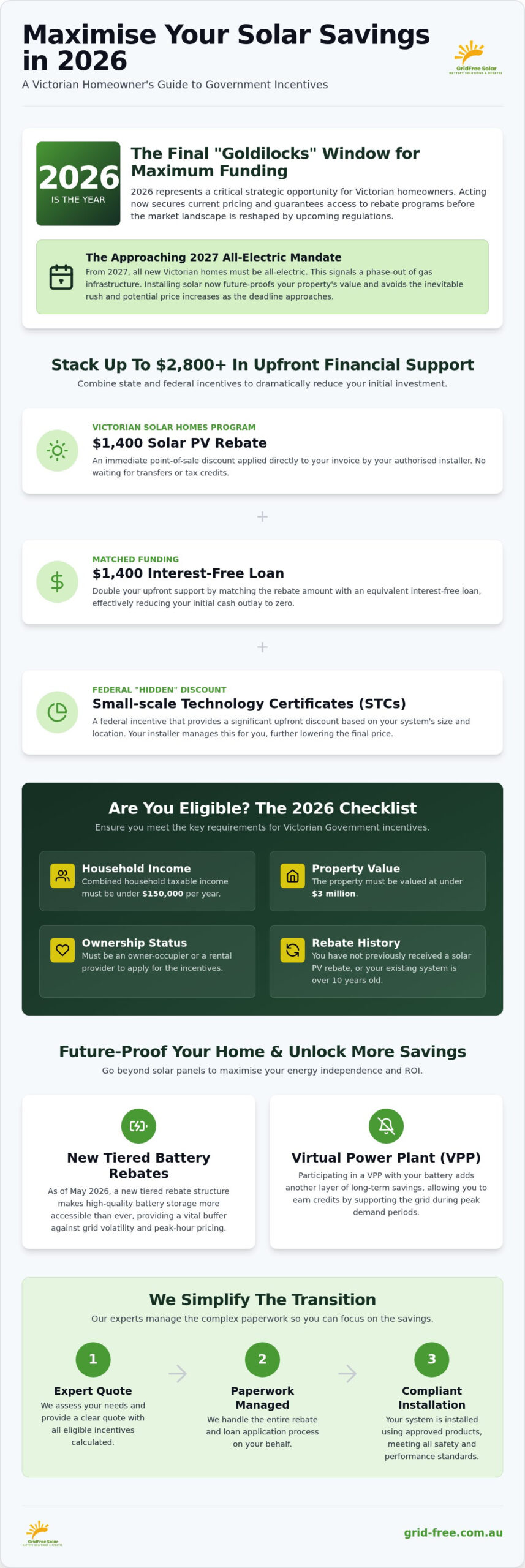
Retail power prices in Melbourne continue to challenge household budgets. Peak-hour demand charges are particularly aggressive. These costs make grid reliance a financial liability. Government solar incentives Victoria currently provide a combined upfront benefit of up to $2,800 when you pair the state rebate with an interest-free loan. This financial support, combined with the federal STC discount, significantly accelerates your return on investment.
The historical growth of Solar power in Australia shows that early adopters reap the highest rewards. Delaying your installation means absorbing another year of inflated utility bills while the value of federal incentives continues its scheduled annual decline. The “wait and see” approach is costing you money every day your roof remains empty. Take control of your energy future now. Professional installers are currently managing high volumes, but the 2026 window remains open for those who act decisively.
Victorian Solar Homes Program: Rebates and Interest-Free Loans
The core of government solar incentives Victoria is the Solar Homes Program. It provides the immediate financial relief needed to transition away from grid reliance. For 2026, the state offers a rebate of up to $1,400 for solar PV systems. This value is applied directly to your invoice by authorised retailers. It removes the stress of waiting for a tax return or a bank transfer. You see the savings on day one. It is a direct reduction. Simple. Efficient.
The program operates on monthly release cycles. This ensures a steady flow of funding, but demand often outstrips supply. Secure your allocation early in the month to avoid missing out on the current window. If you have already received a rebate at a previous address, you’re generally ineligible for a second PV rebate. However, an exception exists if you are replacing a system that is at least ten years old. This allows long-term solar users to upgrade to modern, high-efficiency technology without losing government support.
The $1,400 Solar PV Rebate Breakdown
Transparency is vital. Your installer must use components from the Solar Victoria approved product list to qualify. This list ensures that every subsidised system meets strict safety and performance standards. The rebate is available to owner-occupiers and rental providers for properties valued under $3 million. As of July 1, 2026, the combined household taxable income cap is $150,000. This shift makes it more important than ever to verify your eligibility before signing a contract.
Interest-Free Loans: Reducing Upfront Costs to Zero
The interest-free loan is the ultimate cash-flow tool. You can match your $1,400 rebate with an additional $1,400 loan. This brings your total upfront government benefit to $2,800. Repayments are capped at $29.17 per month over a four-year term. In most cases, the energy savings from your new system will exceed this monthly payment. It’s a self-funding upgrade. The loan is a strategic choice for Victorians who want to preserve their capital while investing in long-term energy security.
Incentives for Home Construction and Renovations
Building a new home? You don’t have to wait until you move in. You can apply for rebates during the construction phase. This allows you to integrate solar into the build process, ensuring maximum aesthetic and technical compatibility. Some exemptions exist for specific energy customers, such as those with Solstice Energy, who may have unique eligibility pathways. Coordination with your builder is vital. They must facilitate the installation through a Solar Victoria-registered retailer to ensure the funds are released.
Landlords can also claim the $1,400 rebate for up to two rental properties each financial year. This increases property value and attracts high-quality tenants looking for lower running costs. Pair this with a hot water rebate of up to $1,400 for Australian-made systems to maximise your return. If you’re ready to start, we can help you navigate the professional solar and battery installation process from start to finish.
The Federal “Hidden” Discount: Small-scale Technology Certificates (STCs)
While state rebates often grab the headlines, the federal government provides a substantial upfront discount that many homeowners overlook. This isn’t a traditional cash-back scheme. It is a market-based incentive known as Small-scale Technology Certificates (STCs). Every new solar installation creates a specific number of these certificates based on its expected renewable energy generation until 2030. These STCs hold a monetary value that fluctuates based on market demand. By trading these certificates, you effectively reduce the purchase price of your system before you even pay the deposit. It is a critical component of government solar incentives Victoria that acts as the first line of financial defence against high installation costs.
The “Stacking Strategy” is where the real value lies. You aren’t forced to choose between federal and state support. You can combine the federal STC discount with the Victorian Solar Homes Program to slash thousands from the retail price. This dual-layered approach is the secret to achieving a rapid return on investment. In 2026, this combination remains the most effective way to transition to clean energy without a massive capital outlay. Speed is essential here. The federal incentive is designed to decrease every year, making the current window the most profitable for your household budget.
Calculating Your STC Value in Victoria
Melbourne is classified as Zone 4 in the federal solar mapping system. This rating dictates how many certificates your system generates. A standard 6.6kW residential system in Melbourne typically attracts an STC discount of approximately $1,400. If you scale up to a 10kW system to support a larger home or a battery, that value increases proportionally. Market prices for STCs generally sit between $35 and $40 per certificate, though this can shift. Your installer usually handles the STC trade-in for you. This means the “price” you see on a quote is almost always the “net price” after the federal discount has already been subtracted.
The STC Phase-Out Schedule
The federal government is gradually winding down this programme. Every year on January 1st, the “deeming period” for certificate generation reduces by one year. This means that waiting until 2027 will automatically reduce your federal incentive by roughly 10%. It is a non-negotiable reduction. For a typical 6.6kW system, this delay could cost you several hundred dollars in lost subsidies. Larger commercial-scale systems face even steeper losses. Don’t let inertia erode your savings. Secure your certificate allocation now to lock in the 2026 rates. By the time 2030 arrives, this particular stream of government solar incentives Victoria will have ceased entirely. Procrastination is a direct tax on your energy independence.
Are You Eligible? Victorian Incentive Requirements
Eligibility is the gatekeeper. Many homeowners assume they qualify, only to be hit with a rejection because of a minor technicality in their documentation. To successfully claim government solar incentives Victoria, you must meet stringent financial and property-based benchmarks. It’s about precision. One error in your application can result in a permanent loss of funding. We ensure your submission is airtight from the start.
Financial Eligibility Deep Dive
Financial compliance is the first hurdle. For all applications submitted after July 1, 2026, your combined household taxable income must be under $150,000 per year. This figure is specific. It refers to the “taxable income” listed on your most recent ATO Notice of Assessment, not your gross salary or total package. If the property has multiple owners, their incomes are aggregated to reach this threshold. You must provide clear, digital copies of these assessments to avoid immediate disqualification. Your property value must also sit below $3 million. Most applicants use their latest council rates notice as proof of valuation. If your home has recently undergone a major renovation that might push it over this limit, you need to verify the current Valuer-General data before proceeding. Accuracy saves time.
Technical Eligibility: Approved Retailers and Products
Technical standards are equally rigid. You are required to engage a Solar Victoria Authorised Retailer. Using a non-authorised installer immediately excludes you from all state funding. There are no exceptions to this rule. Every component in your system must also appear on the Solar Victoria Approved Product List. This includes the panels, the inverter, and any integrated battery storage. Cheap, non-approved systems are a high-risk gamble. They often fail to meet Australian safety standards and always result in the loss of your $1,400 rebate. By choosing approved hardware, you guarantee the longevity of your investment and the security of your government funding. We specialise in high-performance, compliant systems that pass every audit.
Investment properties require a different approach. While owner-occupiers are limited to one PV rebate, rental providers can claim rebates for up to two rental properties each financial year. This is a strategic opportunity for Melbourne investors to increase property value while the 2026 incentive window remains open. You must have a signed rental agreement in place and the property must be valued within the $3 million limit. Don’t leave your eligibility to chance.
Ready to confirm your status? We provide professional handling of rebate paperwork for customers to ensure your application is successful the first time.
Maximising Your ROI: Beyond the Initial Rebate
Securing your upfront government solar incentives Victoria is just the beginning. True financial optimisation comes from how you manage your energy after the panels are on the roof. In 2026, the strategy has shifted from simply exporting power to the grid to intelligent self-consumption and storage. You need to look beyond the initial rebate cheque. It’s about the long-term yield of your asset.
The Solar Battery Opportunity in Melbourne
The federal battery support program transitioned to a tiered system on May 1, 2026. This provides rebates scaled to the size of your storage unit. It’s a game-changer for those looking to bypass rising peak-hour tariffs. A battery is no longer a luxury. It’s the engine room of an all-electric home. Storing your own clean energy is the only way to achieve true grid independence as we move toward the 2027 mandates. For a detailed breakdown of current state and federal funding, consult our Victorian Battery Rebate Guide.
Virtual Power Plants (VPPs) and Demand Response
Melbourne owners are now leveraging Virtual Power Plants to turn their batteries into revenue streams. By joining a VPP, you allow a provider to briefly access your stored energy during grid stress events. In exchange, you receive ongoing credits on your power bill. It’s a sophisticated way to boost your ROI while supporting local grid stability. You maintain control. You keep your backup. You just get paid for being a smart energy partner. This is the “hidden” incentive that transforms a static asset into an active earner. It’s the future of Melbourne’s distributed energy network.
Feed-in Tariffs (FiT) in Victoria have stabilised at lower levels because of the high volume of solar already in the grid. Relying on exports to pay off your system is an outdated tactic. The most profitable move in 2026 is using your own solar power to run high-draw appliances like heat pumps and electric heating. Every kilowatt you use yourself is a kilowatt you don’t have to buy at retail prices. This shift in focus ensures your government solar incentives Victoria deliver the maximum possible value over the life of the system.
The GridFree Professional Advantage
Long-term compliance requires more than just good hardware. It requires professional oversight. Our team manages the entire Solar Victoria portal process for you. We ensure your data is accurate and your rebate is secured without the stress of administrative errors. We offer a “Paperwork-Free” promise because we believe you should focus on the savings, not the forms. Start your journey with our Solar Panel Installation Melbourne guide to see how we build systems that stand the test of time. Efficiency is our standard. Savings are your result.
Secure Your Energy Independence Before the Window Closes
2026 is the final year to capitalise on the “Goldilocks” window of state and federal support. By stacking the $1,400 Victorian rebate with interest-free loans and federal STCs, you can eliminate thousands in upfront costs. The landscape is shifting. The 2027 all-electric mandates are approaching, and eligibility rules like the $150,000 income cap are becoming more stringent. Don’t let administrative complexity or shifting deadlines cost you thousands in lost savings.
As Melbourne-based solar experts and an Authorised Solar Victoria Retailer, we are specialists in government solar incentives Victoria applications. We handle the complex paperwork on your behalf to ensure your transition is seamless and successful. Our team is ready to help you optimise your home’s energy future with intelligent, high-performance solutions. Take the first step toward a self-sufficient, modern home today. We’re here to guide you through every step of the process.
Check Your Eligibility and Get a Custom Solar Quote Today
Frequently Asked Questions
Can I get the Victorian solar rebate if I already have solar panels?
You can only receive a second solar panel rebate if you are replacing a system that is at least ten years old. The Solar Homes Program is designed to support new installations or the modernisation of outdated technology. If your current system is younger than a decade, you remain ineligible for another PV rebate. However, you might still qualify for a battery rebate or a hot water incentive to further lower your grid reliance.
What is the income limit for the Victorian solar rebate in 2026?
For all applications submitted from July 1, 2026, the combined annual household taxable income must be $150,000 or less. This is a reduction from the previous $210,000 threshold. You must provide an ATO Notice of Assessment for each person named on the property title to verify this amount. This rule applies to both the solar PV and hot water rebates under the current government solar incentives Victoria framework.
How do I apply for the interest-free solar loan in Victoria?
The interest-free loan is applied for through the Solar Victoria portal after you receive a quote from an authorised retailer. Once your eligibility is confirmed, the loan of up to $1,400 is paid directly to your installer. You then repay the balance over four years in monthly instalments of $29.17. It’s a seamless way to reduce your upfront costs to zero without paying a cent in interest charges or hidden fees.
Can I stack the Victorian solar rebate with the federal STC discount?
Yes, you can absolutely stack these incentives to maximise your savings. Most Melbourne households combine the $1,400 state rebate with the federal STC discount, which is typically worth another $1,400 for a 6.6kW system. When you add the interest-free loan, your total upfront benefit can reach $2,800. This multi-layered approach ensures your system pays for itself much faster while providing immediate relief from rising electricity tariffs across the state.
Is there a specific rebate for solar batteries in Victoria right now?
As of May 1, 2026, the federal Cheaper Home Batteries Program offers tiered rebates based on the storage capacity of the unit you install. This federal support replaces the previous flat-rate state battery rebates in many instances. Larger batteries attract higher subsidies to encourage grid stability and demand response participation. We specialise in identifying the most profitable battery configuration for your specific energy needs while handling all the complex rebate paperwork for you.
Do solar rebates apply to homes under construction in Melbourne?
Solar rebates are available for homes under construction in Melbourne and regional Victoria. You don’t need to wait until you move in to start the application process. You must engage an authorised retailer early to coordinate with your builder. This ensures the mounting points and electrical infrastructure are integrated into the build. Applying early secures your funding allocation before the monthly release quota is exhausted by existing homeowners in the region.
How long does it take for the Victorian solar rebate to be approved?
Most rebate applications are processed within two to three weeks, provided all your documentation is accurate. Delays usually occur when ATO Notices of Assessment are missing or property valuations aren’t clearly documented. Using a specialist installer who manages the portal on your behalf significantly reduces this timeframe. Once approved, you’ll receive an eligibility status notification, allowing your installer to proceed with the installation and claim the government solar incentives Victoria directly.
What happens to the solar rebate if I move house?
The solar rebate is a one-off benefit tied to the property and the applicant. If you move house, the solar system and the associated rebate benefits remain with the property. If you have an outstanding interest-free loan with Solar Victoria, you must generally pay the remaining balance in full before the property title is transferred. You cannot “take” the rebate to a new address if you have already claimed it at your previous residence.