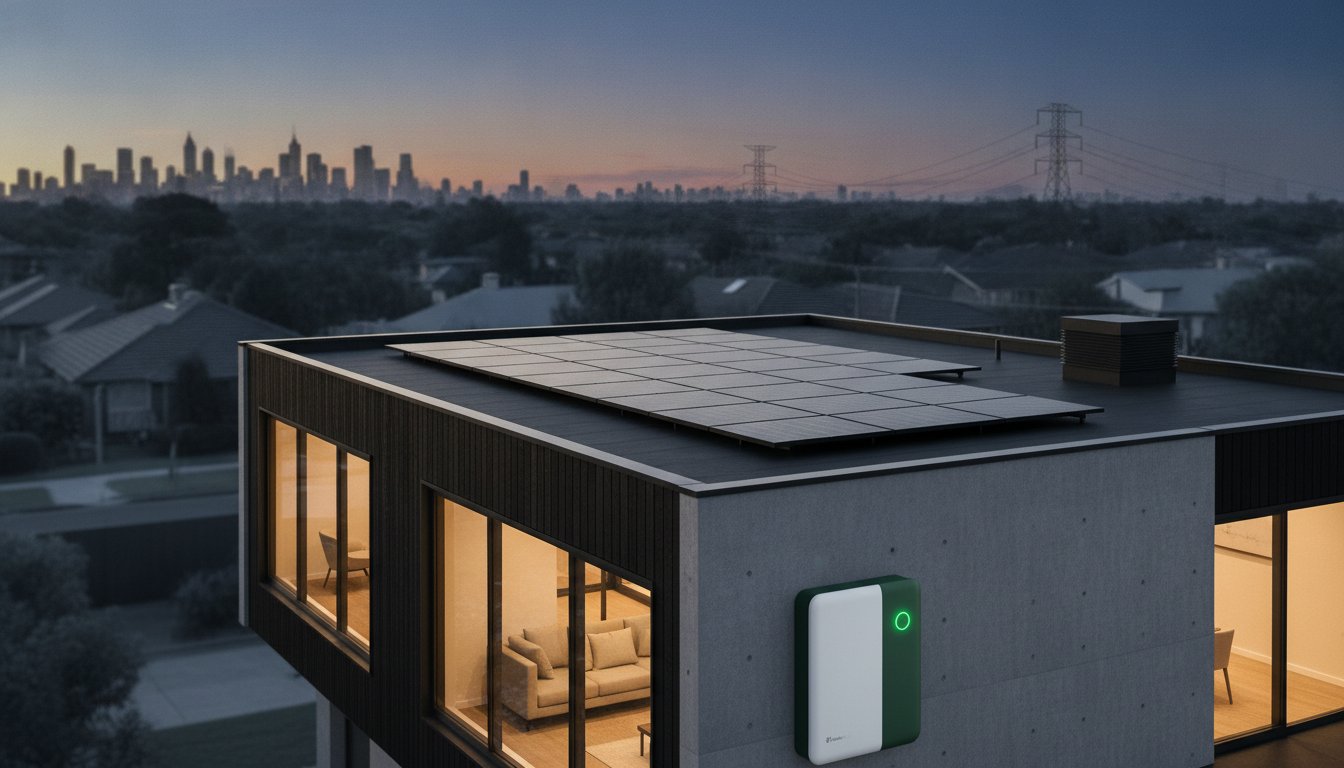
In 2026, the Australian power grid is no longer a safety net. It’s a financial liability. While you export sunshine for a pittance, retailers charge record rates the moment dusk hits. It’s a lopsided system. It leaves Melbourne homeowners feeling exploited and vulnerable to unstable infrastructure. Achieving true energy independence solar battery integration is the only definitive way to opt out. By capturing your excess generation, you stop being a grid casualty and start becoming your own utility provider.
You’re likely tired of “unprecedented” price hikes and the fear of the next local blackout. We’ll show you exactly how to break that cycle. This guide provides the blueprint to master the current storage landscape, slashing your grid reliance while securing your home’s power supply. We’ll detail the latest Victorian battery rebates, the intelligence of modern LiFePO4 systems, and the precise steps to maximise your ROI. It’s time to stop paying for peak power and start owning your energy future.
Key Takeaways
- 2026 is the tipping point. Market volatility means solar panels alone won’t protect your wallet from rising evening rates anymore.
- Master the storage revolution. Use an energy independence solar battery setup to bridge the gap between daytime generation and your family’s peak demand.
- Define your level of freedom. Understand why a 90% reduction in grid reliance is often more strategic for Melbourne homes than going completely off-grid.
- Avoid common sizing traps. Learn to find the balance between a system that leaves you short in winter and one with expensive, wasted capacity.
- Maximise your financial return. Navigate the latest Victorian battery rebates and VPP incentives to lower your upfront investment.
Defining Energy Independence in the 2026 Australian Market
Energy independence isn’t just a buzzword. In 2026, it’s a survival strategy. For the modern Australian household, energy independence is the comprehensive ability to generate, store, and intelligently manage your own electricity with minimal reliance on an increasingly volatile national grid. It’s the ultimate pivot. You’re moving from being a passive consumer to becoming an active energy producer. We’ve reached a tipping point where wholesale market volatility and aging infrastructure have made traditional grid reliance a financial gamble.
Modern home energy storage systems allow you to break this cycle. You no longer just “have solar”; you own a micro-utility. True energy independence solar battery integration provides the dual benefit of complete financial autonomy from rising retail rates and the absolute security of a continuous power supply during external network failures. It is about taking control of your home’s most vital resource.
The End of the Feed-in Tariff Era
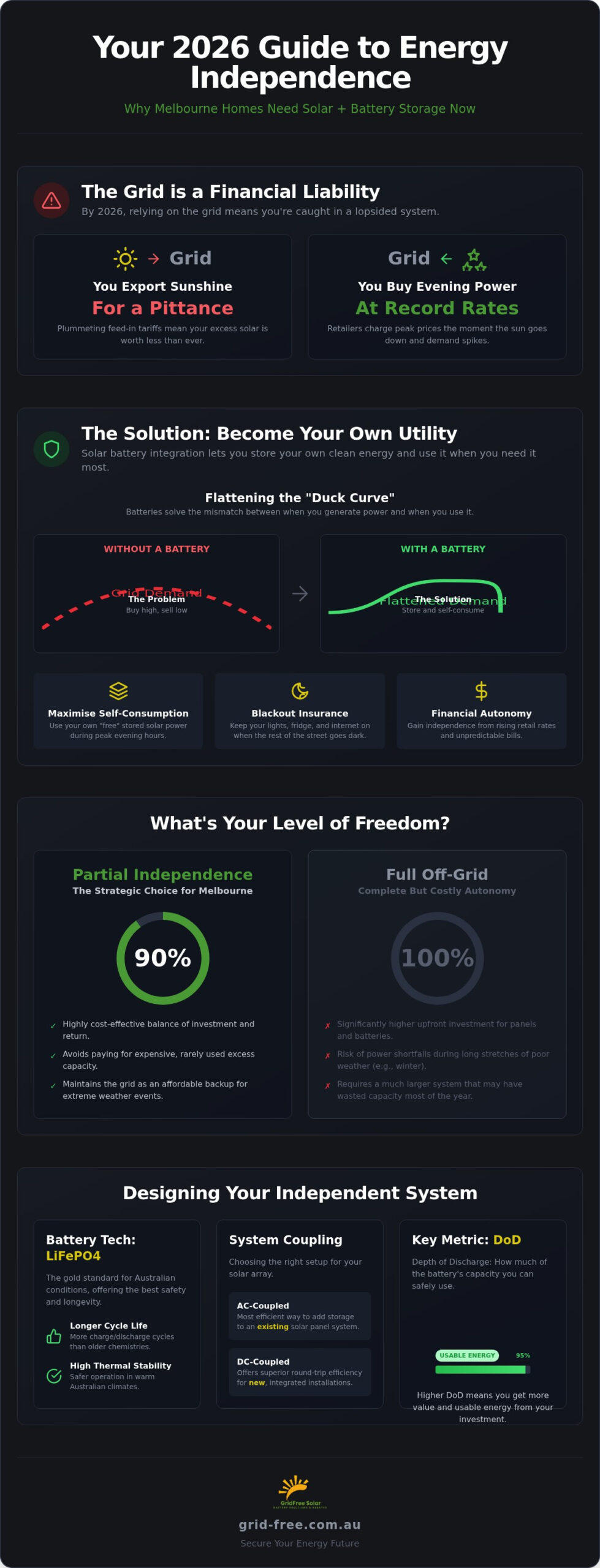
The days of making a profit by simply exporting solar to the grid are over. Across Victoria, feed-in tariffs have plummeted to record lows. We’re now seeing the “Solar Sponge” effect in full force. The grid is saturated with midday solar. This forces retailers to lower export rates, sometimes to near zero. You’re effectively penalised for producing clean energy at the wrong time. Batteries change the math. They turn that low-value export energy into high-value evening power. Instead of selling your sun for cents and buying it back for dollars, you keep it. It’s a simple, logical shift from passive export to active self-consumption.
Grid Reliability and the “Blackout Insurance” Factor
Melbourne’s grid is under pressure. Frequent instability and localised outages are becoming the new normal for many Victorian suburbs. Energy independence isn’t just about the bill; it’s about the peace of mind. Knowing your lights, fridge, and internet stay on while the rest of the street goes dark is a significant psychological win. It’s vital to distinguish between basic backup and “Whole-of-Home” capabilities. Basic setups might only keep a few lights on. A sophisticated energy independence solar battery system, professionally installed, can support your entire lifestyle. You gain a layer of protection that the grid simply cannot guarantee.
Why Solar Panels Alone Won’t Cut It: The Storage Revolution
Solar panels on their own are a half-finished strategy. They generate power while you’re at work, but your home’s demand peaks when the sun goes down. This is the mismatch problem. It’s the primary reason many Victorians still see high power bills despite having large solar arrays. To achieve true energy independence solar battery technology is mandatory. It bridges the gap between generation and consumption. Without it, you’re essentially a part-time participant in the renewable transition.
The “Duck Curve” illustrates this perfectly. During the day, the grid is flooded with solar, driving prices down. In the evening, as solar drops off and demand spikes, prices soar. Without storage, you’re forced to buy expensive peak power. A battery flattens this curve. It isn’t just a bucket for electricity; it’s the intelligent core of your system. Modern hybrid inverters act as the traffic controller. They direct power to your appliances, your storage, or the grid with millisecond precision to ensure you never pay for a kilowatt you could have provided yourself.
The Mechanics of Modern Solar Storage
For Melbourne retrofits, AC-coupled systems are often the most efficient way to add storage to an existing array. If you’re starting fresh, DC-coupled systems offer superior efficiency. Pay close attention to Depth of Discharge (DoD). This represents how much of the battery’s capacity you can actually use without causing damage. We focus on LiFePO4 (Lithium Iron Phosphate) technology because it’s the gold standard for Australian conditions. It offers high thermal stability and a significantly longer cycle life than older chemistries, making it a safer long-term investment for your home.
Maximising Self-Consumption in Victoria
Strategic load shifting is the key to ROI. By using your battery to run heavy appliances during peak rate windows, you avoid the highest retail charges. Smart monitoring apps allow you to track this journey toward total energy independence solar battery mastery in real-time. You can see exactly when your home is running on “free” stored sun. For a deeper look at system reliability and technical specs, explore our Energy Storage Solutions Melbourne guide. Optimising your setup ensures you aren’t just saving money but securing your lifestyle. If you’re ready to stop being a grid casualty, you can organise a professional system assessment to find your ideal configuration.
Evaluating Full vs. Partial Independence: What’s Right for You?
Deciding on your level of grid reliance is a strategic financial choice. Most Melbourne homeowners aim for “Partial Independence”. This involves reducing grid usage by 70 to 90 per cent while maintaining a connection for extreme weather events. It’s the ultimate safety net. Conversely, “Full Independence” means cutting the cord entirely. This is rare in suburban Melbourne. The infrastructure needed to survive a week of Victorian winter rain without the grid is immense. While grid-tied systems are accessible, the upfront cost of a fully off-grid storage system typically doubles or triples due to the massive redundancy required for winter autonomy.
For most Victorian families, the 80 per cent mark is the sweet spot. It provides the highest ROI. You eliminate the most expensive peak-rate power without over-investing in capacity you’ll only use twice a year. An energy independence solar battery setup at this scale pays for itself faster. It balances upfront capital with daily operational savings. You get the protection you need without the “off-grid” price tag.
The VPP Factor: Earning While You Store
Virtual Power Plants (VPPs) have changed the game for 2026. A VPP allows you to “rent” a portion of your battery capacity back to the grid during high-demand events. In exchange, you receive credits on your bill. It’s active participation. You’re not just storing power; you’re trading it. You must balance these incentives with your own backup needs. A well-configured system ensures you always keep a “reserve” for blackouts while monetising the rest. It’s a way to make your energy independence solar battery work harder for your wallet.
ROI Analysis: When Does a Battery Pay for Itself?
Payback periods are shrinking. Rising retail prices and the 2026 Victorian regulatory landscape have accelerated the math. Your specific usage patterns and system size are the biggest variables. Don’t ignore the “Hidden ROI” either. A home with a high-performance storage system is a premium asset. It offers protection against future price hikes and increases property value. It’s a hedge against inflation. For a complete financial breakdown, including current Victorian incentives, see our guide on Solar Battery Cost Australia 2026. Taking control now secures your financial future.
Designing Your Independent System: Sizing and Tech Selection
Precision is the difference between a high-performing asset and a wasted investment. Sizing your system requires a cold, data-driven approach to your household’s unique load profile. Many providers push a “one-size-fits-all” 5kWh starter unit. For a typical Melbourne family, this is often a mistake. A battery that small will likely be depleted before your evening meal is even finished on a rainy Tuesday. Conversely, oversizing creates a “sunk cost” trap. You end up paying for storage capacity that sits idle for ten months of the year. Finding the balance is critical for energy independence solar battery success.
Technical compatibility is your next hurdle. If you’re adding storage to an existing array, your panels and inverter must be able to communicate seamlessly with the new hardware. We also prioritise “Black Start” capability. This is a specialized feature that allows your solar system to restart itself using only battery power after a total grid failure. Without it, your panels may remain dormant during a blackout even if the sun is shining. It’s a non-negotiable for true energy security.
Sizing for Melbourne’s Seasonal Variations
Victorian winters present a unique challenge. With fewer sun hours and increased heating loads, your system must be designed for July, not January. A larger solar array is often necessary to ensure your battery actually reaches a 100 per cent state of charge during the shortest days of the year. We recommend implementing a “Winter Reserve” setting. This allows you to lock off a portion of your battery capacity exclusively for emergency backup. You sacrifice a small amount of daily savings to ensure you’re never left in the dark during a winter storm.
Choosing Between Battery Upgrades and New Installations
If you already have storage, you might be facing a choice between a total replacement or an expansion. Technology moves fast. Adding a modern unit to an aging system can sometimes create efficiency bottlenecks. Look for clear signs of degradation. If your battery no longer holds enough charge to get you through the night, or if the round-trip efficiency has dropped noticeably, it’s time for an audit. For a detailed breakdown of when to pivot, check our guide on Solar Battery Replacement Melbourne to evaluate your current setup.
Optimising your storage capacity is a technical task that requires local expertise. You can request a custom sizing blueprint from our Melbourne team to ensure your system is perfectly calibrated for the 2026 energy market.
Securing Your Energy Future with GridFree Solar
GridFree Solar specialises in custom-designed independence pathways for Melbourne homes. We don’t deal in generic solar packages. Instead, we engineer precise solutions that account for your unique load profile and local grid conditions. Our Melbourne-based installation teams are fully CEC-accredited. This ensures your system meets the highest safety standards and preserves all manufacturer warranties. Achieving energy independence solar battery goals requires more than just hardware. It requires a partner who understands the Victorian energy landscape from the ground up.
We provide the “GridFree Advantage”. This means ongoing support and proactive system optimisation. We don’t just install and disappear. We monitor your system to ensure it continues to deliver the maximum ROI as market conditions shift. Whether you’re upgrading an existing array or starting a new installation, we manage the technical complexity so you don’t have to. We turn the transition to self-sufficiency into a seamless, high-impact financial strategy.
The Victorian Battery Rebate and STCs in 2026
Navigating government incentives is often the biggest hurdle for Victorian homeowners. In 2026, the Victorian Solar Homes Program continues to offer storage incentives, but eligibility criteria have become more stringent. Federal Small-scale Technology Certificates (STCs) also play a vital role in reducing your upfront investment. These credits act as a direct discount on the price of your upgrade. We handle the entire application process and paperwork for you. Acting now is essential. Rebate quotas in Victoria are notoriously volatile and often fill up within weeks of release. Don’t let a delay cost you thousands while pursuing your energy independence solar battery goals.
Your Next Steps Toward Independence
A generic online quote can’t account for the condition of your switchboard or the specific orientation of your roof. A professional site audit is the first step toward a reliable system. We assess your infrastructure to ensure it can handle modern, high-capacity storage. This technical scrutiny prevents costly surprises during installation. During our audit, we evaluate:
- Switchboard capacity: Ensuring your electrical hub can handle advanced storage loads.
- Roof orientation: Optimising panel placement for maximum winter generation.
- Usage patterns: Matching battery size to your actual evening consumption.
We then provide a tailored blueprint that reflects your life, not a marketing brochure. Ready to reclaim your power? Request a Professional Solar & Battery Audit from GridFree Solar today and lock in your energy security.
Take Control of Your Energy Future
The 2026 energy market doesn’t reward the passive consumer. Relying on solar panels alone is a legacy strategy that leaves you exposed to peak evening rates and grid instability. True energy independence solar battery mastery requires a shift to active storage. You’ve seen how precise sizing and high-efficiency LiFePO4 technology transform your home from a grid liability into a self-sufficient powerhouse. By capturing your midday generation and deploying it when the sun goes down, you opt out of the retail price cycle and secure your home against local outages.
Don’t let market volatility dictate your household budget. As Melbourne-based experts, we specialise in navigating the complex Victorian rebate landscape and installing high-performance battery upgrades. Our CEC-accredited installers ensure your transition is safe, compliant, and optimised for maximum ROI. It’s time to stop paying for expensive peak power and start owning your generation. Master your energy future with a GridFree Solar battery solution today. Your path to a resilient, grid-free lifestyle is just one professional audit away.
Frequently Asked Questions
Is energy independence with a solar battery actually possible in Melbourne?
Yes, achieving high levels of grid autonomy is entirely feasible for Melbourne homes. While total off-grid living is complex in suburban areas, a well-sized system allows you to cover 70 to 90 per cent of your daily needs. This level of energy independence solar battery integration ensures you avoid expensive peak rates while maintaining a grid connection for prolonged periods of winter cloud cover. It’s about strategic self-reliance rather than isolation.
How much does a 10kW solar battery cost in Australia in 2026?
Battery investment levels in 2026 are influenced by several variables including storage capacity, discharge rates, and the complexity of your home’s electrical switchboard. While industry price ranges fluctuate, the net cost for Victorian residents is significantly reduced by the Solar Homes Program and federal incentives. We recommend focusing on the levelised cost of energy over the system’s life. A professional audit is the only way to get an accurate figure that reflects your specific installation requirements.
Can I add a battery to my existing solar panel system?
Retrofitting storage to an existing array is a common request for our Melbourne team. Most systems can be upgraded using an AC-coupled configuration, which allows the battery to work alongside your current solar inverter. It’s a seamless way to enhance your energy independence solar battery capabilities without replacing your entire setup. We perform a thorough compatibility check of your switchboard and existing hardware to ensure safe and efficient operation.
What happens to my solar battery during a grid blackout?
Your system’s behaviour depends on your specific backup configuration. Standard grid-tied systems shut down during a blackout for safety unless they have a dedicated backup circuit. High-spec installations include a “Black Start” function and an automatic transfer switch. This allows your battery to continue powering essential loads like lights and refrigeration. You can choose between basic emergency backup or more comprehensive whole-of-home protection during extended local network failures.
Are there still solar battery rebates available in Victoria for 2026?
Victoria remains a leader in storage incentives through the Solar Homes Program. In 2026, eligible households can still access interest-free loans and rebates to lower the upfront barrier to storage. These are often capped and distributed in release rounds, so timing is critical. Additionally, federal STCs provide a significant discount. We manage the entire application process to ensure you maximise every available incentive for your specific Melbourne location.
How long will a solar battery last before it needs replacing?
Modern LiFePO4 batteries are designed for longevity, typically lasting between 10 and 15 years. Their lifespan is measured in “cycles,” which represents one full charge and discharge. You’ll notice a gradual decrease in capacity over time, similar to a mobile phone. Most tier-one manufacturers provide a 10-year warranty that guarantees a certain percentage of original capacity remains. Proper temperature management and professional installation are vital to ensuring your storage system reaches its full potential.
Do I need to be completely off-grid to be energy independent?
You don’t need to disconnect from the grid to be independent. Most Victorians opt for “grid-tied independence,” which offers the best financial return. This setup allows you to use your stored sun for 80 per cent of your needs while keeping the grid as a backup for emergency situations or extreme weather. It provides the security of a micro-utility without the massive infrastructure costs required for a 100 per cent off-grid suburban lifestyle.
Can I charge my electric vehicle (EV) using my solar battery?
Charging an EV from your battery is possible, but it requires careful capacity planning. A standard EV battery is often five to ten times larger than a residential solar battery. It’s usually more efficient to charge your vehicle directly from your solar panels during the day. However, your home battery can act as a vital buffer, providing “top-up” power during the evening to ensure your car is ready for the morning commute without drawing from the grid.