
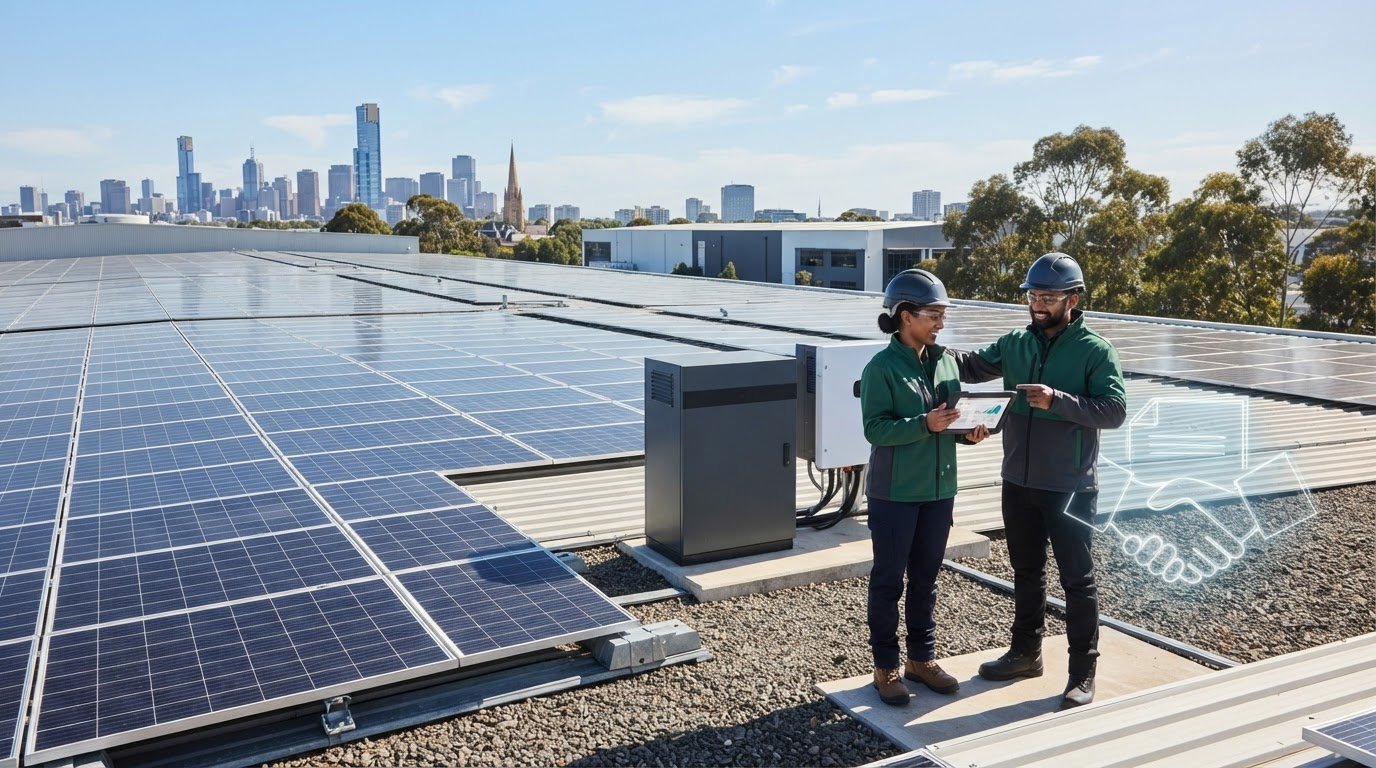
For businesses considering commercial solar panel installation Victoria, one of the biggest decisions is who owns the system. A power purchase agreement (PPA) may provide access to on-site solar with little or no upfront capital, but the contract determines what you pay, how long you’re committed and who is responsible for the equipment.
Owning a system can offer more control, while a PPA may suit a business seeking to avoid the upfront purchase. Neither option is right for every site or energy profile. The best fit depends on your business priorities, electricity use and plans for the property.
This guide explains how commercial solar PPAs work and compares them with system ownership. It covers contract terms, site conditions, electricity-use patterns and Victorian incentive eligibility, as well as how system design and battery storage can align solar generation with demand. GridFree Solar designs and installs commercial solar and battery systems around business and industrial energy needs, providing a practical way to explore an owned system alongside the PPA model.
Key Takeaways
- A commercial solar PPA means buying electricity generated under agreed contract terms, rather than purchasing the solar system outright.
- Compare PPA pricing, contract length, ownership and operating responsibilities with the control and commitments of an owned system.
- Assess the site, business load profile, network connection and system design before considering Victorian incentive eligibility.
- VEU support isn’t an automatic PPA benefit. Assess the scheme’s eligibility requirements for the specific project and system.
- For commercial solar panel installation Victoria, matching system design and battery storage to your demand can help clarify which procurement model suits your operational priorities.
Commercial solar PPAs in Victoria: what a business is agreeing to
A business considering solar faces an early choice: purchase a system, or contract to buy the electricity it generates? A commercial power purchase agreement (PPA) is a contract to buy solar electricity under agreed terms. The system may be installed on the business’s roof or elsewhere on its site, but the business doesn’t necessarily own the equipment. The Power Purchase Agreement (PPA) overview explains the broader role of these agreements in renewable energy projects.
That distinction matters. A PPA is an electricity-supply and procurement arrangement, not simply another way to pay for panels. Ownership, maintenance, metering and billing depend on the agreement. Review its terms in detail rather than assuming every PPA works the same way.
How does a commercial solar power purchase agreement work?
Three roles may be involved: your business as the electricity buyer, the party that owns the solar system, and the party selling the generated electricity. One entity may take on more than one role.
The contract sets out how solar generation is metered and how electricity supplied to the business is recorded and charged. Your site will generally still need a grid electricity account for times when solar generation doesn’t meet demand. Contract duration, pricing and each party’s responsibilities vary, so assess the actual agreement rather than relying on a standard assumption.
Why Victorian businesses consider a PPA
A PPA may appeal if your business wants to use on-site solar without purchasing the equipment outright. This can change the upfront commitment, but it doesn’t remove the need to understand the contract. The electricity price, how it may change, the term and responsibility for the system all matter.
Start by comparing your site conditions with your business’s energy use. A suitable roof or other site area is only part of the picture. Look at when your business consumes electricity and when solar is likely to generate it. A business with substantial daytime demand may use more of its generation on site. With a different usage pattern, the business may rely more on grid electricity or export solar power. These factors inform project planning but don’t guarantee a particular saving.
For commercial solar panel installation Victoria businesses are assessing, consider system design separately from the way the project is funded or contracted. GridFree Solar designs and installs commercial solar and battery systems for business and industrial energy demands. This provides a basis for planning a system around the site, while the PPA remains a separate contract model.
PPA pricing, ownership and responsibilities: understand the contract mechanics
A PPA’s price is set by its contract, not by a universal Victorian rate. The agreement may specify a fixed price, a pricing formula or a rate that changes over time. Compare those terms and any review dates with your current electricity arrangements. Don’t treat an advertised rate or projected comparison as a guaranteed saving.
Keep the two electricity charges distinct. Your business may receive an invoice for solar electricity supplied under the PPA and a separate bill from its electricity retailer for grid power and other applicable charges. Total costs depend on how much solar electricity you use, the PPA’s billing rules and your remaining grid consumption.
Who owns and maintains the commercial solar system?
The contract defines who owns the equipment during the agreement. It should also state who is responsible for monitoring, maintenance, repairs and insurance, and what happens if the system is unavailable or underperforms. Don’t assume that the electricity seller and system operator are the same party.
Site access needs equal clarity. Installation, inspections and repairs may affect staff, customers, deliveries or roof access. Agree on access arrangements, notice periods and how disruption will be managed. For businesses planning commercial solar panel installation Victoria, include these practical details in project discussions alongside system design.
Which PPA clauses deserve close attention?
Read the pricing and operational terms as a working business document. Check:
- Price and invoices: How is the rate calculated? When can it change, does escalation apply, and how are usage and billing handled?
- Performance and data: What performance measures apply, how can you access meter data, and how are discrepancies handled?
- Access and insurance: Who can enter the site, what notice is required, and which party carries specified insurance responsibilities?
- Business changes: What happens if you relocate, sell the property, need roof works or want to end the agreement early?
- End of term: Is the system removed, transferred, sold or kept in operation under new terms?
These clauses can affect future flexibility as much as the opening price. Have the agreement reviewed by appropriately qualified advisers if its commercial, legal, tax or insurance implications need assessment. Keep incentives separate from the PPA’s price terms: Victorian scheme eligibility and requirements are distinct. Review the Victorian commercial solar incentives against the specific project.
To compare a PPA with an owned system, explore commercial solar and battery design tailored to your site and business energy needs.
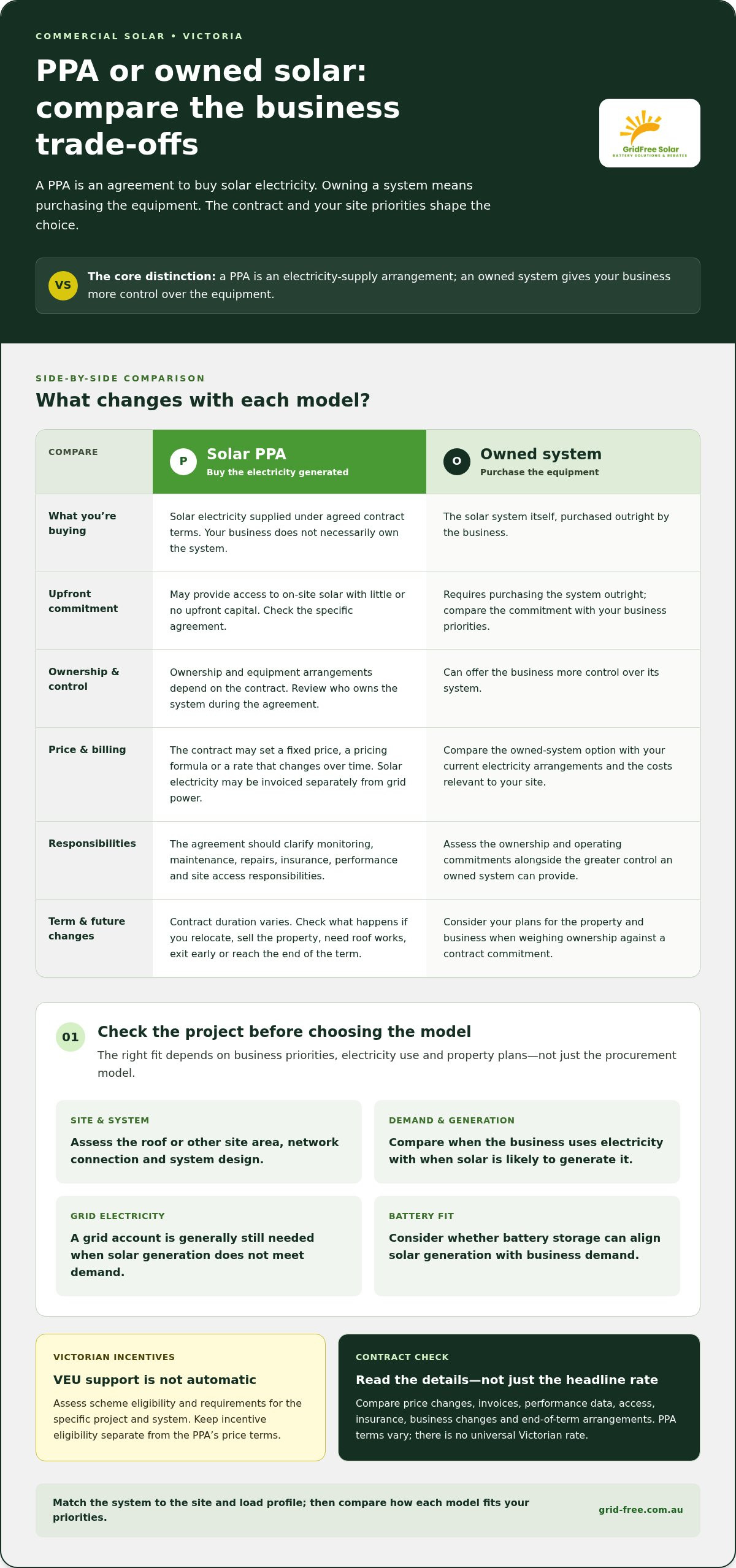
PPA or owned solar in Victoria: compare the business trade-offs
There’s no single best procurement model. Your decision depends on how your business wants to allocate capital, who should control the equipment, how much contractual commitment you’re comfortable with and how long you expect to occupy the site.
Use this table as a starting point. The contract and project structure determine the details.
| Consideration | Commercial solar PPA | Owned solar system |
|---|---|---|
| Upfront commitment | May avoid purchasing the equipment outright, though the contract may include other charges or contributions. | Requires the business to fund the system purchase and installation. |
| Ownership | The system is owned as set out in the agreement, often by a separate system owner during the contract. | The business owns the equipment once purchased, subject to the purchase arrangements. |
| Responsibilities | Maintenance, monitoring, insurance and repairs depend on the contract. | The business has greater responsibility for the asset, with specific arrangements depending on the installation and any service agreements. |
| Flexibility | Contract terms can affect changes to the site, system or business arrangements. | Ownership gives more direct control over system decisions, while site, network and operational factors still matter. |
When might a PPA suit a Victorian business?
A PPA may suit a business seeking to avoid the upfront equipment purchase and willing to buy solar electricity under a long-term agreement. Stable site tenure and predictable operating hours can make it easier to plan around the arrangement, particularly if the business uses solar generation during the day. Assess the pricing, responsibilities, duration and exit terms against your business’s circumstances.
When might owning the solar system be worth comparing?
Ownership may appeal to a business that prioritises direct control over its equipment and system decisions. Weigh the capital commitment against your site occupancy plans and your capacity to take responsibility for an energy asset. Compare both models using the same assumptions for electricity use and project design, rather than relying on headline claims. See the commercial solar installation guide for Melbourne businesses for more system-planning context.
Whichever model you consider, base the design on the site’s demand. A battery may change how solar generation is stored and used, while export arrangements and consumption patterns also affect the project. For commercial solar panel installation Victoria, assess these factors together before comparing ownership and contract options. A tailored solar and battery design can help map the system to business operations without assuming one procurement model suits every site.
Victorian commercial solar eligibility: check the site, system and incentives
Assess the project in sequence before comparing incentive estimates or assuming a PPA qualifies. Site conditions, energy demand, grid connection and system design all influence what’s practical. Consider incentives after establishing the project details, as eligibility depends on current programme rules and factors such as the system and ownership arrangements.
What should a business assess before a Victorian solar project?
- Assess the site. Review usable roof or ground area, shading and structural considerations. Check that the proposed location can accommodate a system without disrupting site operations.
- Map electricity use. Gather interval data, operating hours and existing supply details. Compare daytime demand with likely solar generation to understand how much electricity the business may use on site.
- Identify network requirements. A grid-connected system may need approval from the relevant distribution network service provider (DNSP). Include the connection process in project planning, especially for larger systems.
- Develop the system design. Match the system size and configuration to the site and load profile. If you’re considering a battery, assess how storage could support the business’s demand and operating priorities. For background, see this Victorian battery rebate and storage savings guide.
- Check incentives last. Assess the proposed system and procurement structure against current scheme requirements. Don’t treat an incentive as an automatic PPA benefit or base a business case on an unverified estimate.
How should businesses approach VEU and federal incentives?
Investigate the Victorian Energy Upgrades (VEU) program, but don’t treat it as a promised discount. As of October 2026, the VEU program provides upfront discounts for eligible commercial and industrial solar PV systems between 30 kW and 200 kW. Product, provider and project requirements apply, so check the current criteria before relying on eligibility in a project comparison.
Assess federal certificate eligibility separately. Under the current rules, solar PV systems from 100 kW up to 1 MW entered the expanded Small-scale Renewable Energy Scheme from 1 October 2026. Some systems may therefore intersect with both federal and Victorian schemes, but system size alone doesn’t establish eligibility. Incentives, ownership structure and PPA terms can interact differently, so assess them for the specific proposal. For a broader perspective on how solar certificate mechanisms operate in other jurisdictions, learn more about renewable energy credit models.
For commercial solar panel installation Victoria, a site-led design gives your business a practical basis for comparing procurement models and incentive assumptions. GridFree Solar tailors commercial solar and battery installations to business and industrial energy demands. Plan a commercial solar system around your site and energy use.
Plan a commercial solar installation in Victoria and choose your next step
A sound project starts with your business, not a standard system size. Gather information on when and how your site uses electricity, then use it to compare system design and procurement options. A clear project brief helps you weigh an owned installation against a PPA without treating either as the default.
What information helps shape a commercial solar design?
Prepare recent electricity bills, interval data where available and a schedule of operating hours. Together, these show when demand occurs and how it may align with solar generation. Define your priorities, such as using more solar during the day, considering battery storage, supporting resilience objectives or planning for future demand.
Then document site conditions. Note roof or land constraints, access requirements, planned expansion and tenancy arrangements that could affect the project or system ownership. These details help shape a design around the site and your operational priorities instead of relying on assumptions about available space or long-term occupancy.
How can GridFree Solar help with the installation decision?
GridFree Solar delivers commercial solar and battery installations designed around business and industrial energy demands. If your preferred approach is to own a system, a tailored installation can be planned around your site and energy use. If you’re considering a PPA, assess the installation design separately from the electricity purchase contract, including the contract’s price, duration and responsibilities.
Rebates may also affect project planning, but eligibility isn’t automatic. GridFree Solar helps businesses navigate applicable government programmes, with eligibility assessed against the relevant scheme rules and project details.
Use this sequence to move from initial research to a considered decision:
- Gather the evidence: collect bills, interval data and operating schedules.
- Set your priorities: decide what matters around capital, control, storage and site tenure.
- Assess the site: consider usable installation area, access, tenancy and future changes.
- Compare the models: review owned-system and PPA terms against the same demand and design assumptions.
For commercial solar panel installation Victoria businesses can plan around their actual site and energy profile, start with a tailored design and a clear procurement comparison. Explore commercial solar installation for your business.
Make your next solar decision with confidence
A commercial solar PPA is a contract choice, not simply a way to install panels. Compare its pricing, duration, ownership and responsibilities with the control and commitments of owning a system. The right fit depends on your business priorities, site tenure and electricity use.
Start with your energy bills, operating patterns and site conditions. Then shape the design around when your business needs power, whether battery storage supports your objectives and which current Victorian incentive rules may apply. Eligibility isn’t automatic, so assess it against the specific project.
For commercial solar panel installation Victoria businesses can plan around real operational demands, GridFree Solar provides tailored commercial solar solutions and solar and battery installation for business and industrial sites. The company also helps businesses navigate applicable solar and battery rebate processes. This installation expertise is separate from a PPA contract, so you can assess system design alongside your preferred procurement model.
Explore a commercial solar solution designed around your business and take the next step towards a solar plan that fits your site and energy needs.
Frequently Asked Questions
What is a commercial solar power purchase agreement in Victoria?
A commercial solar PPA in Victoria is an agreement under which a business buys electricity generated by a solar system, often installed at its site. The business pays according to agreed contract terms, while another party may own the equipment. Ownership, maintenance, metering and billing responsibilities depend on the agreement. Unlike purchasing a system outright, the business is buying its output. Review the pricing structure, contract term and end-of-contract provisions before committing.
Is a commercial solar PPA better than buying a solar system?
Neither option is automatically better. A PPA may suit a business seeking to avoid purchasing equipment outright, while system ownership may appeal to a business that prioritises control. Compare capital planning, site tenure, operational responsibilities, contract flexibility and energy use. For example, a business expecting to relocate may weigh a long contract differently from one with stable site plans. The project design and agreement terms determine which option fits your circumstances.
How does a solar PPA work for a Victorian business?
A solar PPA lets a business buy electricity generated by a system installed on or supplying its site. The agreement sets out the pricing method, metering arrangements, duration and each party’s responsibilities. The business may still need grid electricity when solar generation doesn’t meet demand, so the PPA charge is only one part of its overall electricity costs. Assess the proposed arrangement against your site’s usage patterns and operating needs.
Can a Victorian business claim a solar discount if it uses a PPA?
Possibly, but a PPA doesn’t automatically qualify or disqualify a project for a discount. Eligibility depends on current programme rules and project details, including the system, products, provider and ownership or contract arrangements. Check current Victorian Energy Upgrades requirements and relevant federal certificate rules separately. Before factoring an incentive into your decision, verify that the specific proposal meets the applicable criteria rather than assuming eligibility based on the system type alone.
Who owns and maintains panels under a commercial solar PPA?
The agreement identifies who owns the solar equipment and allocates responsibilities for maintenance, monitoring, insurance and repairs. These arrangements vary between PPAs. Review how site access works, how issues are reported and addressed, what performance measures apply, and how planned roof works are handled. The signed contract defines each party’s obligations, so read those provisions carefully rather than relying on general descriptions of how a PPA works.
What happens when a commercial solar PPA ends?
The agreement sets out what happens at the end of its term. Options may include removing the system, transferring ownership, extending the arrangement or another outcome agreed by the parties. Review who handles removal or transfer, any equipment condition requirements and required notice periods. Also check what the contract says if your business relocates or the property is sold before the PPA ends.
How do I know if my Victorian business site suits commercial solar?
Site suitability depends on electricity use, operating hours, usable roof or land area, site conditions and network connection requirements. Start with electricity bills and interval data, if available, to see when your business uses power. Then assess the site and develop a design around its constraints and demand. For commercial solar panel installation Victoria businesses, including Melbourne operators, consider a battery when storage supports a clear operational need, not as an automatic addition.