
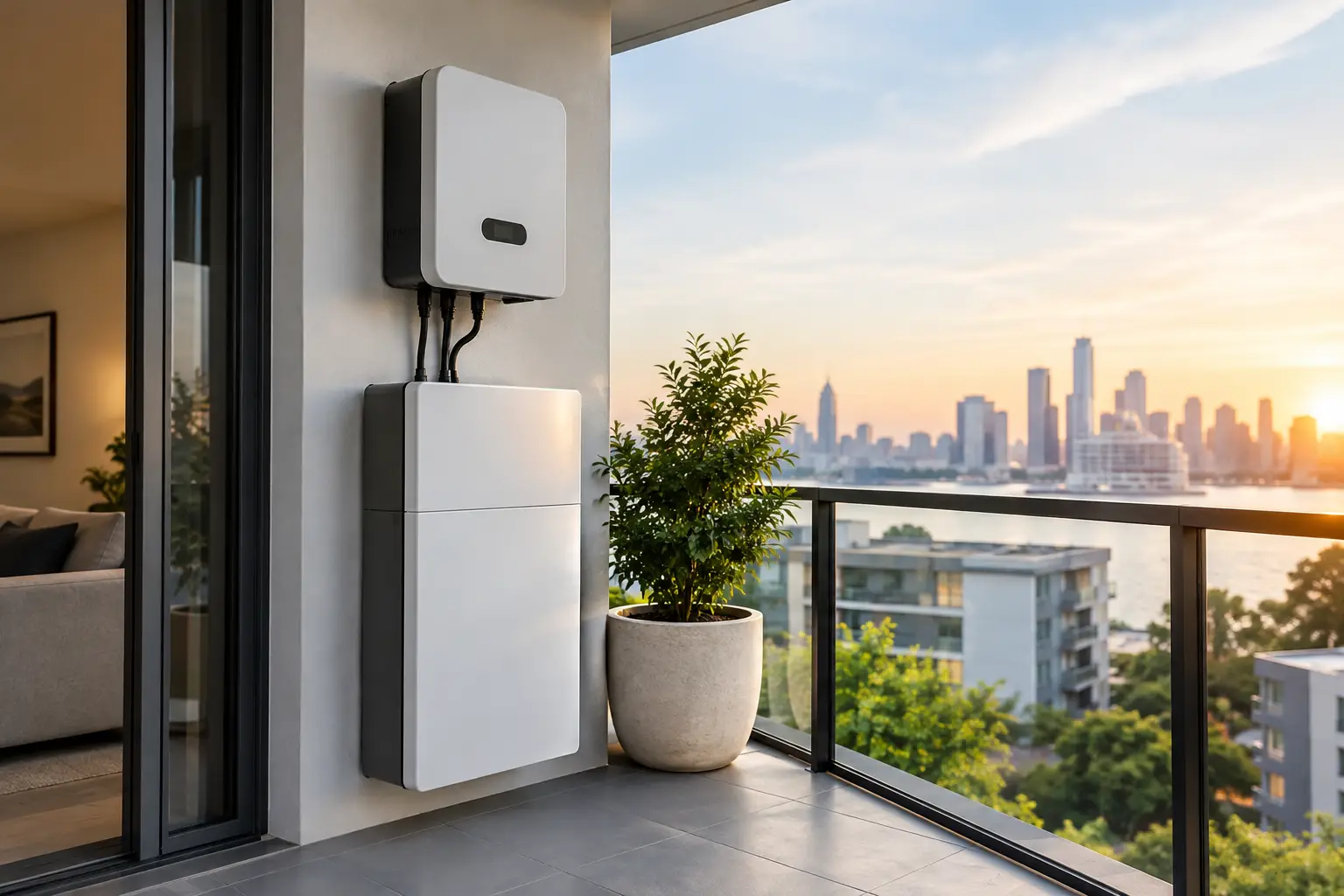
For apartment owners, the best solar batteries for apartments are not simply the biggest units with the highest advertised capacity. The right battery must fit the available space, work with your building’s electrical setup, meet strata requirements and deliver meaningful savings from the solar energy you can actually access. Get those details right and battery storage can reduce expensive evening grid usage, provide selected backup power and give you more control over rising electricity costs.
Apartment battery projects need more planning than a typical detached home installation. That does not make them unachievable. It means the best result starts with a clear assessment of ownership, solar access, switchboard capacity and your daily energy use.
What makes a battery suitable for an apartment?
A solar battery stores surplus electricity from your solar panels so it can be used later, rather than being exported to the grid for a relatively low feed-in tariff. In an apartment, the value is often strongest in the late afternoon and evening, when household demand rises and grid electricity is commonly more expensive.
The practical challenge is that apartments vary widely. You may have solar panels connected directly to your individual meter, access to a shared rooftop solar system, or no existing solar at all. Your battery may need to sit in a garage, storage area, utility room or a compliant outdoor location. Fire safety clearances, ventilation, access for installers and emergency services, and local building rules all matter.
A good apartment battery should offer safe chemistry, compact dimensions, intelligent monitoring and a capacity that suits your household rather than a generic package. It should also be compatible with your inverter and meter arrangement, or be part of a properly designed solar and battery upgrade.
The best solar batteries for apartments: what to compare
There is no single best brand for every apartment. The strongest choice depends on how much energy you use, whether backup power is important and what your strata scheme permits. However, several battery platforms are regularly considered for Australian apartment applications because they combine established local support, monitoring capability and scalable system options.
Tesla Powerwall 3
Tesla Powerwall 3 is often considered by apartment owners who want a high-capacity, all-in-one battery solution with strong monitoring features. It is designed to pair solar generation, battery storage and backup capability within a tightly integrated system. For a larger apartment, townhouse-style residence or a property with significant evening consumption, its capacity can be attractive.
The trade-off is that a larger battery is not automatically a better investment. If your apartment has limited solar generation or low daily consumption, much of that capacity may remain underused during parts of the year. Physical location, access and backup configuration also need careful site assessment.
Enphase IQ Battery systems
Enphase batteries are a compelling option for apartment owners with Enphase microinverters or those who value a modular system. Rather than committing to one large battery from the outset, a modular design can allow capacity to be built up over time as energy needs change.
This can suit smaller households that want to begin with storage sized for self-consumption, then add more capacity after reviewing real usage data. Enphase systems can also provide detailed monitoring at panel level when paired with compatible equipment. The right configuration still depends on switchboard space, installation location and whether backup circuits are required.
BYD Battery-Box with a compatible inverter
BYD Battery-Box systems are known for their modular format and broad compatibility with selected hybrid inverters. This flexibility can be useful where an apartment has an existing solar system and a battery upgrade is being considered.
A modular battery can be sized more precisely than a one-size-fits-all option. That matters in apartments, where solar output and available installation space may be limited. The critical point is compatibility: battery, inverter, solar array and backup equipment must be designed as one system, not selected as separate products on price alone.
Sungrow battery systems
Sungrow offers integrated inverter and battery options that are commonly used across Australian residential solar projects. For apartments with suitable solar access, a Sungrow system may provide a cost-effective path to storage, smart monitoring and selected backup functionality.
It is worth comparing the warranty, usable capacity, expansion options and backup performance against other shortlisted systems. A lower upfront price can be valuable, but only if the battery is appropriately sized, installed by accredited professionals and supported locally for the long term.
Size the battery around your apartment’s energy habits
Battery capacity is measured in kilowatt-hours, or kWh. The ideal size is based on the solar energy you regularly export and the electricity you need after the sun goes down. A small apartment occupied by one or two people may get better value from a modest battery than from a large unit that cannot be fully charged most days.
As a starting point, review your electricity bills and smart-meter data if available. Look at your daily usage, especially from late afternoon to morning, and compare it with the output from your solar system. A well-sized battery should absorb a useful portion of regular solar surplus and discharge during higher-cost periods.
Backup power changes the conversation. If you want a battery to keep essential loads running during an outage, identify those loads first. Lighting, the fridge, internet, selected power points and medical equipment may be priorities. Running every appliance, including ducted air conditioning, electric hot water or an induction cooktop, requires a much larger and more expensive design. Many apartment owners are better served by an essential-loads backup setup that focuses on comfort and safety.
Strata approval and common-property issues
For most apartment owners, strata approval is the first major consideration. Solar panels on a shared roof, cables running through common areas, battery placement in communal spaces and modifications to building infrastructure may all require formal approval.
Start by checking your strata by-laws and speaking with the strata manager or committee before purchasing equipment. Provide a clear proposal that explains where the battery will be installed, how it will be isolated, which areas are affected and how installation will meet relevant Australian Standards and manufacturer requirements.
If rooftop solar is common property, individual battery ownership can become more complex. In some buildings, the practical solution may be a shared solar and battery project managed by the owners corporation. In others, an individual system may be possible where dedicated panel allocation and metering can be established. The right pathway depends on the building’s electrical design and governance, not just the battery brand.
Check the installation location before choosing equipment
A battery should never be selected from a brochure without a site inspection. Apartment car parks and storage cages can appear convenient, but access restrictions, fire separation, flood exposure, vehicle impact risk and ventilation requirements can rule them out. Balconies can also be unsuitable due to space, weather exposure and building rules.
An experienced installer will assess the proposed location, cable route, switchboard condition, solar inverter compatibility and communications setup. They will also confirm whether the system needs a gateway, backup board or switchboard upgrade. This upfront work protects performance, compliance and warranty coverage.
Look beyond the purchase price
The best battery investment is measured over its working life, not by the initial quote alone. Compare usable capacity, expected daily cycling, warranty terms, product support, installation quality and monitoring features. Ask how the system will respond during an outage, which circuits will be backed up and whether future expansion is possible.
Government incentives can also affect the numbers. Battery and solar rebate programs, virtual power plant offers and retailer plans change over time and may have eligibility conditions. Professional guidance can help you understand the available options without building your decision around an incentive that does not suit your usage or building arrangement.
GridFree Solar can assess whether your apartment is suitable for solar and battery storage, design a system around your consumption and help navigate the installation, compliance and rebate process. A properly planned battery is not just a piece of hardware on a wall. It is a practical way to keep more of the energy you generate, use less costly grid power and make your apartment work harder for you.
Before choosing a model, start with your building, your electricity profile and your backup priorities. That is how an apartment battery becomes a reliable long-term energy upgrade rather than an expensive compromise.