
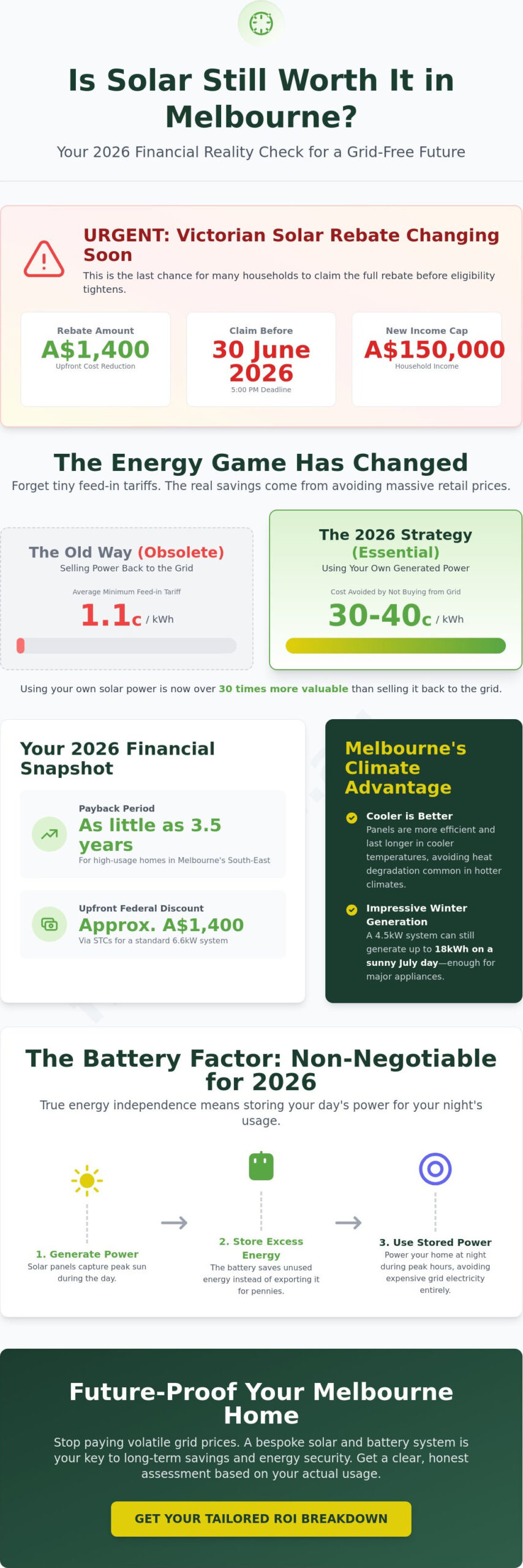
If your household earns over A$150,000, you have until 5 pm on 30 June 2026 to claim your A$1,400 Victorian solar rebate before the eligibility gates slam shut. With the average minimum feed-in tariff in Victoria now sitting at a dismal 1.1c per kWh, the old strategy of selling power back to the grid is officially dead. You’re likely feeling the squeeze of skyrocketing electricity costs and asking the hard question: is solar worth it Melbourne? It’s exhausting to navigate the noise of ‘solar cowboys’ while trying to secure your energy future in a climate known for its four seasons in one day.
We’re cutting through the confusion to show you the brutal truth about solar savings in 2026, focusing on intelligent battery integration and genuine energy independence. You’ll discover the latest payback periods, the reality of winter performance, and how to outsmart the big retailers. This definitive guide provides a clear roadmap to a future-proofed home that thrives regardless of rising grid prices and shifting government policies.
Key Takeaways
- Secure your A$1,400 Victorian rebate before the income eligibility cap drops to A$150,000 on 1 July 2026. This time-sensitive opportunity is the last chance for many high-earning Melbourne households to reduce upfront costs.
- Understand why the question of is solar worth it Melbourne now depends entirely on self-consumption rather than grid exports. With feed-in tariffs averaging just 1.1c per kWh, using your own energy is the only path to a fast payback.
- Prioritise battery storage to capture midday generation and avoid expensive peak-hour retail rates. Modern batteries are no longer an optional extra but a core component for achieving true energy independence.
- Leverage Melbourne’s cool climate to maximise panel efficiency even during cloudy periods. Well-designed systems are engineered to perform year-round, generating significant power despite the city’s variable winter weather.
- Avoid ‘cookie-cutter’ installations by conducting a thorough audit of your energy bills and household habits. A bespoke design ensures your investment is future-proofed for high-drain appliances and upcoming technological shifts.
Is Solar Still Worth It in Melbourne for 2026? The Honest Verdict
The energy game in Victoria has fundamentally shifted. By mid-2026, the question of is solar worth it Melbourne isn’t about the pittance the grid pays you; it’s about the massive costs you avoid. Retail electricity prices continue to climb, yet regulated minimum feed-in tariffs have vanished. With the average minimum rate now sitting at a dismal 1.1c per kWh, the old strategy of ‘exporting for profit’ is dead. This marks the birth of the self-consumption era. You’re no longer a mini-power station selling to big retailers. You’re a self-sufficient homeowner shielding your bank account from the Victorian Default Offer (VDO) hikes.
Despite the ‘four seasons in one day’ reputation, Melbourne’s latitude remains a powerhouse for generation. The payback period for a high-quality system can be as little as three and a half years in certain conditions. This rapid return on investment is driven by the widening gap between what you pay for power and what you save by generating your own. Every kilowatt-hour used at home is worth significantly more than one sold back to the grid. To win in 2026, you must prioritise using your own clean energy as it’s produced. When you stop paying 30 or 40 cents per unit to a retailer, is solar worth it Melbourne becomes a resounding yes.
The Reality of Melbourne’s Solar Potential
Don’t let the grey skies fool you. Solar panels thrive on light, not heat. Excessive heat actually degrades panel efficiency, making Melbourne’s cooler, breezy conditions ideal for hardware longevity and daily performance. When examining the broader context of Solar power in Australia, Victoria’s insolation levels are more than sufficient for high-yield residential systems. Even in the depths of July, a sunny day can see a 4.5kW system generate up to 18kWh. This is ample power to cover major household appliances, provided you time your usage correctly. Our unique temperature swings are actually a benefit, keeping your inverter and cells within optimal operating ranges more often than in the sweltering northern states.
Rising Power Bills vs. Solar Investment
Energy independence is the ultimate hedge against inflation. As the VDO trends upward, solar owners lock in their power costs for the next two decades. The financial window for entry is also tightening. The Victorian Government’s Solar Homes Program will reduce the income eligibility cap from A$210,000 to A$150,000 on 1 July 2026. This creates a time-sensitive imperative for many Melbourne families. Beyond the balance sheet, there’s a profound peace of mind factor. You can run your climate control during a February heatwave without dreading the next quarterly statement. To further boost your home’s thermal efficiency, you can visit QLD Shade to see how premium shutters and awnings can naturally lower indoor temperatures. You aren’t just buying hardware; you’re securing a fixed, low-cost energy future in an increasingly volatile market.
Calculating Your ROI: The 2026 Melbourne Financial Breakdown
The financial math behind your roof has fundamentally changed. In 2026, the question of is solar worth it Melbourne is answered by the speed of your Return on Investment (ROI) and how effectively you bypass retail price hikes. While a premium installation requires a significant initial outlay, federal and state incentives drastically lower that barrier. Small-scale Technology Certificates (STCs) provide an immediate upfront discount of approximately A$1,400 for a standard 6.6kW array. Don’t be seduced by the ‘cheap solar’ trap. Systems marketed at impossibly low prices often use sub-par inverters and low-grade panels that fail within years. It’s the most expensive mistake you’ll make. High-quality hardware pays for itself through reliability; budget junk just costs you twice in repairs and lost generation.
In the South-East suburbs, a well-optimised system can achieve a payback period in as little as three and a half years for high-usage homes. Larger 10kW systems offer even better economies of scale for families with high daytime demand. A payback period is the time it takes for the total electricity bill savings to equal the initial net cost of the solar installation. To understand the full breakdown of what you’ll pay in 2026, including how STC deeming periods and tiered rebate structures affect your upfront costs, review the detailed solar system price Victoria homeowners guide for a complete picture of current market rates. If you’re looking for a precise estimate based on your specific consumption, you can request a tailored ROI breakdown from a local expert who understands Victorian energy rates.
Victorian Government Incentives & Rebates
The window for maximum state support is closing. Solar Victoria’s Solar Homes Program currently offers a rebate of up to A$1,400 plus an optional interest-free loan of the same amount. However, urgency is paramount. On 1 July 2026, the household income eligibility cap will drop from A$210,000 to A$150,000. If your household earns between these figures, you must submit your application by 5 pm on 30 June 2026 to secure your funding. A specialist installer should manage this administrative burden for you, ensuring your paperwork is lodged correctly and on time.
Payback Periods by Household Type
Your lifestyle dictates your savings. ‘Daytime Users’, such as retirees or those who work from home, see the fastest ROI because they consume energy as the sun produces it. Conversely, ‘Evening Peakers’ who use most of their power after sunset will find that is solar worth it Melbourne depends heavily on shifting their appliance use or adding storage. Introducing an Electric Vehicle (EV) into the mix accelerates your ROI dramatically. By charging your car with your own solar production rather than grid power, you effectively eliminate petrol costs while shortening your system’s payback period by months.
The Battery Factor: Why Storage is Non-Negotiable for 2026 ROI
Stop donating your energy to big retailers for a pittance. A standard 6.6kW system produces its peak power while most Melbourne homes are empty. Without storage, that excess energy vanishes into the grid for a measly 1.1c per kWh. This is why is solar worth it Melbourne is a question that now requires a battery-first answer. Intelligent storage transforms your home from a passive consumer into an active energy manager. You capture the midday surge and deploy it when retailers charge their highest peak rates. It is about total control over your generation. You no longer rely on the grid’s charity; you rely on your own reserves.
Beyond the daily cycle, there is the security factor. Melbourne’s storm seasons are becoming more volatile. Blackout protection provides the unquantifiable value of keeping your fridge running and lights on when the local grid fails. Whether you are looking at a Victorian Government’s Solar Homes Program rebate for a new installation or a battery upgrade, scaling for the future is essential. High-quality hardware ensures you can add capacity as your energy needs grow, especially with the inevitable shift toward electric transport. For Victorian households seeking a “set and forget” energy strategy, investing in a LiFePO4 battery is widely regarded as the safest and longest-lasting chemistry available for residential solar storage.
How VPPs Change the Economic Equation
Virtual Power Plants (VPPs) have revolutionised the ROI timeline for Victorian households. By joining a VPP, you allow a provider to orchestrate your battery’s discharge during grid stress events. You participate in grid arbitrage; buying low, storing, and selling at a premium during Melbourne’s summer heatwaves. Providers like Amber Electric or Flow Power allow you to tap into these spot price spikes. A typical 10kWh battery can generate hundreds of dollars in annual credits through these programs, effectively shaving years off the traditional payback period that sceptics often cite.
Maximising Self-Consumption
Standard solar-only homes often struggle to reach 30% self-consumption. Most of the generation happens when the house is quiet. Adding smart storage pushes that figure toward 90%. Modern smart inverters act as the brain of the operation. They automatically prioritise your home loads and EV charging before sending a single watt to the battery. This integrated approach is why we focus on battery-ready designs from day one. You aren’t just buying a box. You’re installing an intelligent energy ecosystem that ensures is solar worth it Melbourne remains a definitive yes for your specific lifestyle.
Overcoming Melbourne Weather: Performance in Clouds and Winter
Melbourne’s variable weather is not a dealbreaker. It’s an advantage. Solar panels are light-driven, not heat-driven. High temperatures actually degrade performance. Melbourne’s cool breezes keep cells within optimal thermal ranges, ensuring higher efficiency than in sweltering northern climates. When sceptics ask is solar worth it Melbourne, they’re usually picturing a grey July morning. They’re missing the bigger picture. Modern panels are engineered to harvest diffuse light through thick cloud cover, meaning your system keeps working even when the sun isn’t visible.
Winter performance is predictable and manageable. In July, output typically drops to 50% of the annual average. But don’t let that discourage you. A sunny winter day can still see a 4.5kW system generate up to 18kWh. This is more than enough to cover your essential daytime loads. Success at Melbourne’s latitude requires precision. A panel tilt of 30 to 35 degrees is essential to capture the low-hanging winter sun and maximise your ROI during the shortest days of the year.
Leafy suburbs like Camberwell or Ivanhoe face unique shading hurdles. A single shaded panel can cripple a traditional string inverter system, dragging down the performance of every other panel in the series. Micro-inverters are the solution. They allow each panel to operate as an independent unit. If a gum tree limb shades one corner of your roof, the rest of the array continues at full capacity. This ensures is solar worth it Melbourne remains a positive calculation even for homes with significant canopy cover.
Choosing Hardware for the Victorian Climate
N-Type solar cells are the gold standard for 2026. They offer superior low-light performance and lower degradation rates compared to older P-Type technology. For bayside residents from Brighton to Frankston, salt mist corrosion resistance is a non-negotiable specification. Tier 1 hardware comes with a 25-year performance warranty. This isn’t just a marketing claim; it’s a financial safeguard. It ensures your system survives the Bass Strait winds and delivers consistent power for decades.
Maintenance and Monitoring
Does Melbourne rain actually clean your panels? Generally, yes. The city’s frequent showers are usually sufficient to wash away light dust and pollen. However, heavy bird droppings or thick soot require a professional eye to maintain peak efficiency. Use monitoring apps to track daily yields in real-time. If you see a sudden dip compared to your historical data, you’ll know there’s an issue before your next bill arrives. Local Melbourne support is vital here. You need a team that understands our specific grid requirements, not a national call centre reading from a script.
Ready to see how your roof handles the winter sun? Book a custom design assessment to get a performance forecast for your specific location.
Your Melbourne Solar Action Plan: Getting Started with GridFree
Transitioning to clean energy requires a methodical approach to ensure maximum ROI. In 2026, the question is solar worth it Melbourne is answered through precision engineering and strategic timing. Don’t rush into a generic package. Follow this five-step roadmap to secure your energy independence and outsmart rising retail prices. Success depends on data, not guesswork.
- Step 1: Energy Audit. Review your last four bills from United Energy, Jemena, or Citipower. We analyse these to identify your seasonal consumption patterns and peak demand periods. This data forms the foundation of your savings forecast.
- Step 2: Custom Design. ‘Cookie-cutter’ 6.6kW kits fail most Melbourne homes. We design bespoke arrays that account for your specific roof orientation and local shading issues. A tailored layout ensures every panel performs at its peak.
- Step 3: Rebate Approval. Secure your spot in the Solar Homes Program. Remember, the income eligibility cap drops on 1 July 2026. We handle the administrative heavy lifting to lock in your A$1,400 rebate and interest-free loan.
- Step 4: Professional Installation. Expect a seamless process. Our team manages the grid connection and hardware mounting with minimal disruption to your daily routine. We ensure all components meet rigorous Australian standards.
- Step 5: Post-Install Optimisation. We set up your monitoring apps and integrate your system with a Virtual Power Plant. This ensures you start earning grid credits and maximising self-consumption from day one.
Why GridFree Solar is the Local Choice
We aren’t just installers. We’re energy strategists. As a Clean Energy Council (CEC) Approved Seller, GridFree Solar maintains the highest standards of hardware and safety. Our expertise extends beyond simple panels. We specialise in complex battery integration, ensuring your home is ready for the self-consumption era. If you have an ageing system that isn’t delivering the results you expected, explore our Solar Battery Replacement services to revitalise your existing setup with modern, high-efficiency storage.
Ready to Slash Your Bills?
The window for maximum government support is closing fast. is solar worth it Melbourne? Yes, but only if you act before the 30 June 2026 deadline for high-income households. We provide a no-obligation, data-backed assessment of your roof’s potential using advanced solar modelling software. Current lead times for Victorian installations are steady, but demand is expected to surge as the rebate deadline approaches. Secure your energy future now. Book Your Melbourne Solar Assessment Today and take the first step toward true grid independence.
Secure Your Energy Independence Before the Deadline
The Victorian energy market won’t wait for you to catch up. We have proven that is solar worth it Melbourne is a resounding yes, but only for those who pivot to smart storage and claim their state incentives before the 1 July 2026 income cap reduction. Shifting your focus to self-consumption is the only definitive way to neutralise rising retail rates and take control of your household budget. Melbourne’s temperate climate provides the perfect backdrop for hardware longevity, ensuring your high-performance investment delivers reliable power through every season.
As a CEC Approved Solar Retailer and Victorian battery rebate specialists, we offer the technical authority you need to navigate this transition. Our local Melbourne installation teams ensure your system is engineered for maximum ROI and long-term stability. Don’t let another expensive quarterly bill cycle erode your savings while you wait on the sidelines. It is time to join the thousands of Victorian homeowners who have already secured their financial future.
Get a Free, No-Obligation Solar ROI Forecast for Your Melbourne Home and start your journey toward total grid independence today.
Frequently Asked Questions
Is solar actually worth it in Melbourne given the cloudy weather?
Yes. Solar panels generate electricity from light, not heat, meaning they perform exceptionally well even on overcast Victorian days. Melbourne’s cooler climate prevents the thermal degradation often seen in northern states, allowing your hardware to operate at peak efficiency for longer. While winter yields are lower, the annualised savings from bypassing retail price hikes ensure is solar worth it Melbourne remains a definitive yes for proactive homeowners.
How much does a typical 6.6kW solar system cost in Melbourne in 2026?
A high-quality 6.6kW installation generally ranges between A$5,250 and A$8,900 depending on component selection. Premium systems featuring advanced N-Type cells or micro-inverters can reach between A$6,800 and A$11,000. Avoid budget systems priced significantly below these markers; they often use inferior components that fail to survive Melbourne’s volatile weather conditions and lack local warranty support. For a comprehensive breakdown of what drives these price differences in 2026, including the impact of STC deeming period reductions and the new tiered battery rebate structure, see our full solar system price Victoria cost guide.
Can I still get the Victorian solar rebate in 2026?
Yes, but the window for eligibility is rapidly closing for many households. The Solar Homes Program currently offers a rebate of up to A$1,400, but a critical regulatory shift occurs on 1 July 2026. On this date, the household taxable income eligibility cap will drop from A$210,000 to A$150,000. You must submit your application by 5 pm on 30 June 2026 to secure funding under the current, more inclusive threshold.
Is it better to wait for battery prices to drop further?
Delaying your investment is usually a financial mistake due to the high opportunity cost of remaining on the grid. While hardware costs fluctuate, the immediate savings from self-consumption and Virtual Power Plant (VPP) income outweigh potential future price drops. Every month you wait is another month of paying 30c to 40c per kWh to a retailer while your panels could be generating that power for free.
How long is the payback period for solar in Victoria?
Most Melbourne households achieve a full return on investment within three and a half to seven years. This timeline depends heavily on your ability to maximise self-consumption during daylight hours or store excess energy in a battery. With the average minimum feed-in tariff now at 1.1c per kWh, the fastest path to ROI is using your own power rather than selling it back to the grid. This shift in strategy is why is solar worth it Melbourne now depends on intelligent energy management, which includes reducing the heat load on your home with solutions like Best Outdoor Blinds to lower cooling costs.
Do I need to clean my solar panels in Melbourne?
Melbourne’s frequent rainfall typically handles the majority of cleaning by washing away dust and pollen. However, you should still conduct a visual inspection annually to check for heavy debris, bird droppings, or soot buildup which can block light and reduce efficiency. If your monitoring app shows a sudden dip in performance that doesn’t align with weather patterns, it is time to check your array for obstructions.
What happens to my solar power during a blackout?
Standard solar systems automatically shut down during a blackout to prevent power from ‘back-feeding’ into the grid and endangering line workers. If you require energy security during outages, you must install a battery with an ‘islanding’ or blackout protection feature. This allows your home to operate as an independent micro-grid, keeping your essential appliances running even when the rest of the street is in darkness.
Which is better for Melbourne: North-facing or East-West facing panels?
North-facing panels provide the highest total annual yield, but an East-West orientation is often superior for households without batteries. East-facing panels capture the morning sun when you’re getting ready for work, while West-facing panels power your home during the expensive late-afternoon peak. A split array provides a more consistent power curve throughout the day, which is essential for maximising self-consumption and reducing your reliance on expensive grid power.