
Last Updated: November 1, 2026
Quick Summary
Solar inverter repair cost is driven by the diagnostic fee, labour, parts and the value of lost generation while the system is down. A single repair on a young inverter is usually money well spent, but a second major repair on an inverter past its service life rarely pays back before the next fault.
- A repair quote should itemise the fault found, parts, labour, timeframe and its own warranty.
- Heat, grid voltage issues, moisture and failed capacitors or boards cause most inverter faults.
- Inverters do not last as long as panels and most fail well before the array does.
- Manufacturer warranties often exclude labour, callout fees and freight, so a claim can still cost you.
- String inverters are generally the simplest and cheapest type to replace.
Table of Contents
- Repair or Replace? How to Read the Warning Signs
- Solar Inverter Repair Cost: What You Pay For
- Solar Inverter Replacement Cost: What a New Unit Involves
- Solar Inverter Lifespan: When Age Tips the Decision
- Solar Inverter Warranty: What It Covers and What It Doesn’t
- Repair vs Replace: A Practical Decision Framework
- What a Repair or Replacement Quote Should Include
- Book a GridFree Solar Inverter Assessment
- Frequently Asked Questions
Repair or Replace? How to Read the Warning Signs
A dead inverter is one of the most common faults in a home solar system, and the decision that follows is rarely simple. This guide from GridFree Solar sets out the real cost of solar inverter repair vs replacement, so you can choose with numbers rather than guesswork. The warning signs usually appear well before total failure, and catching them early changes the maths considerably.
Symptoms of a Faulty or Failed Inverter
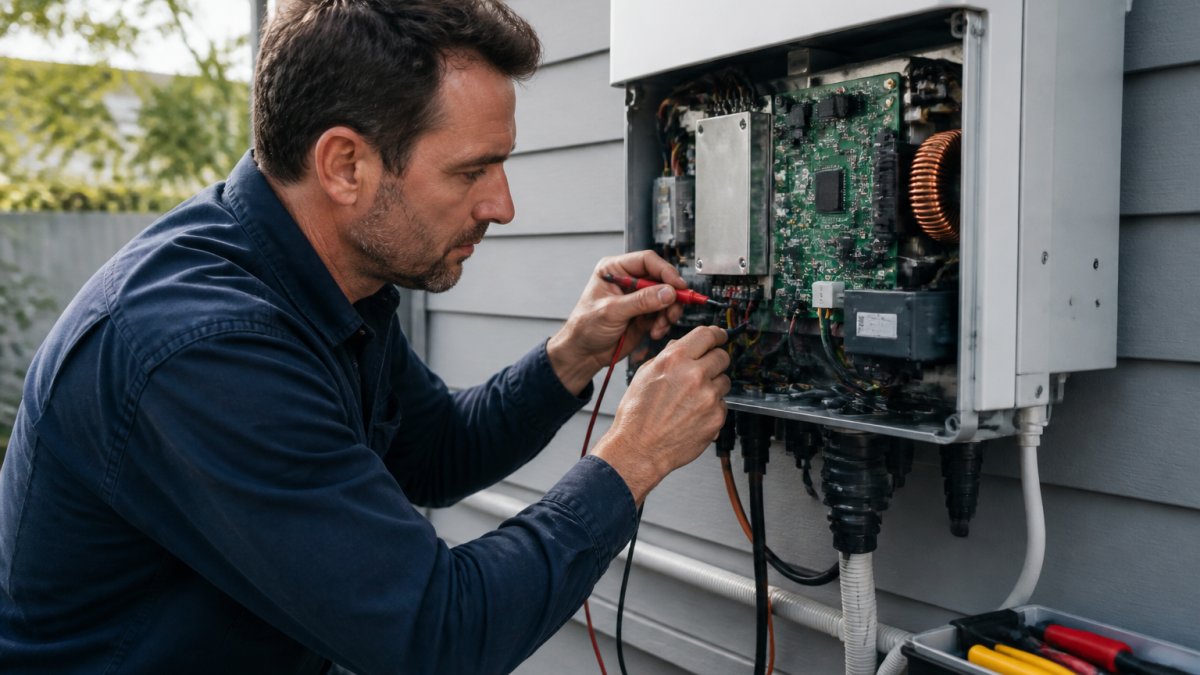
A faulty inverter announces itself in a handful of recognisable ways. A blank display, a unit that trips its power switch repeatedly, or an app that stops reporting are the obvious ones. Subtler signs matter just as much: output that drops on clear days, error codes that clear then return, or a fan that runs constantly.
Watch out: a repeatedly tripping inverter is not a nuisance to ignore. Persistent faults can indicate an internal problem that worsens with every restart. If you rely on monitoring, review the inverter app’s historical output before calling anyone; a pattern of declining generation tells a technician far more than a single bad day. Our guide to monitoring your solar system’s performance and home energy use explains what normal output looks like across seasons.
Common Inverter Faults and What Causes Them
Most inverter faults trace back to a small set of causes. Heat is the big one: inverters mounted in direct sun or a poorly ventilated garage run hotter than they should, and electronics age faster at high temperature. Grid voltage issues, moisture ingress and failed capacitors or circuit boards account for most of the rest.
A common mistake is assuming every fault means a new unit. Some faults are genuine board-level failures; others are wiring, firmware or isolator issues a qualified technician can resolve on a service call.
Solar Inverter Repair Cost: What You Pay For
Solar inverter repair cost is driven by four components: the diagnostic fee, labour, parts, and the value of the energy you are not generating while the system is down.
Diagnostic and callout. Ask before booking whether a diagnostic fee applies and whether it is credited against the repair if you proceed, the answer changes the effective cost of a small repair. For current pricing and quotes, contact GridFree Solar directly.
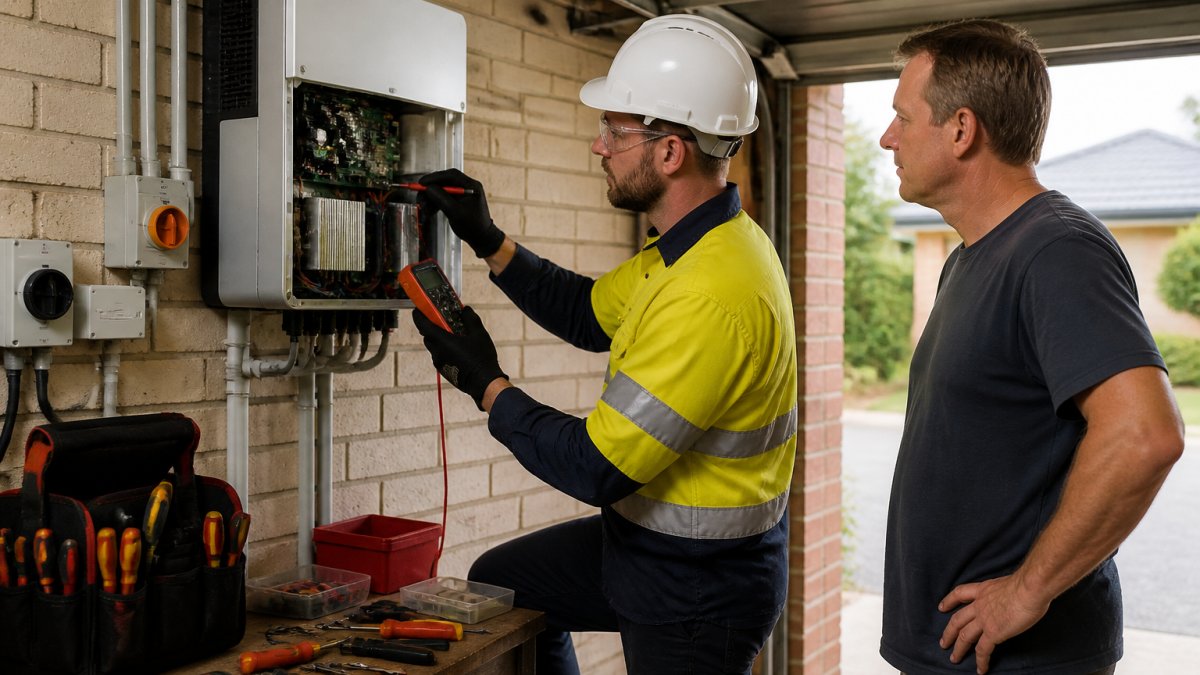
Labour. Labour is typically billed by the hour, and the hours depend on access. A wall-mounted string inverter in a ventilated garage is a straightforward job; a unit in a hot roof space, behind landscaping, or on a multi-storey wall takes longer and costs more in access and safety planning. Labour also covers isolation, testing and recommissioning, not just the swap of a part.
Parts. This is where quotes diverge most. A circuit board, display module, fan assembly or communication card for an older model may be hard to source, no longer stocked, or only available as a refurbished unit. If a replacement board is unavailable, a repair quote can climb toward the price of a new inverter, and the repair still leaves you with an aging unit.
Downtime. A repair that takes three weeks to source a part is not the same as a repair completed in two days. Every day the inverter is offline is a day of lost generation, and that lost production has a dollar value. Estimate it by taking your system’s average daily output, multiplying by your self-consumption and export rates, and multiplying again by the number of days offline. In summer the daily loss is higher than in winter, so a fault in December costs more in lost production than the same fault in June.
A repair quote should state the fault found, the parts required, the labour estimate, the expected timeframe, and whether the work carries its own warranty. A quote that says only “repair inverter, $X” is not comparable to anything.
The repeat-repair trap. A single repair on a young inverter is usually money well spent. But if the same unit has already had one major repair, the expected cost is not the repair quote, it is the repair quote plus the probability-weighted cost of the next failure. A second board-level repair on an inverter past its service life often fails to pay back before the next fault arrives.
What a Repair Quote Should Itemise
To compare quotes accurately, ask for each of the following as a separate line:
- Diagnostic fee and whether it is credited against the repair
- Parts, with part numbers and whether new, refurbished or third-party
- Labour hours and hourly rate
- Access equipment or safety planning, if required
- Freight for parts, if not stocked locally
- Warranty on the repair itself, and its duration
- Expected downtime and the assumed date parts will arrive
A quote that itemises these lets you compare like for like. A quote that bundles them does not.
Solar Inverter Replacement Cost: What a New Unit Involves
Solar inverter replacement cost is not just the box on the wall. A proper installed cost includes the unit itself, labor to remove and refit, any switchboard or isolator work, and commissioning. Like-for-like replacement is the cheapest path; changing inverter type or adding battery readiness adds cost and complexity.
Efficiency ratings matter here, because a more efficient unit generates more from the same panels over its life. If you are comparing models, our guide to solar inverter efficiency ratings explains what the figures mean in practice, and our advice on choosing the right solar inverter for Australian homes covers sizing and compatibility. GridFree Solar provides installed quotes so the comparison is like for like.
Solar Inverter Lifespan: When Age Tips the Decision
Solar inverter lifespan is the single strongest argument in the repair-or-replace debate. Inverters do not last as long as panels, and most reach the end of their reliable service life well before the array does. An inverter past its expected service life that fails once will usually fail again.
That is the tipping point. Spending on a major repair for an old unit buys time, not reliability, and the next failure may arrive within a year. If the unit is young and the fault is minor, repair wins comfortably. If it is old and the fault is board-level, replacement is usually the economical choice. For wider context on system life and future costs, see our article on estimating solar system lifespan and replacement costs.
Solar Inverter Warranty: What It Covers and What It Doesn’t
Solar inverter warranty terms vary widely, and the detail decides who pays. Most manufacturer warranties cover the unit and parts for a defined period, but labor, callout fees and freight are frequently excluded or capped. A warranty claim can still leave you out of pocket.
Consumer guarantees under the Australian Consumer Law can sit alongside the manufacturer warranty. Check the current guidance from the Australian Competition and Consumer Commission for how they apply. Keep your installation paperwork, as claims may depend on proof of a licensed install. Before authorising any repair, check whether the fault falls inside the warranty period; a warranty repair costs you nothing but time.
Repair vs Replace: A Practical Decision Framework
Use this framework to score the decision. If most answers land on the left, repair. If most land on the right, replace.
| Question | Repair | Replace |
|---|---|---|
| Inverter age | Within service life | Past expected lifespan |
| Fault type | Minor, single component | Board-level or repeated |
| Parts availability | Readily sourced | Obsolete or unavailable |
| Warranty status | Still covered | Expired |
| Repair cost vs new unit | Well below | Close to or above |
| Downtime tolerance | Can wait for parts | Needs power restored |
The Lifetime Cost View
The cheapest quote today is rarely the cheapest outcome. Compare the repair cost plus the likely cost of the next repair against the installed cost of a new unit spread over its service life. A single repair on a young inverter almost always wins. A second major repair on an old one rarely does.
Cost by Inverter Type and System Size
String inverters are generally the simplest and cheapest to replace. Hybrid inverters cost more because they manage battery charging as well as solar. Microinverters sit behind each panel, so a fault affects one panel and replacement is modular, though access and labor differ. Larger systems need larger inverters, which raises the unit cost. If you are weighing a replacement that adds battery readiness, our guide to upgrading your solar inverter for a battery covers the site checks and eligibility questions first.
What a Repair or Replacement Quote Should Include
A quote you can compare should name the fault found, list parts and labor separately, state the diagnostic fee, and give a clear timeframe. For replacement, it should specify the model, its efficiency rating, whether switchboard work is included, and who handles warranty registration. Ask whether old equipment is removed and disposed of, and get the total in writing before work starts.
Book a GridFree Solar Inverter Assessment
A failing inverter is a decision with a deadline, and guessing costs money either way. GridFree Solar’s CEC Accredited Installer team can diagnose the fault and explain repair and replacement options. Installations are designed to comply with AS/NZS 5139:2019 and AS/NZS 3000. GridFree Solar also provides rebate guidance and battery upgrade planning.
Frequently Asked Questions
How long should my solar inverter last?
Most string inverters last around 10 to 15 years, while microinverters and some hybrid units can reach 15 to 20 years. Actual solar inverter lifespan depends on heat exposure, ventilation, and how hard the unit works. An inverter past year 10 that needs a major repair is usually a candidate for replacement, because a second failure within a few years is common and the money spent on the first repair is lost.
Do you need a licensed electrician to repair a solar inverter?
Yes. Inverter work involves DC and AC wiring connected to your switchboard, so it must be done by a licensed electrician, and solar installations should use a Clean Energy Council accredited installer. Attempting a DIY repair risks electric shock, voids your solar inverter warranty, and can breach AS/NZS 3000 wiring rules. Always ask for the licence number and a Certificate of Electrical Safety when the job is finished.
When is it better to replace a solar inverter than repair it?
Replacement often makes more sense when the unit is well past its expected service life, when the repair quote approaches the price of a new inverter, when the fault is in the circuit board or transformer, or when the same unit has already been repaired. If your system is still under warranty, check the warranty terms first. A like-for-like replacement also lets you move to a newer, more efficient model.
Does solar inverter replacement include installation?
A proper quote should state this clearly. A solar inverter replacement quote should set out what it includes, such as the new unit, labour, removal of the old inverter, reconnection and testing. Ask whether the price covers any switchboard changes, mounting adjustments, and warranty registration. If the replacement unit is a different brand or size, confirm compatibility with your existing solar panels and monitoring before accepting the quote.
