Table of Contents
- What You’ll Need Before You Start Comparing Solar Inverters
- String Inverter vs Microinverter Efficiency: Which Suits Your Roof?
- Hybrid Solar Inverter Benefits for Battery-Ready Households
- How to Size a Solar Inverter to Your Array and Load Profile
- CEC Approved Solar Inverters List: What to Check Before You Sign
- Grid Compliance, AS/NZS 4777 and State Battery Rules
- Warranty, Firmware Updates and the Repair vs Replace Decision
- Conclusion
- Frequently Asked Questions
Last Updated: September 21, 2026
What You’ll Need Before You Start Comparing Solar Inverters
Choosing the right solar inverter starts with three things: your roof’s shading pattern, your daily energy use, and your plans for a battery. This guide walks you through how to choose the right solar inverter for Australian homes, from sizing to compliance.
The inverter is the brain of your solar system. It turns the direct current (DC) your panels make into the alternating current (AC) your home uses. Pick the wrong one and you lose power, money, and warranty cover.
Gather these before you compare models:
- A recent power bill showing your daily usage in kilowatt-hours (kWh)
- Your roof’s orientation and any shade from trees or buildings
- A battery plan for the next five years, even a rough one
- Your switchboard’s age and available wall space
The Clean Energy Council’s approved products list is the best place to confirm a model is eligible for rebates.
Check your switchboard first. Many older homes need an upgrade before any inverter can be installed, and that cost lands outside the solar quote.
String Inverter vs Microinverter Efficiency: Which Suits Your Roof?
String inverters and microinverters both convert solar power, but they handle shade and roof layout very differently. A string inverter connects all panels to one central unit. Microinverters sit under each panel and convert power individually.
String inverter: one box on the wall, lower cost, easy to service. Best for unshaded roofs facing one direction.
Microinverter: one unit per panel, better shade tolerance, panel-level monitoring. Best for complex or partly shaded roofs.
Hybrid inverter: a string inverter with battery inputs built in.
Shading, Roof Orientation and Power Optimizers
Shade on one panel drags down the whole string unless you add power optimizers. These small devices sit behind each panel and keep the rest of the array working when one is shaded.
Hybrid Solar Inverter Benefits for Battery-Ready Households
Hybrid solar inverter benefits come down to one thing: you avoid buying a second inverter later. A hybrid unit manages your panels and your battery from day one, so adding storage is a plug-in job rather than a full replacement.
Hybrid units also let you:
- Charge a battery from solar during the day
- Pull cheap grid power overnight when tariffs are low
- Export stored power during high feed-in tariff windows
- Keep essential circuits running during an outage
A hybrid inverter only helps if it is compatible with the battery you eventually buy. Check the approved battery list before you sign, or you may pay for hybrid capability you can never use.
How to Size a Solar Inverter to Your Array and Load Profile
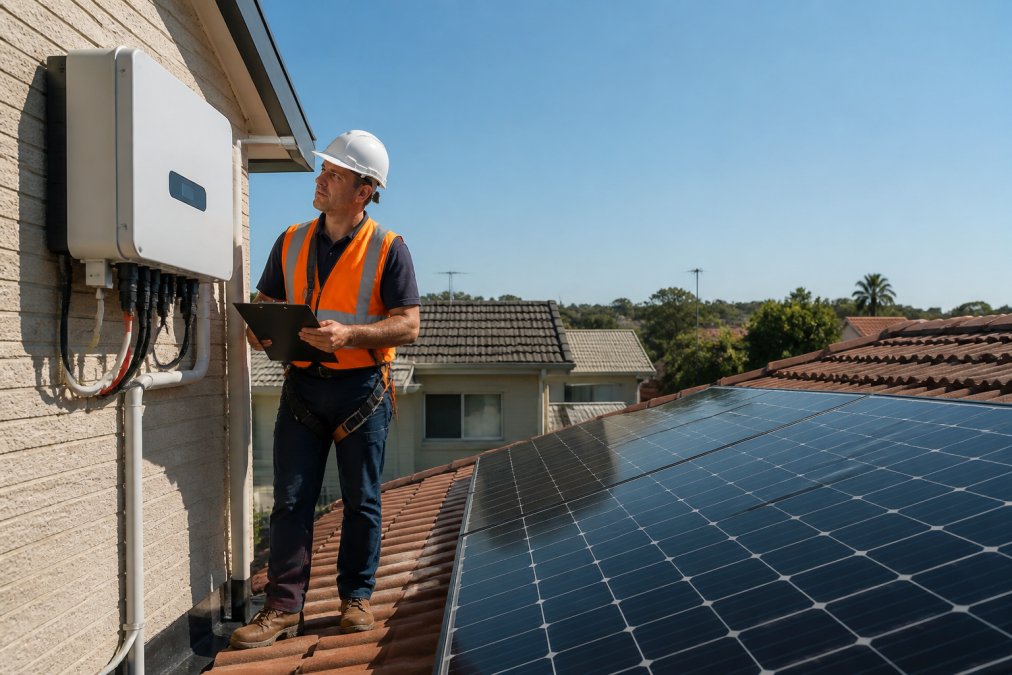
Sizing is where most quotes go wrong. The inverter should match your array’s realistic output and your home’s load profile, not just the panel count on the roof. Get this wrong and you either clip heavily at midday or pay for capacity you never use.
AC/DC Ratio, Clipping and Peak Demand
The AC/DC ratio compares your inverter’s capacity to your array’s rated output. A ratio between 1.0 and 1.3 is common, and a slightly oversized array is normal. The reason is that panels rarely hit their rated output, real-world conditions cut them back.
Here is the trade-off:
| AC/DC Ratio | What Happens | Best For |
|---|---|---|
| Under 1.0 | Inverter rarely maxes out, higher cost per watt | Shaded roofs, north-facing only |
| 1.0 to 1.2 | Balanced output, minimal clipping | Most homes |
| 1.2 to 1.33 | Some clipping at midday, faster payback | Large arrays, low daytime use |
| Over 1.33 | Noticeable clipping, check network limits | Rarely recommended |
Temperature Derating and Inverter Oversizing
Most inverters are rated at 25°C ambient, but a wall-mounted unit in a garage or on a west-facing wall can sit at 45°C or more on a summer afternoon. When that happens, the inverter derates, it throttles output to protect itself. A 5 kW inverter on a hot wall may only deliver 4.2 kW at the moment your array is producing peak power.
Single-Phase vs Three-Phase and Load Profiling
Most suburban homes have a single-phase supply, which caps inverter capacity at around 5 kW in many network areas. Three-phase homes can install larger inverters and balance loads across phases, which matters if you run heavy equipment or plan a large array.
To profile your load properly, look at three things:
- Base load, the constant draw from fridges, standby power, and always-on devices. This is what a battery covers overnight.
- Daytime load, what runs while the sun is up. This is what your solar covers directly.
- Evening peak, the spike from cooking, heating, and EV charging. This is what drives battery sizing and inverter capacity decisions.
CEC Approved Solar Inverters List: What to Check Before You Sign
The CEC approved solar inverters list is the first filter for any quote. Only listed models qualify for federal rebates and network connection.
Check these before you sign:
- The exact model number, not just the brand
- Current listing status on the CEC database
- Efficiency rating and its test conditions
- Battery compatibility if you plan storage
- Warranty length and who honours it locally
A quote naming a brand but not a model number is a red flag. Installers can swap in a cheaper unit on the day, and you may not notice until something fails.
Grid Compliance, AS/NZS 4777 and State Battery Rules
Grid compliance is not optional, and it varies by state. The AS/NZS 4777 standards for grid connection set the technical rules for how your inverter interacts with the network.
Ask your installer three questions:
- Which network rules apply to my address?
- Does my inverter support remote setting changes?
- Am I eligible for any state battery scheme?
Warranty, Firmware Updates and the Repair vs Replace Decision
Warranty and firmware support are the parts of an inverter quote buyers ignore, then regret. Most inverters carry a 5 to 10 year warranty, but the terms vary widely, and the warranty is only as good as the local support behind it.
What to check:
- Whether the warranty covers labour, not just parts
- Who pays for removal and reinstallation
- Whether the manufacturer has local service support
- How long spare parts stay available
- Whether the warranty is transferable if you sell the home
Firmware Updates and Ongoing Monitoring
Firmware updates keep your inverter compliant as network rules change. Some models update remotely over the internet. Others need a technician on site with a laptop. Ask which yours does before you buy, a model that needs a site visit for every update will cost you time and money over its life.
- Output drops, a sudden fall in daily generation often means a string fault, shading change, or inverter issue.
- Error codes, these tell you what the inverter thinks is wrong before it fails completely.
- Compliance warnings, some networks push setting changes remotely, and your inverter needs to accept them.
Heat, Placement and Long-Term Health
The single biggest factor in inverter lifespan is heat. A unit mounted in full afternoon sun on a west-facing wall will run hotter and fail sooner than one in a shaded, ventilated spot. If your installer proposes a sunny wall, ask about a shade structure or an alternative location.
Repair vs Replace: A Practical Decision Guide
| Situation | Better Choice |
|---|---|
| Under 8 years old, minor fault | Repair |
| Failed unit under warranty | Warranty replacement |
| Over 12 years old, repeated faults | Replace |
| Old model, no firmware support | Replace |
| Repairable, but parts delayed months | Weigh repair against downtime |
| Old string inverter, planning a battery | Replace with hybrid |
Two more factors tip the decision:
Downtime cost. Every day your inverter is down, you are buying grid power you would otherwise generate. If a repair takes six weeks and a replacement takes one, the replacement may pay for itself in avoided bills.
Before you replace, check whether the fault is actually the inverter or a string, isolator, or wiring issue. A qualified installer can diagnose this in under an hour, and it may save you thousands.
Conclusion
Getting the inverter right is the difference between a system that pays for itself and one that quietly underperforms for a decade. GridFree Solar provides expert solar panel and battery storage installation services designed to help Australian homeowners achieve smarter energy management and significant cost savings. Our solutions empower you to store solar energy efficiently, optimize your grid usage, and maximize your financial returns through smart energy monitoring.
Frequently Asked Questions
What is the best solar inverter for Australian homes?
There is no single best solar inverter for every home. The right choice depends on your roof’s shading, whether you plan to add a battery, your load profile and your budget. A string inverter suits unshaded roofs on a tight budget, while a hybrid inverter makes sense if you want battery storage later. Check that any model you consider appears on the CEC approved solar inverters list and complies with AS/NZS 4777.2 for grid connection.
How do I choose the right size solar inverter for my solar system?
Start with your array’s kilowatt rating and your household’s peak demand. A common approach is an AC/DC ratio between 1.1 and 1.3, so a 6.6 kW array often pairs with a 5 kW inverter. Check your load profile to confirm the inverter capacity covers your evening peaks, and factor in clipping losses. Your installer can model this using your electricity bill and roof layout before you commit.
Is a 5kW inverter enough to run a house?
A 5 kW inverter covers many households, especially if your daytime usage is moderate and heavy appliances run during solar hours. It will not run multiple high-draw appliances at once, such as ducted air conditioning, an oven and a pool pump simultaneously. Review your peak demand and consider a larger inverter capacity or battery storage if your evening consumption is high.
Do I need a CEC-approved inverter for my installation?
Yes, if you want to claim federal rebates and connect to the grid. Installers must use components on the CEC approved solar inverters list to keep your system eligible under the Small-scale Renewable Energy Scheme. CEC approval also confirms the model meets Australian safety and performance standards. Ask your installer for the model number and verify it yourself before signing.