
Last Updated: October 31, 2026
Quick Summary
Solar system lifespan is the expected service life of each major component measured separately: panels, inverter and battery. Panels rarely get replaced on schedule, while inverters usually need one replacement and batteries are the earliest and most variable replacement. Plan for at least one inverter replacement during a 25-year panel life.
- Batteries have the shortest and most variable life because cycling matters more than age.
- Physical damage, roof work and failed junction boxes cause more early panel replacements than slow output loss.
- A string inverter is the cheapest unit to replace; a hybrid inverter costs more.
- Build a five-line ledger covering upfront cost, savings, maintenance, replacements and end-of-life costs.
- Run payback twice: once on the original investment and once with replacement costs and degradation added.
Table of Contents
- Why Solar System Lifespan Drives Your Real Return
- Solar Panel Degradation Rate and Expected Output Over 25 Years
- Solar Inverter Replacement Cost and When to Budget for It
- Solar Battery Lifespan, Cycle Counts and Replacement Planning
- Solar System Payback Period Before and After Replacements
- Repair or Replace: Deciding Component by Component
- Warranties, Disposal and End-of-Life Handling
- Getting a Lifespan and Replacement Quote From GridFree Solar
- Frequently Asked Questions
Why Solar System Lifespan Drives Your Real Return
Estimating solar system lifespan and replacement costs is the difference between a system that pays for itself and one that quietly drains your budget in year twelve. Homeowners often focus on the upfront price and overlook the replacement schedule sitting behind it.
Your solar system is not one asset with one expiry date. It is three assets with three very different lifespans, and each one resets your return on investment when it fails.
The Three Lifespans Inside One System
Solar system lifespan is the expected service life of each major component, measured separately: panels, inverter and battery. A common mistake is treating the warranty period as the lifespan.
Batteries generally have the shortest and most variable life, because how you cycle them matters more than how old they are. Plan for replacement decisions across the system’s life, not just one.
Solar Panel Degradation Rate and Expected Output Over 25 Years
Solar panel degradation rate is the annual decline in a panel’s power output as its cells age. Most modern panels degrade slowly, and the loss compounds: a panel producing slightly less each year delivers noticeably less by year 25 than it did on day one.
Manufacturers publish a degradation curve in the panel datasheet, so ask for it before you sign. The Clean Energy Council’s consumer guidance on solar systems explains what accredited installers must disclose and what the panel warranty should cover.
What most guides miss is that degradation is not the main reason panels get replaced. Because these panels are often mounted directly onto the shingles, homeowners must carefully weigh the long-term structural implications of roof repair versus replacement to ensure the integrity of the entire array.
Solar Inverter Replacement Cost and When to Budget for It
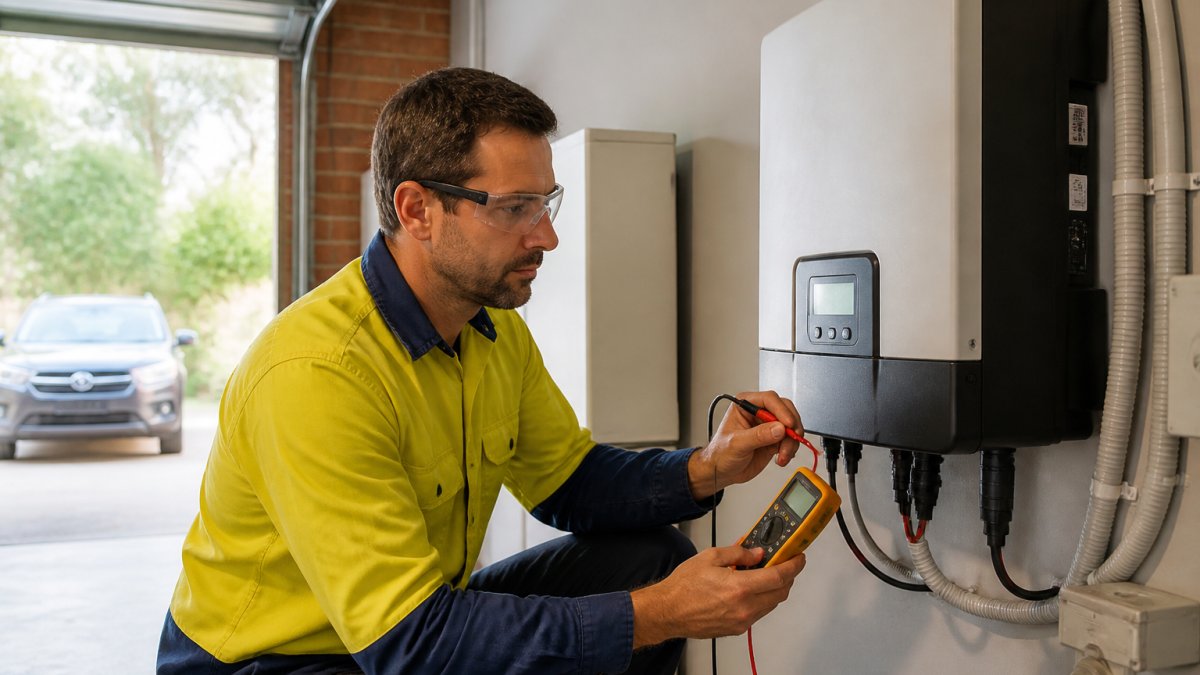
Inverter replacement is one of the more predictable expenses in a system’s life, and one homeowners often forget. An inverter is a power electronics device running under load in a hot enclosure, and it generally will not last as long as the panels it serves.
What Drives the Price of a Replacement Inverter
A replacement inverter is not a like-for-like purchase. Four variables move the quote more than anything else:
- Type. A string inverter is the cheapest unit to replace. A hybrid inverter costs more because it includes battery-ready circuitry and changeover hardware, even if you have not fitted a battery yet.
- Capacity. A 5 kW replacement sits at the lower end; a 10 kW or three-phase unit at the upper end. Moving up a size usually means new cabling, a new isolator and a switchboard check, not just a bigger box.
- Compatibility with the existing array. The replacement must be matched to the panel array’s DC voltage and current, not just its total wattage. An inverter sized only on the old nameplate can run outside its MPPT window and clip output.
Because those variables swing widely, inverter replacement pricing depends on your specific array. Speak with GridFree Solar for a current quote based on your system.
When to Budget for It
Plan for at least one inverter replacement during a 25-year panel life. The timing depends on the technology:
- String inverters generally have the shortest service life of the major components because all the conversion work passes through one unit in one enclosure.
- Hybrid inverters carry the same heat and load stresses plus battery management electronics, so they are not automatically longer-lived.
- Microinverters spread the conversion across units under each panel, which changes the failure profile and the replacement logistics rather than removing the cost.
When you plan a battery upgrade, it can make sense to consider it alongside an inverter change rather than as a separate job.
Sizing a replacement inverter without checking the array’s DC ratings can cause compatibility problems. Confirm the array’s voltage and current limits against the new inverter’s datasheet before you sign.
Symptoms That Point to Replacement
Inverters rarely fail without warning. Common signals include:
- Frequent fault codes or shutdowns, especially in hot weather.
- Output that has dropped noticeably against the same months in previous years.
- A noisy fan or a unit that runs hot to the touch.
A single repair on a unit with years left is often worthwhile, while repeated repairs on an ageing unit can add up to more than a replacement. If you are weighing a battery at the same time, our guide to battery upgrade versus replacement covers when bundling pays off.
Solar Battery Lifespan, Cycle Counts and Replacement Planning
Solar battery lifespan is measured in cycles as much as years. A battery rated for a high cycle count can still degrade early if it is routinely pushed to full depth of discharge or left in extreme heat.
We specify CEC-approved batteries and install to AS/NZS 5139:2019, the standard that governs battery installation safety.
When your battery nears end of life, replacement planning should start months before it fails. For more on upgrade paths, see our guide to solar battery replacement cost.
| Component | Typical Lifespan Driver | Replacement Reality |
|---|---|---|
| Solar panels | Degradation rate and physical damage | Rarely replaced on schedule |
| Inverter | Heat and continuous load | Usually one replacement |
| Battery | Cycle count and depth of discharge | Earliest replacement, most variable |
Solar System Payback Period Before and After Replacements
Solar system payback period is the time your bill savings take to recover the upfront cost. Most payback calculations stop at the original purchase, which flatters the result. A lifecycle payback calculation adds the replacement schedule and shows the real break-even year.
Build the Ledger Before You Divide
Payback is simple arithmetic once the inputs are honest: total lifetime cost divided by annual bill savings. The problem is that most quotes only supply the first number. Build a five-line ledger instead:
- Upfront cost after rebates and incentives, not before.
- Annual bill savings, based on the tariffs you actually avoid and the export rate you actually receive.
- Maintenance allowance, covering inspections, cleaning where needed and minor repairs.
- Replacement costs, timed to the year they fall due rather than spread evenly.
- End-of-life costs, including removal and compliant disposal.
When you add an inverter and a battery to the lifetime ledger, payback stretches. To recalculate your return once replacement costs are factored in, see our solar panel payback period Victoria guide. The system still pays, but later than the sales quote implied.
Why Timing Matters More Than the Total
A replacement cost in year 12 is not the same as the same amount spread across 25 years. Two systems with identical lifetime costs can have very different paybacks depending on when the inverter and battery fall due.
A practical way to model it is to run three scenarios side by side:
- Upfront only. The sales-quote version. Useful as a baseline, not as a decision tool.
- Upfront plus one inverter replacement. The most likely residential case over a 25-year panel life.
- Upfront plus inverter and battery replacement. The realistic case if you rely on stored energy rather than export.
Each scenario should use the same savings assumption so the comparison is fair. If the savings assumption changes between scenarios, the payback difference tells you nothing about the replacements.
The Assumptions That Move the Answer Most
The payback result is sensitive to a small number of inputs:
- Retail tariff versus feed-in tariff. Savings come mostly from avoided consumption, not from export. A system sized to self-consume pays back faster than one sized to export.
- Self-consumption share. The proportion of generation used on site, rather than exported, is the biggest single lever on annual savings.
- Battery round-trip efficiency. Stored energy is not free energy; losses reduce the savings attributed to the battery.
Run the payback calculation twice: once on the original investment, and once with replacement costs and degradation added. If the second number still beats your alternative use of the money, the system is a sound lifecycle decision, not just a good sales quote.
Repair or Replace: Deciding Component by Component
Repair wins when the fault is isolated and the component has years left.
Repeated repairs on an ageing inverter can cost more than a single replacement. A single failed panel in a healthy array is typically a repair rather than a rebuild.
If you are weighing added capacity against a full replacement, our guide to battery upgrade versus replacement walks through when each one pays off.
Warranties, Disposal and End-of-Life Handling
Warranties split into product and performance cover, and the two do different jobs. Product warranties cover defects; performance warranties guarantee a minimum output percentage over time.
Under Australian Consumer Law, statutory guarantees can sit alongside manufacturer warranties. Our guide to solar panel warranties explained covers the protections available to you.
Disposal is the forgotten cost. Panels and batteries cannot go in general waste.
Getting a Lifespan and Replacement Quote From GridFree Solar
A quote that only lists today’s price is incomplete. Ask for a lifetime schedule: expected inverter replacement, battery replacement timing, and disposal handled at end of life.
GridFree Solar is a CEC accredited installer working to AS/NZS 5139:2019 and AS/NZS 3000, and we provide rebate guidance to help you compare realistic figures. Ask us for a lifespan and replacement schedule alongside your system quote.
Frequently Asked Questions
How long do solar panels typically last?
Most quality panels carry a product warranty of 12 to 25 years and a performance warranty of 25 to 30 years. In practice they keep generating well beyond that, but output falls gradually. Degradation on modern modules is typically gradual, and output declines slowly over time. Panels rarely fail outright; the more common issue is a single module or connector fault that can be isolated and replaced.
How much does it cost to replace a solar inverter?
Solar inverter replacement cost depends on the inverter type, size and whether you upgrade to hybrid capability at the same time. A like-for-like swap on a standard string inverter is the cheapest route; moving to a hybrid inverter adds cost but opens the door to battery storage later. Pricing varies with brand, capacity and installation complexity, so ask GridFree Solar for a current quote rather than budgeting from a generic figure. Plan for at least one inverter replacement across a 25-year system life.
How long do home solar batteries last?
Solar battery lifespan is measured in cycles as much as years. Home battery lifespans depend on the product and how it is used, and warranty terms vary between models. Daily cycling, depth of discharge, ambient temperature and how hard the battery works during peak export all affect how quickly it reaches end of life. A battery that is cycled gently and kept out of direct heat will typically reach the upper end of its rated life.
Do solar panels need to be replaced after 25 years?
Not automatically. At 25 years most panels are past their performance warranty but still generating. The decision comes down to measured output versus replacement cost. If the array is producing close to its warranted degradation curve and the inverter has been maintained, there is no need to replace working panels. Replace when output drops sharply, when multiple modules fail, or when you are re-roofing and the labour is already being paid for.
What affects the lifespan of a solar system?
Heat, installation quality, shading, soiling, humidity and salt exposure all shorten component life. A poorly ventilated roof space cooks an inverter faster than anything else. Loose mountings and water ingress at connectors cause faults that have nothing to do with the panel itself. Choosing CEC-accredited installers and equipment compliant with AS/NZS 5139 helps build a system suited to its installation conditions.
How can I estimate the long-term cost of maintaining a solar system?
Build a simple lifecycle budget: replacement of key components over the system’s life, occasional monitoring and inspection, and a contingency for module or isolator faults. Compare that total against projected electricity bill savings and export income. For a lifecycle estimate based on your usage and eligible rebates, contact GridFree Solar.
Solar systems reward homeowners who plan the whole life, not just the purchase. GridFree Solar can map your inverter and battery replacement timeline, confirm CEC-approved equipment and safety compliance, and give you a quote built around your actual energy usage. Get started with GridFree Solar and see what your system really costs across its full life.
