
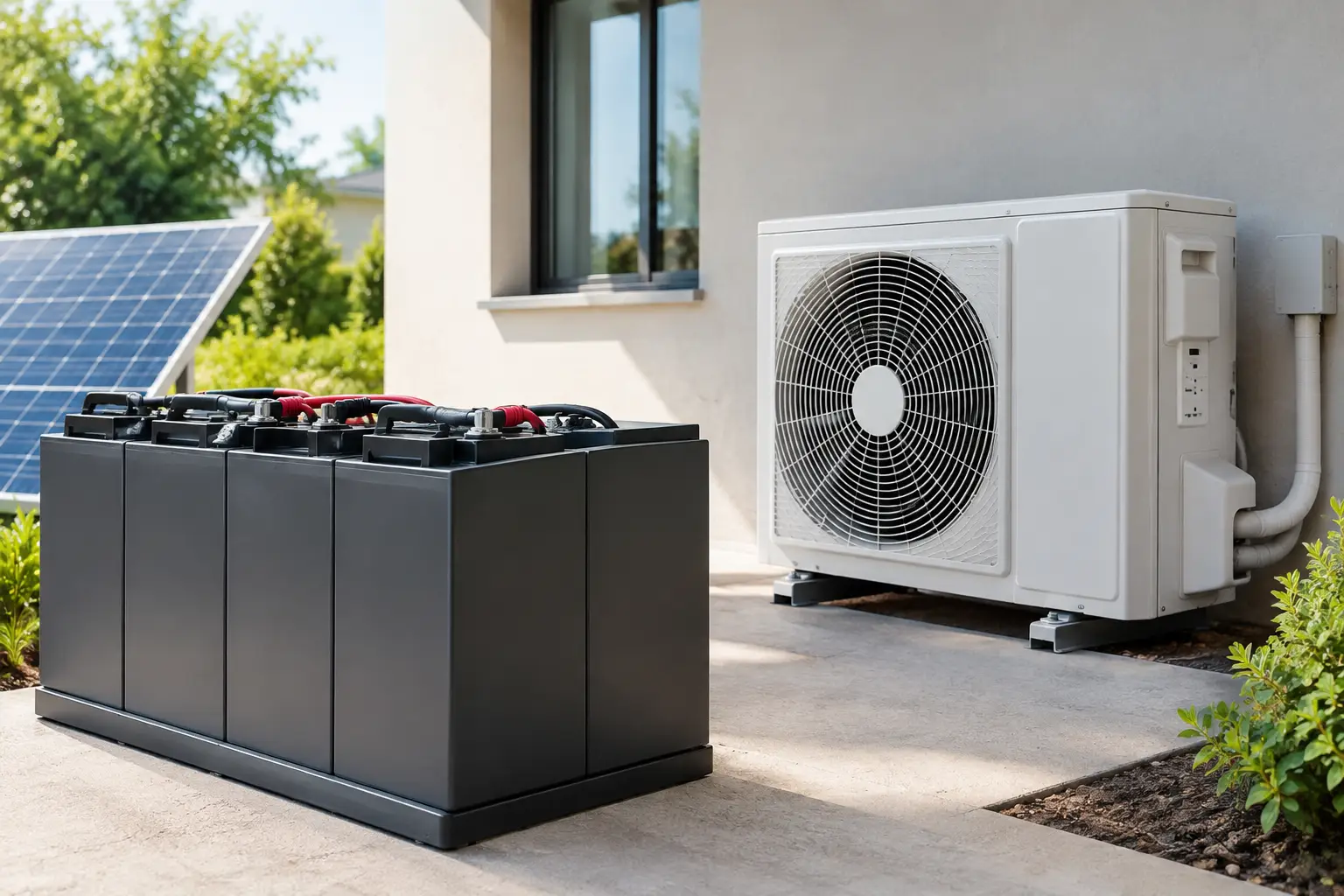
A hot afternoon is when home energy systems face their real test. Your air conditioner is running, solar production may be starting to fall, and electricity prices can be at their highest. So, can batteries power air conditioners? Yes, a correctly designed battery system can run many residential air conditioners, but the answer depends on the air conditioner’s size, how long you need it to run, your battery capacity and the system’s power output.
For households looking to reduce evening grid use or keep essential cooling available during an outage, battery-backed air conditioning can be a practical part of a solar energy plan. The key is designing the system around how your household actually uses power, rather than relying on a simple battery-size rule.
Can batteries power air conditioners reliably?
A home battery stores electricity generated by solar panels or imported from the grid during lower-cost periods. When your solar production drops or grid electricity becomes expensive, the battery can supply power to appliances, including air conditioners.
The challenge is that air conditioners use more energy than most household appliances. A fridge may use a relatively small amount of power over time, while a ducted system can draw several kilowatts whenever it is actively cooling or heating. Batteries must be assessed for two separate capabilities: how much energy they can store and how much power they can deliver at once.
Battery capacity is measured in kilowatt-hours, or kWh. This tells you how long the battery can supply energy. Battery power output is measured in kilowatts, or kW. This tells you whether the battery can handle the air conditioner’s immediate demand alongside other loads such as lighting, refrigeration, cooking and pool equipment.
A battery with plenty of stored energy but a low power output may not be able to run a larger ducted unit by itself. Conversely, a high-output battery with limited capacity may run the system well, but only for a shorter period. A quality system design accounts for both.
How much battery power does an air conditioner need?
There is no single answer because air conditioner consumption changes with the system type, outdoor temperature, insulation, thermostat setting and the size of the area being cooled. Inverter air conditioners are especially variable. They use more power when bringing a hot room down to temperature, then reduce their draw while maintaining it.
As a broad guide, a small split system may use around 0.7 to 1.5 kW while operating under moderate conditions. A larger split system may use 1.5 to 3 kW or more. Ducted air conditioning can draw substantially more, particularly when several zones are running or the home is trying to cool down after a very hot day.
That means a battery can often support a single efficient split system for several hours, especially when it is paired with daytime solar generation. Running whole-home ducted air conditioning through a long summer evening is possible with the right equipment, but it generally calls for a larger battery bank and careful load management.
For example, a usable 13 kWh battery supplying an air conditioner that averages 2 kW could theoretically run it for about six hours. In real homes, that battery is also likely to be supporting other appliances. Allowing for household loads and sensible reserve capacity, the practical run time may be shorter.
Battery capacity is only part of the calculation
It is tempting to choose a battery based purely on the number of hours you want air conditioning. However, a useful design starts with your wider energy profile.
A household that runs cooling mainly from midday to late afternoon may use solar power directly, with the battery covering the transition into the evening. This is often a cost-effective approach because the panels do much of the heavy lifting while the sun is out.
A household that needs cooling overnight has a different requirement. The battery must hold enough stored energy after sunset to cover the air conditioner and normal evening loads. Larger systems, or batteries that can be expanded over time, may make better financial sense in this situation.
It also matters whether backup power is a priority. Not every battery system is configured to run during a blackout. To keep selected circuits operating when the grid is down, the system needs suitable backup capability and an appropriately designed backup board. Air conditioning may be included, but larger systems can place significant demand on a battery during an outage.
Split systems are usually easier to support
For many Australian homes, an efficient split system is the easiest type of air conditioner to run from solar and battery power. It typically serves one room or zone, can be operated only when needed, and often has a lower running load than a whole-home ducted system.
This does not mean ducted air conditioning is unsuitable. It simply requires more detailed planning. Zoning can make a major difference, allowing you to cool occupied rooms rather than the entire house. Running fewer zones, setting a realistic temperature and avoiding heavy-demand appliances at the same time can all reduce the battery size required.
Commercial sites face similar decisions. A small office, retail space or workshop may be able to use solar and batteries to offset a substantial portion of daytime cooling. If air conditioning must continue after business hours, the battery design should reflect the site’s actual demand profile, not just its daytime solar output.
Solar makes battery-powered cooling work harder for you
Solar panels and batteries are strongest when they work together. On a clear day, solar can power your air conditioner directly before charging the battery with surplus energy. That stored energy can then be used in the late afternoon and evening, when grid tariffs may be higher and solar production is lower.
Without solar, a battery can still charge from the grid at lower-cost times and discharge later. But the savings case is usually stronger when your household can capture its own solar generation instead of exporting it for a low feed-in tariff.
Panel sizing matters too. If your home has high cooling demand, the solar system needs enough generation capacity to cover daytime consumption and leave meaningful surplus for battery charging. A small solar array may reduce air conditioning costs, but it may not consistently fill a large battery on hot days when you need it most.
Seasonality also deserves consideration. Summer offers long solar days and high cooling demand. In winter, solar generation is lower while reverse-cycle heating may become a major load. A good system is designed for year-round household value, not one perfect summer scenario.
Practical ways to extend battery run time
You do not need to sacrifice comfort to get better results from a battery system. Small operating choices can significantly reduce the energy required to cool a home.
Set the air conditioner to a reasonable temperature, commonly around 24 to 26°C in summer. Closing blinds before the afternoon sun hits, sealing drafts and using ceiling fans can reduce the compressor’s workload. Pre-cooling the home while solar production is strong can also be more efficient than waiting until the house is already hot and relying entirely on the battery after sunset.
Smart monitoring helps turn these choices into measurable savings. By seeing solar production, battery charge, household demand and grid imports in one place, you can identify when air conditioning is drawing heavily and adjust habits accordingly. Automated energy controls can also prioritise solar use or limit non-essential loads when backup capacity matters.
Choosing the right system for your property
The right battery is not necessarily the biggest one. It is the system that fits your energy use, roof space, existing solar setup, air conditioning load, budget and long-term goals.
A household focused on reducing evening electricity bills may only need enough battery capacity to cover typical after-work cooling and essential appliances. A family seeking blackout resilience may prefer additional capacity, backup configuration and a plan for which air conditioning zones stay available during an outage. A business may prioritise reducing demand during expensive operating hours.
This is why a site assessment is valuable. It can identify whether your switchboard, inverter, solar array and air conditioning setup are ready for battery integration, and whether upgrades or load controls would improve performance. It also provides a clearer view of available rebates and the expected return from storing solar energy rather than sending it back to the grid.
GridFree Solar designs integrated solar and battery systems around these practical questions, including battery upgrades for homes that already have solar but want greater control over when they use their energy.
The most useful next step is to look at your actual electricity data, especially on hot days. It shows whether your battery should cover one split system for the evening, selected ducted zones, or a broader backup plan that keeps your home comfortable when the grid is less reliable.