
More than 40 solar retailers have been formally banned from the Victorian Solar Homes Program for deceptive conduct. It’s a sobering reality. While the sun is free, the path to harvesting it is riddled with sophisticated traps. If a salesperson knocks on your door or cold-calls you in 2026, they aren’t just being pushy; they’re breaking the law. Avoiding solar scams Victoria has become a high-stakes game of spotting digital funnels and verifying credentials that shift faster than the Melbourne weather.
We understand the hesitation. You want lower bills, but the fear of losing thousands to a “fly-by-night” operator is a massive barrier. This guide changes the power dynamic. We’ll equip you with the definitive 2026 homeowner’s protection checklist to identify dodgy operators and secure a fair dinkum deal. You’ll learn how to verify rebate claims via the Service Victoria app, why looking for old CEC accreditation is now a red flag, and how to identify a legitimate local installer with a physical Melbourne office. Stop the guesswork. Secure your investment.
Key Takeaways
- Identify modern “solar cowboys” who have pivoted from illegal door-knocking to deceptive AI-generated social media ads and spoofed government websites.
- Spot immediate red flags, including quotes that fall suspiciously below Melbourne market averages or companies lacking a physical Victorian office.
- Master the essential steps for avoiding solar scams Victoria by verifying New Energy Tech (NET) Approved Seller status and mandatory SAA installer accreditation.
- Understand the legal process for claiming Solar Victoria rebates to ensure you aren’t misled by retailers manipulating STCs or non-existent state battery grants.
- Discover why partnering with a local Melbourne specialist with a physical showroom is your best defence against “phoenix” companies that vanish before your warranty expires.
The Current State of Solar Scams in Victoria
Victoria is a global leader in renewable energy. The sheer scale of residential solar adoption in Australia has turned our state into a lucrative playground for “solar cowboys” looking for a quick buck. In 2026, the game has changed. While the Victorian government has banned door-to-door sales and cold-calling, scammers have pivoted. They now use sophisticated AI-generated social media ads and spoofed websites to harvest your data. These “digital door-knockers” are harder to spot but just as dangerous to your hip pocket.
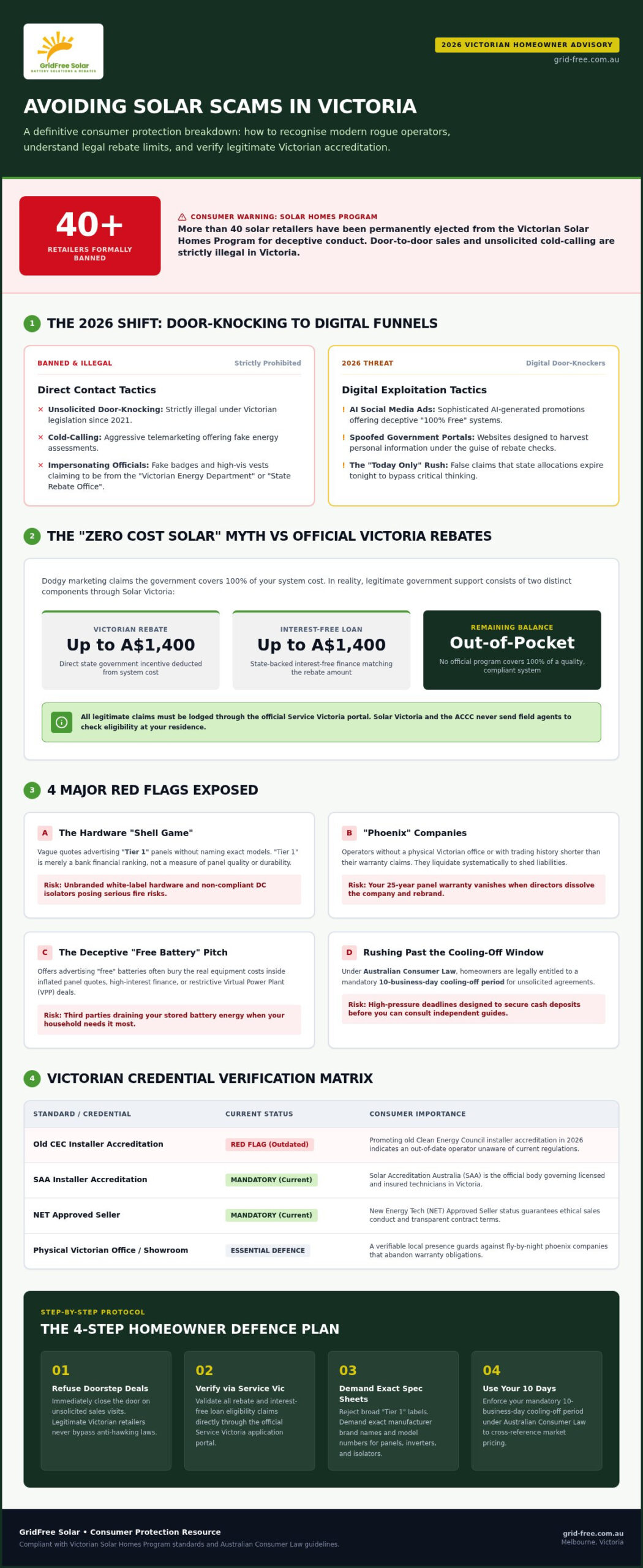
The “Zero Cost Solar” myth is their primary weapon. You’ve seen the ads: “Government paying for 100% of your solar.” It’s a lie. While Solar Victoria offers a rebate of up to A$1,400 and an interest-free loan of the same amount, no program covers the entire cost of a quality system. These traps often lead to “phoenix” companies. They install sub-standard gear, take your money, and shut down within months. When the inverter fails or the roof leaks, you’re left with a useless system and an insurance claim that might be rejected due to non-compliant installation. Avoiding solar scams Victoria starts with acknowledging that if a deal sounds too good to be true, it’s likely a trap.
The “Government Representative” Impersonation
Scammers often hide behind official-sounding titles like the “Victorian Energy Department” or “State Rebate Office.” They might even wear high-vis vests and carry forged ID badges with government logos. Don’t be fooled. Solar Victoria and the ACCC never send representatives to your home to sell products or “check eligibility.” If someone knocks on your door claiming to be from the government to discuss your energy bills, they’re breaking the law. Close the door. Legitimate retailers will never bypass the strict regulations that have been in place since 2021.
High-Pressure Sales Tactics: The “Today Only” Trap
Urgency is a red flag. Scammers want to bypass your critical thinking by claiming a rebate is “expiring tonight” or offering a “today only” discount. A professional solar panel installation Melbourne requires a detailed site analysis or satellite mapping to ensure the system actually works. It’s not a five-minute phone decision. Under Australian Consumer Law, you have a mandatory 10-business-day cooling-off period for unsolicited agreements. If a salesperson tries to pressure you into signing immediately or demands a massive cash deposit upfront, walk away. Your home’s safety and your financial security are worth more than a fake discount.
Red Flags: How to Spot a Dodgy Deal Instantly
Spotting a scammer requires a sharp eye for inconsistencies. The first red flag is often the quote itself. If a price is significantly lower than the Melbourne market average, the company is likely cutting corners on hardware, safety, or labour. Check the company history before signing anything. A business with no physical Victorian office or a track record shorter than its own warranty period is a massive risk. A phoenix company is a business that deliberately liquidates to avoid liabilities and warranty claims, only to rise again under a new name with the same directors. These operators are the primary threat to your 25-year warranty. Always cross-reference any quote against Solar Victoria’s official Buyers Guide to ensure the offer aligns with industry standards.
The Hardware Shell Game
Scammers love the term “Tier 1.” It sounds prestigious. In reality, Tier 1 is a financial ranking used by banks to assess a manufacturer’s stability; it’s not a guarantee of panel performance or longevity. Dodgy operators use this vague label to hide “white-label” panels that lack local warranty support in Australia. If your quote doesn’t list specific brand names for panels and inverters, you’re being set up for a hardware shell game. Non-compliant DC isolators and unbranded inverters aren’t just inefficient; they’re genuine fire risks. Avoiding solar scams Victoria means demanding exact model numbers and data sheets before any deposit is paid.
The “Free Battery” and VPP Scams
The “free battery” pitch is the latest evolution in deceptive marketing. These offers usually hide the battery cost in inflated panel prices or high-interest finance agreements. Often, they require you to join a Virtual Power Plant (VPP). While VPPs have their place, some agreements strip you of your energy independence by giving a third party control over your stored power. You might find your battery drained when you need it most. Before signing a contract that sounds too good to be true, verify the Victorian battery rebate 2024 to 2026 rules to see what state support is actually available.
Don’t fall for the trap of paying large upfront deposits before a site inspection is conducted. A reputable installer will always assess your roof’s condition and shading first. If you’re feeling pressured by a “today only” offer, it’s time to step back. You can consult with a local Melbourne specialist to get a transparent, high-quality assessment of your home’s energy potential without the high-pressure tactics.
The Official Victorian Solar Checklist
Don’t take their word for it. In 2026, avoiding solar scams Victoria requires a proactive verification strategy. Start with the New Energy Tech Consumer Code (NETCC). If a retailer isn’t a signatory, they aren’t eligible for Victorian rebates. It’s that simple. Next, verify the installer’s accreditation. While the Clean Energy Council (CEC) maintains the approved products list, the actual tradesperson on your roof must hold active Solar Accreditation Australia (SAA) credentials. Use the SAA website to search their license number before they touch your tiles.
Always confirm the retailer appears on the official Solar Victoria authorised list. Finally, demand a written performance estimate. This shouldn’t be a generic flyer. It must account for your specific Melbourne roof orientation and shading. A north-facing roof in Glen Waverley performs differently than an east-west split in Geelong. If they can’t provide these calculations, they aren’t specialists; they’re order-takers. If they try to rush you, remember your Consumer Affairs Victoria door-to-door sales protections. Legitimate experts respect your right to due diligence.
Administrative Verification
Use the ABN Lookup tool. It’s free. Check if the business has been registered for GST and how long they’ve been operating under their current name. Scammers often “phoenix” every few years to shed warranty obligations. Search for independent reviews on platforms like ProductReview or Google, but look for specific details about the installation process rather than generic “great service” comments. Ensure your quote provides a clear breakdown of the solar battery cost Australia. Transparency is the hallmark of a legitimate local partner. If the numbers are lumped together, they’re hiding something.
The Site Inspection Must-Haves
A fair dinkum installer will never quote purely from a satellite image. They must check your switchboard for safety compliance and your roof structure for integrity. Ask directly: “Will you be using your own employees or sub-contractors for the install?” Direct employees usually mean better accountability and consistent quality control. Demand a line-item quote. It should clearly separate hardware, labour, and the rebate amount. If they can’t explain why a certain inverter was chosen for your specific energy profile, they haven’t done the work. A professional site inspection is your best defence against unexpected costs on installation day.
Verifying Rebates and Government Incentives
Financial transparency is your strongest shield against dodgy operators. Many scammers manipulate Small-scale Technology Certificates (STCs) to obscure the true cost of a system. STCs are federal incentives that act as a point-of-sale discount, but dishonest retailers often inflate their base prices to “swallow” the certificate value. This leaves you paying premium prices for budget hardware. Avoiding solar scams Victoria requires you to see a clear breakdown. Your quote must show the gross system price before the STC discount is applied. If they refuse to show the math, they’re likely hiding a massive markup.
The Victorian Solar Homes rebate has its own strict protocols. A critical protection measure is that the retailer cannot apply for the rebate on your behalf. You must initiate the application through the Service Victoria app using a unique quote ID provided by an authorised retailer. If a salesperson asks for your MyGov login or offers to “handle the paperwork” for you, stop immediately. This is a major security breach. Be wary of “limited time” government deadlines. While rebate quotas exist, they are managed transparently by Solar Victoria. Anyone claiming a rebate will “disappear by Friday” is simply using high-pressure tactics to force a signature.
The Truth About “Zero Deposit” Finance
Interest-free deals often come with a hidden sting. While “zero deposit” sounds attractive, these finance products typically charge the solar company a dealer fee of 15-25%. Most retailers simply add this fee to your system price. You end up paying thousands more than a cash buyer for the exact same hardware. Compare the total contract price against a mortgage redraw. Using your home loan’s lower interest rate usually offers a far better ROI and keeps your property title clear of complex “pay-as-you-save” encumbrances. Read the fine print before committing your future energy savings to a third-party financier.
Solar Victoria Audit Requirements
Safety is non-negotiable. Energy Safe Victoria (ESV) and Solar Victoria conduct random post-installation audits to ensure systems meet rigorous standards. You should welcome these inspections. They are a free expert check of the installer’s work. If your system fails an audit, the retailer is legally required to rectify the issues at their own expense. A Certificate of Electrical Safety (CES) is your legal proof of a compliant install. Never make the final payment until you have this document in your hand. If you suspect foul play, you can contact our Melbourne-based team for a professional second opinion or report the operator to the Victorian Building Authority (VBA) to protect other homeowners.
Choosing a Trusted Melbourne Solar Partner
Selecting a partner shouldn’t be a gamble. While the previous sections highlight the sophisticated traps set by “solar cowboys,” the ultimate strategy for avoiding solar scams Victoria is simple: look for a physical presence. A local solar panel installation Melbourne expert with a physical showroom offers something a PO Box cannot: accountability. You can walk in, touch the hardware, and meet the team responsible for your investment. GridFree Solar operates as a safe harbour for Victorians. We don’t just sell systems; we design high-performance energy solutions that meet the most stringent safety standards in the state. From initial satellite mapping to final inspection, our process is transparent and focused on your long-term ROI.
The GridFree Solar Standard
Integrity is our baseline. We are fully committed to NETCC compliance and reject the high-pressure, “today-only” tactics that plague the industry. Our focus remains on energy storage solutions Melbourne homeowners can rely on for genuine grid independence. We understand that Victorian rebate rules are complex and shift frequently. Our local team handles the entire Solar Victoria rebate paperwork process for you, ensuring every document is lodged correctly via the official portal. We eliminate the administrative headache, ensuring you receive every cent of the A$1,400 rebate and loan you’re entitled to without the risk of non-compliance.
Protecting Your Investment for 25+ Years
Don’t confuse a performance warranty with a product warranty. A performance warranty guarantees the panels will produce power, but if the internal components fail, you need a robust product warranty backed by a company that still exists. GridFree Solar only sources hardware from manufacturers with a dedicated Australian support office. If a component fails in ten years, you won’t be chasing an offshore call centre. We provide the technical expertise for future battery upgrades and system expansions as your energy needs evolve. We believe in building systems that last as long as your mortgage.
Ready to secure a fair dinkum deal? Contact GridFree Solar today for a transparent, no-obligation assessment of your home’s solar potential. We respect your time and your budget, providing a clear path to energy independence without the high-pressure sales pitch.
Secure Your Energy Future with Confidence
The era of the “solar cowboy” is ending, but your vigilance remains your best asset. By mastering the 2026 protection checklist, you’ve moved from a potential target to an informed decision-maker. Remember the non-negotiables: verify NETCC status, demand a physical Melbourne office, and never bypass the official Solar Victoria rebate portal. Avoiding solar scams Victoria isn’t just about saving money; it’s about ensuring your home’s safety and your long-term energy independence.
GridFree Solar stands as your local safe harbour. As a NETCC Signatory and Solar Victoria Authorised Retailer, our Melbourne-based experts prioritise engineering excellence over high-pressure sales. We handle the complex administrative landscape so you don’t have to. Don’t leave your roof to chance or offshore call centres. Secure a system backed by genuine local support and professional accountability. It’s time to invest in technology that actually delivers on its promise.
Book a Fair Dinkum Solar Assessment with GridFree Solar today and take the first step toward a secure, high-performance energy future. Your journey to grid independence starts with a partner you can trust.
Frequently Asked Questions
Is solar really free in Victoria under the government scheme?
Solar is never entirely free. While Solar Victoria provides a rebate of up to A$1,400 and an interest-free loan of up to A$1,400 for eligible households, these only offset the total investment. You must meet specific eligibility criteria, including a household income cap of A$150,000. Anyone promising a system at zero cost is likely hiding fees in high-interest finance or using sub-standard hardware that will fail within years.
How can I tell if a solar door-knocker is a scammer?
If someone knocks on your door to sell solar in Victoria, they are breaking the law. Door-to-door solar sales have been strictly banned under the Solar Homes Program since 1 September 2021. Legitimate companies like GridFree Solar respect these regulations. Do not engage with them, don’t show them your energy bills, and never sign anything on the spot. Report the encounter to Solar Victoria immediately.
What should I do if I’ve already signed a contract with a dodgy solar company?
Act quickly to exercise your legal rights. Under Australian Consumer Law, you have a mandatory 10-business-day cooling-off period for unsolicited agreements. You can cancel the contract without penalty during this time. Send a formal cancellation notice via email or registered post. If the company refuses to cooperate or if you’ve been pressured, contact Consumer Affairs Victoria or the Victorian Building Authority (VBA) to lodge a formal complaint.
Does the Victorian solar rebate apply to batteries in 2026?
The state-funded Victorian battery loan program is permanently closed. However, you can still access incentives through the federal Cheaper Home Batteries Program. GridFree Solar specialises in navigating these battery rebates for Melbourne residents to enhance energy storage capacity. Be wary of salespeople claiming state-level battery grants still exist in 2026. They are likely misrepresenting the current incentive landscape to secure a quick sale on an overpriced system.
Why is my solar quote so much cheaper than others I’ve received?
Extreme price differences usually indicate compromised quality or hidden risks. A suspiciously cheap quote often suggests the use of “white-label” panels without local warranty support or non-compliant DC isolators. It might also be the work of a “phoenix company” that will shut down before your warranty is ever tested. Avoiding solar scams Victoria means comparing quotes against market averages to ensure your system is safe, legal, and built to last.
Who do I contact to report a solar scam in Melbourne?
Start by contacting Consumer Affairs Victoria for advice on your consumer rights. If the scam involves the Solar Homes Program, report it directly to Solar Victoria’s compliance team. For safety concerns or non-compliant electrical work, contact Energy Safe Victoria (ESV) or the Victorian Building Authority. Reporting these operators helps protect the Melbourne community and ensures the industry remains professional and transparent for everyone.
Can I get solar installed if I live in a rental property in Victoria?
Yes, rental providers in Victoria can access the Solar Homes rebate. This program allows landlords to install solar panels on rental properties with the support of a rebate and interest-free loan. The process requires a signed agreement between the landlord and the tenant regarding any potential rent contributions. It’s an excellent way to improve property value while lowering energy costs for Victorian tenants through professional installation.
What is the New Energy Tech Consumer Code (NETCC) and why does it matter?
The New Energy Tech Consumer Code (NETCC) is the mandatory standard for solar retailers in Victoria. It replaced the old Clean Energy Council Approved Retailer program. Choosing a NETCC signatory like GridFree Solar ensures you are protected by enforceable benchmarks regarding quoting, sales conduct, and warranties. If a retailer isn’t a NETCC Approved Seller, they cannot participate in the Solar Victoria rebate program, leaving you ineligible for state incentives.