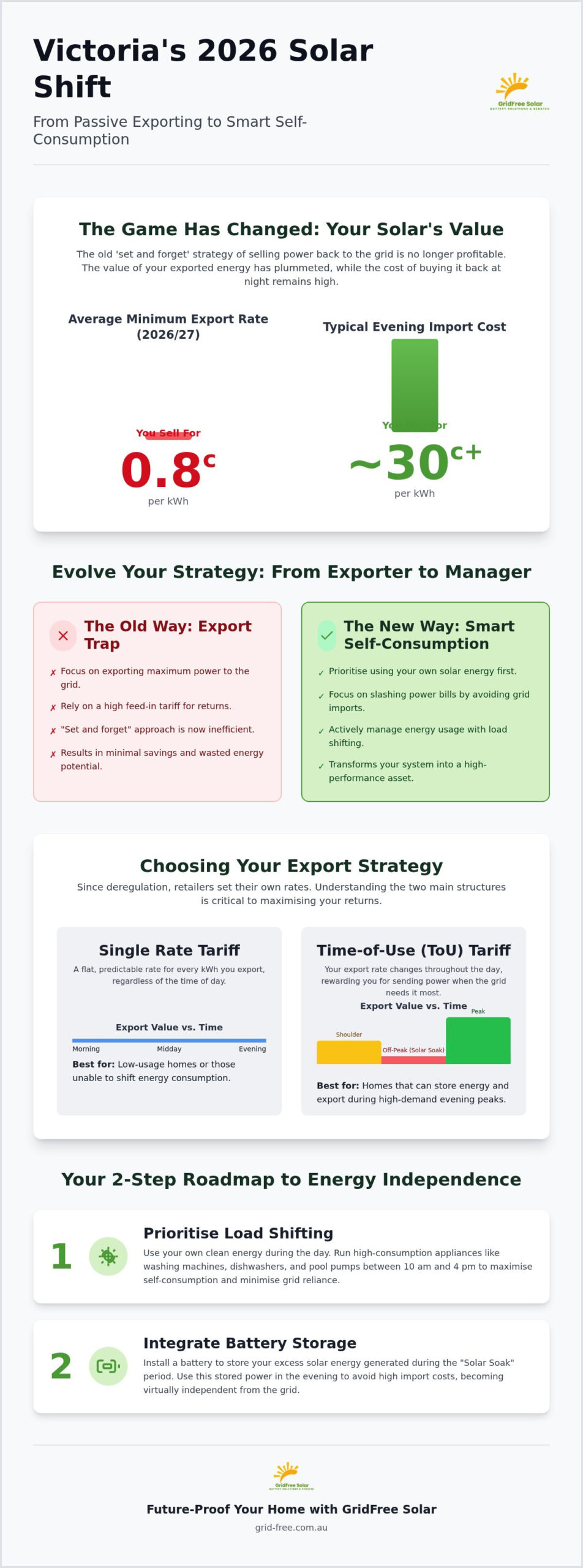
The era of earning a passive income from your roof is officially over. With the average minimum solar feed in tariff Victoria offers for 2026/27 plummeting to a mere 0.8c per kWh, the old “set and forget” strategy has failed. It’s frustrating to watch your high-quality energy being sold back to the grid for next to nothing while your evening import costs remain stubbornly high. You aren’t alone in feeling that the game has changed; however, this doesn’t mean your solar investment is a write-off.
We’ll show you exactly how to navigate this deregulated landscape and transform your system into a high-performance financial asset. You can still slash your power bills by shifting your focus from export to aggressive self-consumption. This guide breaks down the 2026 Victorian regulatory environment. It explains why current retail offers vary so wildly and provides a clear roadmap for reclaiming your energy independence through intelligent battery integration. Your panels are still your best tool for beating price hikes. You just need a smarter way to use them.
Key Takeaways
- Understand the deregulated 2026 landscape where the Essential Services Commission (ESC) has shifted pricing control to individual retailers.
- Discover why the solar feed in tariff Victoria provides is now a secondary metric compared to aggressive household self-consumption.
- Avoid the “Export Trap” by prioritising load shifting to use your own clean energy during peak daylight hours.
- Learn how battery storage acts as the ultimate hedge against low export rates and rising evening power costs.
- Develop a data-driven strategy to transform your solar system into a high-performance financial asset.
Understanding Victoria’s Solar Feed-in Tariff (FiT) in 2026
The solar landscape has shifted. A decade ago, premium schemes offered generous returns for every kilowatt-hour exported to the grid. Today, the solar feed in tariff Victoria provides is a different beast entirely. It functions as a credit on your electricity bill; a small offset against your usage rather than a primary revenue stream. Understanding this distinction is vital for any homeowner looking to optimise their return on investment in a high-cost energy market.
The 2026 environment is defined by deregulation. Since July 1, 2025, retailers have had the freedom to set their own rates, provided they remain above $0.00. This is a significant departure from previous years where a government-mandated floor protected export values. While this change encourages market competition, it also places the burden of comparison on the consumer. You must now distinguish between the baseline minimum offers and competitive market offers that can reach up to 8c per kWh. You are no longer just a solar owner; you are an energy manager.
Who Sets the Rates in Victoria?
The Essential Services Commission (ESC) maintains oversight of the Victorian energy market. While they no longer set a mandatory minimum rate as they did in 2024, they still monitor retailer behaviour to ensure transparency and fairness. They calculate the value of solar based on wholesale electricity prices and avoided transmission losses. This regulatory framework is part of the broader history of Feed-in tariffs in Australia, which has evolved from incentivising adoption to managing a grid saturated with daytime solar. With the average minimum solar feed in tariff Victoria offers for the 2026/27 financial year sitting at just 0.8c per kWh, the financial incentive has moved away from the ESC’s floor and toward aggressive retail shopping.
Eligibility for Victorian FiTs
Securing a feed-in tariff requires more than just panels on your roof. Your system must be connected to the grid via a bidirectional smart meter. This device tracks exactly how much power you consume versus how much you export in real-time. Most residential systems under 10kW are eligible for standard retail offers, while larger commercial setups may require bespoke agreements. When you engage a professional for solar panel installation Melbourne experts will typically manage the grid connection application and ESC paperwork on your behalf. This ensures your system is compliant and ready to earn credits from the moment it’s switched on.
Single Rate vs. Time-of-Use: Choosing Your Export Strategy
Deciding how you are credited for your power is the most critical financial choice you’ll make this year. In 2026, the solar feed in tariff Victoria provides is split into two distinct paths: the simplicity of a single rate or the complexity of Time-of-Use (ToU). While a flat rate offers a predictable credit for every kilowatt-hour exported, it often ignores the reality of a volatile energy market. As wholesale prices fluctuate, the timing of your export becomes just as important as the volume of energy you produce.
The Single Rate Minimum Explained
A single rate tariff applies the same credit to your account regardless of the time of day. This is the “set and forget” option. It suits low-usage households or those who cannot shift their energy habits to match daylight hours. The Essential Services Commission monitors these baseline offers to ensure they remain transparent, even in a deregulated market. However, simplicity comes at a cost. During periods of high grid demand, your flat rate stays low, meaning you miss out on the premium values that occur when the grid is under pressure. It provides stability, but it lacks the agility needed to maximise modern solar returns.
Time-of-Use Feed-in Tariffs: A Deep Dive
ToU structures divide the day into peak, shoulder, and off-peak windows. In Victoria, the “Solar Soak” period typically occurs between 10 am and 2 pm. This is when the grid is saturated with solar energy, and export values are at their lowest. Conversely, the evening peak is when the grid needs your power most. If you can hold your energy and export it during these high-demand windows, you can significantly outperform the standard 0.8c average. It is a game of timing and data.
Smart inverters and integrated battery systems are the keys to winning this game. They allow you to automate your exports, holding onto your power during the midday slump and discharging it when rates are highest. This strategy, known as energy arbitrage, effectively turns your home into a mini-power plant. If your current setup isn’t delivering these results, it might be time to upgrade to an intelligent battery system that handles the heavy lifting for you. By aligning your exports with grid needs, you transform a low-value solar feed in tariff Victoria offer into a high-yield financial strategy.
Why High Feed-in Tariffs Aren’t the Key to Solar Success Anymore
Chasing the highest export rate is a legacy strategy that no longer serves the modern Victorian homeowner. In 2026, the solar feed in tariff Victoria provides is often a distraction from the real source of wealth: avoided cost. While you might celebrate a 5 or 8 cent credit, you are likely still paying 30 cents or more to buy that same energy back from the grid two hours later. This is the “Export Trap.” It is a mathematical losing game where the house always wins unless you change your approach.
The 2026 energy market prioritises grid stability over mass residential exports. Because the grid is often flooded with excess solar during the day, the wholesale value of that power frequently drops to near zero. Your solar energy is worth four to five times more when it stays within your four walls than when it crosses the meter. To maximise your ROI, you must stop viewing your system as a mini-power station and start viewing it as a private reserve.
The Death of the ‘Passive’ Solar Investment
The “set and forget” era of solar is over. Years ago, high government-mandated rates allowed owners to ignore their consumption habits while still seeing a healthy credit. Today, that passive approach leads to disappointing returns and bill shock. The widening gap between what retailers pay you and what they charge you has fundamentally changed the math of solar ownership. Success now requires active management and a shift in mindset. The most valuable electron is the one you never export.
The Shift to Energy Independence
True energy independence in Melbourne means reducing your reliance on the grid to the absolute minimum. You are moving from being a passive consumer to a “prosumer” who controls their own generation, storage, and usage. This transition is why energy storage solutions Melbourne homeowners are adopting have become the primary driver of system value. By storing your midday excess, you effectively “arbitrage” the grid, using your own 0.8c-value power to offset a 30c-value evening peak. This isn’t just about being green; it’s about taking command of your household’s financial future. Your solar feed in tariff Victoria rate becomes irrelevant when you aren’t sending them any power to begin with.
Strategic Ways to Boost Your Solar Returns in Melbourne
Stop settling for pennies on the dollar. While the standard solar feed in tariff Victoria offers has declined, your potential for savings has never been higher. You simply need to change the rules of engagement. Moving from a passive exporter to a proactive energy manager is the only way to safeguard your ROI in 2026. This shift requires a combination of behavioural changes and high-tech hardware upgrades designed for the modern, deregulated grid.
Mastering Load Shifting
The most immediate way to beat low export rates is to stop exporting. You should run your heaviest appliances during the “Solar Noon” peak when generation is at its highest. Automate your dishwasher, washing machine, and pool pump to operate between 11 am and 3 pm. Melbourne’s erratic weather means you can’t always rely on a clear sky; therefore, smart automation is superior to manual switching. Electric hot water heat pumps are particularly effective. They act like a thermal battery, soaking up excess generation to provide hot water long after the sun goes down. This single change can drastically improve your self-consumption ratio.
The Battery Advantage in 2026
Batteries have transitioned from a luxury to a financial necessity. They allow you to capture your 0.8c-value energy during the day and use it when it’s worth 30c or more at night. This is energy arbitrage in its purest form. To make the numbers work, you should leverage the Victorian battery rebate while it remains available. If your existing storage is struggling to hold a charge, a solar battery replacement Melbourne specialist can upgrade you to a modern, high-cycle lithium-ion system. These newer units offer better depth of discharge and smarter grid integration.
Virtual Power Plants (VPPs) and Premium FiTs
Joining a Virtual Power Plant (VPP) is a sophisticated way to access premium export rates. By allowing a provider to occasionally tap into your stored energy during grid emergencies, you can earn significantly more than the standard solar feed in tariff Victoria retailers offer. It’s a trade-off. You give up a degree of battery control in exchange for higher financial rewards. Always evaluate the fine print of Victorian VPP offers to ensure the discharge frequency doesn’t compromise your evening independence. If you’re ready to stop wasting your solar energy, book a system performance audit with our team today.
Future-Proofing Your Home with GridFree Solar
Success in the 2026 market isn’t about luck. It’s about engineering. Generic, off-the-shelf systems are designed for a high-export era that no longer exists. To truly master the solar feed in tariff Victoria offers today, you need a configuration that mirrors your specific consumption habits. GridFree Solar specialises in this transition, moving you away from grid reliance and toward total energy autonomy through intelligent, data-driven design.
Our approach is built on local Melbourne expertise and a commitment to high-performance outcomes. We understand the specific administrative landscape of Victoria and the technical requirements of the modern grid. By focusing on integrated solar and battery solutions, we ensure your investment remains a sound financial asset regardless of how retail rates fluctuate in the future. You aren’t just buying panels; you are securing a professional partnership.
Tailored Energy Audits
We don’t guess; we calculate. Our team performs a deep-dive analysis into your smart meter data to identify precisely when and how your household uses power. This allows us to recommend a battery capacity that covers your evening peak without overcapitalising on unneeded storage. We also ensure every installation is “VPP-ready,” giving you the option to join a Virtual Power Plant and access premium rates when the grid is under stress. GridFree Solar optimises self-consumption for Melbourne homes by synchronising solar generation peaks with each household’s unique daily load profile.
Seamless Rebate Management
Navigating the administrative landscape of Solar Victoria can be a minefield for the uninitiated. Between the state battery rebate and federal incentives, there is significant money on the table for those who act quickly. We handle the entire application process on your behalf, ensuring you receive every cent you’re entitled to without the paperwork headache. This transparency is vital when calculating the solar battery cost Australia 2026 homeowners should expect, as these incentives can drastically shorten your payback period.
Our Melbourne-based team provides more than just an installation; we provide a roadmap to independence. From the initial site visit to ongoing support, we ensure your system continues to outperform the standard solar feed in tariff Victoria retailers provide. Don’t let your investment stagnate under outdated configurations. Contact our specialists today to secure your bespoke energy independence roadmap and start reclaiming your power from the retailers.
Secure Your Energy Independence Today
The landscape of 2026 has made one thing clear: the grid no longer pays for your generosity. Relying on the standard solar feed in tariff Victoria retailers offer is a recipe for diminishing returns. You must pivot. Success now lies in aggressive self-consumption and intelligent storage. By capturing your own generation, you bypass high retail costs and insulate your home from market volatility. The days of passive solar earnings are behind us. Transitioning to a proactive prosumer model is the only way to ensure your system remains a high-performance financial asset.
We help you bridge the gap between simple generation and total energy mastery. As Melbourne-based solar experts and an authorised Solar Victoria retailer, we specialise in battery ROI optimisation. We don’t just install hardware; we engineer long-term financial outcomes for Victorian families. Stop letting your excess energy go to waste. It’s time to take control of your energy bills with a custom GridFree Solar solution. Your path to grid independence starts with a system designed for the future. You have the power. Now, it’s time to keep it.
Frequently Asked Questions
What is the current minimum solar feed-in tariff in Victoria for 2026?
The market has shifted toward total deregulation. The Essential Services Commission (ESC) no longer mandates a fixed minimum; however, the average minimum solar feed in tariff Victoria offers for the 2026/27 financial year is just 0.8c per kWh. Retailers are now permitted to set their own rates as long as they stay above zero. This change forces you to be a proactive consumer. You must compare individual retail offers to find rates that actually reflect the value of your generation.
Can I get a higher feed-in tariff by switching electricity retailers?
Yes, switching retailers is one of the fastest ways to improve your export credits. In 2026, market offers vary significantly, with some major providers offering up to 8c per kWh compared to the sub-1c average. You shouldn’t just look at the export rate in isolation. It’s vital to compare the total value of the plan, including daily supply charges and usage rates. High export offers often come with higher import costs, so a balanced analysis is essential.
Is it worth getting solar panels in Victoria if the feed-in tariff is low?
Absolutely. Solar remains a powerful financial tool because its value isn’t tied to what you sell, but what you don’t buy. Every kilowatt-hour you consume directly from your roof saves you the full retail price of electricity, which is often 30c or more. This “avoided cost” is the real engine of your ROI. By prioritising self-consumption and battery storage, Melbourne homeowners can effectively ignore low export rates and focus on total bill elimination and energy independence.
How does the Victorian time-of-use feed-in tariff work?
Time-of-use (ToU) tariffs provide different credit amounts based on when you send power to the grid. In Victoria, rates are typically lowest during the “solar soak” period in the middle of the day when generation is high. They increase during the late afternoon and evening peak when grid demand rises. Households with smart inverters or batteries can automate their exports to target these high-value windows, effectively maximising their financial returns through strategic timing and data-driven management.
Do I need a battery to benefit from the feed-in tariff?
You don’t strictly need a battery to receive a solar feed in tariff Victoria retailers provide; however, storage is becoming essential for a strong ROI. Without a battery, you are forced to export excess energy during the day when rates are at their lowest. A battery allows you to hold that power and either use it yourself or export it during peak periods when the credits are significantly higher, turning a low-value export into a high-value financial asset.
Will my feed-in tariff change if I add more panels to my system?
Adding panels usually requires a new grid connection agreement, which can move you from an older, legacy tariff to a current market offer. Most retailers allow systems up to 10kW for standard residential feed-in tariffs. If your upgrade pushes you beyond this limit, you might need a bespoke commercial agreement. It’s vital to check with your retailer before expanding to ensure you don’t accidentally lose a competitive rate during the system modification or meter reconfiguration process.
What happens to my feed-in tariff if I join a Virtual Power Plant (VPP)?
Joining a VPP typically replaces your standard retail credit with a premium export rate or a fixed monthly benefit. In exchange for these higher returns, you allow the VPP operator to manage your battery during grid emergencies. This can be highly lucrative in Victoria’s volatile energy market. You should weigh the increased income against the occasional loss of stored energy, ensuring the agreement aligns with your household’s evening power needs and overall energy independence goals.
Are there any size limits for solar systems to receive a feed-in tariff in Victoria?
Most Victorian retailers offer standard feed-in tariffs for residential systems up to 10kW on a single-phase connection. For larger properties with three-phase power, limits often extend to 30kW. If your system exceeds these capacities, you are classified as a large-scale generator and must negotiate a specific commercial contract. Always verify your local distributor’s export limits, as some congested areas may have specific restrictions on the amount of power you can send back to the grid.