
Table of Contents
- The 2026 Rules for Solar Battery Installation Requirements in Australia
- Why AS/NZS 5139 Compliance Sets the Baseline for Safety
- Where Your Battery Can Go: Clearance and Location Rules
- The Core Solar Battery Safety Standards You Should Know
- Why You Need a Clean Energy Council Accredited Installer
- Retrofitting vs. New Builds: Key Differences in Compliance
- Protecting Your Investment: Insurance, Warranty, and Audits
- Your Solar Battery Installation Compliance Checklist
- Frequently Asked Questions
Last Updated: September 8, 2026
The 2026 Rules for Solar Battery Installation Requirements in Australia
Adding a battery to your solar system is the fastest way to slash your evening power bill, but the solar battery installation requirements in Australia have tightened considerably since AS/NZS 5139 was introduced. This standard, along with AS/NZS 3000, now governs nearly every decision, from where the unit sits to who is legally allowed to wire it in.
The short version: if you want a compliant system that your insurer will actually cover, you need a Clean Energy Council accredited installer and a battery that meets strict safety standards. Skipping these steps can void your warranty, jeopardise your home insurance, and create a genuine fire risk.
Below, we break down the rules you need to know before you book an installation, and we will show you exactly how to check that your system is compliant.
Why AS/NZS 5139 Compliance Sets the Baseline for Safety
AS/NZS 5139 is the dedicated Australian standard for the safe installation of battery energy storage systems (standards.org.au). It exists because lithium-ion batteries carry a real risk of thermal runaway, a chain reaction that can release flammable gas and cause intense fires. The standard prevents that scenario through strict rules on location, clearance, and ventilation.
A compliant installation is not just about ticking boxes. It is a risk assessment process that considers your home’s layout, the battery’s specifications, and potential fault conditions. The standard works alongside AS/NZS 3000, which covers the general electrical wiring, to ensure the entire system is safe from the solar panels to the switchboard.
Most importantly, compliance is a legal requirement, not a recommendation. Your local network distributor and your state’s electrical safety regulator expect to see evidence that the installation meets these standards before the system is energised.
A common mistake is assuming any electrician can install a battery. Standard electrical licences do not cover the specialised knowledge required for AS/NZS 5139 compliance. Using an unaccredited installer can leave you with a non-compliant system that your insurer may refuse to cover after a fire or fault.
Where Your Battery Can Go: Clearance and Location Rules
The location of your battery is the single most important safety decision in the installation process. The rules are prescriptive, and they depend on whether the unit is indoors, outdoors, in a garage, or on a wall. Getting this wrong is the most frequent cause of failed safety audits.
Indoor Installations and Habitable Room Restrictions
The most common restriction homeowners encounter is the proximity requirement to habitable rooms. A battery cannot be installed directly against a wall that backs onto a bedroom, living room, or any space where people sleep or spend extended time. This rule protects occupants from toxic gas and fire in a thermal event.
AS/NZS 5139 defines a habitable room as any room used for sleeping or normal domestic living, including bedrooms, living areas, and studies. The standard requires that a battery installed indoors be separated from these spaces by construction with a specific fire-resistance level (FRL). In practice, a single layer of plasterboard is not sufficient; the separating wall typically needs to be brick, concrete block, or a specifically rated fire-resistant panel system.
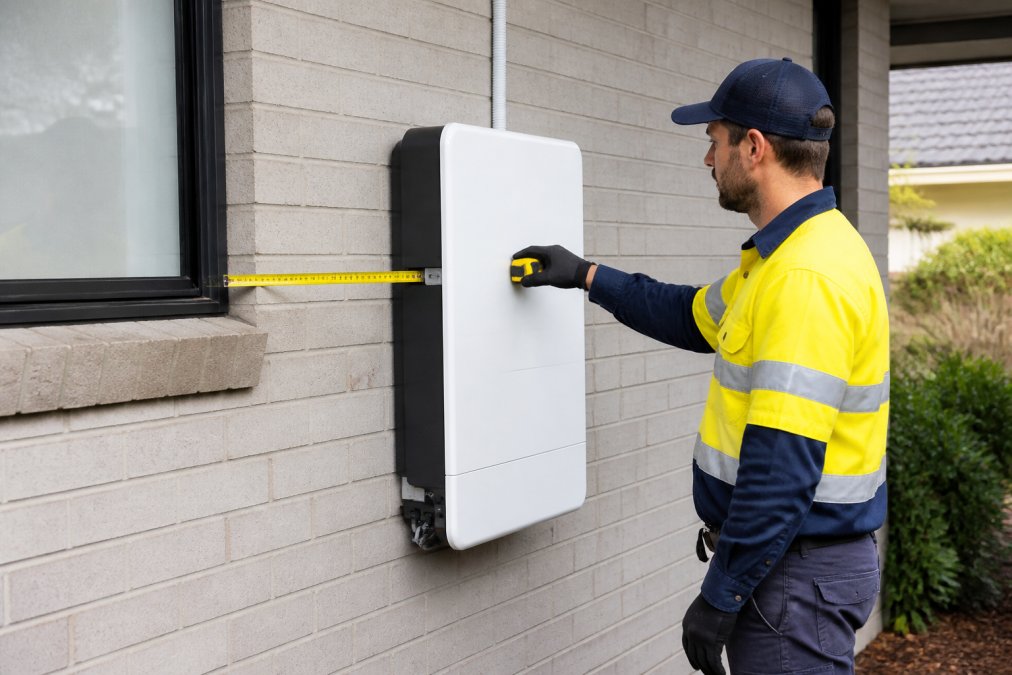
For indoor installations, the battery must be mounted in a dedicated area such as a garage, utility room, or purpose-built enclosure that is not a thoroughfare. A common rule of thumb is maintaining at least 1 metre of clearance from doorways and windows that lead into habitable spaces, and ensuring no air conditioning return air vent is within the battery’s designated exclusion zone. Your installer should measure these clearance zones precisely during the site assessment.
Outdoor Placement and Fire-Resistant Barriers
Outdoor placement is often the preferred solution because it removes the battery from the living envelope entirely. However, outdoor units still face strict rules. They must be mounted on a load-bearing wall or structure, and they need to maintain specific distances from property boundaries, windows, and neighbouring structures.
The typical clearance requirement for an outdoor battery is a minimum of 1 metre from windows, doors, and property boundaries, though this can vary based on the battery’s specific certification and the wall construction. Units must also be elevated at least 300 mm above ground level to protect against flooding and allow airflow beneath the unit for thermal management.
If you cannot achieve the required clearance distances, the solution is usually a fire-resistant barrier. These barriers, typically made from specific grades of metal sheeting such as 0.5 mm steel or a minimum 6 mm fibre-cement sheet, are installed between the battery and the protected area to contain a potential fire. The barrier must extend beyond the battery’s footprint, typically 300 mm on all sides, and be fixed to a non-combustible substrate. This is a technical decision that depends on the battery’s specifications and the wall construction.
A frequent compliance failure is installing a battery in a garage that shares a wall with a bedroom, without checking whether the wall’s construction meets the fire-resistance rating required by AS/NZS 5139. Many garages have lightweight timber-framed walls with only a single layer of plasterboard, which does not meet the standard. If your garage wall is not up to spec, the battery may need to be relocated or a fire-rated barrier installed.
Ventilation and Airflow Requirements
Ventilation is not an optional extra; it is a critical safety system. Lithium-ion batteries can release flammable gases such as hydrogen and carbon monoxide during a thermal event. Without adequate ventilation, these gases can accumulate to explosive concentrations. AS/NZS 5139 therefore mandates specific ventilation rates for indoor installations.
For most residential indoor installations, natural ventilation is sufficient if the battery is installed in a room with permanent ventilation openings to the outside air. The standard typically requires a minimum free-air opening of 1,500 mm² per kilowatt-hour of battery capacity, up to a maximum of 10,000 mm². If the room cannot achieve this, mechanical ventilation, such as an exhaust fan triggered by a gas detector, is required.
A common pattern is to install the battery in a garage with a louvred door or a permanent wall vent. If your proposed location is a sealed room without external ventilation, your installer will need to install a vent or choose a different location. Outdoor installations do not require additional ventilation, but they must not be enclosed in a cabinet that restricts airflow around the unit, as this can void the manufacturer’s warranty and cause overheating.
When planning the location, check the battery’s ingress protection rating. Units installed outdoors need a higher IP rating, typically IP54 or above, to withstand rain and dust. Your installer should confirm the unit’s rating matches its proposed location, as exposure to the elements can void the manufacturer’s warranty.
Clearance Zone Diagram and Measurement Guide
A practical way to visualise the requirements is to map out a clearance zone around the battery. Imagine a rectangular exclusion zone extending from the battery’s outer surfaces. For indoor installations, this zone typically extends 1 metre in front of the unit (for access and maintenance) and at least 300 mm on each side and above. No combustible materials, such as cardboard boxes, paint tins, or stored clothing, should be placed within this zone.
For outdoor installations, the exclusion zone extends 1 metre from the front of the unit and 300 mm from the sides and rear. This zone must remain clear of vegetation, gas meter boxes, and other services. Your installer should mark these zones during the site assessment and confirm that no future modifications to your home will encroach on them. switchboard upgrade requirements.
The Core Solar Battery Safety Standards You Should Know
Beyond AS/NZS 5139, several other standards govern the safety and performance of your system. Understanding these helps you verify that the equipment your installer proposes is genuinely fit for purpose and legally transportable and connectable.
| Standard | Purpose | Why It Matters to You |
|---|---|---|
| AS/NZS 5139:2019 | Battery installation safety | Governs location, clearance, and fire safety |
| AS/NZS 3000 | Electrical wiring (Wiring Rules) | Ensures safe connection to your switchboard |
| UN38.3 | Lithium battery transport safety | Proves the battery passed transport safety tests |
| IEC 62040-1 | Electrical safety for power systems | Covers safety for inverter and UPS components |
The most critical document you should receive is the Certificate of Electrical Safety (CES). This is issued by your installer upon completion and is your proof that the work meets the Wiring Rules and local regulations. Without it, you have no evidence of compliance, and your insurance claim could be rejected.
Why You Need a Clean Energy Council Accredited Installer
The Clean Energy Council (CEC) accreditation is the industry benchmark for solar and battery installers in Australia. It signals that the installer has completed specific training on AS/NZS 5139 and understands how to apply the standard in real-world installations. This is not just a badge; it is a prerequisite for accessing most government rebates, including the Small-scale Renewable Energy Scheme (cleanenergyregulator.gov.au).
Choosing a CEC accredited installer protects you in several ways. They are qualified to perform the required site assessment, they know how to handle the paperwork for your network distributor, and they carry the appropriate insurance for the work. If something goes wrong, you have recourse through the CEC’s complaints process, a safety net you do not get with an unlicensed operator.
Retrofitting vs. New Builds: Key Differences in Compliance
If you are adding a battery to an existing solar system, the compliance process is more complex than a new installation. A retrofit requires a thorough check of your existing switchboard, inverter compatibility, and the condition of your current wiring. Many older homes need a switchboard upgrade to handle the bi-directional power flow a battery creates.
A new build or a simultaneous solar and battery installation is generally more straightforward because the system can be designed as a whole from the start. This allows the installer to optimise the location of the inverter and battery together, ensuring they meet clearance requirements without the constraints of an existing layout. Integrating the battery at the design stage saves both time and cost.
Protecting Your Investment: Insurance, Warranty, and Audits
A battery is a significant financial investment, and its protection depends on compliance. Many home insurance policies in Australia may require evidence that the battery was installed to AS/NZS 5139. If a fire occurs and you cannot produce a Certificate of Electrical Safety, your claim may be denied, leaving you liable for the damage.
Warranty protection is equally strict. Battery manufacturers will void the warranty if the unit is installed incorrectly, in an unsuitable location, or by someone without the proper accreditation. Before you sign anything, confirm that your installer is approved by the battery manufacturer, as this approval is often a condition of the warranty.
Post-installation audits are a growing trend among insurers and network distributors. These audits verify that the installation matches the documentation and that clearance zones have not been compromised over time. Keeping your installation documents organised and ensuring any future modifications to your home do not encroach on the battery’s clearance zone is essential.
Your Solar Battery Installation Compliance Checklist
Before your installer leaves the site, work through this checklist to confirm your installation is compliant and your investment is protected.
- Confirm your installer holds current Clean Energy Council accreditation
- Verify the battery model is listed on the CEC’s approved battery list
- Check that the installation location meets AS/NZS 5139 clearance zones from habitable rooms and boundaries
- Request and receive a Certificate of Electrical Safety (CES) for the work
- Confirm the battery has UN38.3 transport certification and IEC 62040-1 electrical safety compliance
- Review the manufacturer’s warranty terms to confirm the installer is an approved partner
- Ask for a copy of the site assessment and system design documentation
- Ensure your inverter is listed as compatible with the specific battery model
Post-Installation Maintenance and Audit Schedule
Compliance is not a one-time event. Once your battery is energised, it enters a maintenance lifecycle that affects both safety and warranty validity. Many battery manufacturers require annual inspections to maintain warranty coverage, and your home insurance policy may also reference ongoing maintenance obligations. Here is a practical schedule to follow:
Monthly (Homeowner):
- Visually inspect the battery area for any new stored items within the clearance zone. Move anything that has crept into the exclusion area.
- Check that the battery’s status indicator lights are normal and that no error codes are displayed.
- Listen for unusual sounds from the battery or inverter, such as buzzing or clicking, which may indicate a fault.
- Confirm that no new cracks or damage are visible on the battery casing.
Quarterly (Homeowner):
- Check that ventilation openings (louvres, vents, or grilles) are not blocked by dust, cobwebs, or debris. Clean with a soft brush if needed.
- Verify that the area around the battery is free of vegetation growth if installed outdoors. Trim any plants back to maintain the 300 mm side clearance.
- Test the battery’s performance through your monitoring app to confirm it is charging and discharging as expected.
Annually (Professional Inspection):
- Engage a CEC-accredited installer or electrician to perform a full system inspection. This should include checking all electrical connections for tightness, verifying torque settings on DC isolators, and testing the battery’s internal BMS (battery management system) communication.
- Confirm that the battery’s firmware is up to date. Manufacturers periodically release updates that improve safety algorithms and performance.
- Have the installer verify that the Certificate of Electrical Safety is still valid and that no new regulations have been introduced that affect your installation.
The Independent Audit Procedure
A growing trend among insurers and network distributors is the independent post-installation audit. This is a separate review conducted by a third party, not the original installer, to verify that the installation matches the documentation and that all safety standards were met. While not yet mandatory in all states, some network distributors in Victoria are piloting random audits for battery installations, particularly those connected under the AS/NZS 4777.2 standard for inverter requirements.
If your installation is selected for an audit, the auditor will typically check:
- That the battery model matches the one listed on the CEC approved list and the CES.
- That physical clearances match the site assessment drawings.
- That the switchboard has the correct circuit breaker ratings and that the battery is on a dedicated circuit.
- That all labelling is present, including the battery’s emergency shut-off instructions and the warning sign indicating the presence of an energy storage system.
To prepare for a potential audit, keep a dedicated compliance folder containing your CES, site assessment report, system design documents, battery manufacturer’s installation manual, and records of any annual inspections. Store this folder digitally and in a physical location that is accessible but not inside the battery’s clearance zone.
A compliant installation is one that remains compliant over its lifetime. Schedule your annual professional inspection at the same time each year, such as at the start of summer when battery usage increases, and keep a log of all maintenance activities. This documentation is your best defence if an insurance claim or warranty issue arises.
Compliance is the difference between a system that saves you money for decades and one that becomes a liability. The rules exist to protect your home, your family, and your investment. Working with a team that understands these requirements inside out is the only way to guarantee peace of mind.
Frequently Asked Questions
What are the Australian standards for solar battery installation?
The main standard is AS/NZS 5139, which covers the safe installation of battery energy storage systems. It dictates where a battery can be placed, clearance distances from doors and windows, and fire safety measures. It works alongside AS/NZS 3000, the general wiring rules. Any grid-connected system must also meet the requirements of the Clean Energy Council and your local network distributor.
Can any electrician install a solar battery?
No. While a licensed electrician is required to do the electrical work, most battery rebates and grid connection approvals require the installer to be a Clean Energy Council accredited installer. This accreditation proves they have specific training on battery systems and the AS/NZS 5139 standard, which directly reduces the risk of a poor or unsafe installation.
Where does a solar battery need to be installed?
The location is strictly governed by AS/NZS 5139. It must not be installed inside a habitable room, such as a bedroom or living area. Common compliant locations include garages, external walls, or dedicated utility areas. The battery must also maintain specific clearance zones from doorways and windows to ensure safe egress and prevent fire spreading.
Can you install your own solar battery?
In most cases, no. Installing a battery yourself would void the manufacturer’s warranty and likely your home insurance. It would also fail to meet the compliance requirements needed to connect to the grid or claim government rebates. A DIY installation of a lithium-ion system is a serious fire and electrical hazard that requires a Clean Energy Council accredited installer to manage safely.