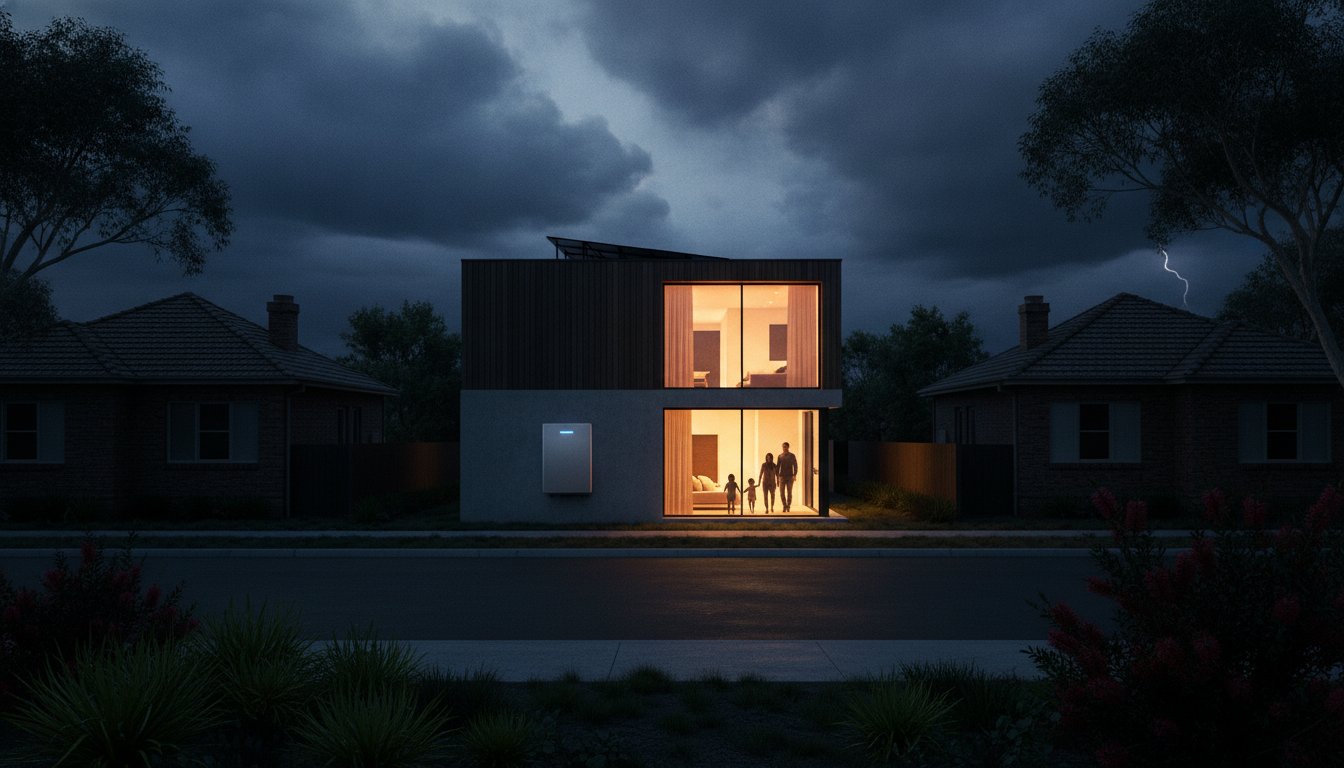
Most Melbourne homeowners believe their solar panels will keep the fridge running during a storm. They are mistaken. Without the right configuration, your system automatically shuts down the moment the grid fails to protect line workers. Securing a solar battery for home blackout protection Melbourne is no longer a luxury; it’s a strategic necessity for the 2026 energy landscape.
It’s frustrating to watch your panels generate excess power all day only to sit in the dark when a local transformer blows. You deserve a system that provides genuine security. This guide reveals how to secure your property using the latest 2026 technology and federal incentives. We’ll break down the technical difference between simple backup and true blackout protection. You’ll discover how to navigate the shift from state loans to the federal Cheaper Home Batteries Program. We also explain the mandatory CSIP-AUS protocols and how to optimise your storage for Melbourne’s specific grid zones. It’s time to turn your home into a self-sustaining sanctuary that remains powered when the rest of the street goes dark.
Key Takeaways
- Understand the “anti-islanding” trap and why standard solar setups fail during outages without dedicated islanding technology.
- Evaluate different levels of security by comparing essential circuit backup with comprehensive whole-home solutions when selecting a solar battery for home blackout protection Melbourne.
- Size your storage capacity for Melbourne’s winter “gap” in June rather than peak summer generation to ensure reliability during the storm season.
- Identify current 2026 federal rebate eligibility and explore how Virtual Power Plants (VPPs) can offset your initial investment through ongoing grid support credits.
- Learn why a professional switchboard audit is the critical first step to ensuring your home is technically prepared for a seamless transition to battery power.
Why Standard Solar Fails in a Blackout: The Anti-Islanding Trap
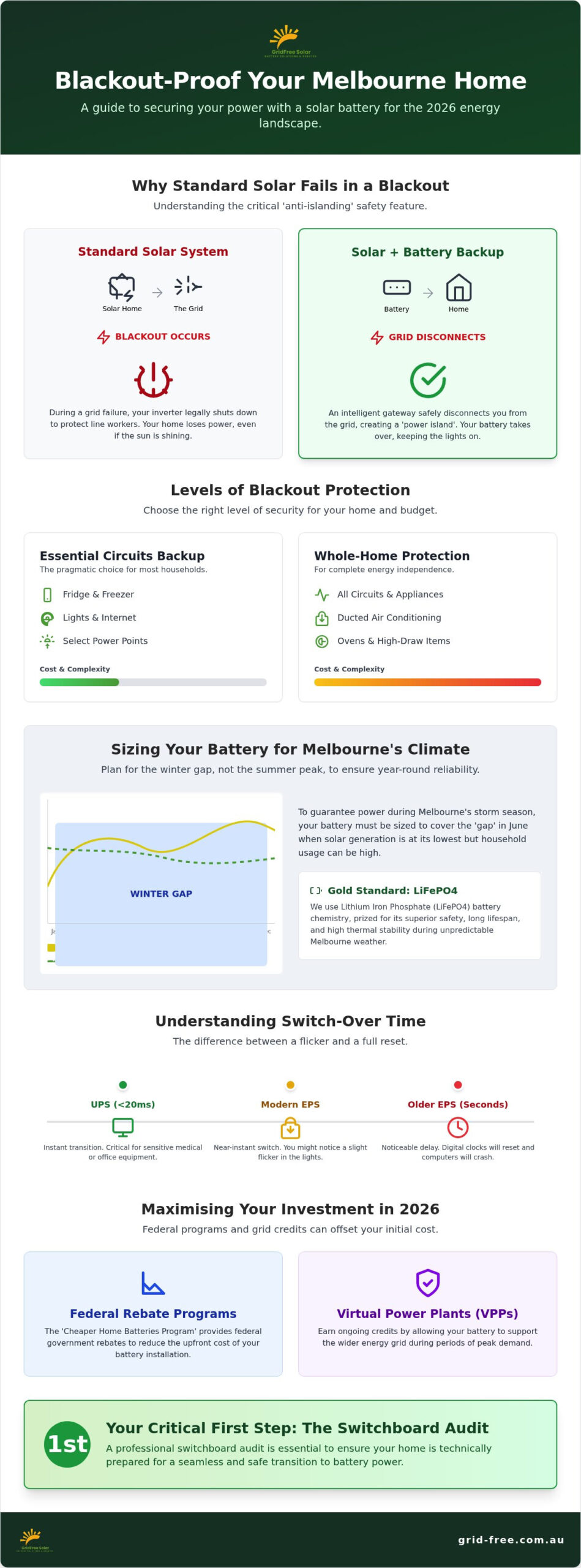
Most Melbourne homeowners are shocked when their solar panels go dark during a storm. It feels counterintuitive. You have panels; the sun might even be out; yet the lights remain off. This isn’t a system fault. It’s a mandatory safety feature known as anti-islanding. Australian law requires all grid-connected inverters to shut down instantly if they detect a grid failure. This prevents your system from sending electricity back into the street lines while technicians are performing dangerous repairs. Without a specific home energy storage configuration, your solar investment is legally sidelined exactly when you need it most.
True blackout protection is the technical ability to “island” your property. This involves physically disconnecting from the street grid so your home becomes its own independent micro-grid. To achieve this, you need more than just a battery. You require an intelligent Gateway or a dedicated backup box. This hardware acts as the brain of the system, sensing the grid drop and switching your energy source in a heartbeat. For Melbourne residents, an Emergency Power Supply (EPS) is a dedicated circuit or system-wide setting that allows your battery to discharge stored energy to your home while the external grid is down.
EPS vs. UPS: Understanding the Switch-Over Time
Timing is everything when the power fails. A traditional Uninterruptible Power Supply (UPS) offers an “instant” transition, usually under 20 milliseconds. This is critical for sensitive medical equipment or high-end home offices where even a second of downtime causes data loss. Standard EPS systems historically took several seconds to kick in, causing clocks to reset and computers to crash. However, 2026 inverter technology has significantly narrowed this gap. Modern high-performance setups now achieve switch-over times so fast that you might only notice a slight flicker in the lights before the battery takes over.
The Melbourne Grid Factor: AusNet and United Energy Zones
Local geography dictates your blackout risk. In Melbourne’s leafy eastern suburbs served by AusNet, fallen branches during storm season are the primary cause of prolonged outages. Conversely, the western growth corridors managed by United Energy often face grid instability due to rapid infrastructure expansion and high demand. Each Distribution Network Service Provider (DNSP) has unique rules regarding how batteries discharge and support the grid. Navigating these Victorian DNSP requirements is complex, making local expertise essential when installing a solar battery for home blackout protection Melbourne. We ensure your system is compliant with local network standards while maximising your energy security during local grid events.
Levels of Blackout Protection: Essential Circuits vs. Whole-Home
Security isn’t one-size-fits-all. When configuring a solar battery for home blackout protection Melbourne, you must decide between maintaining a “survival” mode or total energy independence. Most residential systems in 2026 utilise Lithium Iron Phosphate (LiFePO4) chemistry. This technology is superior for safety and longevity, offering high thermal stability during Melbourne’s unpredictable heatwaves and storm seasons. It’s the gold standard for reliable discharge when the grid fails.
The Essential Circuits approach is the pragmatic choice for most households. It involves wiring specific, high-priority loads to your backup gateway. By focusing only on the fridge, lighting, and Wi-Fi, you ensure your food stays fresh and you remain connected during a network failure. Conversely, Whole-Home protection aims to run everything, including heavy-draw items like induction cooktops and ducted air conditioning. While appealing, this requires massive battery stacks and high-output inverters. For most Melburnians, the cost-to-value ratio leans heavily toward essential circuit protection; it provides the majority of critical security for a fraction of the total investment.
Choosing Your Essential Circuits
Prioritisation is your best defence against a flat battery. For a short four-hour outage, you can afford some luxuries. However, during a 24-hour Victorian storm event, every kilowatt-hour is precious. High-draw appliances are the enemy. A single boil of a kettle can consume more energy than your LED lights will use in two days. Split systems and electric ovens will drain a standard 10kWh battery in less than two hours if left unchecked. We recommend auditing your switchboard to identify which appliances are truly non-negotiable. If your current storage feels insufficient, considering a battery upgrade can bridge the gap between basic backup and true reliability. You can also check current Victorian rebates to see if you’re eligible for financial support to expand your capacity.
Load Shedding and Smart Management
Modern 2026 systems remove the guesswork from energy management. Smart inverters now integrate directly with home automation platforms to manage your “energy budget” in real time. Load shedding extends your battery’s run time during blackouts by automatically disconnecting non-critical appliances when stored energy hits a predefined threshold. This ensures your lights stay on until the sun rises, even if someone accidentally leaves a heater running. These intelligent systems don’t just store power; they actively defend your home’s comfort during a crisis. It’s a seamless transition from grid-reliance to intelligent self-sufficiency.
Sizing Your Battery for Melbourne’s Winter and Storms
Sizing a solar battery for home blackout protection Melbourne based on January performance is a strategic error. Melbourne winters are notoriously grey and short. In June, your solar harvest can drop to just 20% of its summer peak. If a storm knocks out the grid during a week of overcast weather, a battery sized only for summer will leave you in the dark by 8:00 pm. You must size for the “Winter Gap” to ensure your system has enough capacity to bridge multiple days of low generation.
This brings us to “Days of Autonomy”. This metric defines how long your home can function without grid support or significant solar input. Most Melbourne households aim for 24 hours of autonomy for essential circuits. To calculate this accurately, you must look at usable capacity rather than nominal capacity. The “Depth of Discharge” (DoD) determines this; a battery with 10kWh nominal capacity and a 90% DoD only provides 9kWh of actual energy. Factoring in these technical limits is essential when reviewing the Solar Battery Cost Australia 2026: The Definitive Price & ROI Guide for your property.
The 10kWh vs. 13kWh Debate
A 10kWh unit is the current “sweet spot” for the average Victorian suburban home. It comfortably covers overnight baseload and keeps the fridge and lights running during a standard outage. However, high-demand households are increasingly stacking batteries to reach 20kWh or more. This is particularly relevant if you have transitioned to an all-electric home or own an electric vehicle (EV). An EV battery is significantly larger than a home storage unit; attempting to charge your car during a blackout will deplete your home backup in minutes. Modern 2026 configurations often include smart diversions to protect your home reserves from EV charging during a crisis. While the Victorian Government solar battery program has evolved, the focus remains on ensuring systems are sized for genuine resilience rather than just daily cycling.
Upgrading Existing Systems for Better Backup
Many homeowners with older systems wonder if they can add blackout protection without starting from scratch. The answer is usually yes, thanks to AC-coupling. This method allows a new battery and its dedicated inverter to sit alongside your existing solar setup. It’s an ideal solution for systems installed five or ten years ago that were marketed as “battery-ready” but lacked the physical storage. If your current storage is underperforming or you need to modernise your setup, explore Solar Battery Replacement Melbourne: Upgrade Your Storage Now to understand your path to a more resilient home.
Maximising ROI: Victorian Rebates and VPPs in 2026
Investing in a solar battery for home blackout protection Melbourne is no longer just about avoiding a dark house; it’s a calculated financial strategy. In 2026, the ROI calculation has shifted from simple bill reduction to asset protection and increased property value. A home that remains fully functional during a grid failure is a premium product in the Melbourne real estate market. You’re buying security, but you’re also building equity in a city where grid reliability is becoming a major buyer consideration. The tangible savings on your quarterly power bill are only half the story.
The financial landscape for storage has evolved significantly. While the older Victorian state loan programs have closed, the federal Cheaper Home Batteries Program has stepped in to provide the heavy lifting. This program offers an upfront discount of approximately 30% on your system, which equates to roughly $372 per usable kilowatt-hour. For a standard 10kWh setup, this is a massive reduction applied directly at the point of sale. To qualify in 2026, your system must be technically capable of participating in a Virtual Power Plant (VPP), ensuring your investment supports the wider Melbourne grid while paying for itself faster.
Claiming the Victorian Battery Rebate
Securing your rebate requires precision. The application process is now handled primarily at the point of sale by your installer, but you must meet strict eligibility criteria. The most significant change for 2026 is the income threshold. From July 1, 2026, the combined household income limit for Victorian solar incentives drops from $210,000 to $150,000 per year. Applications submitted before this deadline are assessed under the higher cap. Common pitfalls include choosing non-approved hardware or failing to provide updated council rates notices. Ensure your documentation is flawless to avoid a rejection. For a detailed breakdown of the current rules, read our Victorian Battery Rebate 2024 to 2026: The Complete Guide to Storage Savings.
Joining a Melbourne VPP
Virtual Power Plants are the secret to accelerating your payback period. By joining a VPP, you allow a provider to occasionally draw small amounts of power from your battery to stabilise the grid during peak demand. In exchange, you receive ongoing credits that can range from $150 to $600 annually. In 2026, Victoria has at least seven active VPP providers. The critical feature to look for is the “Blackout Reserve.” This setting ensures the VPP never drains your battery below a certain level, such as 20%. This means you aren’t left with an empty battery if a storm hits immediately after a grid event. It’s about balancing income with your personal security needs. Ready to see how much you could save? Contact GridFree Solar for a custom ROI projection today.
The GridFree Advantage: Precision Blackout Installations
GridFree Solar doesn’t just drop a box on your wall. We deliver integrated energy solutions tailored to the specific volatility of the Victorian grid. A solar battery for home blackout protection Melbourne is only as effective as the engineering behind its installation. Our approach moves beyond hardware; we architect a system that understands your home’s unique load profile and switchboard limitations. By choosing a specialist in Energy Storage Solutions Melbourne, you ensure your transition to backup power is seamless and safe. We monitor your system in real time using 2026 diagnostic tools. Often, our team identifies a grid anomaly or a performance drop in your storage before you even notice a flicker in your lights. This proactive local support is what separates a professional installation from a generic retail transaction.
Expert Installation vs. ‘Solar Cowboys’
Poorly configured backup circuits are a liability. “Solar cowboys” often take shortcuts with switchboard wiring, which leads to catastrophic fire risks or permanent damage to sensitive electronics during a high-speed switch-over. Our Victorian-accredited electricians treat your safety as a non-negotiable priority. Every installation involves a rigorous compliance check to meet the latest 2026 Australian standards, ensuring your “islanding” capability is legally and technically sound. We exclusively deploy Tier 1, VPP-ready technology from brands with a proven track record in the Australian climate. This ensures your system is not only robust enough for a three-day storm but also intelligent enough to participate in the lucrative Melbourne VPP market discussed earlier. We don’t just wire for today; we wire for a decade of reliability.
Get Your Melbourne Blackout Audit
True energy independence starts with a site-specific assessment. We conduct a comprehensive audit of your switchboard to determine its backup readiness and identify any necessary upgrades to your existing infrastructure. If your current system is aging or underperforming, we specialise in battery upgrades that breathe new life into existing solar arrays. Our expertise isn’t limited to residential properties either. We are also a definitive leader in Commercial Solar Installation Melbourne, helping local businesses maintain critical operations during widespread grid failures. Don’t wait for the next storm to test your system’s limits. Secure your property against the next storm season with a precision-engineered solution. Book your Melbourne blackout audit today and take the first step toward a home that remains bright when the rest of the street goes dark.
Secure Your Energy Future Today
Melbourne’s energy landscape is shifting rapidly. You now understand that standard solar panels aren’t a guarantee of power during a grid failure. True resilience requires precision engineering, specifically sizing your storage for the June winter gap and implementing smart islanding technology. By leveraging 2026 federal rebates and VPP incentives, you can off-set your initial costs while building significant property equity.
Investing in a solar battery for home blackout protection Melbourne is the definitive way to protect your lifestyle from local grid volatility. GridFree Solar provides custom-engineered backup solutions designed for our specific network zones. As Victorian-accredited specialist installers with proven expertise in Solar Victoria rebate claims, we ensure your transition is seamless and technically superior. Don’t wait for the next storm season to test your limits. Secure your Melbourne home with a blackout-proof solar battery from GridFree Solar today. You’ve done the research; now it’s time to take control and enjoy the peace of mind that comes with a truly independent home.
Frequently Asked Questions
Will my solar battery work instantly when the power goes out?
Most systems feature a brief delay during the transition. While a true UPS provides millisecond switching, most Emergency Power Supply (EPS) configurations take between two and ten seconds to activate. You will notice the lights flicker or a brief pause before the battery takes over. This transition is usually fast enough to keep your fridge running, though sensitive electronics like desktop computers might reboot if you don’t have a dedicated high-speed gateway installed.
Can I run my air conditioner on a solar battery during a blackout?
Technically yes, but it is rarely advisable for extended periods. A standard 10kWh solar battery for home blackout protection Melbourne can be drained in under two hours by a large split-system air conditioner. We recommend prioritising fans or using the AC sparingly during daylight hours when your solar panels are actively replenishing the storage. Smart load shedding can automatically manage these high-draw appliances to ensure your critical lighting remains powered overnight.
How long will a 10kWh battery last during a typical Melbourne power outage?
A 10kWh unit typically sustains essential circuits for 24 hours or more. This includes your fridge, Wi-Fi, LED lighting, and phone charging. However, if you attempt to run “whole-home” loads like electric ovens or heaters, that duration drops to roughly three hours. For Melbourne’s winter storm season, we focus on a survival-mode configuration that guarantees your food stays fresh and your communication lines remain open until the grid is restored.
Do I need a special inverter for blackout protection?
You definitely need an inverter with “islanding” or backup functionality. Standard grid-tie inverters are designed to shut down during a blackout for safety. To maintain power, you require a hybrid inverter or a battery-specific inverter paired with a backup gateway. This hardware manages the physical disconnection from the grid, allowing your home to operate safely as an independent micro-grid while protecting utility workers from electrical back-feed.
Is the Victorian battery rebate still available in 2026?
The landscape has changed for 2026. While the original Solar Victoria battery loan program is closed, you can still access the federal Cheaper Home Batteries Program. This provides an upfront discount of roughly $372 per usable kWh. Be aware that the combined household income threshold for Victorian solar panel and hot water rebates was lowered to $150,000 on July 1, 2026, making it vital to check your eligibility early.
Can I add a battery to my existing solar system for blackout protection?
Absolutely. We specialise in AC-coupling, which allows us to integrate storage into almost any existing solar setup. You don’t need to replace your current panels or inverter to gain energy security. By adding a dedicated battery inverter and storage unit, we can retro-fit your property with full solar battery for home blackout protection Melbourne. This is a popular choice for homeowners who want to upgrade their energy independence without a complete system overhaul.
What happens if my battery runs out of charge during a long blackout?
If your storage hits zero during the night, your home will lose power until the sun rises. Modern 2026 systems feature “black start” capability, which allows the solar panels to wake up the inverter and begin recharging the battery as soon as daylight is detected. To avoid this scenario, we recommend setting a “backup reserve” of 20% in your battery settings, ensuring you have a buffer for the most critical hours.
Does blackout protection work for three-phase homes in Melbourne?
Yes, though the installation is more complex. Three-phase homes in Melbourne require either a dedicated three-phase hybrid inverter or three separate single-phase inverters working in sync. You must decide whether you want backup across all three phases or just a single “emergency” phase. Our specialists audit your switchboard to determine the most cost-effective way to ensure your larger Melbourne property remains functional during a total network failure.