Table of Contents
- Assessing Shade: Minor vs. Significant Shading
- The Impact of Partial Shading on Solar Panels
- Panel-Level Optimisation vs. String Inverters
- Microinverters vs. Power Optimisers for Shaded Systems
- Designing Your Shaded Solar Array: Roof Orientation and Tilt
- Solar System Monitoring and Maintenance Services
- When to Avoid Solar Due to Excessive Shade
- Frequently Asked Questions
Last Updated: August 20, 2026
Assessing Shade: Minor vs. Significant Shading
Shade is the solar system designer’s most persistent challenge. Unlike ideal installations on unobstructed roofs, shaded systems lose productivity in ways that compound across seasons and time of day.
Minor shading typically affects less than 20% of your array at peak sun hours, morning or afternoon shadow from a nearby tree, chimney, or neighbouring structure. A well-designed system can tolerate this level of obstruction. Significant shading occurs when more than 25-30% of panels fall into shadow during peak generation hours (roughly 10am to 3pm), or when shade persists across multiple hours daily.
This distinction determines which design approach makes financial sense. GridFree Solar’s assessment process starts by understanding whether your roof’s shade profile allows a conventional string inverter setup or demands panel-level optimisation hardware.
DIY shade analysis tools and sun path mapping
Before commissioning a professional assessment, you can gather useful baseline data yourself. Free web-based sun path mapping tools let you enter your address and see interactive sun paths overlaid on satellite imagery of your roof, revealing which structures, trees, or terrain features cast shadows at different times. Take screenshots for different seasons to understand how shade patterns shift, afternoon shade in winter (when panels are already less efficient) is far less damaging than morning shade in summer.
A simple DIY approach: photograph the surrounding landscape from roof height at 9am, noon, and 3pm on a clear day in both winter and summer. This visual record helps any installer understand your specific situation and prevents dismissals that mask poor design thinking.
When shade losses become uneconomical
Not all shaded roofs justify solar investment. The economics shift when shade losses exceed roughly 35-40% of potential annual output, stretching payback beyond 10 years.
Your local electricity rates matter significantly, higher rates make even degraded systems viable. Battery storage changes the equation too: a shaded array paired with battery storage can still provide grid independence and bill reduction. Government incentives through the Small-scale Renewable Energy Scheme also affect viability.
GridFree Solar’s team evaluates whether your roof falls into the uneconomical zone by modelling actual shade patterns against your consumption profile and local tariffs. If shade losses genuinely exceed 40%, the honest recommendation is often to wait, invest in other efficiency measures first, or explore alternative sites like a garage roof or ground-mounted array.
The Impact of Partial Shading on Solar Panels
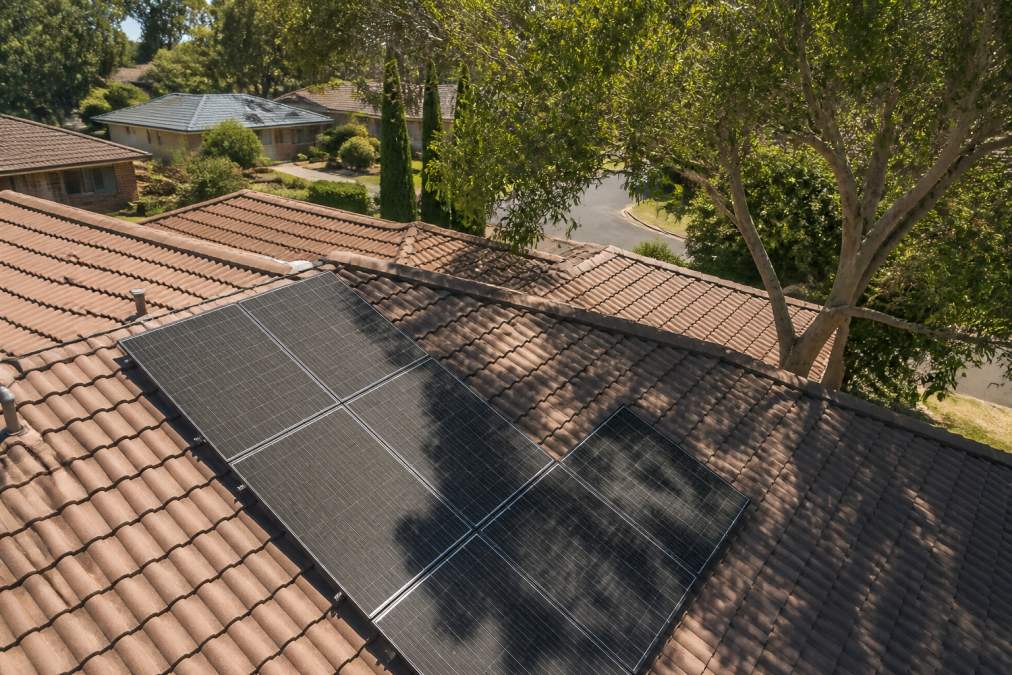
Partial shade creates a deceptively complex problem in traditional string inverter systems. When one panel in a string falls into shadow, it doesn’t simply produce less power, it can drag down the entire string’s output far beyond what the single shaded panel’s lost production would suggest.
This happens because panels in a string are wired in series. A shaded panel acts as a bottleneck, forcing all panels in that string to operate at the shaded panel’s reduced current level. A panel that’s 50% shaded can reduce the entire string’s output by 50%, even though 80% of the string remains in full sun.
How bypass diodes protect against clipping
Bypass diodes are small semiconductor devices embedded in modern solar panels that prevent this catastrophic loss. When a panel falls into shadow, the bypass diode allows current to bypass that panel entirely, letting the rest of the string continue operating at full capacity. Without bypass diodes, partial shading would make string inverter systems impractical for any roof with intermittent shade. However, bypass diodes only prevent total string collapse, they don’t optimise each panel’s performance individually.
Seasonal shading variations and energy yield
Shade patterns shift dramatically across seasons. Winter shade from a deciduous tree might be severe, while summer shade is lighter. A northern structure casts longer shadows in winter but minimal shadow in summer.
Many homeowners underestimate seasonal variations. A roof that seems moderately shaded in autumn might face severe shade in winter. Energy yield models that average shade across the year can mask these seasonal peaks and troughs. GridFree Solar’s design process maps seasonal shade profiles separately, showing which months will deliver strong performance and which will be constrained.
This matters for battery sizing and export strategy. If your system faces heavy winter shade, your summer surplus becomes more valuable for export or storage.
Panel-Level Optimisation vs. String Inverters
The core decision in shaded system design is whether to use a traditional string inverter (one large inverter for many panels) or panel-level optimisation hardware (microinverters or power optimisers, with one device per panel or small group).
String inverters are simpler and cheaper upfront, working well for unshaded roofs. For shaded systems, their weakness is that one shaded panel drags down performance across the entire string.
Panel-level optimisation means each panel (or small group) has its own power electronics, allowing each panel to operate at its optimal voltage and current regardless of shade elsewhere on the roof.
How microinverters and power optimisers differ
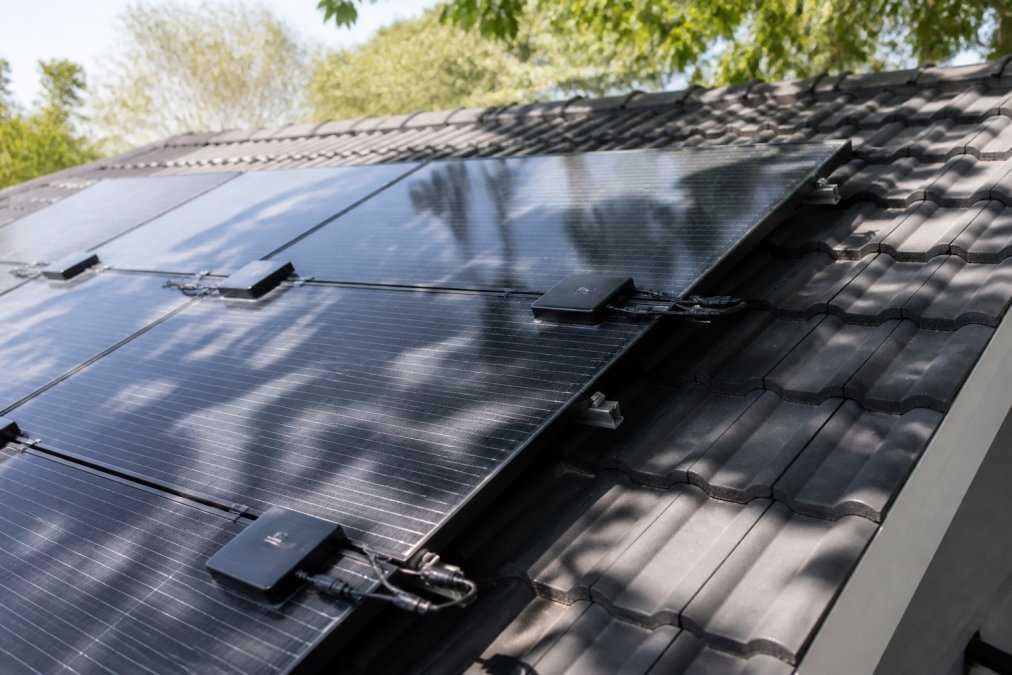
Microinverters convert DC to AC at each panel, with every panel having its own small inverter. This maximises flexibility, each panel operates completely independently. If one panel fails, the others continue unaffected. Monitoring is granular, showing real-time output from each individual panel. The trade-off is cost and complexity.
Power optimisers sit between the panels and a central inverter, optimising each panel’s output without converting to AC on the roof. This hybrid approach is cheaper than full microinverters but more expensive than string inverters alone. They’re often the sweet spot for shaded roofs, addressing the core problem without the full cost and complexity of microinverters.
ROI calculation for shade-mitigation hardware
Adding microinverters or power optimisers costs more upfront but recovers that cost through improved energy yield in shaded conditions. If shade reduces your annual output by 20-25%, power optimisers typically pay for themselves within 4-6 years. If shade losses are only 10-15%, payback extends beyond 8 years, and a string inverter might be acceptable. If shade losses exceed 35-40%, even panel-level optimisation may not justify the investment.
Your local electricity rate amplifies the economics. GridFree Solar’s assessment includes ROI calculation specific to your address, rates, and shade profile, so you know exactly how long the hardware investment takes to recover.
Microinverters vs. Power Optimisers for Shaded Systems
For most shaded roofs in Australia, this choice comes down to performance gains versus cost. Both technologies solve the core problem of individual panel shading losses.
Microinverters excel when multiple partially shaded panels are spread across the array, offering maximum granularity in performance monitoring. Power optimisers work better when shade is clustered, affecting a specific section rather than scattered across it. For most residential shaded roofs, power optimisers deliver 85-90% of the performance benefit of microinverters at 60-70% of the cost.
AC modules: A complete alternative for shade
AC modules integrate microinverters directly into the panel during manufacturing. From a performance standpoint, AC modules are equivalent to microinverters, with each panel operating independently. The advantage is installation simplicity; the disadvantage is less flexibility if you need to replace or upgrade components later, and typically higher per-watt cost.
AC modules make sense if you’re building a new system from scratch and want maximum simplicity. For retrofits or upgrades, separate microinverters or power optimisers usually offer better value and flexibility.
Designing Your Shaded Solar Array: Roof Orientation and Tilt
Once you’ve chosen your optimisation strategy, the next design layer is physical placement. Roof orientation (azimuth) and tilt angle both influence how much shade your system receives and how well it performs during low-light hours.
Azimuth is the compass direction your panels face. In the Southern Hemisphere, north-facing panels are ideal. However, east or west-facing sections still work, simply generating more power in morning or afternoon respectively.
Tilt angle affects how panels receive diffused light during overcast conditions. Steeper angles (40-50 degrees) perform better in winter when the sun is lower. For shaded roofs, tilt angle becomes more important because low-light performance matters more, you’re already losing direct sun to shade, so capturing diffused light efficiently becomes critical.
Optimising azimuth and pitch for low-light performance
Shaded systems benefit from slightly steeper tilt angles than unshaded systems. A standard pitch of 25-30 degrees works for most Australian roofs, but shaded arrays often perform better at 35-40 degrees. East-facing arrays on shaded roofs often outperform west-facing because morning sun is typically clearer and more direct than afternoon sun.
GridFree Solar’s design process models your specific roof orientation against local weather patterns and shade timing to recommend the optimal tilt.
Battery storage integration with shaded systems
Battery storage transforms the economics of shaded solar. A shaded array might generate 60-70% of what an unshaded system produces, but paired with battery storage, it can still provide significant bill reduction and grid independence.
Shaded arrays benefit from larger battery capacity relative to panel size because generation is more inconsistent. You’re capturing power when shade allows, then storing it for evening use. Battery storage also improves the value of your shaded array’s summer surplus, allowing you to capture excess power for winter use rather than exporting it at lower rates.
Solar System Monitoring and Maintenance Services
Real-time monitoring becomes essential in shaded systems. You need visibility into whether each panel is performing as expected and whether shade patterns match your design assumptions.
GridFree Solar’s monitoring platform tracks performance at the panel level, showing exactly which sections of your array are underperforming and when. This granularity helps you spot problems early, a panel with unexpectedly low output might indicate a fault, soiling, or a shade pattern that’s changed since installation.
Real-time performance tracking and thermal imaging
Panel-level optimisation systems reveal individual panel performance, crucial for shaded arrays. You can see if shade is hitting panels as predicted or if unexpected obstructions have emerged.
Thermal imaging detects panels running hotter than expected, indicating reduced performance. In shaded systems, thermal imaging helps identify panels that are partially shaded or have soiling issues, allowing targeted cleaning or maintenance. Annual maintenance should include professional thermal imaging to catch performance issues before they accumulate.
When to Avoid Solar Due to Excessive Shade
If shade analysis reveals that more than 40% of your roof receives shade during peak sun hours for most of the year, solar investment becomes financially marginal.
This doesn’t mean never pursue solar, it means exploring alternatives first. Improving insulation, upgrading to a heat pump hot water system, or installing a ground-mounted array on an unshaded part of your property often delivers better returns. Some homeowners find that waiting 5-10 years makes more sense than installing a constrained system now.
GridFree Solar’s honest assessment includes this conversation. If your roof genuinely falls into the uneconomical shade category, we’ll tell you directly rather than designing a system that underperforms your expectations.
Shaded roofs don’t disqualify solar, they demand smarter design. Whether through panel-level optimisation hardware, battery storage integration, or careful roof positioning, GridFree Solar’s team has helped Australian homeowners unlock value from constrained roofs. Our CEC-accredited installers combine professional assessment with compliance to AS/NZS 5139:2019 and AS/NZS 3000 standards, ensuring your system is safe, efficient, and optimised for your specific shade profile. Connect Now to discuss whether your roof qualifies and what design approach will deliver the strongest returns.
Frequently Asked Questions
What is the impact of partial shading on total solar system output?
Partial shading can reduce system output far more than the shaded area alone. When one cell in a string is shaded, bypass diodes prevent the entire string from shutting down, but the string’s output drops to match the weakest cell. A single shaded panel can cut 20-30% of string output. Panel-level optimisation with microinverters or power optimisers isolates each module, limiting losses to just that panel and preserving the rest of the array’s energy production.
How do microinverters and power optimisers mitigate shade impact?
Both technologies apply maximum power point tracking (MPPT) at the module level rather than the string level. Microinverters convert DC to AC at each panel, whilst power optimisers condition DC voltage before a central inverter. This isolation means shading one panel does not degrade neighbouring panels’ performance. Microinverters suit roofs with mixed orientations; power optimisers offer a lower-cost middle ground between string inverters and full microinverter systems.
When is a shaded roof too compromised for solar to be worthwhile?
If shade covers more than 25-30% of your roof during peak generation hours (9am-3pm), or if hard shadows persist year-round, system payback extends beyond 10 years and may not justify the investment. Seasonal shade that clears in summer is manageable; permanent shade from tall buildings or dense tree canopy is not. A professional site assessment using solar irradiance mapping and thermal imaging can determine whether your roof meets minimum performance thresholds.
Can string inverters work on shaded roofs?
String inverters can work on shaded roofs, but efficiency suffers significantly. A single shaded panel in a string can limit the entire string’s output to that panel’s reduced capacity, even if other panels receive full sun. Bypass diodes prevent complete string failure, but clipping losses remain high. String inverters suit fully unshaded roofs; for any partial shading, panel-level optimisation (microinverters or power optimisers) is the better choice.
This article was written using GrandRanker