What if your most volatile monthly overhead wasn’t a fixed cost, but a strategic choice? For many local owners, the weight of peak-hour electricity rates in Victoria feels like an inescapable tax on growth. You’re likely frustrated by the complexity of Victorian Energy Upgrades (VEU) and the fear that a major installation might disrupt your daily trade. Securing high-performance solar for small business Melbourne has moved beyond being a green luxury. It’s now a critical financial shield against a volatile market.
We’ll show you exactly how to navigate this landscape to reclaim your bottom line. This guide reveals how to stack the current $84 Victorian Energy Efficiency Certificates with federal incentives to slash upfront costs by up to 35%. You’ll discover the latest smart battery technologies and the 2026 rebate shifts that make rapid ROI possible. We’ve simplified the administrative maze, from the expanded 1MW SRES limits to the Cheaper Home Batteries program, so you can focus on running your business with cheaper, smarter power.
Key Takeaways
- Maximise your financial hedge by stacking federal STCs with Victorian Energy Efficiency Certificates (VEECs) to reduce upfront system costs by up to 35%.
- Learn why high-performance solar for small business Melbourne is the most effective way to neutralise rising peak-hour electricity rates and Victorian Default Offer (VDO) benchmarks.
- Discover the “Smart Meter” advantage and how to use 15-minute interval data to size a system for rapid ROI rather than just maximum roof coverage.
- Understand the streamlined installation process that uses detailed site audits to ensure your daily trade continues without disruption.
- Explore how integrated battery upgrades and custom-designed commercial solutions provide a definitive path to energy independence for Melbourne shopfronts.
Why Melbourne Small Businesses are Fast-Tracking Solar in 2026
Electricity is the new rent. For many Victorian shopfronts, power bills have morphed from a manageable utility into a predatory overhead. While the Victorian Default Offer (VDO) remains a benchmark, it doesn’t shield you from the underlying volatility of the national grid. Adopting solar for small business Melbourne is the most aggressive move a director can make to reclaim control over their margins. It transforms a variable, uncontrollable expense into a predictable, fixed-cost asset.
Melbourne’s consumer base has also shifted. Sustainability is no longer a niche preference. It’s a “social licence” to operate. Customers from the CBD to the outer suburbs now actively seek out businesses that demonstrate local environmental responsibility. Installing solar proves your commitment to the community while simultaneously protecting your profit. The rapid expansion of Solar power in Australia reflects this dual benefit of financial savvy and community leadership.
The Melbourne Energy Context: 2026 Tariffs
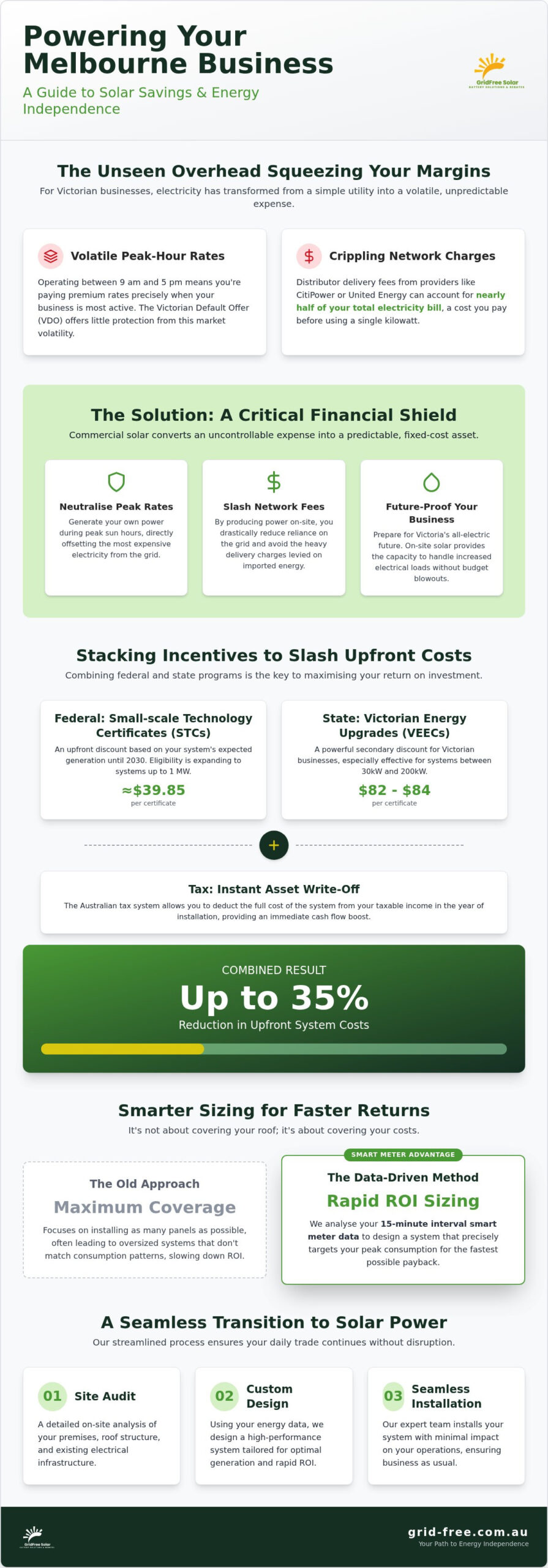
Current commercial tariffs in Victoria are heavily weighted toward peak-hour consumption. If your business operates between 9 am and 5 pm, you’re a “daylight loader.” This is the ideal profile for solar for small business Melbourne. You consume energy exactly when your panels are at peak production. This strategy bypasses the heavy network charges levied by distributors like CitiPower or United Energy. These charges can often account for nearly half of your total bill. By generating power on your own roof, you avoid these delivery fees entirely and lock in a lower cost per kilowatt-hour.
Future-Proofing Against the Victorian Transition
Victoria is leading the national shift away from gas. New regulations and market pressures are forcing a rapid transition to full electrification for heating, cooling, and hot water. This shift significantly increases the electrical load on your premises. Solar provides the necessary capacity to handle this increased demand without blowing out your operational budget. It prepares your infrastructure for the next decade of energy policy. Energy independence for a Melbourne small business means the technical capacity to generate and store enough on-site power to insulate the bottom line from network tariff hikes and grid instability.
Victorian Business Solar Rebates and Incentives Explained
Rebates aren’t just bonuses. They’re capital injections into your business infrastructure. For many directors, the complexity of government schemes is the only barrier to entry. However, the financial landscape for solar for small business Melbourne has never been more lucrative. By understanding the interplay between federal and state support, you can effectively neutralise a significant portion of your upfront investment.
The foundation of every commercial quote is the Small-scale Technology Certificate (STC). As of August 2026, the market price for these certificates remains stable at approximately $39.85. These are calculated based on the expected generation of your system until 2030. For larger operations, the federal landscape is shifting. From 1 October 2026, eligibility for the Small-scale Renewable Energy Scheme (SRES) expands to include systems up to 1 MW. This allows mid-sized Melbourne enterprises to access the same upfront discounts previously reserved for smaller shopfronts.
Beyond federal support, the Victorian Energy Upgrades (VEU) program provides a secondary layer of savings. This program operates through Victorian Energy Efficiency Certificates (VEECs), which currently hold a spot price between $82.25 and $84.30. When you stack these incentives, the total reduction in system costs can reach up to 35%. Additionally, the Australian tax system allows for the instant asset write-off of solar hardware. This means you can often deduct the full cost of the system from your taxable income in the year of installation, providing an immediate boost to your cash flow.
Federal vs State Incentives: Can You Double Dip?
Yes, you can. Stacking incentives is the “secret sauce” for achieving a rapid ROI. While the STC discount is federal, the VEU discount is a state-based kicker specifically for Victorian businesses. For systems between 30kW and 200kW, the VEU program is particularly aggressive. Eligibility for the Solar Victoria $3,500 business rebate typically requires your business to operate from non-residential premises and employ fewer than 50 people. Combining these ensures your out-of-pocket expense is minimised from day one.
Navigating the Paperwork Without the Headache
Admin shouldn’t stall your transition to clean energy. A professional installer acts as your “Trusted Advisor,” handling the bureaucratic heavy lifting. You’ll simply need to provide your ABN, recent electricity bills, and proof of property ownership or a lease agreement. This streamlined approach ensures you receive your discounts at the point of sale rather than waiting for a tax return. If you’re looking to eliminate peak-hour charges entirely, check out our Victorian Battery Rebate Guide to see how storage fits into your incentive stack. You can request a rebate eligibility check today to see which discounts apply to your specific Melbourne location.
Sizing the Right System for a Melbourne Shopfront
Bigger is rarely better. For a Melbourne shopfront, over-provisioning leads to wasted capital and diminished returns. The goal isn’t to cover every square centimetre of your roof. It’s to match your generation capacity with your actual daytime baseload. While the press often focuses on solar incentives for big business, the most profitable systems for smaller enterprises are those sized with surgical precision. A 100kW warehouse setup is irrelevant for a local cafe. You need a system that aggressively targets your specific operational hours.
Your “Smart Meter” is your most valuable consultant. We use it to analyse 15-minute interval data, mapping your exact usage spikes throughout the day. This data-driven approach ensures you aren’t paying for capacity that simply exports to the grid for a pittance. For the majority of Melbourne retail outlets and hospitality venues, the 5kW to 20kW range represents the “sweet spot.” This capacity typically covers heavy refrigeration and lighting loads without the bloated capital expenditure of industrial-scale arrays. Securing the right solar for small business Melbourne starts with this consumption-first philosophy.
Roof Space and Structural Considerations
Melbourne’s architectural diversity demands a tailored mounting strategy. Whether you’re operating out of a heritage building with slate tiles or a modern warehouse with corrugated iron, the installation must be non-negotiable on safety. We require a structural engineering certificate for every commercial project to verify weight limits and wind loading. Orientation is also a strategic choice. While North-facing panels maximise total yield, an East-West split often serves a business better. This configuration flattens the generation curve, providing consistent power for early morning coffee rushes and late afternoon trade when electricity prices are at their peak.
The Role of Commercial Battery Storage
Batteries are the definitive solution to the “Evening Peak” problem. If your business trade continues past 5 pm, you’re likely paying some of the highest rates in the country just as your solar production drops. Storage allows you to capture excess midday energy and deploy it when the sun goes down. More importantly, it helps you dodge expensive “Demand Charges.” These are fees based on your highest point of usage in a single interval. A battery shaves these peaks, keeping your billing profile flat and predictable. For detailed hardware pricing and return-on-investment timelines, consult our guide on Solar Battery Cost Australia.
The Installation Process: Minimising Business Disruption
Installation shouldn’t mean downtime. For a running enterprise, the physical rollout of solar for small business Melbourne must be a precision operation. A professional installer acts as a project manager, synchronising technical requirements with your trading hours to ensure your front door stays open. We treat the transition as a streamlined five-step deployment designed for speed and compliance.
- Step 1: Site Audit. We conduct a forensic review of your switchboard and roof structure, cross-referencing this with the 15-minute interval data discussed in the previous section.
- Step 2: Grid Approval. We manage the technical application with your distributor, whether it’s Jemena, AusNet, CitiPower, or United Energy, to secure your connection agreement.
- Step 3: Permits. For businesses in the Melbourne CBD or inner suburbs like Yarra and Port Phillip, we navigate heritage overlays and council planning permits on your behalf.
- Step 4: Physical Installation. Our teams work in coordinated shifts, often performing the most intrusive electrical work outside of your peak trading hours.
- Step 5: Commissioning. We activate your system, perform rigorous safety testing, and configure your monitoring app so you can track your ROI in real-time.
If you’re ready to secure your energy future without the logistical headache, you can book your commercial site audit to get the process started.
Managing Installation as a Commercial Tenant
Renting your premises isn’t a deal-breaker for solar. In Victoria, Environmental Upgrade Finance (EUF) allows tenants and landlords to collaborate on building improvements where the energy savings cover the loan repayments. This creates a “Win-Win” scenario. The landlord sees an increase in property value and NABERS ratings, while you enjoy immediate relief from skyrocketing power bills. For those on short-term leases, we focus on modular system designs that offer maximum flexibility for future relocations.
Safety and Compliance Standards
Commercial solar is a high-stakes electrical installation. To qualify for Victorian rebates and maintain your business insurance, you must use a Clean Energy Council (CEC) Accredited Installer. Every system we deploy meets AS/NZS 5033 standards, ensuring your asset is protected against Melbourne’s extreme weather shifts. Commercial grade inverters are engineered for continuous high-load operation and advanced grid-support functions that standard residential units simply cannot match. This technical superiority is what ensures your system remains operational for the full 25-year lifecycle of the panels.
Maximising Your ROI: The GridFree Solar Advantage
Generic solar packages are a liability for your balance sheet. Most off-the-shelf systems fail to account for the specific shading, roof orientation, and interval data of a Melbourne shopfront. At GridFree Solar, we reject the cookie-cutter approach. We design high-performance solar for small business Melbourne that functions as a precision financial instrument. By custom-engineering every array, we ensure your generation matches your heaviest consumption periods. This strategy drives down your payback period from the first day of operation.
The GridFree Solar Approach to Business Solar
Our team specialises in high-efficiency panels and tier-1 commercial inverters. These components are chosen for their durability in Victoria’s temperamental climate and their superior grid-support capabilities. Our role as your Trusted Advisor means GridFree Solar handles the bureaucratic heavy lifting. We navigate the VEU and STC certificate creation processes so you don’t have to. For a deeper look at our technical methodology, explore our specialised page on Commercial Solar Installation Melbourne. We ensure every system is future-proofed for the Victorian energy transition.
Calculating Your Payback Period
In 2026, the ROI for Melbourne businesses has accelerated. By stacking federal STCs with Victorian Energy Efficiency Certificates (VEECs), many of our clients see an upfront cost reduction of up to 35%. Typical payback periods for a well-designed system now range between three and five years. This timeline is significantly shorter than traditional commercial investments. When you incorporate an integrated battery solution, you further insulate your business from evening peak rates and demand charges. This doesn’t just save money; it provides total energy independence.
Our post-installation support ensures your investment continues to perform as expected. We provide real-time monitoring tools that allow you to track your savings and system health directly from your smartphone. Local Melbourne expertise is non-negotiable for rebate success when deploying solar for small business Melbourne. GridFree Solar understands the specific requirements of distributors like CitiPower and United Energy, ensuring your grid connection is approved without delay. Don’t leave your overheads to chance. Contact GridFree Solar for a custom business energy audit today and lock in your 2026 savings.
Secure Your Competitive Edge with Local Solar
Electricity isn’t just a bill; it’s a strategic variable you can finally control. By stacking federal STCs with Victorian Energy Efficiency Certificates, you’ve seen how upfront costs can drop by 35%. Precision sizing based on your 15-minute interval data ensures you aren’t paying for wasted capacity. Implementing solar for small business Melbourne is about more than sustainability; it’s about bottom-line resilience in a volatile market.
Our CEC Accredited Installers and local Melbourne support team take the guesswork out of the transition. We are specialists in Victorian rebate claims, handling the bureaucratic hurdles so you don’t have to. The 2026 energy landscape is shifting fast. Don’t leave your margins to the mercy of the grid. Take control of your overheads today and lead your industry into a cleaner, more profitable future.
Get a Custom Solar ROI Analysis for Your Melbourne Business
Frequently Asked Questions
How much can a small business in Melbourne save with solar in 2026?
Savings vary by consumption, but stacking Victorian Energy Upgrades (VEU) with federal incentives can reduce upfront system costs by up to 35%. For a standard shopfront, this transition often results in a 40% to 60% reduction in monthly electricity bills. By generating power on-site, you bypass high network charges from distributors like CitiPower. This makes solar for small business Melbourne one of the most effective ways to neutralise rising operational overheads.
Do I need council approval for commercial solar panels in Melbourne?
Council approval is generally not required for standard roof-mounted systems on non-heritage buildings. However, if your business is located within a heritage overlay or the Melbourne CBD, you may need a planning permit. We handle these administrative checks during our initial site audit. It’s essential to verify structural integrity with a certified engineer, especially for older inner-city buildings, to ensure the roof can safely support the additional weight of a commercial-grade array.
What is the Victorian Energy Upgrades (VEU) program for solar?
The VEU program is a state-based initiative that provides upfront discounts through Victorian Energy Efficiency Certificates (VEECs). In late 2026, the market value for these certificates remains strong, often sitting between $82.25 and $84.30. This program is specifically designed to incentivise businesses to upgrade to high-efficiency solar PV systems. As an accredited specialist, we manage the entire certificate creation process, ensuring the discount is applied directly at the point of sale.
Can I install solar if I rent my business premises in Melbourne?
Yes, you can install solar as a commercial tenant by utilising Environmental Upgrade Finance (EUF). This “Win-Win” arrangement allows the cost of the system to be repaid via your council rates, with the energy savings typically exceeding the repayments. It increases the property value for the landlord while slashing your monthly overheads. We facilitate these discussions with landlords to ensure the legal and financial structures benefit all parties involved in the lease.
How long does a commercial solar installation take for a small shop?
A typical installation for a small Melbourne shopfront is completed within one to three days. The timeframe depends on system complexity and switchboard requirements. We coordinate the most intrusive electrical work outside of your peak trading hours to ensure your business remains operational throughout the process. Following the physical install, the commissioning and grid connection approval from your distributor usually takes an additional one to two weeks before the system is fully active.
What happens to my solar production on Melbourne’s famously cloudy days?
Modern high-efficiency panels are designed to generate power even under diffuse light or heavy cloud cover. While peak output occurs during direct sunlight, your system will still produce significant energy during Melbourne’s overcast winter months. We use local meteorological data to model your expected annual yield with high accuracy. This ensures your ROI calculations are based on realistic Victorian weather patterns rather than optimistic laboratory conditions, providing you with a dependable financial forecast.
Is there a specific rebate for small business batteries in Victoria?
Small businesses can access significant support through the federal Cheaper Home Batteries program, which offers a discount of approximately 30% on systems between 5kWh and 100kWh. This is a point-of-sale discount handled by your installer. Stacking this with existing solar for small business Melbourne incentives allows you to capture excess midday generation and deploy it during expensive evening peak periods, effectively insulating your shop from the most volatile electricity tariffs.
What is the difference between STCs and LGCs for my business?
Small-scale Technology Certificates (STCs) provide an upfront discount for systems up to 100kW, which is the standard for most small businesses. From October 2026, this threshold expands to 1MW. Large-scale Generation Certificates (LGCs) are typically for industrial-scale arrays and provide ongoing revenue based on generation rather than an upfront rebate. We help you determine which certificate scheme offers the fastest payback period based on your specific system size and projected energy consumption.