
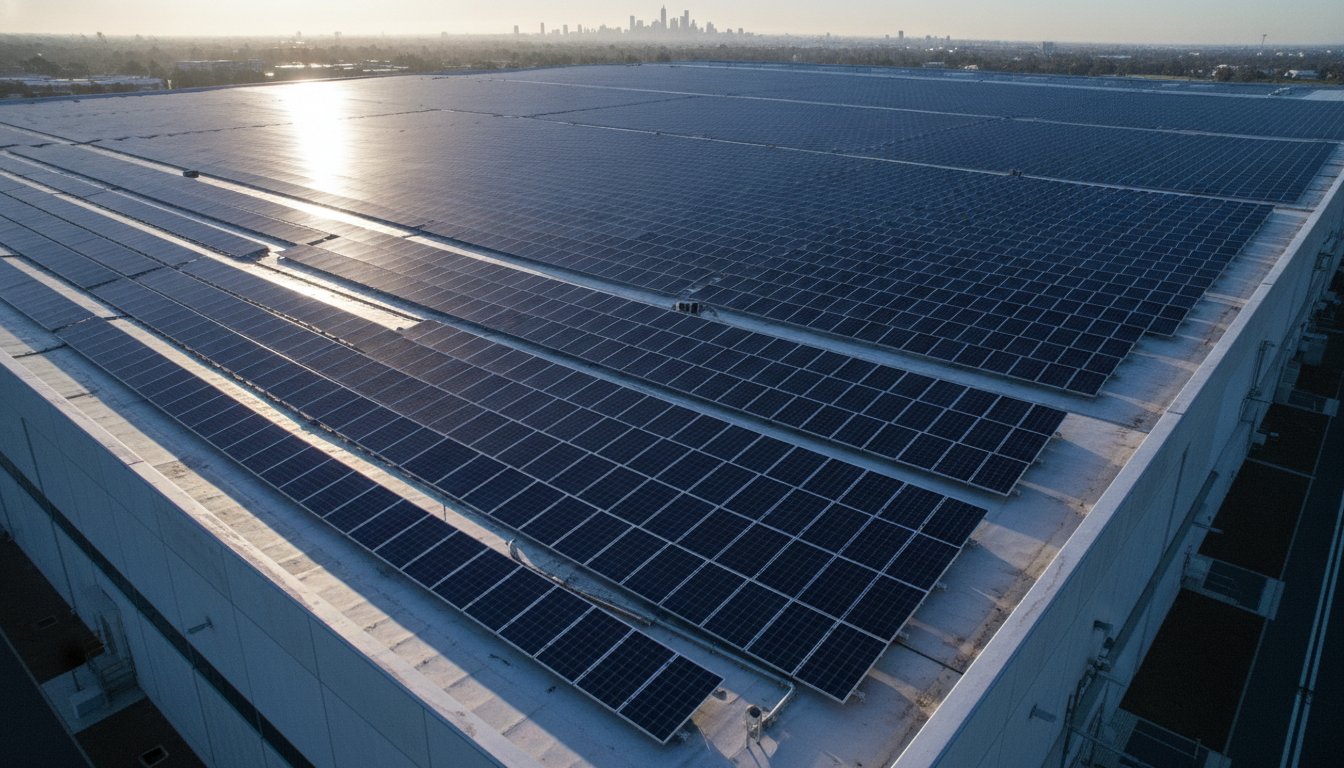
For Melbourne manufacturers, electricity is no longer a simple utility cost; it’s a direct threat to your operating margins. If your facility operates in industrial heartlands like Dandenong or Campbellfield, you’ve already felt the sting of volatile Victorian tariffs and punishing peak demand charges. You know that every production shift is a gamble against a grid that’s becoming increasingly unreliable and expensive.
This is where the strategy changes. We’ve built this guide to help you master the technical and financial landscape of solar for manufacturing plants Melbourne, ensuring you slash overheads and reclaim control. We’ll break down the October 2026 SRES expansion to 1MW, explain how Victorian Energy Upgrades can provide up to $34,000 in incentives, and show you why industrial battery upgrades are now the only way to neutralise peak demand fees. It’s time to turn your factory roof into a high-performance asset that drives 2026 ROI and secures your energy independence for the long term.
Key Takeaways
- Capitalise on the 2026 energy shift by transforming your manufacturing facility into a high-performance, strategic energy asset.
- Master the updated financial landscape, including expanded federal schemes and Victorian incentives, to maximise the ROI of solar for manufacturing plants Melbourne.
- Identify the critical technical differences between baseload and peak demand to neutralise expensive charges during high-intensity production shifts.
- Ensure long-term system reliability by prioritising Tier 1 components and rigorous structural audits designed for high-vibration industrial environments.
- Future-proof your operations with intelligent battery storage to secure grid independence and navigate complex distribution network requirements.
The Shift to Solar in Melbourne’s Manufacturing Sector
Melbourne’s industrial heartlands are evolving. In 2026, the traditional model of passive energy consumption is no longer viable for factories in Dandenong, Campbellfield, or Somerton. The 2026 energy landscape is defined by extreme price swings and a grid that rewards those who generate their own power. Investing in solar for manufacturing plants Melbourne isn’t just about environmental optics; it’s a cold, hard financial hedge against a market that has become increasingly hostile to heavy energy users.
Manufacturers are uniquely positioned to win here. Large roof footprints in Melbourne’s north and south-east offer massive potential for energy harvesting. Transitioning from a consumer to an active producer allows your facility to dictate its own overheads. This shift is part of a broader trend in Solar power in Australia, where industrial players are now leading the charge toward energy independence. By reclaiming control over your energy supply, you protect your bottom line from external market shocks.
Rising Energy Costs in Victoria
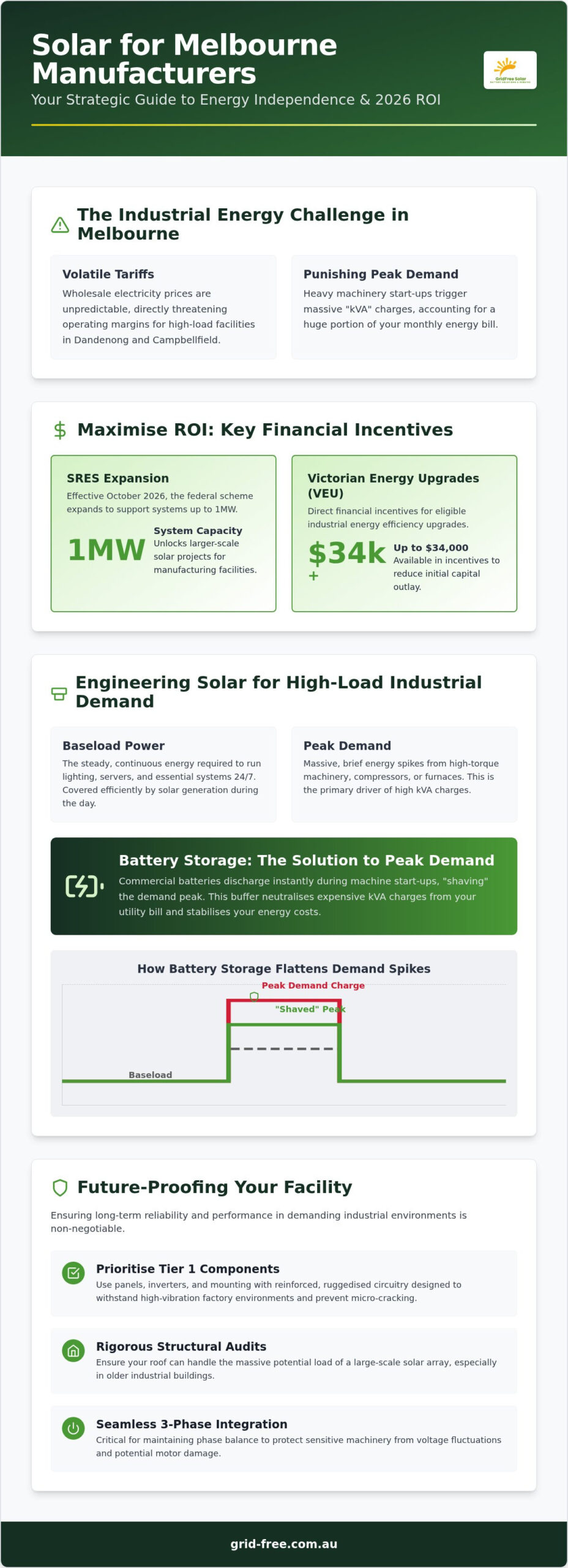
Wholesale electricity prices in Melbourne are notoriously volatile. For a high-load manufacturing plant, this volatility translates into unpredictable operational costs that eat into margins. Industrial energy rates are forecast to remain high as the state transitions away from legacy coal assets. Manufacturing facilities are hit hardest because their production cycles often align perfectly with peak tariff windows. Every machine start-up during a peak period triggers demand charges that can account for a massive chunk of your monthly bill. Solar provides the immediate relief needed to flatten these peaks and stabilise your monthly expenditure.
The ESG Mandate for Melbourne Manufacturers
Sustainable operations are now a prerequisite for securing high-value contracts. If you’re pitching to Tier 1 procurement teams or global supply chains, your carbon footprint is under the microscope. Solar is the most visible and verifiable commitment to sustainable manufacturing you can make. It directly impacts your Environmental, Social, and Governance (ESG) ratings, which are increasingly tied to company valuation and investor interest. By integrating commercial solar installation Melbourne, you aren’t just saving on bills; you’re qualifying your business for the next decade of industrial growth. Proactive energy management signals to stakeholders that your facility is modern, efficient, and resilient.
Engineering High-Load Solar Systems for Industrial Demand
Manufacturing isn’t like retail. Your facility doesn’t just consume energy; it demands it in massive, high-torque surges. Engineering solar for manufacturing plants Melbourne requires a granular understanding of your facility’s load profile. We distinguish between baseload, the steady energy required to keep the lights and basic systems running, and peak demand, the massive spikes occurring when heavy machinery, compressors, or furnaces engage. Peak Demand Management is the strategic use of on-site generation and storage to offset high-intensity power draws, preventing expensive “kVA” charges from appearing on your utility bill.
Industrial zones like Dandenong or Campbellfield are high-vibration environments. You must prioritise Tier 1 components with reinforced mounting and ruggedised internal circuitry to prevent micro-cracking and electrical fatigue over a twenty year lifespan. Seamless integration with existing 3-phase industrial power systems is non-negotiable. This ensures phase balance is maintained, protecting your sensitive machinery from voltage fluctuations and potential motor damage. If your current infrastructure is struggling to keep up, a professional commercial energy audit can identify exactly where your engineering is failing to meet production demand.
Battery Storage: The Secret to Managing High-Torque Startups
High-torque machinery creates instantaneous surges that solar panels alone cannot always meet. By integrating commercial solar battery storage, you create a high-speed buffer for your plant. The battery discharges instantly during machine start-ups, “shaving” the peak and neutralising the kVA charges that usually drive up Victorian industrial bills. This technical synergy is why the Clean Energy Council has championed game-changing solar incentives for large-scale storage. Beyond cost reduction, these systems provide critical backup power to keep sensitive production lines active during local grid instability.
Optimising Inverter Capacity for Large-Scale Plants
Your choice of inverter architecture dictates your system’s total uptime and resilience. For massive factory roofs, we often weigh the benefits of centralised inverters against string inverters. While centralised units offer simplicity, string inverters provide superior redundancy; if one unit fails, the rest of the plant keeps generating. Consider the following when selecting hardware:
- Monitoring Software: Use platforms that track real-time production against specific machine usage.
- Heat Dissipation: Ensure hardware is rated for Melbourne’s summer extremes to prevent thermal derating.
- IP Ratings: High Ingress Protection (IP) ratings are essential for hardware exposed to industrial dust and debris.
Modern monitoring allows you to see exactly when your solar is covering your load and when you’re drawing from the grid. This data is the foundation of intelligent energy management, allowing you to shift production schedules to coincide with peak solar generation windows.
Navigating Victorian Solar Rebates and Incentives for Industry
2026 is a watershed year for industrial solar funding in Victoria. The Federal Government’s October 1, 2026, expansion of the Small-scale Renewable Energy Scheme (SRES) from 100kW to 1MW has fundamentally rewritten the ROI calculation for solar for manufacturing plants Melbourne. This shift provides an upfront discount of approximately 20% on installation costs. For an 850kW system, this could mean a reduction of over $230,000. It’s no longer just about long-term savings; it’s about massive Day 1 capital relief that preserves your operational cash flow.
You can stack these federal benefits with state-level support to further accelerate your payback period. The Victorian Energy Upgrades (VEU) program offers additional upfront incentives for systems between 30kW and 200kW. As of August 2026, a 200kW installation can attract incentives of up to $34,000. For facilities looking to stabilise their grid connection and manage peak loads, the Victorian battery rebate remains a critical tool for funding high-capacity storage that mitigates expensive demand charges.
Tax strategy is the final piece of the financial puzzle. Renewable energy assets often qualify for instant asset write-off provisions, allowing you to accelerate depreciation and improve your tax position immediately. This combination of upfront discounts, state incentives, and tax benefits can pull your payback period into the three-to-six-year range. It’s a rare window where government policy and technology costs align perfectly for the manufacturing sector.
Solar Victoria Business Rebates
Eligibility for Victorian state rebates often hinges on your business size and turnover. For Melbourne-based manufacturing SMEs, the application process is rigorous but manageable with a specialist partner. We recommend preparing your structural audits and electrical line diagrams early to fast-track your claim. Combining these state-specific grants with federal incentives ensures you aren’t leaving money on the table when upgrading your facility. Act now to secure your spot before funding pools for the current cycle are exhausted.
Understanding LGCs for Systems Over 100kW
While the SRES expansion offers upfront relief, systems exceeding 100kW can still participate in the Large-scale Generation Certificate (LGC) market. These certificates create an ongoing revenue stream based on every megawatt-hour of clean energy your plant produces. The administrative process for industrial LGC registration is complex, requiring ongoing metering and annual reporting. However, for massive manufacturing sites with a ten-year horizon, forecasting LGC prices can provide a predictable secondary income that offsets rising grid energy costs. It transforms your factory roof into a consistent financial yield generator.
Key Considerations for Commercial Solar Installation in Melbourne
Precision is the baseline for industrial deployment. Successful solar for manufacturing plants Melbourne depends on more than just hardware; it requires a deep understanding of Victorian infrastructure and building codes. Before a single rail is fixed, a comprehensive structural roof audit is mandatory. Many older factory roofs in suburbs like Braeside or Epping weren’t designed for megawatt-scale arrays. We ensure your facility meets the revised AS/NZS 5033:2021 standards, guaranteeing that your roof can handle the static load and wind uplift of a high-density commercial system.
Managing your grid connection is the most complex administrative hurdle. Whether your facility sits on the United Energy, AusNet, or Jemena network, each Distributed Network Service Provider (DNSP) has unique technical requirements for large-scale systems. We handle these negotiations directly to ensure your system integrates without compromising local grid stability. Our installation teams prioritise your production schedule. We coordinate work around your shifts to minimise downtime, ensuring your assembly lines remain operational while we transition your plant to renewable power.
Safety protocols are non-negotiable in a high-voltage industrial environment. Modern systems must include rapid shutdown capabilities and advanced fire protection. As of July 2026, all Victorian inverters must be installed with the AS/NZS 4777.2:2020 Australia A settings. These aren’t just regulatory hurdles; they are essential safeguards for your staff and your capital equipment. Ready to assess your facility’s potential? Book a structural feasibility study with our engineering team today.
Melbourne Grid Connection and Export Limits
Industrial zones often face saturated feeders, which can lead to strict export limits from your DNSP. If the grid cannot accept your excess power, we design zero-export or limited-export systems. These utilise smart controllers to dynamically adjust inverter output in real-time. This ensures you maximise self-consumption without triggering grid faults or violating your connection agreement. It’s about being a good neighbour to the grid while prioritising your own energy independence.
Maintenance and Performance Monitoring
Industrial environments are inherently harsh. Dust, soot, and chemical residue from nearby operations can settle on your panels, degrading performance by up to 20% over time. We utilise thermal imaging for proactive fault detection, identifying hot spots in large arrays before they lead to system failure. This level of technical oversight is why professional solar installation Victoria requires a team with specialised commercial experience. We don’t just install panels; we engineer long-term reliability into your facility’s DNA.
Future-Proofing with GridFree Solar Commercial Solutions
Stop reacting to rising energy costs. Start dictating them. GridFree Solar delivers the technical precision required for high-output industrial environments. We don’t believe in “off-the-shelf” solutions. Every solar for manufacturing plants Melbourne project begins with a granular, site-specific energy load profile analysis. This data-driven approach ensures your system is sized perfectly for your machinery requirements, avoiding the pitfalls of over-engineering or under-performance.
Our proactive approach covers the entire lifecycle of your investment. We handle the complex rebate management and VEU compliance so you can focus on production. From the initial engineering phase to the final grid-connection, we ensure a seamless transition. Beyond the hardware, we provide ongoing support and performance optimisation, ensuring your asset delivers its promised ROI well into the 2030s.
The GridFree Commercial Advantage
We speak the language of industrial ROI. Our team provides transparent data reporting designed for CFO-level decision making. We don’t just install new systems; we also offer specialised Battery Upgrade & Replacement services for existing commercial setups. If your legacy solar system is underperforming or failing to mitigate peak demand, we can integrate modern storage to fix the gap. Choosing GridFree for solar for manufacturing plants Melbourne ensures you have a local partner who understands exactly how to neutralise Victorian energy volatility.
Next Steps for Your Manufacturing Plant
Your journey toward energy independence starts with a site-specific energy load profile analysis. We map your facility’s consumption patterns to identify exactly where solar and storage will have the highest impact. We then manage the entire timeline, from the initial quote through to the final grid-connection, with minimal disruption to your operations. Seamless integration of commercial solar installation Melbourne with intelligent storage is the only way to future-proof your plant against the 2026 energy market. Ready to slash overheads? Consult with our commercial specialists today.
Reclaim Your Industrial Operating Margins
The 2026 energy landscape is a call to action for every factory owner in Victoria. You’ve seen how the combination of expanded federal incentives and the Victorian Energy Upgrades program has fundamentally shifted the ROI for solar for manufacturing plants Melbourne. It’s no longer just about sustainability; it’s about strategic cost control in a volatile market. By engineering a system that specifically targets your peak demand surges, you insulate your business from the punishing demand charges that threaten your bottom line.
Success requires more than just panels; it demands precision engineering and local expertise. GridFree Solar stands as your trusted advisor, offering high-performance commercial battery storage and expert rebate navigation to ensure no funding is left on the table. As local Melbourne industrial specialists, we understand the specific grid constraints of our region’s manufacturing hubs. Don’t let rising tariffs dictate your facility’s future. Secure your manufacturing plant’s energy future with a GridFree Solar audit. The opportunity to lock in decade-long energy independence is here. It’s time to act.
Frequently Asked Questions
How long is the typical payback period for industrial solar in Melbourne?
Payback periods for industrial systems in Victoria typically range between three and six years. This timeline is driven by high Victorian industrial tariffs and the immediate reduction in peak demand charges. By utilising the expanded SRES scheme and state-specific incentives, your facility can see a faster return on investment. We focus on high-yield engineering to ensure your system pays for itself through direct overhead reduction and improved operational efficiency.
Can my manufacturing plant operate entirely off-grid with solar and batteries?
Operating a high-load manufacturing facility entirely off-grid is technically possible but rarely the most efficient strategy. The scale of battery storage required to buffer heavy machinery surges 24/7 is substantial. Most Melbourne manufacturers find the best ROI through a grid-hybrid model. This setup allows you to use solar for manufacturing plants Melbourne to slash daytime costs while maintaining the grid as a failsafe for extreme production spikes.
What happens to production if the solar system needs maintenance?
Your production lines will continue to run without interruption during routine maintenance. Commercial solar systems are engineered with modularity in mind; individual strings or inverters can be isolated for service while the rest of the array continues generating. Because your facility remains grid-connected, the power supply automatically switches to the grid if the solar system is temporarily offline. We schedule major checks during planned downtime to ensure zero impact on your output.
Are there specific Victorian grants for manufacturing energy efficiency in 2026?
The Victorian Energy Upgrades (VEU) program remains the primary vehicle for industrial energy incentives in 2026. This scheme provides significant upfront discounts for commercial solar systems between 30kW and 200kW. For a 200kW system, your business could access incentives of up to $34,000. These state-level benefits can be combined with federal tax provisions like the instant asset write-off to maximise your total project funding and accelerate your payback period.
How does Melbourne’s weather affect the output of a large-scale industrial array?
Melbourne’s moderate climate is actually ideal for solar efficiency. While cloud cover reduces peak generation, solar panels perform more efficiently in the cooler Victorian air than in extreme heat. High temperatures can cause thermal derating, where inverter efficiency drops to protect the hardware. We use Tier 1 components with superior temperature coefficients to ensure your facility maintains high energy yields even during the peak of a Melbourne summer when demand is often highest.
Will installing solar void my factory building’s roof warranty?
Professional installation should never void your roof warranty. We conduct a rigorous structural audit before any hardware is mounted to ensure your roof’s integrity is maintained. We often use non-penetrative mounting systems for Klip-Lok or similar industrial profiles, which preserve the manufacturer’s warranty. By adhering to the revised AS/NZS 5033:2021 standards, we ensure your installation is fully compliant and structurally sound, protecting both your building and your solar investment for decades.
How do I know if my industrial switchboard needs an upgrade for solar?
Your switchboard’s suitability depends on its current fault current rating and available physical space. Large-scale solar for manufacturing plants Melbourne requires 3-phase balance and specialised protection devices that may not fit in legacy boards. During our initial site audit, we assess your electrical infrastructure to determine if an upgrade is required for safety and grid compliance. Modernising your board often improves the overall electrical resilience of your entire plant and prevents future downtime.
What is the difference between STCs and LGCs for a 150kW manufacturing system?
As of October 2026, a 150kW system is eligible for Small-scale Technology Certificates (STCs) rather than just Large-scale Generation Certificates (LGCs). This is a critical shift for your cash flow. STCs provide an immediate upfront discount, estimated at roughly 20% of the total installation cost. In contrast, LGCs are created annually based on actual generation and sold over time. Most manufacturers now prefer the STC route for the instant capital relief it provides during the construction phase.