
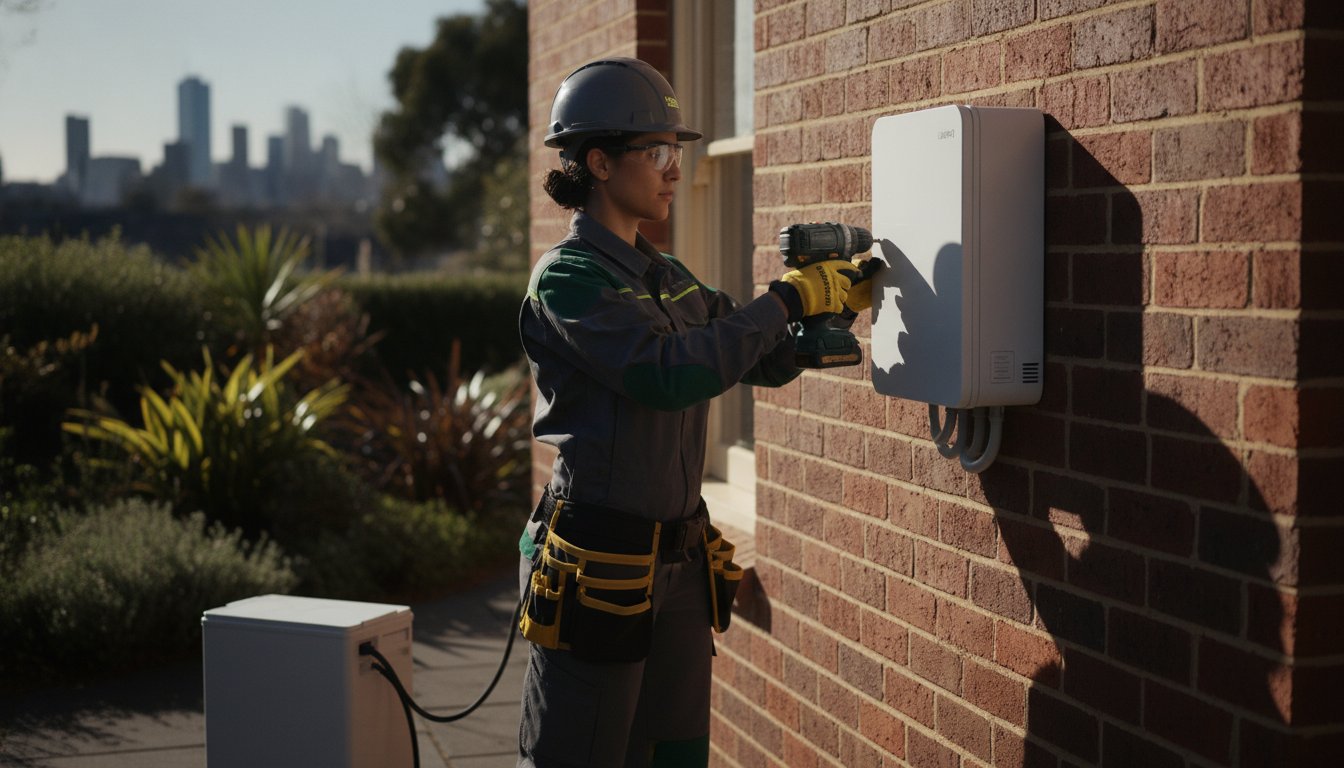
Your aging solar battery isn’t just losing capacity; it’s a financial anchor in an era of skyrocketing Melbourne electricity tariffs. If your lithium-ion unit no longer lasts through the night, you’re paying for peak-hour power that should be free. Understanding the current solar battery replacement cost Australia market requires more than just a quote. It demands a strategic approach to modern energy storage.
You likely feel the frustration of shifting rebate rules and decreasing hardware performance. We’re here to simplify the transition. This 2026 guide breaks down the financial reality of upgrading to high-efficiency LiFePO4 systems while managing the latest federal incentives. We’ll explain how to leverage the Cheaper Home Batteries Program and prepare for the critical July 1 income cap changes. You’ll learn how to secure your energy future, achieve total grid independence during blackouts, and ensure your installation meets the strict new CER compliance standards for a seamless rebate application.
Key Takeaways
- Factor in more than just hardware. Understand how decommissioning fees and labour influence the total solar battery replacement cost Australia in 2026.
- Secure your savings by navigating the new 2026 federal rebate tiers and the updated Victorian income threshold of $150,000.
- Future-proof your home with modern LiFePO4 chemistry. This ensures superior safety, thermal stability, and a longer operational lifespan than legacy units.
- Optimise your return on investment by correctly sizing your upgrade to match current evening consumption patterns and high peak-hour tariffs.
- Streamline the transition with a professional energy audit. This ensures your new battery integrates perfectly with your existing inverter setup.
Understanding Solar Battery Replacement Cost in Australia for 2026
The 2026 market marks a critical turning point for residential energy storage. Many early adopters who pioneered Solar power in Australia roughly a decade ago are now seeing their first-generation units hit a performance wall. Capacity is dropping. Charge cycles are slowing. For these homeowners, 2026 is the strategic “sweet spot” for an upgrade. While hardware prices have finally stabilised due to mature supply chains, the complexity of a replacement differs significantly from a fresh installation. You aren’t just buying a new battery; you’re decommissioning a legacy system and technical hurdles often arise when matching new tech with older solar arrays.
Hardware vs. Labour: What are you actually paying for?
Total project expenses are split between high-tech hardware and specialised technical expertise. A standard 10kWh lithium-ion replacement unit remains the primary investment in 2026. However, Victorian A-Grade electricians specialised in storage now command higher rates due to the rigorous safety standards required for modern lithium chemistries. Unlike a first-time install, a replacement involves removing and recycling your existing unit. Certified recycling fees for early lithium or lead-acid batteries are a necessary part of the solar battery replacement cost Australia. Don’t overlook these logistical costs. Safe disposal is a legal requirement in Victoria and ensures your upgrade remains environmentally responsible.
The Cost of Doing Nothing: Grid Reliance in 2026
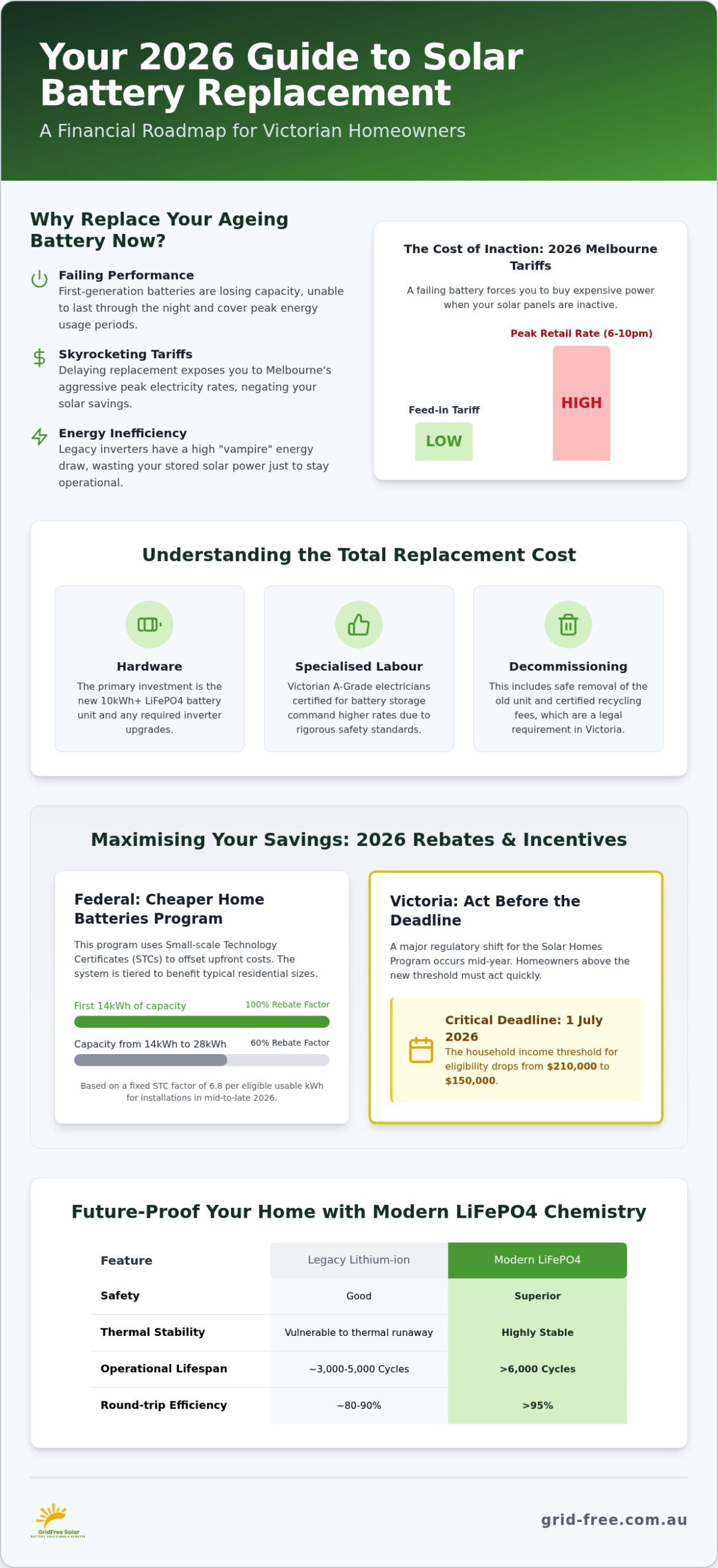
Sticking with a failing battery is a choice that carries its own heavy price tag. Melbourne’s 2026 electricity price forecasts show a widening chasm between measly feed-in tariffs and aggressive peak retail rates. If your storage unit can’t hold enough charge to cover the 6 PM to 10 PM window, you’re directly exposed to Melbourne’s highest energy spikes. There is also the hidden issue of “vampire” energy draw. Inefficient legacy inverters often consume significant power just to remain operational. By delaying your replacement, you’re effectively subsidising the grid while your own solar harvest goes to waste. Upgrading now eliminates this inefficiency and restores your total grid independence.
Modern LiFePO4 systems offer far superior round-trip efficiency compared to units from five years ago. This means more of the energy your panels produce actually reaches your appliances. Transitioning to a contemporary system isn’t just about fixing a broken component; it’s about optimising your entire home’s financial performance for the next decade.
Maximising ROI: Rebates and Incentives for Victorian Homeowners
Timing your upgrade in 2026 is a calculated financial move. The primary driver for savings is the federal “Cheaper Home Batteries Program,” which utilises Small-scale Technology Certificates (STCs) to offset the solar battery replacement cost Australia. For installations occurring between May and December 2026, the STC factor is fixed at 6.8 per eligible usable kWh. This federal incentive employs a tiered system. The first 14kWh of capacity receives 100% of the STC factor, while capacity between 14kWh and 28kWh receives 60%. This makes standard residential sizes, typically around 10kWh to 13kWh, the most rebate-efficient choice for homeowners looking to replace aging units.
Victorian Rebate Eligibility in 2026
Victoria’s incentive landscape has evolved significantly. While the state’s interest-free battery loan program concluded in 2025, homeowners can still access official Solar Victoria incentives for related solar panel upgrades. A major regulatory shift occurs on July 1, 2026. The household income threshold for the Solar Homes Program will decrease from $210,000 to $150,000. If your household earns above this new limit, you must act before the July deadline to secure any remaining state-based support. GridFree Solar specialises in this administrative maze. We handle the complex Victorian battery rebate documentation and federal STC applications to ensure you receive every cent of available funding.
Comparing Payback Periods: 2021 vs. 2026
The financial logic for energy storage has fundamentally shifted over the last five years. In 2021, a battery was often a 10-year commitment before seeing a return. By 2026, the solar battery cost in Australia has reached a parity point with rising retail electricity prices. Melbourne households now face aggressive “time-of-use” tariffs that penalise evening consumption. By storing your own solar harvest for use during the 6 PM peak, you can reduce your payback period to between 6 and 8 years. Participation in a Virtual Power Plant (VPP) can accelerate this ROI even further. VPPs allow you to earn credits by discharging stored energy during grid peak events, effectively turning your replacement battery into a revenue generator. If you want to see how these numbers apply to your specific suburb, our team can optimise your storage strategy based on your latest power bills.
Modern systems also provide better long-term security. Unlike legacy units, 2026-grade batteries are designed for high-cycle environments. This means your replacement won’t just pay for itself faster; it will continue to deliver savings well beyond its payback window. Every day you rely on a failing legacy battery is a day of missed peak-hour savings.
Choosing Your Replacement: Modern Tech and Future-Proofing
Selecting the right hardware for your upgrade is a decision that dictates your home’s energy security for the next 15 years. You aren’t just replacing a box on the wall; you’re choosing the chemistry and intelligence that will manage your household’s most critical resource. In 2026, the solar battery replacement cost Australia homeowners pay must deliver more than just storage. It must provide long-term thermal safety and high-cycle reliability that legacy units simply cannot match.
The Rise of LiFePO4 in the Australian Market
Thermal stability is paramount in our climate. While early lithium-ion units relied on NMC (Nickel Manganese Cobalt) chemistries, the industry has shifted decisively toward LiFePO4 (Lithium Iron Phosphate). These units are virtually immune to thermal runaway, making them the safest choice for Melbourne’s scorching summer days. Beyond safety, the longevity is incomparable. Older units typically offered 3,000 charge cycles before significant degradation. Modern LiFePO4 systems deliver upwards of 10,000 cycles. This effectively triples the functional life of your investment. When exploring energy storage solutions in Melbourne for 2026, prioritise chemistries that handle deep discharges without compromising cell structure.
Inverter Compatibility and Retrofitting
Technical compatibility is the most frequent hurdle in replacement projects. You must decide between AC-coupling and DC-coupling. If your existing solar panels are performing well but your inverter is aging, a smart hybrid inverter is the superior choice. This allows for a DC-coupled setup, which is more efficient because it reduces the number of times energy is converted. However, if your current solar inverter is relatively new, AC-coupling allows you to add the battery as a separate unit without disturbing your existing array. This flexibility is key to managing the total solar battery replacement cost Australia while maintaining system integrity.
Don’t settle for a like-for-like replacement size. Your energy needs have likely grown since your first installation. With the shift toward all-electric homes, a 13kWh or 15kWh unit often provides a better ROI than a smaller 10kWh unit. Larger capacity also ensures genuine blackout protection. During Melbourne’s volatile storm seasons, a properly sized battery with a dedicated backup circuit keeps your lights, refrigeration, and Wi-Fi running while the rest of the street sits in the dark. Ensure your new system is VPP-ready. This future-proofs your home for upcoming Victorian grid participation programs, allowing you to earn credits while supporting local network stability.
The Replacement Journey: From Site Audit to Grid Connection
Precision in the planning phase prevents budget blowouts. A successful upgrade requires more than just unboxing new hardware; it’s a multi-stage technical transition. Every step must align with the Clean Energy Regulator’s 2026 standards to ensure your system remains eligible for federal incentives. Understanding this process helps you manage the total solar battery replacement cost Australia while avoiding the delays common with inexperienced contractors. Speed and accuracy are the hallmarks of a professional transition.
- Step 1: Energy Audit. We conduct a deep-dive hardware assessment to identify “battery-ready” gaps in your current solar wiring and inverter setup.
- Step 2: Safe Decommissioning. Our team handles the safe removal and certified recycling of your legacy unit, ensuring compliance with Victorian hazardous waste regulations.
- Step 3: Switchboard Upgrades. We modernise your safety switches to meet 2026 standards, ensuring your home can handle the high discharge rates of modern LiFePO4 systems.
- Step 4: Installation and Commissioning. We mount your new storage unit and integrate it with your inverter, following the March 1, 2026, mandatory geotagged photo evidence protocols.
- Step 5: Grid Approval. We manage the final Solar Victoria inspection and coordinate with your network provider (like AusNet or United Energy) for official grid connection.
Pre-Installation: Site Audits and Safety
Safety is non-negotiable in the Victorian climate. Our professional solar installation in Melbourne begins with a structural and electrical check. We navigate specific Victorian council requirements for battery placement, ensuring your unit meets the latest fire safety clearance zones. Identifying these gaps early prevents unexpected additions to your solar battery replacement cost Australia. Don’t let a generic installer guess your site requirements. Precision ensures performance and long-term reliability.
Post-Installation: Monitoring and Optimisation
The job isn’t finished when the last bolt is tightened. We configure your monitoring app to track real-time self-consumption, allowing you to see exactly when your home switches from solar to battery power. This transparency is vital for understanding your first “post-replacement” bill from your Victorian retailer. Modern LiFePO4 units require minimal maintenance, but scheduled digital health checks ensure your system remains optimised for Melbourne’s seasonal shifts. You’ve invested in the best hardware; now ensure it works for you. Contact GridFree Solar to book your 2026 site audit and start your transition to total grid independence.
Why GridFree Solar is Victoria’s Specialist in Battery Upgrades
Choosing the right partner for your upgrade determines whether your system thrives or merely survives. At GridFree Solar, we specialise in transforming outdated storage into high-performance assets. We understand that the solar battery replacement cost Australia homeowners face is a significant investment in future security. Our team doesn’t just swap boxes. We engineer integrated solutions that maximise every kilowatt-hour produced by your panels. Making your solar battery replacement in Melbourne a seamless experience is our core mission. We combine technical precision with a deep, localized understanding of the Victorian energy landscape. We don’t just sell products. We deliver long-term reliability and total grid independence.
The Local Advantage
Expertise matters when dealing with complex grid requirements. We are a local Melbourne team. This means we have deep, working knowledge of Victorian network distributors like Powercor, Jemena, United Energy, and AusNet. We know their specific rules. We understand their connection protocols. As an Authorised Solar Victoria Retailer, we fast-track your rebate approvals by minimising the total solar battery replacement cost Australia through strategic rebate application. We handle the bureaucratic heavy lifting. You get the savings without the stress. Our A-Grade Victorian electricians ensure every installation meets the strict 2026 safety standards. We provide direct support from senior installers based right here in Melbourne. No call centres. No generic advice. Just expert local service that understands our climate and our grid.
Secure Your 2026 Upgrade
The window for rebate-optimised upgrades is narrowing. With the July 1, 2026, income threshold change to $150,000, acting now is a financial necessity. Don’t rely on generic estimates that ignore your specific usage patterns. We provide tailored quotes based on your actual interval data. This ensures your replacement is perfectly sized for your home’s evening demand. We specialise in battery-ready inverter retrofitting, ensuring your modern LiFePO4 system integrates perfectly with your existing solar array. Our current lead times for battery replacements in Victoria are streamlined to ensure you beat the mid-year regulatory shifts. Secure your energy independence today. Get a Professional Solar Battery Replacement Quote and lock in your 2026 ROI before the rules change again. Your path to a lower power bill starts with a single, expert assessment.
Secure Your Energy Independence Today
Your energy future shouldn’t be left to chance or failing legacy hardware. Upgrading in 2026 is a strategic financial move that leverages modern LiFePO4 safety and the final window of high-threshold Victorian incentives. As we’ve explored, the total solar battery replacement cost Australia homeowners pay is now offset by significantly faster payback periods and superior system efficiency. By acting before the July 1 income cap reduction, you ensure your household remains eligible for maximum state support.
GridFree Solar stands ready as your trusted advisor. As an Authorised Solar Victoria Retailer and Specialists in LiFePO4 Upgrades, our Melbourne-based installation team manages the entire technical and administrative journey for you. We don’t just replace hardware; we future-proof your home against rising tariffs and grid instability. Don’t let another peak-hour bill erode your savings while your old battery underperforms. Secure your grid independence with a partner who understands the local Victorian landscape and technical requirements.
Get a Custom Solar Battery Replacement Quote for Your Melbourne Home
Take control of your power today and enjoy the security of a modern, high-reliability storage solution designed for the next decade of savings.
Frequently Asked Questions
What is the average solar battery replacement cost in Australia in 2026?
In 2026, the 10kWh solar battery replacement cost Australia homeowners face typically ranges from A$8,500 to A$12,500. For larger 13-15kWh systems, budgets usually fall between A$10,500 and A$15,500. These figures include the hardware and specialised labour. Costs vary depending on whether your existing inverter is battery-ready or if you need to retrofit a new hybrid unit. Decommissioning and recycling fees for your old unit are also essential factors in the final project total.
Can I claim the Victorian battery rebate if I’m replacing an old unit?
There is no state-specific battery rebate in Victoria for 2026 after the interest-free loan program closed in May 2025. However, you can still access the federal “Cheaper Home Batteries Program.” This incentive uses Small-scale Technology Certificates (STCs) to lower your upfront costs. Eligibility depends on using SAA-accredited installers and CEC-approved products. Remember that the Victorian Solar Homes Program income threshold drops to $150,000 on July 1, 2026, affecting related panel upgrades.
How do I know if my existing solar battery needs replacing?
Degradation is the clearest sign that your storage unit has reached its end of life. If your battery no longer holds enough charge to power your home through the evening peak, or if you notice a sudden spike in quarterly power bills, it’s likely failing. Most lithium-ion units show significant capacity loss after 10 years. Look for physical signs like warning lights on the unit or error codes within your monitoring app that suggest cell imbalance.
Do I need to replace my solar panels when I replace my battery?
You don’t necessarily need to replace your solar panels when upgrading your storage. Modern solar panels typically have a 25-year lifespan, while batteries often require replacement after 10 to 12 years. However, we recommend a full system audit during the battery installation. This ensures your existing array produces enough surplus energy to fill the new battery. If your panels are over 10 years old, upgrading to higher-efficiency modules might improve your overall ROI.
What happens to my old solar battery after replacement?
Old solar batteries are classified as hazardous waste and must undergo certified recycling. They cannot be disposed of in standard council bins. During a professional replacement, your installer should handle the decommissioning and transport of the legacy unit to a specialised recycling facility. These centres recover valuable materials like lithium, cobalt, and copper. This process is a legal requirement in Victoria and ensures that old chemistries don’t end up in landfill.
Is it worth upgrading to a larger battery than my original one?
Upgrading to a larger battery is often the smartest financial move in 2026. As Melbourne households transition to all-electric appliances, evening energy demand is increasing. A larger 13kWh or 15kWh system provides better coverage for these peak periods and offers more robust blackout protection during storms. Since the federal rebate offers tiered incentives up to 28kWh, you can often secure a larger unit with a more favourable return on investment than your original unit.
How long does the physical replacement process take in Melbourne?
The physical installation of a replacement battery usually takes one full day for a standard residential site. This timeframe includes decommissioning your old unit, mounting the new hardware, and commissioning the software. Complex retrofits involving switchboard upgrades or inverter replacements might extend the process. While the on-site work is fast, remember that the pre-installation audit and the subsequent grid connection approval from your Victorian network distributor can add several weeks to the total project timeline.
Will a new battery work with my older solar inverter?
Compatibility depends on your current setup. If you have an older “string” inverter, you’ll likely need to either replace it with a modern hybrid unit or use an AC-coupled battery system. AC-coupling allows the new battery to work alongside your existing inverter without direct integration. During our site audit, we assess your wiring and hardware to determine the most cost-effective path. We specialise in retrofitting battery-ready solutions that maximise your existing solar investment while managing the solar battery replacement cost Australia.