Your metal roof is the most resilient asset on your Melbourne property. It is the ultimate foundation for renewable energy, provided you do not compromise its structural integrity with outdated mounting methods. Installing solar panels on metal roof Melbourne systems requires a precision-engineered approach to survive the city’s notorious wind loads and seasonal hail. You should not have to choose between lower electricity bills and a leak-free home.
It is understandable to feel hesitant about the 2026 regulatory shift. With the Victorian Solar Homes rebate now capped at a $150,000 household income, the window for subsidised independence is narrowing. This guide delivers the technical clarity you need to master the 2026 landscape. You will learn how to navigate the latest AS/NZS 1170.2 standards, secure the A$1,400 point-of-sale discount, and implement non-penetrative mounting that keeps your roof’s warranty intact. We are moving beyond basic installation toward high-performance, grid-independent engineering that protects your investment for the next 25 years.
Key Takeaways
- Discover why metal profiles provide the most robust structural integrity for heavy solar arrays compared to traditional brittle tile alternatives.
- Master the engineering differences between penetrative mounting and non-penetrative clamping to ensure your solar panels on metal roof Melbourne installation remains 100% leak-free.
- Navigate the strict 2026 AS/NZS 1170.2 wind load requirements to protect your system against Melbourne’s specific uplift challenges and thermal expansion.
- Act now to secure the A$1,400 Solar Victoria rebate and interest-free loan before the reduced A$150,000 income cap limits your eligibility.
- Optimise your ROI by stacking PV incentives with the 2026 Victorian battery rebate for a fully integrated energy independence solution.
Why Metal Roofs are Melbourne’s Best Solar Substrate
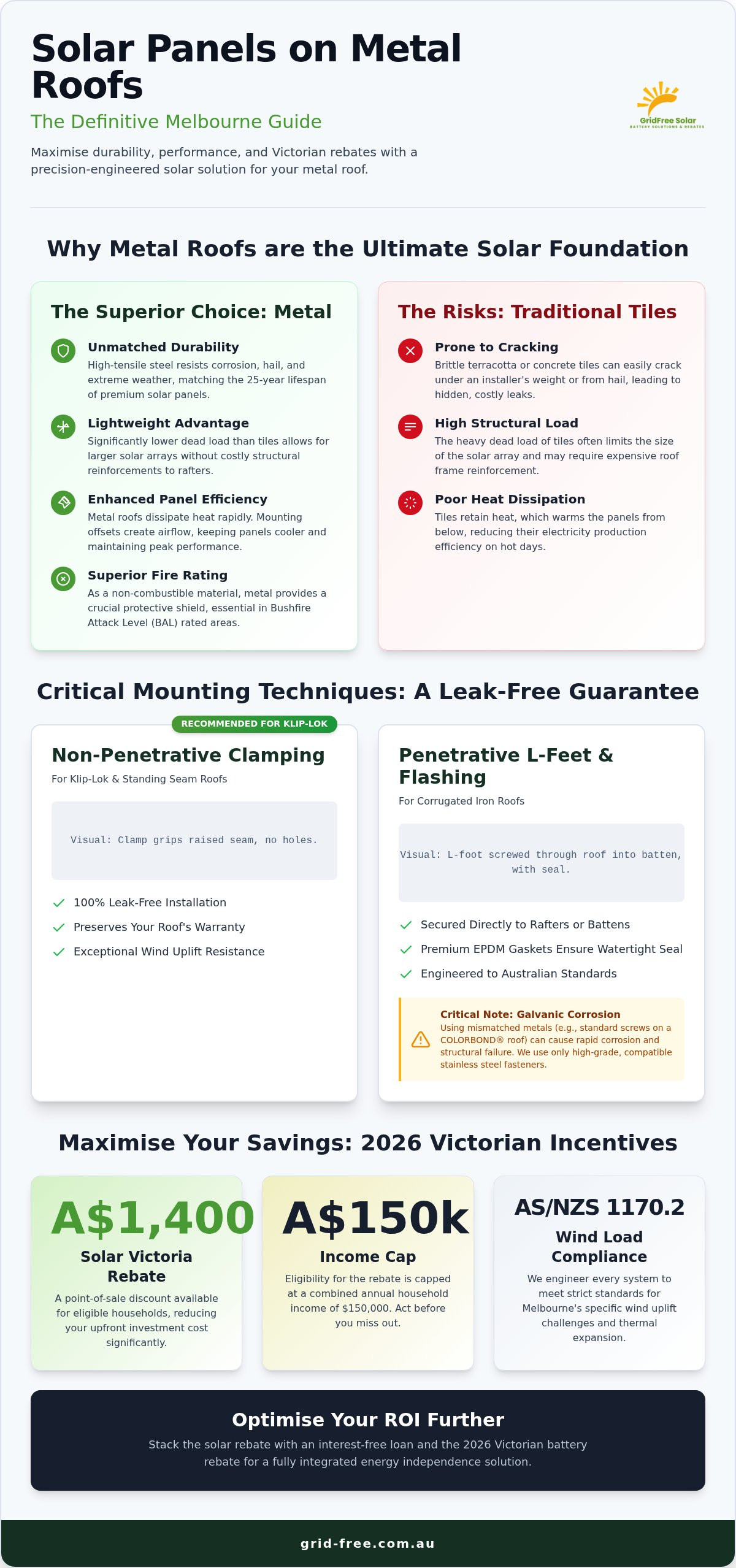
Metal roofing is the elite substrate for Victorian energy upgrades. It offers a level of structural security that terracotta and concrete tiles simply cannot match. When installing solar panels on metal roof Melbourne systems, you are working with a material designed for high-tensile strength and extreme weather resilience. It is the most logical foundation for a long-term energy investment.
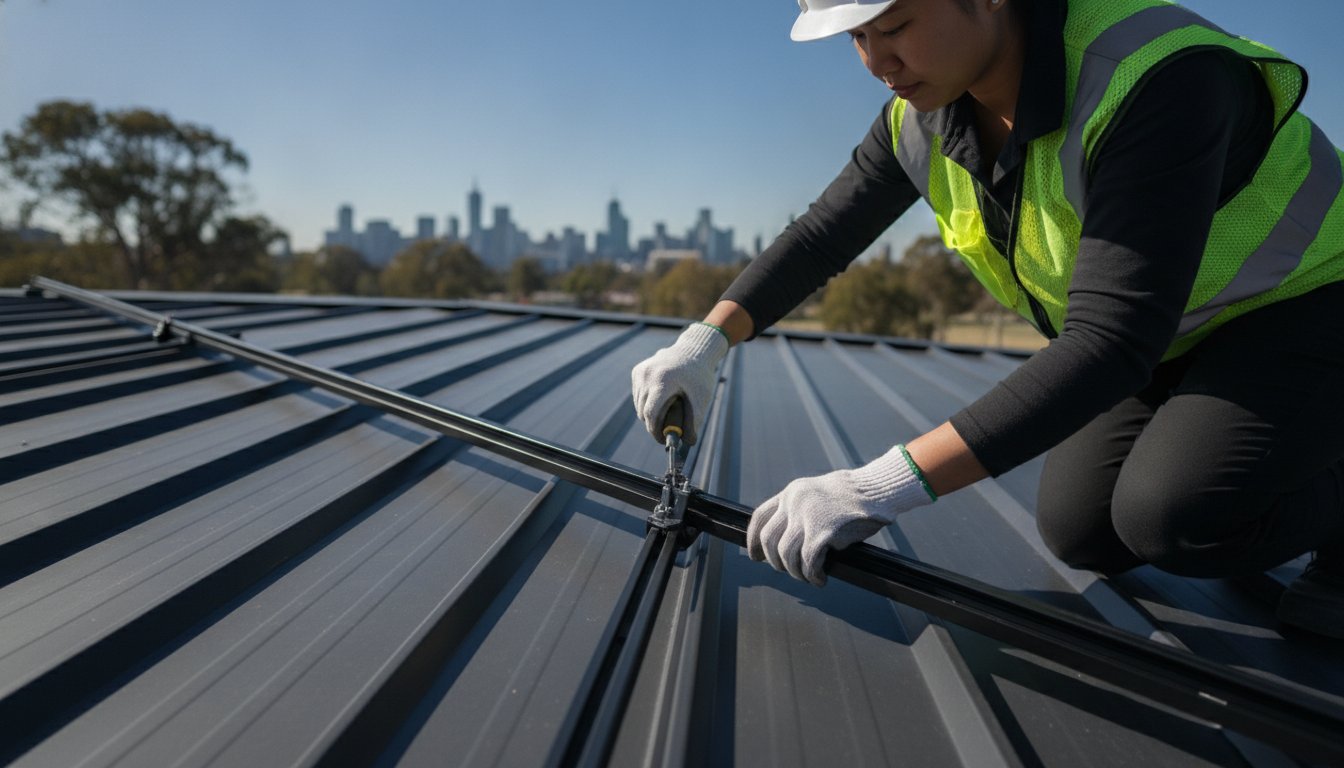
Unlike brittle tiles that often crack under the weight of an installer, metal sheets provide a stable, walk-on surface. This reduces the risk of hidden leaks and speeds up the commissioning process. Modern Rooftop solar power systems require precise alignment; metal profiles like corrugated or Klip-Lok allow for millimetre-perfect racking placement. This precision ensures your array looks as good as it performs.
Fire safety is non-negotiable under Victorian building codes. Metal is non-combustible. It provides a superior fire rating in Bushfire Attack Level (BAL) rated areas, providing a protective shield for your home. Additionally, metal roofs dissipate heat rapidly. By using specific mounting offsets, we create a thermal chimney effect. This airflow keeps panels cool and maintains peak inverter efficiency during 40-degree Melbourne afternoons. High temperatures kill solar production; metal roofs help keep it alive.
Durability and Lifespan in the Melbourne Climate
Melbourne’s weather is notoriously erratic. From the salt-laden air of bayside suburbs like Brighton to the intense UV of the northern plains, your roof takes a beating. COLORBOND® steel is the industry benchmark for corrosion resistance. It matches the 25-year performance warranty of premium solar modules perfectly. While a single hail storm can shatter dozens of concrete tiles, high-tensile metal remains intact. It protects your home and your solar investment from water ingress when the weather turns violent.
Weight Distribution and Structural Advantages
Efficiency starts with engineering. Metal roofing has a significantly lower dead load than masonry alternatives. This weight saving is a massive advantage. It allows for larger, more complex PV arrays without requiring expensive structural reinforcements to your rafters. For commercial properties across Melbourne, this advantage is magnified. Large-scale solar becomes a viable retrofit because the existing steel structure can easily handle the additional kilograms per square metre. It is the pragmatic choice for those seeking total grid independence without the structural headache.
Technical Mounting: Penetrative vs. Non-Penetrative Systems
Choosing the right mounting hardware is the most critical decision in your engineering plan. It determines whether your installation enhances your property or compromises its primary defence against the elements. For solar panels on metal roof Melbourne installations, we categorise systems into two distinct engineering paths: penetrative and non-penetrative. Your roof profile dictates the solution.
Clamping Systems for Klip-Lok Roofs
If you have a Klip-Lok or standing seam profile, non-penetrative clamping is the only acceptable standard. These specialised clamps grip the raised ribs of the metal sheet with immense force, providing high wind-uplift resistance without ever piercing the surface. This method is a non-negotiable requirement for many commercial Melbourne warehouses to ensure they remain eligible for 2026 Victorian solar rebates while keeping the manufacturer’s structural warranty fully intact. By avoiding holes, you eliminate the risk of water ingress entirely.
L-Feet and Flashing for Corrugated Iron
Corrugated iron requires a penetrative approach. We use high-tensile L-feet secured directly into the roof battens or rafters. To maintain a watertight seal, every penetration must be fitted with premium EPDM gaskets. These gaskets act as a permanent barrier against moisture. You must also ensure all fasteners are high-grade stainless steel to prevent the risk of galvanic corrosion. Galvanic corrosion is an electrochemical process where one metal corrodes preferentially when it is in electrical contact with another, dissimilar metal in the presence of an electrolyte like Melbourne rainwater. Using mismatched metals can lead to rapid structural failure and voided BlueScope warranties.
Precision engineering is what separates a high-performing asset from a structural liability. When you prioritise a professional residential solar panel installation, you ensure that every clamp and screw adheres to the strictest Australian standards. Don’t let a generic installer turn your roof into a sieve; insist on profile-specific mounting that respects the material science of your deck.
Overcoming Melbourne Weather: Wind Loads and Thermal Movement
Melbourne’s climate is a rigorous test for any external structure. When you install solar panels on metal roof Melbourne, you are essentially mounting a series of high-surface-area sails onto your home. Without precise engineering, these panels can generate immense uplift forces during a typical Port Phillip Bay gale. All installations must strictly comply with AS/NZS 1170.2:2021, the Australian standard for wind actions. This ensures your array stays attached when wind speeds peak, protecting both your property and your neighbours.
Wind Load Engineering for Bayside and High-Rise Areas
Homes in coastal corridors or elevated positions face significantly higher velocity pressures. We manage this by increasing fastener frequency. This involves installing more L-feet or clamps per rail than a standard inland project requires. We also strictly enforce the “edge zone” rule. Turbulence is highest at the roof’s perimeter, where wind rolls over the gutters. Keeping panels away from these high-pressure zones prevents structural fatigue. You need an engineered mounting plan that accounts for your specific terrain category and building height. Generic installations often skip these calculations, risking catastrophic failure during extreme weather events.
Thermal Expansion: Preventing “Roof Creep”
Metal is a dynamic material. A 20-metre sheet of COLORBOND® steel can expand and contract by several millimetres as temperatures fluctuate between a frosty morning and a scorching afternoon. This phenomenon is known as “roof creep”. If your solar racking is bolted down too rigidly over long spans, it resists this natural movement. This creates immense structural stress on both the roof deck and the solar modules.
We mitigate this by integrating expansion joints into the solar rails. These joints allow the system to breathe, preventing the metal from buckling or tearing at the fastener points. Proper engineering also eliminates “chatter”. This is the annoying clicking or scraping sound caused by metal-on-metal friction during thermal shifts. While rail-less systems are gaining popularity for their sleek look, a traditional railed system often provides better management of these expansion forces on long metal runs. Managing this movement is vital for a silent, durable installation that lasts 25 years.
Maximising ROI: Metal Roofs and 2026 Victorian Rebates
Financial independence starts with understanding the 2026 incentive landscape. Metal roofing is not just a structural choice; it is a financial accelerator. When you install solar panels on metal roof Melbourne systems, you benefit from significantly lower labour costs compared to complex tile retrofits. This speed translates directly into a faster payback period, typically between 4 and 7 years for most Victorian households. You are investing in an asset that pays for itself while protecting your home.
Navigating Solar Victoria Eligibility
The rules have tightened. As of July 1, 2026, the combined household income cap for the Solar Homes Program has dropped to A$150,000. If you exceed this threshold, you lose access to the A$1,400 point-of-sale discount and the A$1,400 interest-free loan. You must act while these subsidies remain available to maximise your return. We recommend using a New Energy Tech Approved Seller to ensure your application meets all regulatory criteria. Stacking these incentives with the Victorian Battery Rebate 2024 to 2026: The Complete Guide to Storage Savings is the most aggressive way to slash your upfront costs and achieve grid independence.
Financial Breakdown: Payback on Metal vs. Tile
Metal roofs simplify the installation logistics. There is no need for tile grinding or the replacement of broken masonry, which often inflates the cost of tile-based projects. This efficiency reduces the “soft costs” of your quote. With Victorian feed-in tariffs now averaging a median of 1.5c/kWh, the goal is total self-consumption. An integrated battery allows you to store your midday generation for evening use, bypassing expensive peak grid rates. Detailed costings are available in our Solar Battery Cost Australia 2026: The Definitive Price & ROI Guide. Joining a Virtual Power Plant (VPP) can further boost your returns by allowing you to trade stored energy during grid peaks when prices are highest.
Precision engineering and rebate mastery are the twin pillars of a successful project. Secure your 2026 incentives today by booking a professional solar rebate assessment with our expert engineering team.
The GridFree Advantage: Expert Metal Roof Installation
GridFree Solar stands as the definitive authority in high-efficiency Victorian energy upgrades. We understand that every roof profile, from corrugated iron to Klip-Lok, requires a bespoke engineering strategy. Installing solar panels on metal roof Melbourne systems isn’t a task for generalists. It demands a specialist partner who manages the administrative burden of rebates while delivering a technically superior structural solution. We prioritise non-penetrative mounting to protect your home’s envelope and maintain your long-term structural integrity. You deserve a system that performs without compromise.
Our Precision Engineering Process
Our local Melbourne teams conduct rigorous site-specific assessments before any hardware arrives at your property. We calculate wind loads based on your exact terrain category to ensure total compliance with the 2026 AS/NZS 1170.2 standards. By designing customised rail layouts that account for thermal expansion, we eliminate the risk of buckling or structural fatigue. This methodical approach ensures your array remains silent and secure for its entire 25-year lifespan. For a deeper dive into our technical methodology, explore our Solar Panel Installation Melbourne: The 2026 Guide to Energy Independence. We don’t leave your safety or your warranty to chance.
Future-Proofing with Battery Storage
The Victorian energy market in 2026 demands more than just generation; it requires intelligent storage. We specialise in high-capacity battery upgrades that transform a standard PV array into a total grid independence solution. Upgrading to a battery-ready system now ensures you can capitalise on the Victorian battery rebate while funding remains available. This integrated approach allows you to bypass the volatility of fluctuating feed-in tariffs and power your home with your own clean energy through the night. Learn how to secure your energy future with our Energy Storage Solutions Melbourne: Your 2026 Guide to Grid Independence.
Our commitment extends beyond the physical installation to your financial success. We manage the entire Solar Victoria rebate process for you, ensuring you navigate the A$150,000 income thresholds with ease. You get a seamless transition from outdated energy methods to a modern, intelligent solution that slashes your electricity bills. Trust the local experts who combine engineering excellence with financial savvy to deliver a system that dominates the Melbourne climate. Don’t settle for a generic install when you can have an engineered asset.
Secure Your Energy Independence in 2026
Your transition to renewable energy is a structural and financial investment that demands total precision. Metal roofs provide the ultimate canvas for solar, but only when paired with engineering that respects material science. By prioritising non-penetrative mounting and accounting for Melbourne’s unique wind regions, you ensure your asset remains secure for decades. The technical requirements of 2026 don’t leave room for guesswork.
The window for government subsidies is narrowing. To maximise your ROI, you must align with experts who understand the new A$150,000 income cap and the technical nuances of solar panels on metal roof Melbourne installations. GridFree Solar is your Victorian Government Approved Solar Provider. We are expert local Melbourne installers and specialists in high-ROI battery upgrades. It’s time to adopt a grid-independent solution that protects your roof and your financial future.
Request Your Custom Metal Roof Solar Quote from GridFree Solar
Take control of your power today. Join the thousands of Melburnians future-proofing their homes with intelligent, metal-roof-optimised solar technology.
Frequently Asked Questions
Do solar panels damage COLORBOND® roofs in Melbourne?
Solar panels do not damage COLORBOND® roofs when installed by specialists using high-grade mounting hardware. We use EPDM gaskets to seal penetrations on corrugated profiles and stainless steel fasteners to prevent galvanic corrosion. This professional approach ensures your roof remains watertight. Proper engineering protects your home’s primary defence while you generate clean energy. It’s about using the right materials for the Melbourne climate.
Can I install solar on a Klip-Lok roof without drilling holes?
You can definitely install solar on a Klip-Lok roof without drilling a single hole. Non-penetrative clamping systems grip the raised ribs of the profile with immense pressure. This is the preferred engineering method for solar panels on metal roof Melbourne projects involving standing seam or concealed-fix decks. It preserves the structural integrity of your roof and eliminates the risk of future water ingress entirely.
Are there specific solar rebates for metal roofs in Victoria for 2026?
There isn’t a specific rebate exclusive to metal roofs, but you can access the standard 2026 Victorian incentives. Eligible owner-occupiers can secure a point-of-sale discount of up to A$1,400 and an interest-free loan of up to A$1,400. Remember that as of July 2026, the household income cap is A$150,000. Stacking this with the federal STC discount maximises your initial return on investment.
How much does solar installation on a metal roof cost in Melbourne?
A standard 6.6kW solar system in Melbourne typically costs between A$5,500 and A$9,500 after the federal STC discount is applied. Prices vary based on component quality and the complexity of your metal roof profile. Metal installations are often more cost-effective than tile because they require less labour. You should always request a site-specific quote to account for your unique engineering requirements and wind load zones.
Will solar panels make my metal roof hotter or cooler?
Solar panels generally make your metal roof cooler by providing consistent shade to the roof sheets. By maintaining a specific mounting offset, we create a thermal chimney effect that allows air to circulate between the panels and the deck. This airflow dissipates heat rapidly. It reduces the thermal load on your home during a scorching Melbourne summer, which can lead to lower air conditioning costs.
What happens to my metal roof warranty if I install solar?
Your metal roof warranty remains intact if you use manufacturer-approved mounting methods. For Klip-Lok, this means using non-penetrative clamps. For corrugated iron, it requires correct flashing and gaskets that prevent leaks. Using unaccredited installers or non-compliant hardware can void your BlueScope warranty. Always ensure your installer provides a Certificate of Electrical Safety and adheres to the latest AS/NZS 5033 standards.
How do I clean solar panels on a steep metal roof safely?
Safety is the priority when maintaining solar panels on metal roof Melbourne systems, especially on steep pitches. You should never attempt to climb a metal roof without a rated harness and anchor point. While rain often handles light dust, you may need professional help for heavy build-up. We recommend checking with your installer for a list of accredited maintenance specialists who follow strict safety protocols.
Do I need to replace my metal roof before installing solar?
You don’t need to replace your metal roof unless it shows signs of significant rust or structural failure. Most COLORBOND® roofs have a lifespan of 25 to 30 years, which aligns perfectly with the performance life of modern solar modules. If your roof is already 20 years old, it’s often smarter to replace the sheets first. This avoids the high cost of removing and reinstalling the solar array later.