
A solar quote is a technical blueprint for a 25-year power plant; it is not a simple retail receipt. If you have started comparing solar panel quotes Melbourne installers provide, you have likely noticed a massive price gap that makes no sense on the surface. It is frustrating. You are trying to secure your home’s energy future while dodging “solar cowboys” and navigating a Victorian rebate landscape that changed significantly on 1 July 2026.
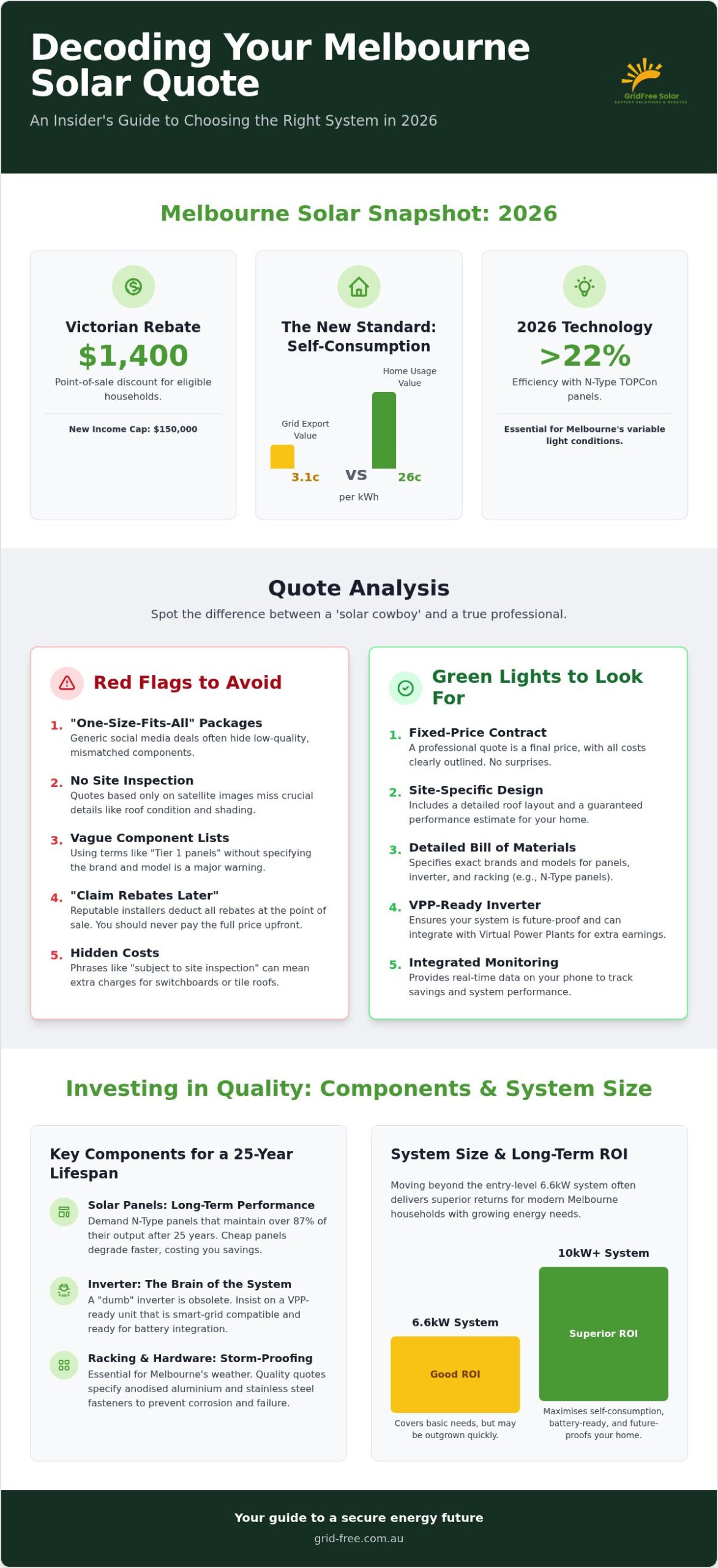
We understand the pressure to get this right. This insider guide will teach you how to decode complex technical specifications, maximise the current $1,400 Victorian rebate, and leverage the federal battery discount. You will gain the confidence to identify high-performance components that actually survive the Melbourne climate. We are stripping away the jargon to reveal the framework for a quality installation. We will examine the new $150,000 household income cap, the shift toward N-type TOPCon efficiency, and why VPP-ready batteries are the 2026 standard for genuine ROI.
Key Takeaways
- Master the art of decoding technical specifications to identify high-performance components and avoid “solar cowboy” red flags when comparing solar panel quotes Melbourne providers offer.
- Secure the full $1,400 Victorian rebate by meeting the updated 2026 eligibility criteria, including the new $150,000 household income cap.
- Shift your focus toward self-consumption with VPP-ready battery integration to offset falling feed-in tariffs and rising electricity prices.
- Move beyond the 6.6kW entry-level mindset to understand why 10kW+ systems deliver superior long-term ROI for modern Melbourne households.
- Leverage local Melbourne expertise to ensure your system is engineered for regional weather patterns and specific DNSP export limits.
Understanding the Melbourne Solar Market in 2026
Melbourne weather is a common excuse for solar sceptics. It is also wrong. Our city remains a high-yield environment because modern photovoltaic technology relies on light intensity rather than extreme heat. In fact, panels often perform more efficiently in Melbourne’s cooler, breezy conditions than in the stifling heat of the north. Modern N-type TOPCon cells now exceed 22% efficiency and thrive in our variable UV conditions. As the broader history of Solar power in Australia shows, Victoria has consistently punched above its weight in renewable adoption despite our “four seasons in one day” reputation.
The Victorian energy landscape has shifted fundamentally this year. With regulated minimum feed-in tariffs sitting at a lowly 3.1c/kWh and retail electricity prices averaging 26c/kWh, the “export everything” model is dead. You aren’t building a power station to enrich the grid. You are constructing a personal utility to protect your own wallet. Self-consumption is the gold standard for 2026. Every watt you generate and use at home saves you significantly more than what you would earn by exporting it to the retailers.
A professional quote is a fixed-price contract. It is not a “rough guide” or a “subject to site inspection” estimate. When you are reviewing solar panel quotes Melbourne installers provide, look for a definitive commitment to the final price. This document must include a site-specific layout and a guaranteed performance estimate. If a provider uses vague qualifiers to hide potential “extra” costs for tile brackets or switchboard upgrades, they aren’t a specialist; they’re a risk.
The 2026 Rebate Reality: STCs and Solar Victoria
Federal Small-scale Technology Certificates (STCs) are phasing out. Every year you wait, the upfront discount drops as the scheme moves toward its 2030 conclusion. For a standard 6.6kW system in Melbourne, this federal incentive currently provides a discount between $1,400 and $1,800. Simultaneously, Solar Victoria has tightened eligibility. As of 1 July 2026, the household income cap has been reduced to $150,000. Your quote must show the $1,400 state rebate and the federal STC discount as clear point-of-sale deductions. Never accept a quote that requires you to pay the full amount and “claim it back later” yourself.
Melbourne’s Micro-Climates and System Design
A system designed for a sun-drenched roof in Mildura will struggle in the Dandenong Ranges. Localised engineering is non-negotiable. Bayside homes require high-spec, salt-mist resistant mounting hardware to prevent long-term corrosion. Properties in the leafy eastern suburbs often need panel-level optimisation to combat shade from heritage trees. National call centres use generic satellite data that misses these nuances. Choosing a local expert ensures your system is geared for your specific suburb’s export limits and weather patterns. Demand Tier 1 panels that are proven to handle Melbourne’s rapid temperature swings without micro-cracking.
Decoding Your Solar Quote: 5 Red Flags and 5 Green Lights
Comparing solar panel quotes Melbourne homeowners receive can feel like a forensic exercise. The price tag is only half the story. You are investing in a 25-year energy asset. To ensure reliability, you must look past the glossy brochures and scrutinise the specific bill of materials. Accuracy matters. A single weak link in your component list can compromise your entire ROI.
The inverter is the undisputed brain of your Melbourne home. It manages power flow and communicates with the grid. In 2026, a “dumb” inverter is obsolete. You need a VPP-ready unit that integrates with the latest smart-grid requirements. Similarly, panel efficiency is about more than just peak wattage. Scrutinise the degradation rate. Top-tier N-type panels maintain over 87% of their original output after 25 years. Cheap alternatives often fade significantly faster, eroding your long-term savings. Don’t settle for generic labels. Demand data.
Don’t overlook the “hidden” hardware. Racking and isolation are where budget installers cut corners. Victorian storms put immense physical stress on your roof. Quality quotes specify anodised aluminium racking and stainless steel fasteners. These components prevent the vibration and corrosion that lead to system failure. Finally, insist on integrated monitoring software. Seeing your real-time savings on your phone turns solar from a passive asset into an active tool for bill reduction. If you can’t see the data, you can’t optimise your usage.
The “Cowboy” Red Flags: What to Avoid
Avoid “one size fits all” packages advertised on social media. These are often bait-and-switch tactics using generic components. A major red flag is any quote provided without a physical site visit or a detailed roof structural assessment. If they haven’t seen your switchboard, they can’t give you a fixed price. Generic inverters without a local Melbourne service centre are another trap. If the unit fails, you’ll be left waiting months for an overseas replacement that may never arrive. Speed is security.
The Professional Green Lights: Signs of Quality
A quality quote includes a detailed shading analysis using professional software like PVSyst. This accounts for every chimney, tree, and neighbouring gable. Look for explicit mentions of Australian Standards AS/NZS 5033 and 4777. This ensures your system meets rigorous safety and performance benchmarks. Professional installers also provide a workmanship warranty that goes beyond the statutory five years. They are confident in their craft. When you request a detailed quote, ensure it aligns with the standards set by Solar Victoria rebates to guarantee your eligibility and long-term peace of mind.
Comparing Solar Panel Quotes: Beyond the Bottom Line
Choosing the lowest bid among solar panel quotes Melbourne companies provide is a high-risk strategy. A “cheap” system often relies on older P-type technology and budget inverters that struggle with our city’s rapid temperature fluctuations. Over a 10-year period, a high-quality “value” quote typically outperforms the budget option by thousands of dollars through higher efficiency and lower maintenance costs. Focus on the long-term yield. A system that stops working shortly after its warranty expires is a total financial loss.
The 6.6kW system is no longer the Melbourne standard. As we transition toward all-electric homes by 2027, a 10kW+ system is the new benchmark for genuine energy independence. However, you must account for your specific Distribution Network Service Provider (DNSP). If you are in a Citipower or United Energy zone, your 10kW system might be restricted to a 5kW export limit. This makes the Australian Government’s Solar Consumer Guide essential reading to understand how these limits impact your financial returns and why battery storage is becoming mandatory.
Don’t ignore the hidden infrastructure costs. Many older Melbourne homes require switchboard upgrades or smart meter installations to accommodate modern solar arrays safely. A professional quote will identify these requirements upfront after a physical inspection. If an installer ignores your switchboard during the quoting phase, expect a “variation” invoice on installation day. Transparency is the hallmark of a specialist.
Component Quality: Tier 1 vs. The Rest
Tier 1 status is a measure of a manufacturer’s financial stability; it is not a direct guarantee of panel quality. For Melbourne residential quotes, we prioritise N-Type solar cells. These offer superior performance in low-light conditions and have a much lower degradation rate than older technologies. Your choice of inverter also depends on your specific roof layout. String inverters are cost-effective for clear, north-facing roofs; micro-inverters are essential for shaded Melbourne properties to prevent a single shadow from tree cover from killing your entire system’s output.
The Importance of Local Support
The “Orphaned System” crisis is a growing problem across Victoria. Thousands of homeowners own solar arrays that are currently offline because their original installer has ceased trading. Rapid response is critical when your primary energy source fails. GridFree maintains a dedicated local Melbourne team to ensure your system stays online and performing at peak capacity. For more details on building a reliable system, see our guide on Solar Panel Installation Melbourne. We don’t just install panels; we partner with you for the life of your power plant.
Maximising ROI: Adding Batteries and VPP Integration
In 2026, solar panel quotes Melbourne families receive are incomplete without a dedicated storage strategy. The financial logic is undeniable. With the Victorian regulated minimum feed-in tariff sitting at just 3.1c/kWh, sending power back to the grid is essentially donating your energy to the retailers. Meanwhile, you are paying approximately 26c/kWh to buy it back at night. A battery closes this gap. It allows you to store your morning harvest for evening use; this effectively increases the value of every generated kilowatt by over 300%.
The rebate landscape has shifted fundamentally. While the Solar Victoria interest-free battery loan closed in August 2026, the Federal Cheaper Home Batteries Program now provides a significant upfront discount. You can claim approximately $258 to $272 per usable kWh for the first 14kWh of capacity. This makes high-performance storage more accessible than ever. To qualify for these incentives in 2026, your system must be “VPP capable” at the time of installation. Virtual Power Plants (VPPs) turn your battery into an active revenue stream. By allowing a provider to occasionally tap into your stored energy during grid peaks, you receive additional credits or lower daily supply charges. It is intelligent innovation that pays.
If you value security, check your quote for “Island Mode” or blackout protection. Most standard battery setups will shut down during a power outage for safety unless specifically engineered with an automatic transfer switch to keep your lights on. We ensure our quotes clearly distinguish between simple “grid-connected” storage and “full backup” capabilities. Don’t assume your battery will work during a blackout; verify it in the line items.
Upgrading Existing Systems
Many Melbourne residents are now looking to add storage to systems installed five or ten years ago. You don’t always need to start from scratch. We specialise in Solar Battery Replacement Melbourne and upgrades using AC coupling. This method allows a battery to be added to almost any existing solar array without replacing your current solar inverter. Conversely, DC coupling is often more efficient for brand-new installations where a single “hybrid” inverter manages both panels and storage. We assess your existing infrastructure to recommend the most cost-effective path to energy independence.
Calculating Your Real Savings
Don’t rely on generic guesswork. Your Victorian smart meter data provides a granular look at your usage patterns. By analysing this data, we can engineer a system that matches your specific “Self-Consumption” potential. The 2026 Melbourne feed-in tariff averages between 3.1c/kWh and 8c/kWh depending on your retailer. Because this is so low, your ROI is now driven by how much grid power you avoid buying, not how much you sell. We use your actual consumption history to simulate how a battery will perform on your specific roof.
Book a battery feasibility assessment to see exactly how much storage can slash your quarterly bills.
The GridFree Process: From Quote to Commissioning
Most solar panel quotes Melbourne homeowners encounter online originate from generic lead-generation platforms. These sites don’t install panels; they sell your contact details to the highest bidder. GridFree operates differently. We are local specialists who own the entire process from the first contact to final commissioning. Our “No-Pressure” consultation begins with your actual energy bills. We don’t start with a sales pitch. We start with data. By analysing your consumption patterns, we identify exactly where your money is going and how a bespoke solar array can stop the bleed.
Every Melbourne roof presents unique challenges. Whether it’s the heritage slate of Hawthorn or the steep pitches of the Dandenong Ranges, a “one-size-fits-all” approach fails. Our custom engineering ensures your system is optimised for your specific micro-climate and roof orientation. On installation day, our CEC-accredited Melbourne electricians handle the heavy lifting. They are experts in Victorian wiring rules and local DNSP requirements. They don’t just bolt panels to your roof; they commission a high-performance power plant. Post-installation, we manage the technical heavy lifting of rebate finalisation and monitoring setup. You get a working system and a clear path to ROI without the administrative headache.
Why Melbourne Businesses Trust GridFree
Commercial energy costs are a major threat to margins in 2026. Businesses across the city are turning to Commercial Solar Installation Melbourne to stabilise their operational expenses. Our commercial quotes focus on aggressive tax depreciation schedules and peak demand reduction. We provide detailed cash-flow modelling that shows exactly when your system will pay for itself. Local Melbourne businesses are currently saving thousands on monthly overheads by switching to self-generated power. We provide the data-backed certainty required for board-level decisions.
Your Next Steps to Energy Independence
Preparation is key to a fast turnaround. To get the most out of your GridFree consultation, have your last four quarterly energy bills ready. You will also need proof of income and property ownership to satisfy the 2026 Victorian rebate criteria. The sooner we have your data, the faster we can lock in your incentives before the next STC phase-out. Get your personalised Melbourne solar quote today and take control of your energy future. Stop renting your power and start owning it.
Secure Your Energy Future Today
You now hold the framework to distinguish a high-performance energy asset from a short-term liability. Solar in 2026 is a strategic investment in self-sufficiency, not just a retail purchase. By prioritising N-type cell efficiency and VPP-ready storage, you’re effectively insulating your home against rising grid costs and plummeting feed-in tariffs. Don’t settle for generic solar panel quotes Melbourne sales teams push via social media. Demand a bespoke engineering plan that leverages your specific smart meter data and the latest Victorian rebate eligibility rules.
Our team of CEC Accredited Installers provides expert Victorian rebate handling and dedicated local Melbourne support and warranty coverage. We ensure your system is engineered for longevity and maximum financial return. Take the next step toward energy independence now. Get a Professional Solar Quote for Your Melbourne Home. The sun is ready; make sure your roof is too.
Frequently Asked Questions
How much do solar panels cost in Melbourne in 2026?
A high-quality 6.6kW system typically ranges from $4,500 to $7,200 after federal and state incentives are applied. These industry averages reflect the Tier 1 components required to withstand Melbourne’s variable climate. Your final investment depends on roof complexity, switchboard condition, and whether you opt for micro-inverter technology or a standard string system. Focus on the 25-year yield rather than the lowest upfront price.
Is the Victorian solar rebate still available for 2026?
The $1,400 Solar Victoria rebate remains active for eligible households. As of 1 July 2026, the combined annual household income cap is $150,000. You can also access an optional interest-free loan of up to $1,400 to further reduce upfront costs. These incentives must be applied as a point-of-sale discount on the solar panel quotes Melbourne specialists provide to you.
How many solar quotes should I get before deciding?
Three quotes are the industry benchmark for a comprehensive comparison. However, quality matters more than quantity. Ensure each quote is like-for-like regarding component efficiency and warranty terms. A quote that is significantly cheaper than others often indicates inferior racking hardware or a lack of local after-sales support. Use the middle quote as your baseline for value and component quality.
What is the best solar panel for Melbourne’s weather?
High-efficiency N-type TOPCon or HJT cells are the superior choice for Melbourne’s rapid temperature swings and low-light winter days. These panels exceed 22% efficiency and maintain higher output as they age compared to older P-type technology. If you live near the coast, ensure your panels have a high salt-mist resistance rating to prevent long-term corrosion from Bayside air.
Can I get a solar quote without a site visit?
Desktop quotes are common but carry the risk of unexpected “variation” invoices on installation day. A physical site visit allows an electrician to inspect your switchboard capacity, roof structural integrity, and specific shading issues from chimneys or trees. Without a site inspection, an installer cannot guarantee a fixed-price contract. Professionalism starts with a ladder, not just a satellite image.
How long does the solar installation process take in Melbourne?
Most projects are completed within 4 to 8 weeks from the date you accept your quote. This timeframe includes the mandatory DNSP grid connection application, Solar Victoria rebate approval, and final scheduling. The physical installation usually takes one to two days. Once installed, your system is commissioned and your smart meter is configured for solar export by your energy distributor.
Do I need a battery with my solar panels in 2026?
Storage is the new standard for modern Melbourne homes. With regulated minimum feed-in tariffs at just 3.1c/kWh, self-consumption is the only way to achieve a rapid ROI. Federal rebates now provide approximately $258 to $272 per usable kWh of battery capacity. This incentive makes it financially logical to store your morning solar harvest for use during expensive evening peak periods.
What is a VPP-ready solar quote?
A VPP-ready quote specifies hardware capable of participating in a Virtual Power Plant. This is a mandatory requirement for claiming current federal battery discounts. VPP-ready systems allow a provider to occasionally tap into your stored energy during grid peaks in exchange for additional credits. It turns your battery into an active revenue stream while supporting the stability of the Victorian energy grid.