
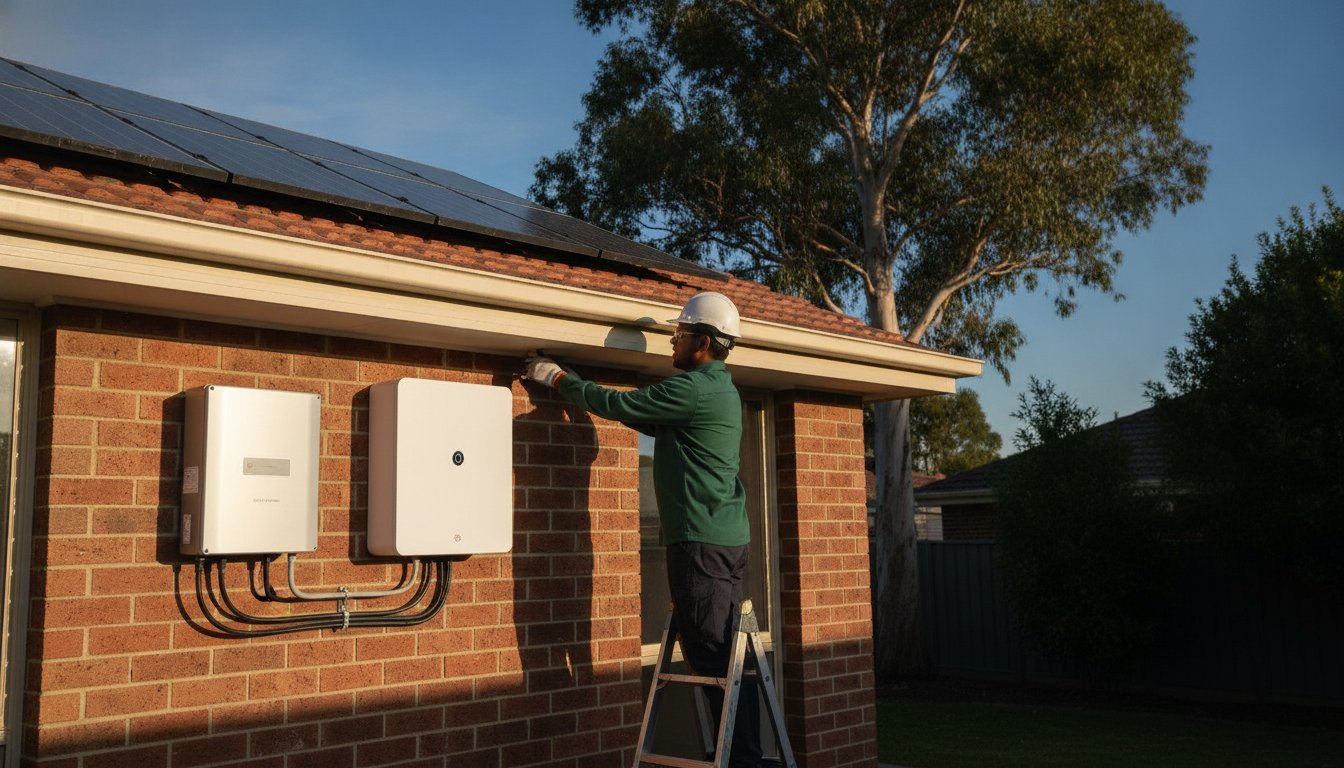
Why are you still gifting your excess solar energy to retailers for a few cents while your evening power bills skyrocket? With feed-in tariffs effectively dead in Victoria, your panels are currently working for the big power companies instead of your wallet. You aren’t alone in this frustration. Most homeowners who want to add battery to existing solar system Melbourne installations are held back by confusion over AC versus DC coupling or fear of technical incompatibility.
It’s time to stop the waste. You can seamlessly integrate modern storage into your current setup to achieve genuine energy independence and drive your quarterly bills toward zero. This 2026 retrofit guide clears the fog. We’ll explore the latest federal STC discounts under the Cheaper Home Batteries Program that can save you thousands upfront. You’ll discover the exact path to choosing between AC-coupled simplicity and DC-coupled efficiency. Secure your home against suburban blackouts and transform your existing solar into a smart, self-sufficient energy hub today.
Key Takeaways
- Bypass the “death of the feed-in tariff” by storing excess solar energy instead of exporting it to retailers for negligible returns.
- Identify the most efficient technical path to add battery to existing solar system Melbourne using either AC or DC coupling.
- Secure significant upfront savings through the 2026 federal Cheaper Home Batteries Program and explore VPP credit opportunities.
- Achieve total energy resilience with backup power solutions designed to keep your home running during Melbourne’s grid outages.
- Maximise your investment by matching storage capacity to your specific evening consumption through a professional energy audit.
Why Add a Battery to Your Existing Melbourne Solar System in 2026?
The economic landscape for Melbourne homeowners has shifted. Your solar panels are likely generating peak power during the middle of the day when the grid needs it least. Meanwhile, retailers like AGL and Origin continue to hike peak-hour rates for the electricity you consume after the sun goes down. Without storage, you are stuck in a cycle of selling low and buying high. To break this loop, you need to understand what is home energy storage and how it serves as the missing link in your energy strategy. When you add battery to existing solar system Melbourne installations, you transform a daytime-only asset into a 24/7 personal power station.
The Death of the Feed-in Tariff in Victoria
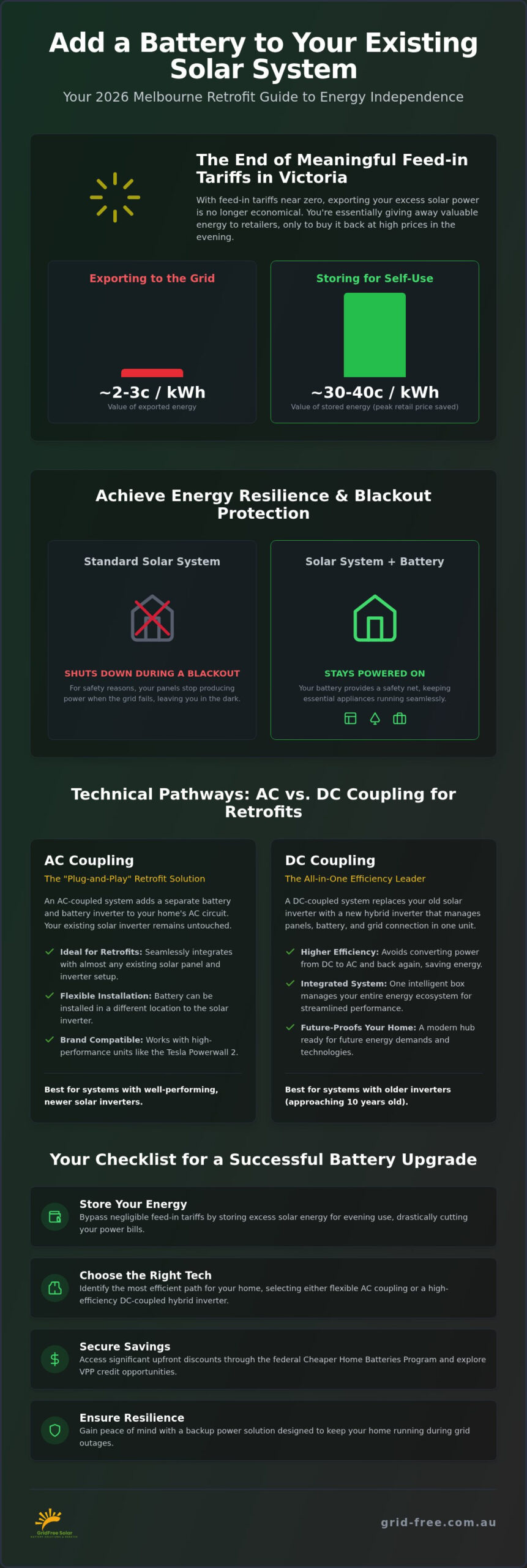
The days of lucrative solar exports are over. As of 1 July 2025, the Essential Services Commission Victoria no longer sets a minimum feed-in tariff, allowing retailers to offer rates that are often near-zero. This is a direct result of the ‘duck curve’, a phenomenon where Melbourne’s grid becomes oversupplied with solar energy at noon, driving the wholesale value of electricity into negative territory. You are essentially paying to give your power away.
The math is simple but brutal. A ‘stored kilowatt’ used during the evening peak saves you the full retail price of electricity, which is significantly higher than the 2 or 3 cents you might receive for an ‘exported kilowatt’. By prioritising self-consumption, you keep your generated energy within your four walls. This shift in strategy is the only way to insulate your household from the volatile pricing structures of the major energy retailers.
Energy Independence and Blackout Protection
Reliability is no longer guaranteed. Melbourne’s suburbs are increasingly prone to grid instability during summer heatwaves and winter storm seasons. Most residents don’t realise that a standard solar setup without a battery will automatically shut down during a blackout for safety reasons. You are left in the dark despite having panels on your roof.
Adding storage provides a critical safety net. While basic storage focuses on bill reduction, high-performance retrofits offer dedicated backup circuits. This ensures that essential appliances stay running when the rest of the street goes dark. Whether it is keeping the fridge cold, the lights on, or maintaining your home security system, the psychological peace of mind is invaluable. Victorian homeowners are now prioritising this resilience, moving away from total grid reliance toward a model of genuine energy sovereignty. It is about taking control of your home’s most vital resource before the next outage hits.
By choosing to add battery to existing solar system Melbourne setups now, you are not just buying hardware. You are securing a fixed energy price for the next decade and ensuring your family remains powered regardless of grid performance or retailer greed.
Technical Pathways: AC vs DC Coupling for Retrofits
Deciding how to add battery to existing solar system Melbourne setups depends entirely on your current inverter technology. You have two primary engineering pathways. AC coupling is often the fastest, most flexible route for older systems. DC coupling is the efficiency leader but requires a more invasive hardware swap. Choosing the wrong path can lead to system bottlenecks or expensive hardware conflicts. You need a solution that balances installation speed with long-term energy yields.
What is AC Coupling and Why is it Perfect for Retrofits?
AC coupling is the method of adding a battery to the AC side of your existing solar system. It’s the ultimate “plug-and-play” solution for Melbourne households. Your current solar inverter stays exactly where it is. This is a massive advantage if your existing panels are performing well. It offers total flexibility. You can install the battery in a different location to the solar inverter, making it ideal for tight garages or side-access points. High-performance units like the Tesla Powerwall 2 are built on this architecture, allowing them to integrate with almost any brand of solar panels already on your roof.
When to Consider a Hybrid Inverter Upgrade
Sometimes, keeping your old equipment is a false economy. If your current string inverter is approaching its 10-year birthday, it’s likely nearing the end of its operational life. This is the perfect moment to consider a hybrid inverter upgrade. A hybrid unit manages both your solar panels and your battery storage in one intelligent box. This is known as DC coupling. It’s more efficient than AC coupling because it avoids converting power from DC to AC and back again.
You should carefully compare the solar battery cost Australia when weighing up an upgrade versus a simple retrofit. While a hybrid swap involves a higher initial investment, the increased efficiency and reduced component count often lead to better ROI over the next decade. You can also check current Victorian Government rebates to see if incentives apply to your specific upgrade path.
Compatibility is the final piece of the puzzle. While AC-coupled batteries are generally brand-agnostic, DC-coupled systems require precise matching. A BYD battery system, for example, must be paired with a compatible hybrid brand like Fronius or Sungrow. The “Battery Management System” (BMS) acts as the brain of the operation. It constantly monitors cell temperature and voltage to protect your investment. It ensures your energy flow is prioritised for self-consumption, keeping your home powered even when the Melbourne grid falters. Don’t leave these technical details to chance. Professional system design ensures your new storage and old panels work in perfect harmony.
Maximising Your ROI: Victorian Rebates and VPPs
Securing a high return on investment for your storage upgrade requires more than just hardware. It demands a strategic approach to the 2026 incentive landscape. While the state-level Solar Victoria battery loan has closed to new applications, the federal Cheaper Home Batteries Program has stepped in to fill the gap. For homeowners looking to add battery to existing solar system Melbourne setups between May and December 2026, the STC factor is set at 6.8 per kWh. This results in an immediate upfront discount of approximately $3,300 for a typical 10kWh battery. Stacking these federal certificates with retailer-specific bonuses is the most effective way to lower the net solar system price Victoria residents actually pay.
Eligibility criteria have also tightened this year. As of 1 July 2026, the combined household taxable income threshold for Victorian solar incentives decreased from $210,000 to $150,000. You must ensure your property meets these updated requirements before committing to an installation. Engaging with the market now allows you to lock in current STC rates before they taper further in 2027.
Claiming the Victorian Battery Rebate in 2026
Navigating the Victorian battery rebate process is straightforward if you follow the mandated pathways. You must use a New Energy Tech Approved Seller (NETCC) to remain eligible for any government-backed incentives. The process begins with a formal quote uploaded to the Solar Victoria portal by your installer. A common pitfall for Melbourne residents is failing to verify that their existing solar system meets the minimum capacity requirements of 5kW. If your older system is undersized, you may need a small panel expansion to qualify for the full battery discount. Accuracy during the application stage prevents costly delays or outright rejection of your claim.
Virtual Power Plants (VPP): The 2026 Income Stream
A Virtual Power Plant (VPP) transforms your battery from a passive storage tank into an active income generator. By joining a VPP, you allow a central operator to occasionally draw small amounts of power from your battery during periods of extreme grid demand. In exchange, Melbourne homeowners typically receive between $200 and $800 per year in bill credits and sign-up bonuses. These “Grid Support” payments are vital for stabilizing Melbourne’s network during heatwaves and preventing localised blackouts.
Smart management is the key to balancing these payments with your household needs. Modern VPP software ensures that a “backup reserve” is always maintained. This means you won’t be left empty-handed if a storm hits while your battery is participating in a grid event. By integrating your storage into a VPP, you accelerate your payback period while contributing to a more resilient Victorian energy grid. It is the ultimate win-win for the financially savvy homeowner.
Step-by-step: How to add a battery to your system
Retrofitting storage is a precision exercise. To add battery to existing solar system Melbourne households must follow a strict technical and administrative sequence to ensure safety and rebate eligibility. It starts with a professional energy audit and system health check. Your existing panels and wiring must be tested to ensure they can handle the increased throughput. Once your system is cleared, you move to selecting capacity. This isn’t a guessing game. You must choose your storage size based on actual evening consumption data from your smart meter. This ensures you don’t overspend on capacity you’ll never use.
Melbourne Network Provider (DNSP) Requirements
Your specific Melbourne suburb dictates your battery export limits. Melbourne is divided into five distinct network zones: United Energy, CitiPower, Powercor, Jemena, and AusNet. Each Distributed Network Service Provider (DNSP) has unique rules regarding how much power you can push back into the grid. Navigating the application process with providers like Jemena or United Energy requires technical precision.
Securing “Pre-approval” is the most critical step before you purchase any hardware. Without this green light, your network provider may refuse to connect your battery to the grid, or they may impose strict export caps that ruin your ROI. A specialist installer manages this paperwork for you, ensuring your system design meets the specific fault-current and power-quality standards of your local Melbourne network.
Installation Day: What to Expect
A professional solar installation Victoria homeowners can rely on typically takes one full day for a battery retrofit. The battery unit is usually mounted in a garage or on a shaded external wall to protect the lithium cells from Melbourne’s extreme summer heat. During this time, your switchboard will undergo significant modifications.
Installers must integrate a “gateway” or smart meter to manage energy flow. If you’ve requested backup power, this is when your essential circuits are isolated. This ensures that when the grid fails, your battery only powers the lights and fridge rather than draining itself trying to run the air conditioner. Once the hardware is bolted down, the final step is system commissioning. Your installer will walk you through the monitoring app, allowing you to track your self-consumption and savings in real time from your smartphone.
Ready to see if your current setup is ready for an upgrade? Request a professional system audit today to lock in your 2026 battery rebates.
Why GridFree Solar is Melbourne’s Battery Upgrade Specialist
GridFree Solar isn’t just another panel installer. We are dedicated storage specialists. When you decide to add battery to existing solar system Melbourne installations, you need a partner who understands the specific hurdles of the Victorian grid. We move beyond generic, one-size-fits-all kits to provide engineered retrofits that actually perform. Our team possesses a deep understanding of Melbourne’s unique climate and network requirements. We ensure your hardware is positioned for maximum thermal efficiency, protecting your investment from our city’s notorious temperature swings.
Choosing the right hardware is only half the battle. We specialise in high-performance, Tier 1 energy storage solutions Melbourne homeowners can rely on for decades. We don’t just bolt a box to your wall. We future-proof your home. Our designs are modular, allowing your storage capacity to grow as your energy needs evolve. Whether you are adding an electric vehicle later or expanding your family, our systems are ready to scale with you.
The GridFree Advantage: Personalised Energy Strategy
We don’t just sell batteries. We optimise your entire energy profile. Every home in Melbourne has a unique consumption fingerprint. Our experts conduct a deep dive into your actual power bills to create a transparent ROI forecast. We exclusively prioritise high-cycle life LiFePO4 battery technology. This chemistry is the gold standard for safety and longevity, outperforming older lithium-ion variants in both durability and discharge depth. You receive a system that isn’t just smart; it is incredibly resilient.
Bureaucracy shouldn’t stand in the way of your energy independence. Our dedicated rebate team handles the entire paperwork trail for you. From securing federal STC discounts to navigating the latest Victorian eligibility rules, we manage the administrative heavy lifting. We ensure you receive every cent of the incentives you are entitled to without the typical government portal headaches.
Ready to Upgrade Your Melbourne Home?
Stop letting your excess solar energy go to waste. Your current panels are a goldmine of untapped potential, and we have the expertise to help you claim it. Our local, Melbourne-based support team is standing by to guide you through the transition. We offer genuine, expert advice grounded in Victorian standards. No overseas call centres. No generic scripts. Just local specialists who know your suburb and your grid.
Take the first step toward a near-zero power bill today. Book a comprehensive system compatibility check with our technical team to see how easily you can integrate modern storage into your home. Get a custom quote for your Melbourne battery upgrade and secure your energy future before the 2026 rebates taper further.
Take Control of Your Energy Future Today
The era of passive solar ownership is over. To truly bypass rising retailer rates and the decline of Victorian feed-in tariffs, you must evolve your energy strategy. Deciding to add battery to existing solar system Melbourne installations is the single most effective way to lock in long-term savings and guarantee your home’s resilience against grid failures. Whether you choose the plug-and-play simplicity of an AC-coupled retrofit or the high-efficiency path of a hybrid upgrade, the technical barriers of the past have vanished.
GridFree Solar is your local partner in this transition. As a Victorian Government Approved Provider, we bring specialised expertise in complex retrofits to every project. Our local Melbourne installation teams are specialists in AC-coupled retrofits, ensuring your current panels work harder for you than ever before. Don’t let your generated power go to waste for another billing cycle while retailers profit from your exports.
Maximise your solar savings—get a Melbourne battery retrofit quote today. You have the power to achieve genuine energy independence; we have the technical precision to make it happen.
Frequently Asked Questions
Can I add a battery to any existing solar system in Melbourne?
Yes, you can upgrade almost any residential setup regardless of its age or original brand. Using an AC-coupled configuration allows the battery to work alongside your current inverter without requiring a full system overhaul. It is the most common way to add battery to existing solar system Melbourne installations because it simplifies the engineering process and keeps your initial setup intact.
How much does it cost to add a battery to an existing solar system in 2026?
Investment levels vary based on your chosen storage capacity and whether you require advanced backup functionality. While hardware prices have stabilised, you should factor in the federal Cheaper Home Batteries Program which provides an upfront discount through Small-scale Technology Certificates. Most Melbourne households find that the reduction in quarterly power bills creates a compelling return on investment over the life of the system.
Is my old solar inverter compatible with a new lithium battery?
Your existing string inverter doesn’t need to be “battery-ready” if you choose an AC-coupled storage solution. These systems have their own internal inverter that manages the battery independently of your solar panels. If you prefer a DC-coupled system, you’ll likely need to replace your old unit with a modern hybrid inverter to ensure the hardware can communicate effectively.
Do I need to upgrade my solar panels to add a battery?
You don’t strictly need new panels, but your existing array must be large enough to generate excess energy for storage. Most modern batteries require a minimum solar capacity to ensure they can reach a full charge during winter months. If your current system is under 5kW, adding a few high-efficiency panels during the retrofit can significantly improve your daily self-consumption rates.
How long does a solar battery last in Melbourne’s climate?
Modern lithium-iron phosphate (LiFePO4) batteries are typically rated for 10 to 15 years of daily cycling. Melbourne’s temperature fluctuations are manageable for Tier 1 hardware, provided the unit is installed in a shaded, well-ventilated area like a garage. High-quality systems include advanced thermal management to protect the cells during our summer heatwaves and cold winter nights.
What is the best solar battery for retrofitting in Australia?
The best choice depends on whether you value ease of installation or maximum round-trip efficiency. AC-coupled units are widely considered the gold standard for retrofits due to their universal compatibility with existing solar inverters. Alternatively, modular systems offer excellent flexibility if you plan to expand your storage capacity as your household energy needs grow over the next decade.
Will adding a battery allow me to run my house during a blackout?
Yes, provided your system is configured with dedicated backup circuits. Not all battery installations provide blackout protection by default, so you must specify this requirement during the design stage. This feature allows your battery to isolate from the grid during an outage, keeping essential appliances like your fridge, lights, and internet router operational while the rest of the street is dark.
How do I claim the Victorian solar battery rebate for a retrofit?
The state-level Solar Victoria battery loan is currently closed to new applications as of mid-2026. However, you can still access significant savings through the federal Cheaper Home Batteries Program. Your installer applies this discount upfront at the point of sale, so no separate application is required. Keep in mind that household income thresholds for related Victorian solar incentives have decreased to $150,000, so checking your current eligibility is a vital first step.