
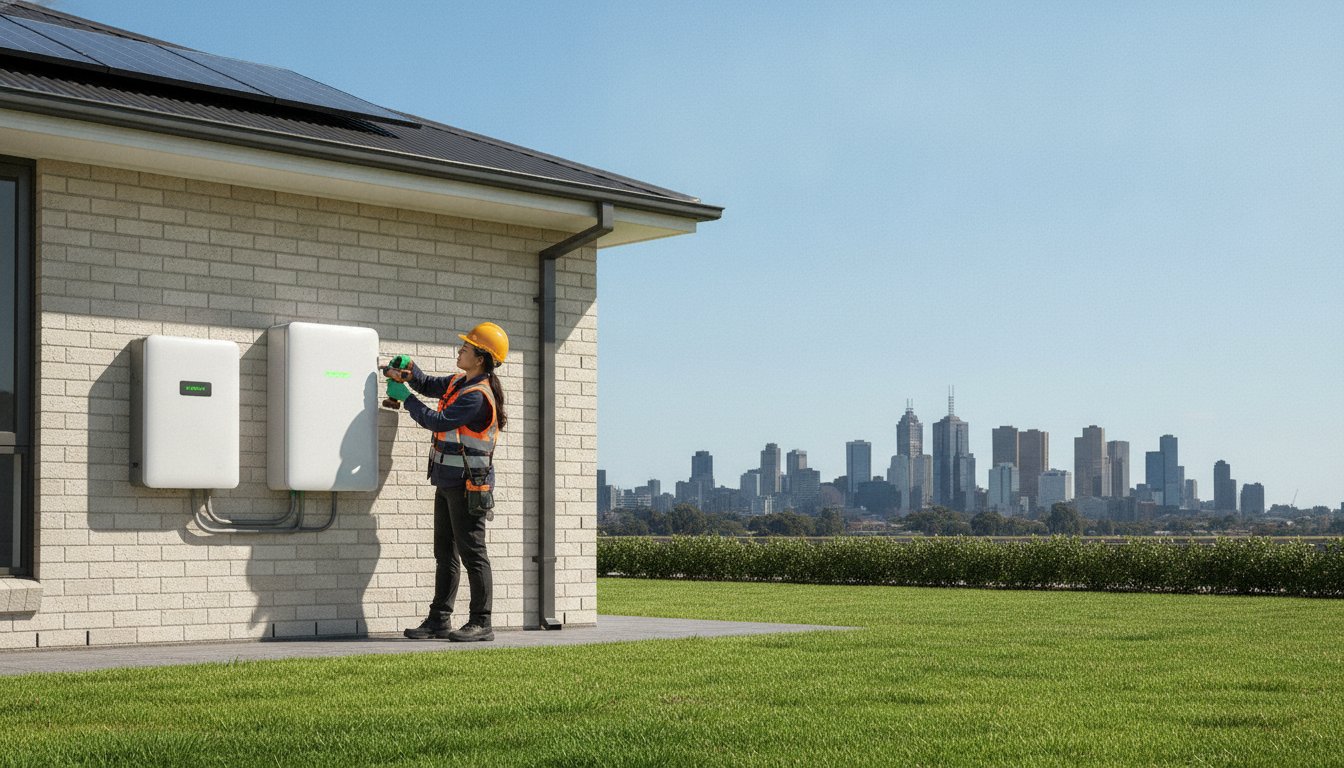
Is your home storage system a silent asset or a growing liability? Many Melbourne homeowners are watching their electricity bills creep up despite having solar installed. It’s a common frustration. You invested in independence, yet you’re still tethered to a volatile grid. Knowing exactly when to replace solar battery hardware is the difference between a high-performing asset and a wasted investment.
We understand the confusion surrounding aging tech and the fear of being ripped off by “solar cowboys.” You deserve clarity. This 2026 checklist identifies the precise moment your storage becomes a financial drain. We’ll show you how to maximise your return on investment by leveraging the current federal rebate of approximately $252 per usable kWh before rates decrease. It’s about taking control of your energy future before the grid takes more of your money.
This article provides a definitive roadmap for your storage upgrade. You’ll learn to spot early failure signs, decode complex warranty terms, and navigate the 2026 regulatory landscape. We’ll outline how a strategic transition to modern, high-reliability technology ensures your home remains powered and your wallet stays protected. Prepare to turn your energy storage back into the powerhouse it was meant to be.
Key Takeaways
- Spot the red flags. Rapid discharge during evening peaks and “Inverter Isolation” faults indicate your storage is failing.
- Understand the decay. Learn how Melbourne’s summer heatwaves accelerate Lithium-ion degradation and compromise your energy security.
- Master the timing. Identify the precise financial tipping point for when to replace solar battery hardware before it becomes a “vampire” asset.
- Verify compatibility. Use our 2026 checklist to confirm if your existing inverter supports a high-performance LiFePO4 upgrade.
- Maximise your ROI. Discover how to leverage current federal incentives for a seamless, expert-led transition to modern storage.
Signs Your Solar Battery Needs Replacing: The Red Flags
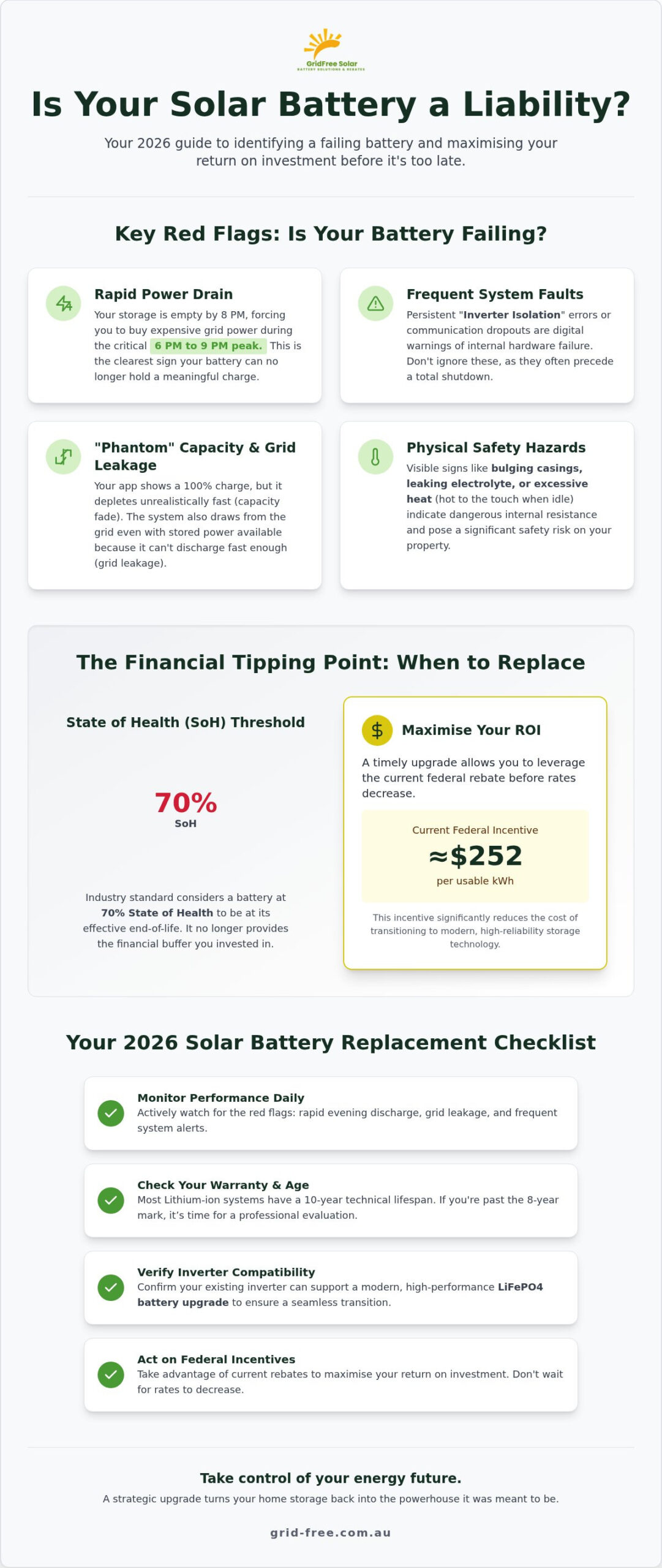
Performance drops aren’t always subtle. Your system might look functional on a sunny Tuesday, but your bank balance often tells a different story. If your evening energy consumption is suddenly draining your storage by 8 PM, your hardware is flagging. Rapid discharge rates during the critical 6 PM to 9 PM peak are the most common indicator for when to replace solar battery units that have reached their chemical limit. You invested in storage to avoid peak grid prices. If you’re back to buying power at dinner time, the battery is no longer doing its job.
Frequent system error codes are another urgent warning. Persistent “Inverter Isolation” faults or communication dropouts between the battery management system (BMS) and the inverter suggest internal hardware failure. Don’t ignore these digital cries for help. They frequently precede a total system shutdown that could leave you without backup during a blackout. Physical inspection is equally vital for Melbourne homeowners. Bulging casings, evidence of leaking electrolyte, or excessive heat radiating from the unit are critical safety hazards. If the unit feels hot to the touch while idle, the internal resistance has climbed to dangerous levels. This isn’t just a performance issue; it’s a site safety risk.
Monitoring Capacity Fade and Grid Leakage
Your monitoring app might claim 100% charge, but if that “full” battery dies in record time, you’re dealing with capacity fade. This is a fundamental limitation of aging rechargeable battery technology. As cells degrade, they lose the ability to hold a deep charge. You’ll also notice “grid leakage.” This occurs when your home begins pulling expensive power from the grid even though your app shows stored energy is available. The battery simply cannot discharge fast enough to meet your home’s current demand. Use your smart monitoring tools to track discharge curves. If the health line drops vertically rather than following a steady slope, the internal chemistry is exhausted.
The 10-Year Benchmark: Is Your Warranty Expiring?
Most Lithium-ion systems installed in Australia follow a 10-year technical lifespan. However, performance doesn’t just stop at year ten; it tapers off significantly. Industry standards suggest that once a battery hits 70% State of Health (SoH), it is effectively end-of-life. It no longer provides the financial buffer you originally paid for. Check your original installation paperwork for performance guarantees. If you’ve passed the eight-year mark, it’s time to evaluate when to replace solar battery components to avoid the “cost of inaction.” A timely upgrade ensures you capture the full value of 2026 federal incentives before the next scheduled rebate reduction.
Understanding Solar Battery Lifespans: Why They Fail
Batteries aren’t static boxes of electricity. They’re complex chemical reactors. Every time you draw power to run your dishwasher or air conditioner, you’re initiating a microscopic wear-and-tear process. Understanding this chemistry is vital for determining when to replace solar battery units before they fail completely. Most modern systems rely on Lithium-ion chemistry, which operates by moving ions between an anode and a cathode. Eventually, these pathways become clogged with “chemical debris,” reducing the total energy the battery can hold.
Depth of Discharge (DoD) plays a massive role in this decay. If your older system is set to a 90% or 100% DoD, you’re essentially redlining the engine every single night. This aggressive usage shortens the lifespan significantly compared to modern setups that manage discharge more intelligently. Keeping an eye on home battery market trends shows that as technology evolves, the industry is moving toward more resilient chemistries that handle deep cycles without the same level of degradation. If your current unit was installed during the first wave of Victorian solar adoption, it likely lacks these advanced protections.
Cycle Life vs. Calendar Life
There is a distinct difference between how many years a battery sits on the wall and how much work it actually does. Cycle Life is the total number of full charge and discharge cycles a system can perform before its storage capacity drops below 80%. A battery rated for 6,000 cycles might theoretically last 16 years, but that assumes perfect conditions. If you’re cycling the unit twice a day to avoid Melbourne’s soaring peak rates, you’ll hit that limit much sooner. Calendar life refers to the natural degradation that happens regardless of use. Even a backup-only unit will eventually lose its “zip” due to simple chemical aging.
Environmental Stressors in Victoria
Melbourne’s climate is notoriously punishing for energy storage. While we don’t have the constant humidity of the north, our extreme summer heatwaves are battery killers. High ambient temperatures accelerate internal chemical reactions, leading to premature capacity loss. Units installed on west-facing exterior walls without adequate shading often fail years before their counterparts in ventilated garages. Modern LiFePO4 (Lithium Iron Phosphate) technology offers far superior thermal stability compared to older Cobalt-based Lithium or Lead-acid variants. If your system is struggling through another Victorian summer, it might be time to assess your upgrade options with a specialist who understands local conditions.
The Financial Tipping Point: Repair vs. Replace
Stop viewing your solar battery as a one-time purchase. It’s a performance asset. When that asset degrades, it stops being a shield against rising energy prices and starts becoming a “vampire” battery. These aging units often consume more energy from the grid to maintain internal thermal management than they actually store for your home. This is the “Cost of Inaction.” Every month you delay an upgrade, you’re buying back your own solar energy from the retailer at a massive markup. The financial bleed is real. It’s often invisible until you compare your current bills to your system’s peak performance years.
Deciding when to replace solar battery hardware isn’t just about waiting for total failure. It’s about efficiency. A 2016-era battery might have a round-trip efficiency of 80%. A 2026 smart storage system pushes that toward 95%. That 15% gap represents pure profit lost to heat and resistance every single day. Component-level repairs are rarely the answer. Most modern units are sealed. Attempting to “fix” a failing cell module is a fool’s errand. The labour costs alone often exceed the price of a superior, warranted replacement that comes with a fresh 10-year performance guarantee.
ROI Analysis: The New Battery Advantage
Modern storage offers more than just capacity. It offers intelligence. 2026 systems are built for Virtual Power Plants (VPPs). These programmes allow you to trade energy during grid stress events, turning your battery into a revenue generator. For a detailed breakdown of current market rates and potential returns, see our guide on Solar Battery Cost Australia 2026. High round-trip efficiency combined with VPP earnings significantly shortens your payback period compared to nursing an old, failing unit. You’re trading a liability for a high-yield asset.
Feed-in Tariffs vs. Self-Consumption
Melbourne’s energy landscape has shifted dramatically. Feed-in tariffs (FiTs) have plummeted. Exporting your excess solar is no longer a viable financial strategy. You must store it. Current Victorian Feed-in Tariffs have dropped so low that your battery’s health is now the primary factor determining your total solar ROI. If your storage isn’t capturing 90% of your excess generation, you’re essentially giving power away to the retailer for a pittance. You then buy it back at a premium once the sun goes down. A timely replacement ensures you keep your power where it belongs: in your home.
Your 2026 Solar Battery Replacement Checklist
Stop guessing. Start measuring. Deciding when to replace solar battery hardware requires a clinical approach to your home energy data. If your system is underperforming, you need a logical sequence of steps to ensure your next investment delivers maximum energy independence. Follow this 2026 checklist to transition from a failing asset to a modern, high-yield storage solution.
- Conduct a professional capacity test: Hire a specialist to measure your actual usable capacity. If your 10kWh battery only yields 6kWh, your degradation has hit the critical 40% failure threshold.
- Verify inverter compatibility: Determine if your current inverter supports modern Lithium Iron Phosphate (LiFePO4) communication protocols or if a hybrid upgrade is necessary.
- Check Federal rebate eligibility: As of July 2026, the Victorian state battery rebate has concluded. However, you can still claim the Federal “Cheaper Home Batteries Program” discount of approximately $252 per usable kWh.
- Audit household energy loads: Your 2018 energy needs are likely obsolete. Account for new induction cooktops, heat pumps, or the EV you plan to buy next year.
- Secure a CEC Accredited quote: Only use Clean Energy Council Accredited installers to ensure your installation meets AS/NZS 5139 safety standards and remains rebate-compliant.
Assessing Inverter Compatibility
Your inverter is the brain of your system. If you’re replacing an older battery, you must decide between AC and DC coupling. Many older units use DC coupling, which may limit your choice of modern battery brands. Upgrading to a modern hybrid inverter during your battery replacement often provides a higher round-trip efficiency and better smart-home integration. This is also the ideal time to evaluate your entire solar array. If your panels are aging alongside your battery, consider a full system refresh. You can learn more about modernising your setup in our guide to Solar Panel Installation Melbourne.
The “Right-Sizing” Audit
Bigger isn’t always better; it’s about matching storage to your specific discharge patterns. A 5kWh battery might suffice for a small townhouse, but a family home with a heat pump and an EV charger typically requires 13.5kWh to 15kWh to achieve true grid independence. Future-proofing is essential. In 2026, Melbourne’s grid is increasingly volatile. Sizing your battery slightly above your current needs provides a safety buffer for peak-period price spikes and potential blackouts. Don’t let “solar cowboys” sell you an oversized unit you’ll never fill. Base your decision on your actual smart-meter data from the last 12 months.
Ready to stop the energy drain? Book a professional capacity test today and get a definitive answer on your battery’s health.
Future-Proofing with a GridFree Solar Upgrade
Future-proofing your home energy system requires more than just a hardware swap. It demands intelligent integration. At GridFree Solar, we specialise in the seamless transition from legacy storage to advanced LiFePO4 (Lithium Iron Phosphate) technology. While the decision of when to replace solar battery units often feels daunting, our process removes the technical friction. We don’t just replace boxes; we re-engineer your storage to handle the aggressive demands of a 2026 Melbourne household. This ensures your new system is VPP-ready and fully optimised for the modern smart grid from day one.
Maximising your energy independence means moving beyond simple backup. Our integrated solutions focus on high round-trip efficiency and rapid discharge capabilities. This allows you to power heavy loads like heat pumps and electric vehicle chargers without dipping into expensive grid reserves. We provide a definitive path from an aging, unreliable asset to a high-performance energy hub. By choosing a timely upgrade, you secure the reliability your family needs while locking in the financial benefits of the latest storage innovations.
Claiming the Victorian Battery Rebate
Navigating the financial landscape in 2026 is critical for a high-ROI upgrade. While the specific state-level grants in Victoria have evolved, Victorian homeowners can still leverage significant savings through the Federal “Cheaper Home Batteries Program.” This rebate provides approximately $252 per usable kWh of capacity. Our experts manage the entire administrative process. We handle the paperwork and ensure the rebate is applied as an upfront discount on your quote. For a comprehensive breakdown of how these incentives apply to your specific situation, consult our Victorian Battery Rebate Guide. We ensure you don’t leave money on the table during your transition to modern tech.
The GridFree Advantage
The GridFree advantage is rooted in localised expertise. Melbourne’s residential layouts and grid conditions require a bespoke approach, not a “one size fits all” kit. Our custom designs account for everything from specific roof orientations to local voltage fluctuations. We’re committed to high-performance, high-safety storage, which is why we prioritise LiFePO4 chemistry for its superior thermal stability and cycle life. You’ll receive ongoing support and monitoring from our Melbourne-based team, ensuring your system operates at peak efficiency for its entire lifespan.
Don’t wait for your current system to become a total liability. Secure your energy future with a specialist who understands the 2026 landscape. Your next step is a professional health check and upgrade consultation. Book your assessment today and let us help you identify the exact moment when to replace solar battery hardware to capture the best possible return on your investment. We take the complexity out of the transition, providing you with a seamless, high-tech solution that protects your wallet and the planet.
Secure Your Melbourne Energy Independence
Your solar storage should be a financial engine. It shouldn’t be a silent drain on your quarterly budget. As we’ve explored, “grid leakage” and capacity fade are definitive signals that your hardware has reached its technical limit. Deciding when to replace solar battery units is a strategic move to restore your home’s efficiency and shield your wallet from volatile prices. Upgrading now ensures you transition to a smarter, more resilient LiFePO4 system designed for 2026 grid demands.
Don’t leave your energy security to chance or “solar cowboys.” Our Clean Energy Council Accredited Installers provide the precision and local Melbourne expertise required for a seamless transition. We take the complexity out of the process with expert rebate assistance and custom-designed storage solutions. We are specialists in Melbourne battery upgrades, dedicated to ensuring your investment delivers long-term reliability and peak performance.
Take control of your electricity bills before the next summer heatwave tests your system to its breaking point. Book Your Professional Battery Health Check with GridFree Solar Today. Your journey toward a more intelligent, independent home starts with a single expert assessment. We look forward to powering your future.
Frequently Asked Questions
How long do solar batteries usually last in Melbourne?
Solar batteries in Melbourne typically last between 10 and 12 years. This lifespan depends heavily on how many cycles the unit performs and its exposure to extreme summer temperatures. While some high-quality LiFePO4 units are rated for 6,000 cycles, frequent discharging during Victorian heatwaves can lead to premature capacity loss and reduced efficiency.
Can I replace just one dead battery module or do I need a whole new system?
Replacing a single module is rarely a viable solution for residential systems. Modern Lithium-ion units are integrated systems where internal cells degrade at similar rates. Mixing a fresh module with aged cells creates voltage imbalances that compromise safety and performance. A full replacement ensures your storage remains reliable and covered by a comprehensive new warranty.
Is there a rebate for replacing an old solar battery in Victoria?
You can claim the Federal “Cheaper Home Batteries Program” rebate for your storage upgrade. As of July 2026, this provides an upfront discount of approximately $252 per usable kWh of capacity. While the Victorian state-specific battery rebate has concluded, this federal incentive significantly reduces the capital outlay for Melbourne homeowners seeking better energy independence.
My battery is still working but the capacity is low—should I replace it?
Low capacity is the primary indicator for when to replace solar battery hardware. Once your State of Health (SoH) drops below 70%, the battery often fails to cover your evening peak loads. You end up buying expensive grid power at dinner time, which destroys your solar ROI and makes the aging unit a financial liability rather than an asset.
What happens to my old solar battery once it is replaced?
Old batteries must be recycled through accredited e-waste programmes. Lithium-ion units contain valuable minerals like cobalt, copper, and lithium that are recovered for secondary use. We coordinate the safe removal and transport of your decommissioned unit to certified recycling centres, ensuring no hazardous materials end up in Victorian landfills or damage the local environment.
Will a new battery work with my 10-year-old solar panels?
New batteries are compatible with older panels through AC coupling or a hybrid inverter upgrade. Solar panels often have a 25-year lifespan, significantly outlasting the first generation of storage technology. We specialise in integrating modern, high-performance LiFePO4 technology with your existing array to extend the life and value of your entire solar investment.
How much does it cost to replace a solar battery in 2026?
Replacement costs depend on the battery’s usable capacity and your choice of brand. The Federal rebate now covers roughly 30% of the hardware price, making 2026 an ideal window for an upgrade before rebate rates decrease. For a precise figure tailored to your home’s energy profile and layout, we recommend a professional site assessment and custom quote.
How do I know if my solar battery is still under warranty?
Review your original installation paperwork or the manufacturer’s digital portal for warranty details. Most reputable brands provide a 10-year performance guarantee that promises a specific capacity, often 60% to 70%, at the end of the term. If your professional health check reveals capacity below these levels, you may be eligible for a warranty claim before the term expires.