
Your window to maximise energy savings is closing faster than you think. If your household income sits between $150,000 and $210,000, you have until 5pm on 30 June 2026 to act before the Victorian solar panel rebate threshold drops. Waiting even one day longer could cost you thousands in missed incentives. Understanding your battery rebate eligibility Victoria is no longer just about being “green”; it’s about securing a 30% upfront discount through the Federal Cheaper Home Batteries Program before the administrative landscape shifts. This isn’t just about panels; it’s about intelligent storage and long-term financial savvy.
We understand the frustration of navigating the confusing overlap between closed State loans and new Federal incentives. It’s difficult to know if your existing solar array is even compatible with modern VPP standards. This guide provides a definitive “Yes or No” on your eligibility for both State and Federal support. You’ll discover the exact technical requirements for battery systems between 5kWh and 100kWh and the specific roadmap needed to lock in your rebate before the July deadline. Let’s clear the confusion and get your home powered by the latest intelligent storage technology.
Key Takeaways
- Act before 5pm on 30 June 2026 to secure your eligibility under the current $210,000 household income threshold before it drops to $150,000.
- Shift your strategy from closed state loans to the Federal ‘Cheaper Home Batteries Program’ which offers a substantial 30% upfront discount.
- Confirm your battery rebate eligibility Victoria by ensuring your system meets the 5kWh to 100kWh nominal capacity and VPP-ready technical standards.
- Follow our streamlined roadmap to verify your property details and obtain an authorised quote from a certified solar and battery specialist.
- Maximise your long-term return on investment by leveraging your eligible battery to join a Virtual Power Plant and earn ongoing energy credits.
The 2026 Victorian Battery Rebate Landscape: State vs Federal Incentives
The energy game in Victoria has shifted. For years, homeowners relied on state-funded interest-free loans to bridge the gap to storage. Those days are over. The Victorian state-level solar battery loan program is now closed to new applications. In its place, a powerful national alternative has emerged. The Federal Cheaper Home Batteries Program has taken the lead. This transition marks a pivot from debt-based support to direct, upfront discounts. It’s a faster, more efficient way to lower your entry costs.
Central to this new era is the Clean Energy Regulator (CER). They oversee the integrity of the incentives and ensure only high-standard technology enters the market. As of July 2025, a landmark change occurred. Small-scale Technology Certificates (STCs) now apply directly to battery storage. This isn’t a future promise; it’s the current reality. By linking incentives to the battery’s usable capacity, the system rewards efficiency. For those assessing battery rebate eligibility Victoria, the focus is now on technical compliance rather than just state-level residency.
Melbourne residents find themselves in a unique “double-dip” position. While the battery loan has ended, the Victorian solar panel rebate remains active, offering up to $1,400 for eligible systems. When you combine this with the Federal battery discount, the total savings are substantial. It’s a strategic moment for Solar power in Australia, as households move beyond simple generation toward total energy independence. Securing your battery rebate eligibility Victoria now ensures you capitalise on both streams before further policy changes occur.
Defining the Cheaper Home Batteries Program
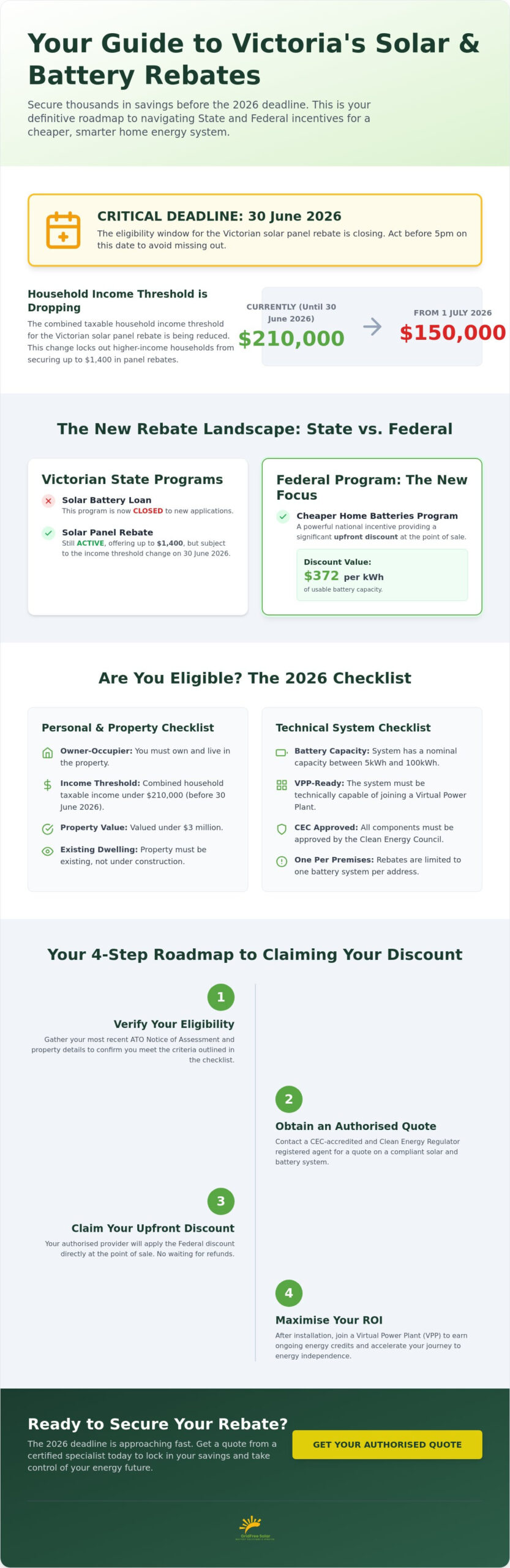
This Federal initiative targets the primary barrier to adoption: high entry costs. It provides a discount valued at $372 per kilowatt-hour (kWh) of usable capacity. For a standard 10kWh system, this translates to a massive reduction in your initial investment. The Clean Energy Regulator manages the accredited provider list to maintain high installation standards. The core benefit is simple. The discount is applied at the point of sale by registered agents, meaning you don’t have to wait months for a refund.
Victorian State Context in 2026
Solar Victoria’s role is now one of oversight and panel-specific support. Their interest-free loan for solar panels is still available for those under the $210,000 income threshold. This threshold is a ticking clock. Applying before the 30 June deadline is essential for those on higher incomes. By coordinating state panel rebates with federal battery incentives, you optimise your system’s ROI from day one. All systems must be CEC-approved and VPP-ready to qualify for the federal component, ensuring your home is prepared for the modern grid.
Are You Eligible? The 2026 Personal & Property Checklist
The income cliff is real. 1 July 2026. That’s the date the Victorian eligibility landscape changes forever. If your combined household taxable income is between $150,000 and $210,000, you’re currently in the sweet spot. But only until 5pm on 30 June. After that, the threshold for the state panel rebate drops to $150,000. You’ll be locked out of $1,400 in direct savings. Don’t let administrative delays cost you. Your battery rebate eligibility Victoria depends on acting during this critical urgency window.
Property status is the next hurdle. For now, these incentives target owner-occupiers. Investment properties are excluded from the primary residential schemes. Your Melbourne home must also be an existing dwelling. If your house is still under construction, you aren’t eligible yet. There’s also the ‘One Battery Per Premises’ rule to consider. You can’t claim multiple rebates for the same address, even if you’re adding storage to a multi-unit development on a single title. Finally, verify your property value. It must be under $3 million to qualify for the Solar Victoria official website standards. Most Victorian homes fit this, but it’s a vital box to tick.
The Income Threshold Verification
Verification is straightforward but strict. You’ll need your most recent Notice of Assessment (NOA) from the ATO for all named owners. This document is the only evidence accepted to prove your combined household taxable income. Calculate your total carefully. If your income has fluctuated near the $210,000 limit, your 2025-2026 tax return will be the deciding factor. Secure your documentation now. The mid-2026 rush will cause processing delays, and an incomplete application won’t hold your place in the queue.
Property and Residency Standards
Standalone houses, townhouses, and units are all eligible property types. The defining factor is residency. You must live in the property as your primary residence to claim the Victorian portion of the incentives. While regional Victoria and Metropolitan Melbourne follow the same core standards, local council programs can sometimes offer additional support. A professional solar and battery installation assessment will confirm if your specific property type and switchboard are ready for a high-performance storage upgrade. Ensure your system meets the property standards before you commit to a contract.
Technical Eligibility: Is Your Solar System Battery-Ready?
Technical specifications aren’t just for engineers. They’re the gatekeepers of your financial return. To secure battery rebate eligibility Victoria, your hardware must meet strict federal and state criteria. It’s not enough to simply buy a battery; it must be the right battery. The Cheaper Home Batteries Program operates on a sliding scale of incentives based on capacity. If your hardware doesn’t appear on the Clean Energy Regulator or CEC approved lists, your application will be rejected before it even reaches a human reviewer.
Size matters. Especially when it’s tied to your bank balance. The federal discount applies to systems with a nominal capacity between 5kWh and 100kWh. However, there’s a critical nuance: the 50kWh STC cap. While you can install up to 100kWh of storage, the Small-scale Technology Certificates (STCs) only apply to the first 50kWh. This means larger commercial-scale residential setups face diminishing returns on the rebate per kilowatt-hour after that halfway mark. You must also confirm if your current solar inverter is compatible. AC-coupled batteries work with almost any existing system, but DC-coupled units often require a specific hybrid inverter. Don’t sign a contract until your installer confirms your inverter’s architecture supports your chosen storage.
Capacity and Performance Standards
The rebate calculation relies on usable capacity, not nominal capacity. Nominal is the total energy the cells can hold; usable is what the system safely allows you to discharge. Since the incentive is valued at $372 per kWh of usable capacity, this distinction is vital for your budget. You can stack multiple modular units to reach your desired storage limit, provided the total doesn’t exceed the 100kWh ceiling. Every component must carry AS/NZS 5139 safety certification. This standard ensures the installation meets rigorous Australian fire and electrical safety codes, a non-negotiable requirement for any successful claim.
Existing Solar PV System Requirements
Storage requires generation. You must have a functional solar PV system already installed or be installing one concurrently. A tiny 2kW array won’t generate enough surplus energy to charge a 10kWh battery effectively, which could impact your battery rebate eligibility Victoria. If you’re looking to replace an old, failing battery, be aware that you generally cannot claim a second rebate for the same premises if an incentive was already paid out for the original unit. Finally, your home must have a functioning smart meter. These devices are standard in Victoria and are essential for the VPP-ready monitoring required by the federal government.
Step-by-Step Roadmap: How to Claim Your Victoria Battery Discount
Precision is your best ally. To lock in your battery rebate eligibility Victoria, you must follow a rigid administrative sequence. Deviating from these steps often leads to delays that could push your application past the 30 June 2026 deadline. If you’re currently in the $150,000 to $210,000 income bracket, speed is essential. Every day you wait is a day closer to the threshold drop. Don’t leave your savings to chance.
The process starts with a professional consultation. Obtain a detailed quote from an authorised retailer like GridFree Solar. This document must specify the battery’s usable capacity and confirm its VPP capability. Once you have your quote, upload your property and income details to the Solar Victoria portal. This is where you’ll provide your ATO Notice of Assessment. After verification, you’ll receive an eligibility token. Secure this token before you pay any deposit or sign a final contract. Without it, you’re flying blind. Following the installation by an accredited specialist, the STC value is assigned to the retailer, who then applies the discount directly to your invoice. A final post-installation safety inspection completes the cycle.
Organising Your Documentation
Gather your paperwork before you start the digital application. You’ll need your most recent council rates notice and primary identification, such as a driver’s licence or passport. Accuracy here prevents the common errors that lead to application rejection. Before committing, use a solar rebate calculator Victoria to estimate your total out-of-pocket cost. Knowing your exact financial position allows you to choose a system that maximises your return without exceeding your budget. Documentation is the foundation of a successful claim.
Working with Accredited Installers
Only “Registered Agents” can facilitate the upfront federal discount. This status is vital. It ensures the installer is authorised to handle the Small-scale Technology Certificates (STCs) on your behalf, reducing your upfront capital outlay. Always verify that your chosen technician holds current Clean Energy Council (CEC) accreditation. This isn’t just about quality; it’s a legal requirement for your battery rebate eligibility Victoria. For a more granular look at the paperwork involved, check our detailed guide on how to claim solar rebate Victoria. Expert guidance ensures you don’t miss a single cent of available funding.
Ready to secure your incentive before the income threshold changes? Request your authorised battery quote from our specialist team today.
Maximising ROI: Moving from Rebate Eligibility to Energy Independence
Securing your battery rebate eligibility Victoria is the first step in a larger financial strategy. While the upfront discount provides immediate relief, the true value lies in how you manage that stored energy over the next decade. With feed-in tariffs in Victoria no longer regulated at a minimum rate as of July 2025, the old model of “exporting to the grid” is dead. You need to store your own power. Calculating your long-term return requires looking past the initial invoice to the total solar battery cost Australia, factoring in self-consumption and grid independence.
Future-proofing your home means preparing for a volatile 2026 energy market. A rebate-eligible battery isn’t just a backup power source; it’s an intelligent asset. By shifting your heavy loads to times when your battery is full, you insulate your household from peak pricing. This transition only works if your system is designed correctly from the start. High-quality solar panel installation Melbourne provides the necessary generation foundation to ensure your battery actually reaches full charge during the shorter winter days. Without enough panels to feed the storage, your ROI will stall.
The VPP Advantage in Victoria
Virtual Power Plants (VPPs) are the next frontier for Victorian households. By joining a VPP, you allow a provider to briefly tap into your battery during extreme grid demand. In exchange, you receive ongoing credits or premium feed-in rates that far exceed standard offers. To qualify for these bonuses, your system must be VPP-ready, a core requirement of the federal rebate scheme. Melbourne-specific programs in 2026 are increasingly aggressive, offering sign-on bonuses for households that bring “smart” storage to the table. This turns your battery into a passive income stream.
The GridFree Approach to Storage
We don’t just install hardware. We engineer solutions that meet the strict criteria for eligible batteries for Victorian rebate. Our team understands the administrative landscape of the 1 July 2026 threshold changes. We help you navigate the paperwork to ensure your battery rebate eligibility Victoria is locked in before the income cap drops. We prioritise high-cycle life and VPP-ready technology to ensure your investment outlasts the payback period. Don’t risk your eligibility with a generic provider who doesn’t understand the local Victorian context.
The 30 June deadline is a hard limit. If your household income is near the threshold, you cannot afford to wait for the spring rush. Contact GridFree Solar today to secure your authorised quote and verify your eligibility before the window shuts. Let’s build your energy independence now.
Secure Your Energy Future Before the Threshold Shifts
Time is the only resource you can’t replenish. The 1 July 2026 income threshold drop is a firm deadline. If your household earns over $150,000, your opportunity to claim the full suite of Victorian incentives ends at 5pm on 30 June. By now, you understand that battery rebate eligibility Victoria isn’t just about residency; it’s about technical compliance and administrative timing. You’ve seen how the 30% Federal discount and VPP-ready standards have replaced old loan models to provide faster, more direct ROI.
Don’t let paperwork or technical confusion stand between you and energy independence. As expert Melbourne-based installers and Authorised Registered Agents for STC claims, we specialise in navigating the complex 1 July 2026 transition. We ensure your system meets every safety and capacity standard required for a successful claim. Check Your 2026 Eligibility with GridFree Solar today to lock in your savings before the window shuts. Your journey toward a smarter, more resilient home starts with a single verified quote. We look forward to helping you take control of your energy future.
Frequently Asked Questions
Is the Victorian battery rebate still available in 2026?
Yes, but the incentive structure has shifted. The previous state-based battery loan is now closed, but the Federal Cheaper Home Batteries Program has taken its place as the primary support mechanism. This new scheme provides a direct upfront discount rather than a loan. You can still combine this with the Victorian solar panel rebate of up to $1,400 if you’re installing a complete system.
What is the income limit for the solar battery rebate in Victoria for 2026?
The Federal battery discount is not means-tested, meaning there is no income cap for that portion of your savings. However, if you’re also claiming the Victorian solar panel rebate, your combined household taxable income must be under $210,000. This threshold is scheduled to drop to $150,000 on 1 July 2026. Secure your application before 30 June to qualify under the higher limit.
Can I get a rebate if I already have solar panels installed?
You certainly can. The current Federal incentive applies to batteries connected to either new or existing solar PV systems. This is an ideal opportunity for households with older systems to add storage and increase their energy independence. We’ll just need to confirm your existing inverter is compatible with modern AC-coupled or DC-coupled battery technology.
How much is the federal battery discount under the Cheaper Home Batteries Program?
The program provides a discount of approximately 30% on the upfront cost of your storage system. This value is calculated at $372 per kilowatt-hour (kWh) of the battery’s usable capacity. For a typical 10kWh home battery, this results in a substantial reduction that is applied directly to your quote by an authorised retailer.
Do I need to pay the rebate back like the old Solar Victoria loans?
No, there is no repayment required for this incentive. Unlike the interest-free loans previously offered by Solar Victoria, the Federal discount is a non-repayable reduction in the purchase price. It functions as a point-of-sale discount, meaning your out-of-pocket costs are lower from day one without any ongoing debt attached to the system.
What happens if I apply for the rebate after 1 July 2026?
Applying after this date means your battery rebate eligibility Victoria for state-level panel support will be assessed under the stricter $150,000 income cap. While the Federal battery discount is expected to remain available, losing the state panel rebate could increase your total system cost by $1,400. High demand in late June often slows processing, so don’t wait until the final week to lodge your paperwork.
Is my house eligible if it is a new build in Melbourne?
New builds are generally ineligible until they are classed as existing dwellings. To qualify for the residential rebates, the property must be completed and occupied. You also need an established connection with a functional smart meter. If you’ve recently moved in and have your first rates notice, you’re ready to apply, but homes still under construction cannot yet be registered. To ensure your property transition is handled professionally, you can learn more about i.Conveyancing.Co for expert conveyancing services in Victoria.
Can businesses in Victoria claim the battery rebate in 2026?
The Cheaper Home Batteries Program is designed for systems up to 100kWh, which covers many small-to-medium commercial solar solutions. While the primary focus is residential, businesses can often access similar STC-based incentives for storage. We recommend a technical assessment to confirm the battery rebate eligibility Victoria for your specific commercial site and energy profile.