

In 2026, your Melbourne home is no longer just a residence; it’s a micro-utility. Waiting until July to secure your solar rebate could be a costly mistake if your household income exceeds the new $150,000 threshold. You’ve likely watched Victorian electricity tariffs climb while your feed-in tariffs continue to vanish. It’s frustrating to generate power you can’t afford to keep. By investing in the right energy storage solutions Melbourne offers, you stop donating energy to the grid and start owning your independence.
We understand the anxiety surrounding battery lifespan and the confusion between Virtual Power Plants and standalone storage. This guide simplifies the technical complexity. You’ll learn how to navigate the 2026 rebate landscape, maximise your ROI through VPP participation, and secure your property against blackouts. We provide the high-authority clarity needed to lower your quarterly power bills to near-zero. Here is your definitive roadmap to total grid autonomy.
Key Takeaways
- Identify the shift from simple backup to active grid participation. Learn why your solar setup needs a strategic bridge to power your home 24/7.
- Evaluate the latest LiFePO4 chemistries and configuration types. Select the most resilient energy storage solutions Melbourne offers to ensure safety and long-term performance.
- Size your system with precision using evening peak load data. Avoid the “over-sizing” trap that often inflates costs and extends your payback period unnecessarily.
- Secure your financial advantage by mastering 2026 Victorian rebates and VPP incentives. Turn your battery into a strategic asset that generates income while protecting you from blackouts.
- Streamline your path to independence with a professional installation roadmap. Understand the critical steps from initial load analysis to the final commissioning of your integrated system.
What are energy storage solutions and why does Melbourne need them in 2026?
Stop donating your hard-earned solar energy to the grid for pennies. What is energy storage? Effectively, it’s the bridge that spans the gap between midday generation and midnight consumption. In 2026, energy storage solutions Melbourne homeowners and businesses deploy have shifted from luxury backups to essential financial tools. The Victorian energy landscape has changed. High feed-in tariffs are a relic of the past. If you’re still relying on the grid to store your excess solar via credits, you’re losing money every single day. Storage is now the only viable path to a genuine return on investment.
Achieving Total Grid Independence is the new gold standard for Victorian properties. This isn’t just about surviving a blackout. It’s about active grid participation. You become the master of your own energy ecosystem, using smart technology to bypass rising peak tariffs entirely. You generate. You store. You control. This is how you reclaim your power from the big retailers. It’s time to stop being a passive consumer and start being an active energy producer.
The core components of a modern storage system
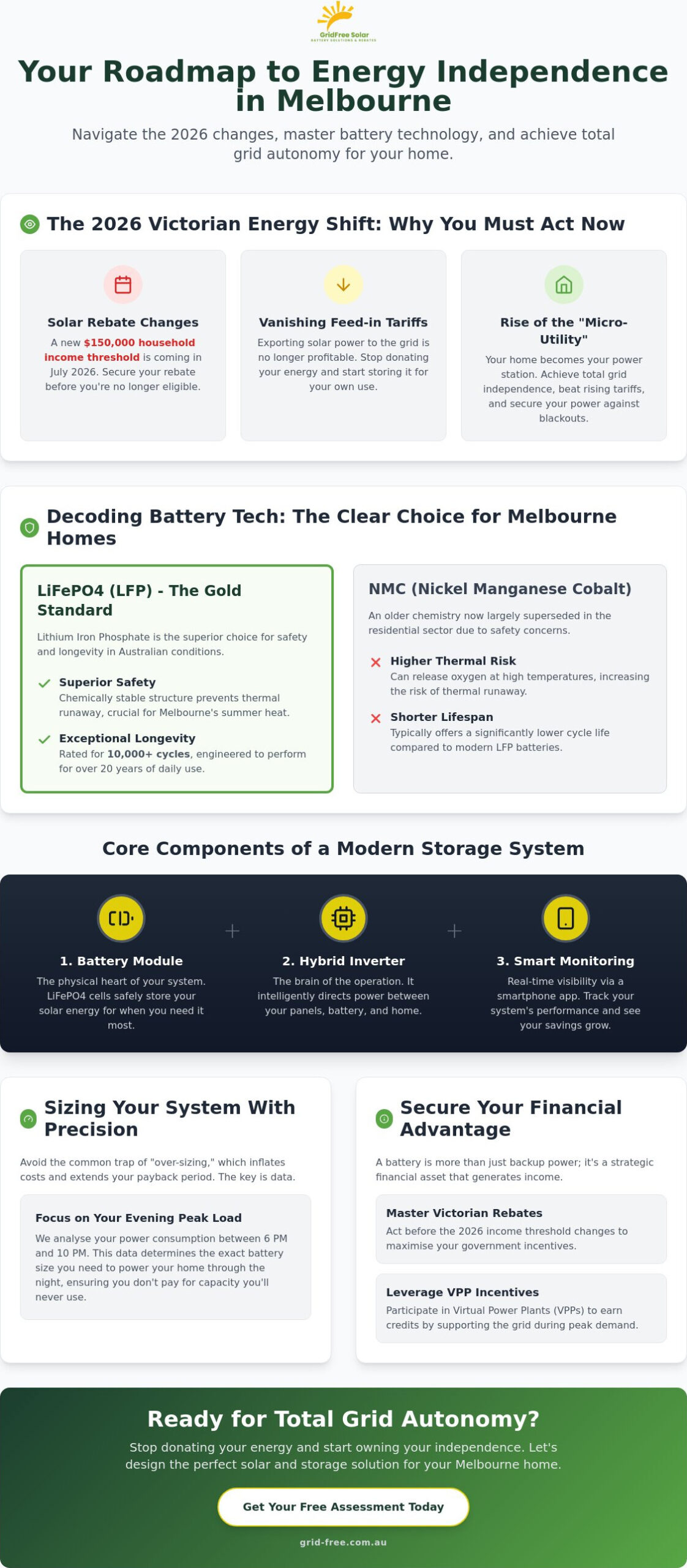
A sophisticated storage setup relies on three critical pillars. First, the battery module is the physical unit where your energy lives. Modern Lithium Iron Phosphate (LiFePO4) cells offer superior safety and high cycle counts. Second, the hybrid inverter acts as the system’s brain. It intelligently directs power flow between your solar panels, your battery, and your home appliances. Finally, smart monitoring provides real-time visibility. You can track your Melbourne property’s efficiency through a smartphone app; seeing exactly how your investment pays off every hour.
Why Melbourne’s grid constraints make storage essential
Victoria’s grid faces unique challenges, specifically the “duck curve” caused by massive daytime solar exports. To manage this, network providers often resort to solar throttling, which limits how much power your panels can actually produce. When you install energy storage solutions Melbourne specialists recommend, you bypass these limits. Your excess power is diverted into your battery rather than being wasted or blocked by the grid. Additionally, Melbourne’s increasingly volatile storm seasons make blackout protection a non-negotiable. While your neighbours wait for the network to be repaired, your system switches to backup mode instantly. You gain the security of knowing your fridge, lights, and essential devices stay powered regardless of grid instability. Understanding how a grid connected solar battery Melbourne homeowners can rely on works within this environment is essential to making the right investment decision.
Decoding the technology: Comparing battery chemistries and configurations
Precision matters; just as industrial sectors rely on the Independent Scale Service for accurate calibration, evaluating the energy storage solutions Melbourne market offers requires looking beyond the sleek casing to the chemical engine inside. In 2026, the choice is clear. Lithium Iron Phosphate (LiFePO4) has outperformed its rivals in every metric that matters to a Victorian homeowner: safety, longevity, and thermal stability. Selecting the wrong chemistry today could leave you with a degraded asset before your ROI is even realised.
LiFePO4: The gold standard for Australian safety
LFP has effectively sidelined NMC (Nickel Manganese Cobalt) in the residential sector. The reason is simple. LiFePO4 chemistry is inherently stable because it does not release oxygen during high-temperature events, effectively eliminating the risk of thermal runaway. This safety profile is a non-negotiable requirement for Melbourne properties facing extreme summer heat. Beyond safety, LFP offers a cycle life that dwarfs previous generations. A rating of 10,000 cycles means your battery is engineered to perform for over 20 years with daily use. This level of durability ensures that your system remains a high-performing asset long after the initial payback period has passed.
AC vs. DC coupling: Which fits your existing solar?
System configuration dictates your overall efficiency. DC coupling is the logical choice for new, high-efficiency solar and battery packages. By keeping the energy in DC form from the panels straight into the battery, you minimise conversion losses. However, for those with an existing solar array, AC coupling is the primary solar battery replacement Melbourne strategy. It provides a seamless way to retrofit storage without replacing your functional solar inverter. While AC coupling involves an extra conversion step, the real-world efficiency difference is usually negligible when compared to the cost-effectiveness of a modular upgrade. The Victorian Solar Homes Program supports both configurations, provided the hardware meets strict safety standards.
Performance isn’t just about chemistry; it’s about environment. Thermal management systems are the unsung heroes of battery health. In Melbourne, where ambient temperatures fluctuate wildly, active cooling ensures your cells operate within their optimal range. Combine this with a high Depth of Discharge (DoD) of 95 to 100 per cent, and you maximise the usable energy available every night. To find the most efficient energy storage solutions Melbourne can provide for your specific roof orientation, it’s time to organise a technical load analysis to determine your ideal configuration.
Sizing your energy storage: Residential vs. commercial requirements
Sizing your energy storage solutions Melbourne investment requires more than a simple estimation of your daily usage. It demands a surgical analysis of your evening peak loads. In 2026, the goal isn’t just to have a battery; it’s to have the right battery. Over-sizing is a common trap that many homeowners fall into, assuming more capacity always equals better value. In reality, an oversized system leads to stranded assets. You pay for capacity you never actually use, which significantly delays your ROI. Precision in sizing ensures every kilowatt-hour of storage is working to pay for itself.
Melbourne’s unique climate plays a defining role in this calculation. During our shorter winter days, your solar array might only generate enough to cover your immediate house load with a small surplus for storage. If your battery is too large, it may never reach a full charge in July. This leaves you with expensive, empty cells. This localized challenge is mirrored at a national level, where initiatives like Grid-Scale Battery Storage Funding are being used to stabilize the broader Victorian network. For the individual property owner, modularity is the solution. Start with a core capacity and expand only when your data proves the need.
Residential storage: Finding the “sweet spot”
For most Melbourne families, the sweet spot usually sits between 10kWh and 13kWh of usable capacity. This range typically covers the heavy lifting of evening cooking, heating, and entertainment without the excessive upfront costs of larger industrial units. When considering how to maximise solar savings, matching your battery to your discharge requirements is vital. Placement is equally critical. While modern LFP batteries are resilient, installing them in garage spaces or outdoor shaded areas protects the thermal management systems from Melbourne’s erratic temperature spikes. This ensures peak efficiency year-round.
Commercial storage: Scalability and demand charge management
In the business sector, storage serves a different master: demand charge management. Commercial properties often face peak demand fees based on their highest point of usage. Strategic energy storage solutions Melbourne businesses implement can “shave” these peaks by discharging stored energy when the facility hits its maximum draw. This prevents the grid from triggering high-cost tariffs. Our commercial solar installation Melbourne packages focus on high-capacity, scalable units. This allows a warehouse or manufacturing plant to start with essential backup and scale up as they transition their fleet to electric vehicles or expand production lines. Future-proofing isn’t about buying the biggest system today; it’s about buying the system that grows with you.
Navigating the Victorian rebate landscape and VPP opportunities
Time is running out. The Victorian government is tightening the belt on solar incentives. By 1 July 2026, the household income threshold for the Solar Victoria rebate drops significantly from $210,000 to just $150,000. If your combined income sits in that bracket, you have until 5 pm on 30 June 2026 to lock in your eligibility. Missing this window could mean losing thousands in upfront support for your energy storage solutions Melbourne project. You need to act before the administrative landscape shifts against you.
Solar Victoria: Current incentives and eligibility
Beyond the income cap, your property must be an owner-occupied home to qualify for the $1,400 PV rebate. While the specific state-based battery loan program has closed, the federal Cheaper Home Batteries Program has stepped in to provide critical financial relief. In 2026, this national initiative provides Small-scale Technology Certificates (STCs) valued at approximately $336 to $372 per kilowatt-hour of usable capacity. The current 2026 rebate application window for those above the $150,000 income threshold closes strictly at 5 pm on 30 June 2026. Ensure your chosen hardware appears on the Clean Energy Council (CEC) approved product list to guarantee compliance. All systems must meet Australian standard AS/NZS 5139:2019 to be eligible for any government support.
Virtual Power Plants (VPPs): Turning your battery into a revenue stream
The most significant shift in 2026 is the requirement for VPP capability. To access federal incentives, your system must be ready to join a network. A VPP allows you to trade your stored energy during Melbourne’s peak demand periods, effectively turning your home into a mini-power station. By comparing the top VPP compatible solar batteries Victoria offers, you can find systems that balance grid support with your personal backup needs. Homeowners participating in these programs are currently earning between $200 and $1,500 annually. This is a strategic revenue stream that accelerates your payback period while providing essential support to the Victorian grid. You maintain control over your backup reserve while the system intelligently trades surplus power for profit.
Claiming these incentives requires a methodical approach. You must engage a NETCC accredited installer to manage the technical documentation and safety certifications. We handle the complexity of the application process to ensure you don’t miss out on available funding. Secure your financial advantage today by choosing the right energy storage solutions Melbourne provider. Organise a consultation to verify your rebate eligibility and start your journey toward total grid independence.
Implementing your integrated solar battery solution with GridFree
Transitioning to a modern energy ecosystem requires more than just high-spec hardware. It demands a partner who understands the local Victorian grid as well as the technical nuances of LiFePO4 chemistry. GridFree Solar is the definitive leader in energy storage solutions Melbourne property owners trust to deliver measurable results. We don’t just install batteries; we engineer a bespoke energy strategy that protects your capital and maximises your independence. Don’t leave your energy future to chance with a generic provider who lacks local integration expertise.
The GridFree design philosophy: Customised for your load
We reject the “one size fits all” approach that plagues the industry. Every property has a unique energy signature. Our specialists begin by auditing your Victorian Default Offer (VDO) bills to pinpoint exactly where your money is being wasted. By analysing your real-world load profile, we design an integrated solar battery solution that matches your consumption patterns perfectly. This data-driven precision prevents the over-sizing trap while ensuring you’re “VPP ready” from day one. You gain a system that is optimised for the 2026 regulatory landscape, allowing you to participate in grid support programs the moment you’re ready.
Professional installation and long-term reliability
The installation journey is a methodical process designed for total reliability. It starts with a comprehensive site analysis followed by a custom electrical design that exceeds Australian safety standards. Our expert installers manage every detail, from the physical mounting of LFP modules to the final commissioning of your hybrid inverter. We provide the high-authority expertise needed to ensure your system performs flawlessly during Melbourne’s erratic weather shifts. Local support is the backbone of our guarantee. If you have a question or need a system health check, our Melbourne-based team is ready to respond. You get the security of a long-term warranty backed by a specialist who understands the Victorian administrative landscape.
The window for the current rebate threshold is closing fast. Every day you wait is another day of donating power to the grid and paying inflated peak tariffs. Reclaim your energy autonomy with a system designed for the next decade. Take the first step toward total grid independence and near-zero power bills. It’s time to stop being a spectator in the energy market and start being a producer. Organise your Melbourne energy storage consultation with GridFree Solar today and secure the most efficient energy storage solutions Melbourne can provide for your property.
Secure your grid independence before the 2026 deadline
The transition from a passive energy consumer to an active producer is no longer a future concept; it’s a financial necessity. With the Victorian rebate income threshold scheduled to drop on 1 July 2026, the window to maximise your government support is closing fast. You’ve seen how the right technology, specifically LiFePO4 chemistry, provides the safety and cycle life needed to outlast rising tariffs. By implementing the energy storage solutions Melbourne properties require for total autonomy, you protect your home or business against blackout risks and volatile grid pricing.
GridFree Solar is your local authority. We are specialists in Solar Victoria rebate claims. Our team provides expert LiFePO4 battery upgrades and replacements tailored to your specific load profile. You get the security of local Melbourne-based support and a design team that understands our specific climate. Stop donating power to the grid. Start owning your independence. Don’t let administrative changes or grid instability dictate your power costs. Take control of your energy ecosystem with a professional, data-backed strategy.
Secure your energy independence with a custom storage solution from GridFree Solar
Your journey toward near-zero power bills starts with a single, intelligent decision. We’re ready to help you build a more resilient, cost-effective future today.
Frequently Asked Questions
Is energy storage worth it in Melbourne in 2026?
Energy storage is absolutely worth the investment in 2026 because it’s the most effective way to shield yourself from rising peak electricity tariffs. Since feed-in tariffs have plummeted, exporting your surplus solar to the grid is a financial loss. By using energy storage solutions Melbourne homeowners can retain their own power and achieve a payback period between 6 and 10 years. It turns your property into a self-sufficient energy hub that operates independently of market volatility.
How much does a solar battery cost in Victoria currently?
The total cost of a solar battery in Victoria depends on the capacity, chemistry, and specific installation requirements of your property. While prices vary between brands, the federal Cheaper Home Batteries Program currently provides a discount of around 30 per cent on the upfront investment through Small-scale Technology Certificates. This incentive, combined with annual earnings from Virtual Power Plants, helps offset the initial capital required. We recommend a professional load analysis to determine the exact system size needed for your energy goals.
Can I add a battery to my existing solar system if it was installed years ago?
Yes, you can integrate a battery into an older solar system using an AC-coupled configuration. This method allows the new storage unit to work alongside your current solar inverter without needing to replace your existing panels or hardware. It’s a highly effective way to upgrade your home’s efficiency and gain blackout protection. This strategy ensures your previous investment continues to deliver value while adding the benefits of modern, high-capacity storage.
What is a Virtual Power Plant (VPP) and should I join one in Melbourne?
A Virtual Power Plant is a network of home batteries that work together to support the grid during peak demand periods. Joining a VPP in Melbourne is highly recommended as it provides an additional revenue stream, with typical earnings between $200 and $1,500 per year. Participation is also a mandatory requirement to access the current federal battery rebates in 2026. You maintain enough backup for your own essential needs while getting paid to help stabilise the Victorian network.
How long do modern solar batteries last in Melbourne’s climate?
Modern LiFePO4 batteries are engineered to last over 20 years and are often rated for 10,000 cycles. Melbourne’s climate requires batteries with robust thermal management systems to handle our sudden temperature spikes and cold winters. High-quality systems maintain the majority of their efficiency even after a decade of daily use. Choosing the right energy storage solutions Melbourne specialists recommend ensures your hardware remains a high-performing asset for the long term.
What are the current Solar Victoria battery rebates available for 2026?
Eligible owner-occupiers can still access a $1,400 rebate for solar PV, but the primary state-based battery loan program has now closed. Support for storage is currently provided through the federal Cheaper Home Batteries Program, which offers certificates valued at approximately $336 to $372 per kilowatt-hour of capacity. Be aware that the household income threshold for Victorian state rebates drops to $150,000 on 1 July 2026. You must submit your application before 5 pm on 30 June 2026 to lock in eligibility under the previous higher threshold.