In 2026, electricity isn’t just a utility bill; it’s a strategic liability that’s actively bleeding your bottom line. While the Victorian Default Offer is set to decrease by an average of $241 for small businesses this July, relying on grid fluctuations is a losing game. You need a definitive plan to reduce business energy costs solar systems and battery storage provide. We understand the frustration of navigating the now-defunct Victorian Solar for Business Program or fearing your hardware might become obsolete before it pays for itself. It’s a complex landscape of shifting tariffs and technical jargon.
This strategic guide promises to hand you the exact steps to slash overheads and achieve total grid independence. You’ll learn how to capitalise on the Federal Cheaper Home Batteries Program and the SRES discount, which still offers an upfront reduction of approximately $1,700 to $1,800 for a typical 6.6kW system. We’re moving beyond simple panels to a future of AI-powered energy management and smart inverters. It’s time to transform your energy profile from a mounting expense into a high-performance financial asset that bolsters your ESG credentials and secures your operational future.
Key Takeaways
- Reframe energy as a strategic asset. Deploy a “Solar Shield” to lock in fixed-cost generation and protect your margins from volatile grid prices.
- Master the audit. Learn how to analyse interval data and peak demand periods to ensure your system is perfectly sized for maximum self-consumption.
- Leverage the technology triple-threat. Discover how to reduce business energy costs solar and battery systems enable through AI-driven peak-shaving and Tier 1 reliability.
- Maximise financial returns. Navigate the 2026 landscape of STCs, LGCs, and federal battery rebates to lower your upfront capital expenditure.
- Demand custom engineering. Understand why local Melbourne expertise beats “cookie-cutter” national aggregators for high-stakes commercial installations.
Why Solar is the Ultimate Hedge Against Volatile Business Energy Costs
Energy is no longer a simple utility; it is a strategic liability. In 2026, ignoring grid volatility is an act of fiscal negligence. Traditional retailers have abandoned the concept of “mates rates” for Victorian industry. They are tightening their margins and passing on grid costs with ruthless efficiency. You need a “Solar Shield”. This is the transition to fixed-cost generation. It protects your bottom line from the unpredictable spikes of the open market. When you reduce business energy costs solar assets become your most reliable defensive financial instrument.
The value extends far beyond the monthly statement. Modern Melbourne B2B contracts now prioritise partners with demonstrable ESG credentials. Solar is your proof of concept. It shows you are an efficient, forward-thinking operator. It secures your position in high-value supply chains. By 2026, the tipping point has arrived. Commercial storage and grid independence are no longer optional extras for the elite. They are the standard for any business intending to survive the decade.
The 2026 Energy Landscape for Victorian Businesses
Victorian commercial tariffs are undergoing a radical shift. While the Essential Services Commission announced that the Victorian Default Offer for small businesses will decrease by an average of 6% from July 1, 2026, this is a temporary reprieve. The underlying trend remains volatile. Retailers are increasingly moving away from simple flat-rate plans toward complex, demand-driven pricing structures. Passive consumption is now a relic. To maintain profitability, you must shift to proactive generation. Modern photovoltaic systems allow you to own the means of production, turning your roof into a high-performance power plant.
Future-Proofing with Commercial Solar Installation Melbourne
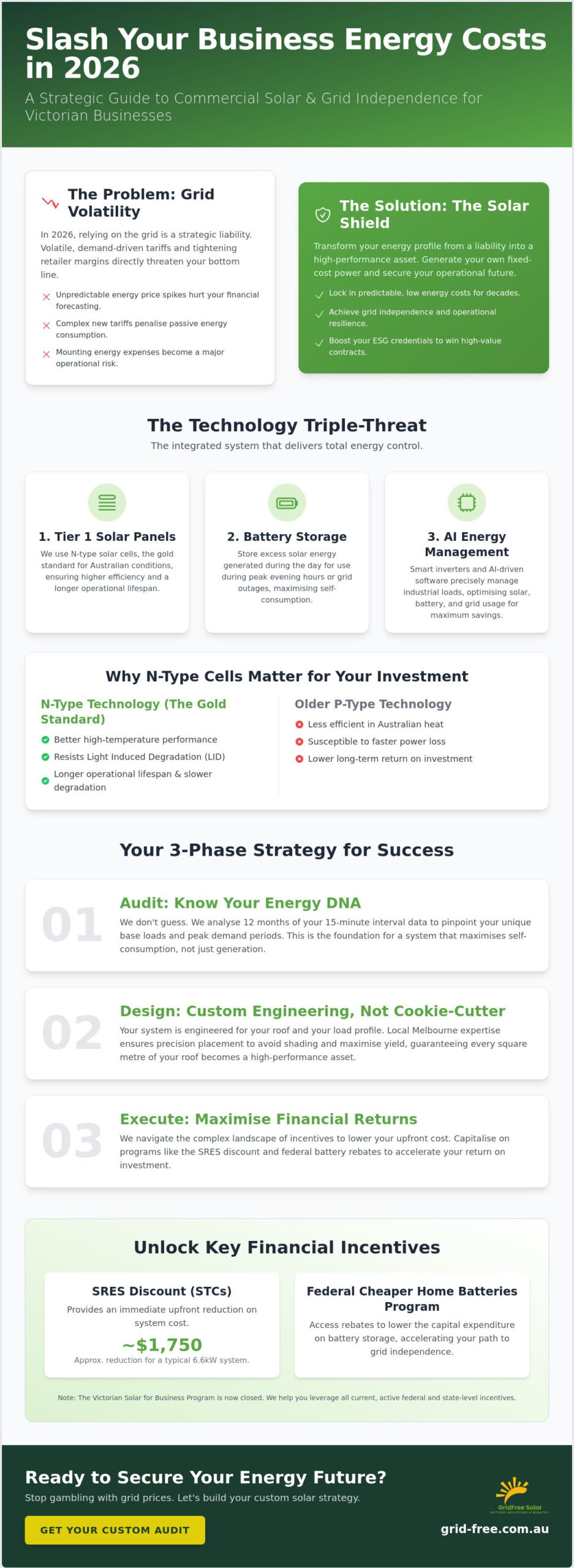
A commercial solar installation Melbourne specialist ensures your 10-year financial forecast is watertight. Reliability is non-negotiable in industrial environments. We utilise N-type solar cells because they are the gold standard for Australian conditions. Unlike older P-type technology, N-type cells resist Light Induced Degradation (LID) and perform better in high-temperature environments. They offer a longer operational lifespan and slower degradation, ensuring your ROI remains intact for decades.
The hardware must be intelligent. High-efficiency inverters act as the central nervous system of your facility. They manage industrial loads with surgical precision, balancing solar output with grid demands and battery storage. This technology triple-threat of panels, storage, and AI management creates a closed-loop system. It provides the energy independence required during grid instability. You aren’t just buying hardware. You are purchasing a predictable future for your operations.
Phase 1: Auditing Your Load Profile to Maximise Solar Self-Consumption
Stop guessing. Start measuring. A generic solar quote is a fiscal gamble that your business cannot afford in 2026. To truly reduce business energy costs solar must be engineered around your specific operational DNA. This begins with a professional energy audit. We don’t just look at your quarterly bill; we interrogate your interval data. By analysing 12 months of consumption in 15 or 30-minute increments, we distinguish your “base load” (the constant power draw of servers and refrigeration) from your “peak load” (the surge when heavy machinery or HVAC systems kick in).
Sizing your system based on your total bill amount is an amateur mistake. In the current market, ROI is driven by daytime consumption. If you install a massive array that produces 100kW at noon while your facility only draws 30kW, you are wasting capital on energy you’ll likely export for a pittance. Before a single panel is bolted down, we evaluate your roof space and structural integrity. High-density N-type arrays require precision placement to avoid shading and maximise yield. Every square metre must earn its keep.
Load Shifting: The Easiest Way to Cut Costs Without Capex
Load shifting is the process of moving electricity consumption to off-peak or solar-abundant times. This is the low-hanging fruit of energy management. By reorganising energy-intensive tasks, such as heavy manufacturing cycles or EV fleet charging, to coincide with peak solar production windows, you effectively run your business for free. Smart automation can manage your air conditioning and heating cycles, pre-cooling or pre-heating buildings during the morning solar ramp-up. This reduces the strain on your system during the late afternoon when solar output begins to dip but grid prices remain high.
Sizing Your System for ROI, Not Just Capacity
Over-sizing without integrated storage can actually hurt your financial forecast. With some retailers reducing solar feed-in tariffs to as low as 3c/kWh in 2026, exporting power to the grid is a losing strategy. Your “self-consumption” ratio is the only metric that matters. A system that is perfectly matched to your load profile ensures that every kilowatt generated is a kilowatt you don’t have to buy from the grid at 30c or 40c. Consulting with a commercial solar specialist is essential to avoid common sizing blunders that lead to stranded assets. We ensure your system is lean, efficient, and ready to reduce business energy costs solar through intelligent design rather than sheer scale.
The Technology Triple-Threat: Panels, Storage, and AI Energy Management
Static hardware is a relic of the past. To truly reduce business energy costs solar and battery assets must operate as a dynamic, intelligent ecosystem. This requires the “Technology Triple-Threat”. Tier 1 solar panels provide the foundation. Reliability is non-negotiable for industrial sites where downtime equals lost revenue. We pair these with high-capacity storage and the most critical component: the AI-driven Energy Management System (EMS). This is the brain of your asset. It orchestrates the flow between generation, storage, and the grid in real-time to ensure you never pay a cent more than necessary.
Integration is where the value is realised. Your solar, battery, and grid connection shouldn’t work in isolation. Modern grid-interactive inverters act as the gatekeeper. They manage energy flows within the premises while responding to dynamic export limits set by the grid. This prevents your system from being throttled during peak production times. It’s a seamless transition from old-school generation to an advanced, modern energy solution.
Commercial Solar Battery Storage: Beyond Simple Backup
Stop thinking of batteries as just a safety net for blackouts. Modern commercial solar battery storage is a precision tool for peak-shaving. It targets the “demand charges” on your bill. These are the expensive fees triggered when your business draws significant power during grid stress periods. By discharging stored solar energy during these peaks, you flatten your demand profile and slash costs. We prioritise LiFePO4 (Lithium Iron Phosphate) chemistry for industrial longevity. It offers superior safety and deep-cycle performance compared to standard lithium-ion alternatives. Your facility stays online even when the Melbourne grid falters.
Virtual Power Plants (VPPs): Turning Energy into Revenue
Your battery is a dormant profit centre. In 2026, the revenue model for Victorian enterprises has shifted toward active grid participation. A VPP allows businesses to monetise their stored energy by discharging to the grid when prices are highest. You essentially become a mini-utility. AI-powered management systems automatically detect when the grid is under pressure and wholesale prices are peaking. The system sells your excess capacity back to the market at a premium. It’s a proactive way to reduce business energy costs solar technology enables through intelligent innovation.
Large Scale Battery Storage Solutions Victoria
Scaling is the key for 24/7 manufacturing. High-volume operations require more than just a standard cabinet. Our large scale battery storage solutions Victoria are engineered for heavy-duty cycles. We’ve seen industrial sites transform their ROI by integrating storage that covers entire night shifts. This removes the reliance on expensive off-peak grid power. These systems are designed to scale alongside your business. Whether you are adding new production lines or expanding your fleet, your energy infrastructure remains a step ahead.
Unlocking Victorian Government Rebates and Commercial Financial Incentives
The incentive landscape in Victoria has shifted. The state-run “Solar for Business Program” concluded on June 30, 2023, and is no longer active. Do not let this stall your transition. Federal incentives have stepped in to fill the gap with even more aggressive support for storage. The Small-scale Renewable Energy Scheme (SRES) remains the primary engine to reduce business energy costs solar systems provide. For a standard 6.6kW system installed in 2026, you can secure an upfront discount of approximately $1,700 to $1,800 through Small-scale Technology Certificates (STCs). These certificates currently trade between $35 and $40, providing immediate capital relief.
For larger industrial operations exceeding 100kW, the focus shifts to Large-scale Generation Certificates (LGCs). Unlike the upfront STC discount, LGCs provide ongoing revenue based on the actual electricity your system generates. This transforms your roof into a high-yield financial asset. When combined with the Instant Asset Write-Off, solar becomes a cornerstone of your 2026 tax strategy. It allows you to accelerate depreciation and improve your cash flow from day one. If upfront capital is a barrier, Green Loans and Power Purchase Agreements (PPAs) allow for solar integration with zero initial outlay.
Solar Energy for Small Business Victoria
Eligibility for current incentives now prioritises integrated storage. The Federal “Cheaper Home Batteries Program” commenced on May 1, 2026. It provides a rebate of approximately 30% on eligible batteries between 5kWh and 100kWh. This program uses a tiered STC system where the government purchases certificates at a set price of $40. Bundling this with a panel upgrade is the most efficient way to maximise your upfront savings. Navigating this administrative landscape is complex. We recommend you review the latest eligibility criteria for solar energy for small business Victoria to ensure your system design qualifies for the maximum available support.
Tax Benefits and Financing Your Energy Transition
Financing solar through monthly energy savings is the most logical path to grid independence. In many cases, the reduction in your monthly power bill exceeds the loan repayment for the hardware. This makes the transition cash-flow positive almost immediately. Consult your accountant to determine how LGCs can provide a steady stream of “white certificates” that act as a secondary revenue source for your industrial site. We handle the technical engineering and the paperwork. To see how these incentives apply to your specific facility, request a commercial solar and battery feasibility study from our Melbourne team today. We ensure you capitalise on every available dollar before the SRES phase-out reduces certificate values further.
Executing Your Commercial Solar Strategy with GridFree Solar
Strategy is nothing without execution. You’ve identified the load profile and mapped the financial incentives. Now, you need a partner who understands the Victorian industrial grid. National aggregators often rely on generic, high-volume sub-contractors. We don’t. A “local Melbourne expert” provides accountability that a distant call centre cannot match. To reduce business energy costs solar requires precision engineering, not a “cookie-cutter” kit shipped from interstate. GridFree Solar treats your roof as a bespoke power plant. We design for your specific voltage requirements and structural constraints.
Performance must be sustained. A commercial solar asset is a 25-year investment. We don’t just install and exit. Our monitoring systems provide real-time data to ensure every string of panels is performing to its engineered potential. We detect anomalies before they impact your yield. This proactive maintenance ensures your ROI remains on track. It’s the difference between a system that merely works and a system that thrives. We provide the technical security you need to focus on your bottom line and long-term operational goals.
The GridFree Difference: Engineered for Australian Conditions
Australia’s climate is brutal on solar electronics. We only deploy Clean Energy Council (CEC) accredited designs. Our engineers prioritise high-efficiency hardware that withstands the UV intensity of a Melbourne summer. We understand that your business doesn’t stop for an install. Our teams specialise in minimal disruption. We coordinate with your site managers to ensure the transition to solar is seamless. Local support means we are on-site when you need us, not weeks later. We are your commercial partners in localized reliability. We take the complexity out of high-voltage integration and regional administrative hurdles.
Start Your Energy Independence Journey Today
Independence is four weeks away. Our streamlined process moves from the initial energy audit to system activation with surgical speed. We take the complexity out of the 2026 rebate applications and grid connection approvals. You focus on your core business; we handle the technical heavy lifting. We offer a no-obligation Victorian commercial solar feasibility study to map your exact energy yield and ROI forecast. This data-backed report provides the clarity needed for board-level approval. It’s time to stop paying for grid instability. Organise your commercial solar consultation with GridFree Solar and secure your 10-year financial forecast today.
Secure Your Commercial Energy Future
The window for maximum government incentives is closing. SRES certificates are phasing out. Now is the time to audit your load profile and deploy a “Solar Shield” around your profit margins. This is the definitive path to reduce business energy costs solar and battery systems provide. You’ve seen how integrating Tier 1 panels with AI-driven storage turns a liability into a revenue stream. Don’t leave your 10-year forecast to the whims of the Victorian grid.
We are CEC Accredited Installers and specialists in Victorian business rebates. Our Melbourne-based commercial support team is ready to engineer a system that matches your operational DNA. It’s about more than just panels; it’s about intelligent, long-term energy independence. Protect your bottom line and reduce business energy costs with a custom GridFree Solar solution. Take control of your overheads before the next tariff hike. Your future-proofed facility starts today.
Frequently Asked Questions
How much can a typical Melbourne business save with solar in 2026?
Savings are a direct result of bypassing the retail grid during peak periods. While the Victorian Default Offer for small businesses is expected to decrease by an average of $241 annually from July 2026, this is a minor shift. Solar allows you to offset peak rates that often exceed 30c/kWh. By using reduce business energy costs solar technology enables, you lock in a fixed cost of generation for decades. This provides a definitive hedge against future retail hikes and market volatility.
What is the “Solar for Business” rebate currently available in Victoria?
The state-run Victorian “Solar for Business Program” concluded on June 30, 2023, and is no longer active. Your primary incentives in 2026 are now federal. The “Cheaper Home Batteries Program” provides a rebate of approximately 30% for systems between 5kWh and 100kWh. Additionally, the Small-scale Renewable Energy Scheme (SRES) still offers an upfront discount of around $1,700 to $1,800 for a typical 6.6kW installation through the trade of STCs.
Is commercial solar worth it for businesses that rent their premises?
Solar remains a high-value asset for tenants through “green leases” or negotiated capital improvements. It directly improves your facility’s ESG credentials, which is increasingly a requirement for Melbourne B2B contracts. If your lease term exceeds five years, the internal rate of return often justifies the investment. It’s a proactive way to secure energy independence and stabilise your operational overheads regardless of property ownership.
How long is the payback period for a commercial solar and battery system?
Most commercial systems achieve full ROI within 3 to 7 years. The 2026 integration of AI energy management and the 30% battery rebate has significantly accelerated this timeline. By targeting peak-shaving and demand charges, you maximise the financial utility of every kilowatt generated. It’s a pragmatic, results-oriented transition for any industrial operator looking to transform energy from a liability into an asset.
Can solar panels provide enough power for heavy industrial machinery?
Modern N-type solar cells and high-efficiency inverters are engineered for heavy industrial loads. They provide the high-voltage stability required for manufacturing and processing machinery. When paired with large-scale battery storage, these systems manage the “surge” during equipment start-up. This reduces your reliance on the grid during expensive peak demand periods. It ensures your reduce business energy costs solar strategy meets the rigours of 24/7 production cycles.
What happens to our business energy supply on cloudy days or at night?
Your supply remains uninterrupted through a grid-interactive inverter. On cloudy days, the system draws supplementary power from the grid or your on-site battery storage. At night, your facility runs on stored solar energy or off-peak grid power. AI-powered Smart Energy Management Systems (SEMS) handle this transition automatically. You get the security of the grid with the financial intelligence of on-site generation.
Do I need to clean or maintain commercial solar panels regularly?
Performance monitoring is the key to maintaining your system’s engineered yield. While solar panels are designed for durability, environmental factors like dust or bird droppings can reduce efficiency if they accumulate. You should monitor your system data closely to identify any production dips. Ensuring your array remains clear and your electrical components are inspected by specialists protects your long-term financial forecast and hardware longevity.
How does a Virtual Power Plant (VPP) benefit my business bottom line?
A VPP transforms your battery from a passive backup into a revenue-generating asset. It allows your business to discharge stored energy back to the grid when wholesale prices are at their peak. You essentially become a localized power provider. AI management systems automate this process, selling your excess capacity during grid stress events. It provides a secondary income stream that further reduces your net energy expenditure in 2026.