
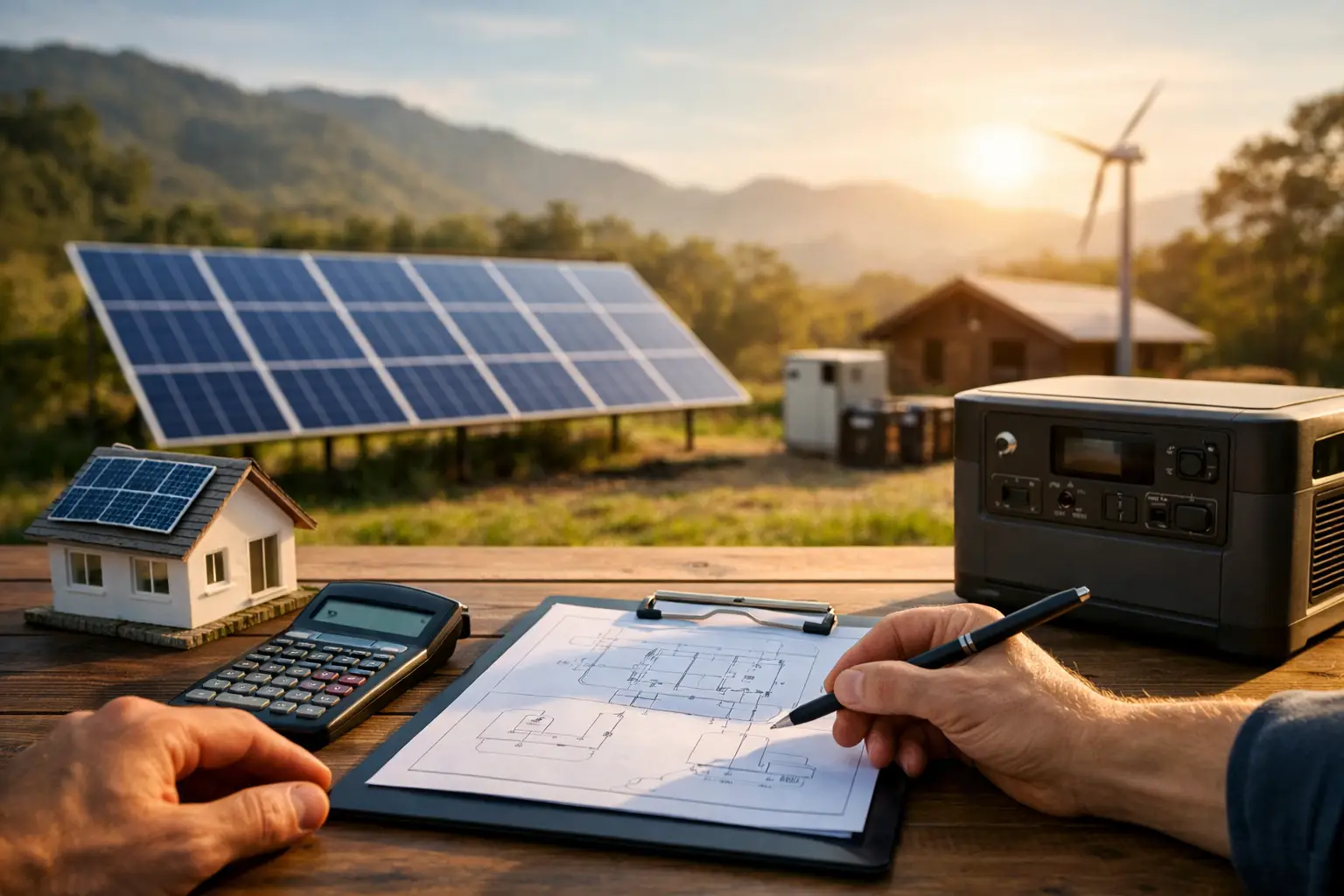
A lot of off-grid systems look good on paper until the first run of cloudy days, a hot spell that pushes the air con harder, or a battery that empties before morning. That is why learning how to size off grid solar system properly matters. Get the sizing wrong and you either overspend on hardware you do not need, or end up with a system that feels unreliable when you need it most.
For most homes and small businesses, off-grid sizing is not about guessing panel numbers. It is about matching generation, storage and inverter capacity to the way the property actually uses energy. The best system is not the biggest one. It is the one designed around your loads, your location and the amount of backup confidence you want.
How to size off grid solar system from the load first
The starting point is always energy use. Before anyone talks about panels or batteries, you need to know what the site consumes each day in kilowatt-hours. If you skip this step, every number after that becomes less reliable.
For an existing property, the easiest way is to review power bills and interval data, then separate essential loads from discretionary ones. For a new build or shed, that means listing each appliance, its wattage and how many hours it runs per day. Fridges, lights, pressure pumps, internet equipment and medical devices often sit in the essential category. Pool pumps, workshop gear and heavy air conditioning usually need closer scrutiny because they can quickly change the size and cost of the entire system.
This is where many people underestimate demand. A fridge may cycle on and off, but a bore pump or large cool room can create high startup loads. A split system might not run all day in spring, then become a major daily load in summer. Good sizing uses realistic seasonal use, not best-case assumptions.
Daily usage and peak demand are different things
A common mistake is to focus only on daily kilowatt-hours. Daily energy use tells you how much solar and battery storage you need over time. Peak demand tells you how powerful the inverter must be at any one moment.
A site might use a moderate amount of energy across the day but still need a large inverter because several appliances run together. Think kettle, microwave, pump and air con all at once. If the inverter is too small, the system can trip or force you to manage appliances manually. That is not the kind of energy independence most people are aiming for.
Work out your battery storage before panel count
If you are asking how to size off grid solar system for dependable overnight use, battery sizing is the next critical step. The battery has to carry the property through the evening, overnight and poor solar periods. In practical terms, you are deciding how many days of autonomy you want.
Autonomy means how long the site can keep running without meaningful solar input. One day may be enough for a lightly used weekender with a generator backup. Two or more days is often more comfortable for a permanent residence or small business where continuity matters.
Say a property uses 20 kWh per day and you want two days of autonomy. That points to 40 kWh of usable storage, before allowing for losses and reserve margins. Not all battery capacity is fully usable, and sensible designs leave buffer capacity to protect battery life and maintain reliability. That is why installed battery capacity is often higher than the simple daily-use calculation suggests.
Battery chemistry, operating temperature and warranty conditions also matter. A battery that looks cheaper upfront may offer lower usable capacity or less flexibility in real-world cycling. For off-grid sites, reliability and discharge performance are usually more important than chasing the lowest initial price.
Solar panel sizing has to cover more than average use
Once the load and storage target are clear, you can size the solar array. The array must do more than cover your average daily consumption. It also needs to recharge the battery, account for inverter and charging losses, and perform through seasonal changes.
In Australia, solar production varies significantly by state, site orientation, shading and time of year. A system that performs comfortably in a bright inland summer may struggle in winter or during extended overcast weather. That is why serious off-grid design often sizes to the worst month, not the best one.
For example, if the property needs 20 kWh per day and total system losses push required generation to 25 kWh, the array must produce that amount even in lower-sun conditions. If winter sun hours at the site are around 4 peak sun hours, you would need roughly 6.25 kW of solar just to meet that daily generation target. In reality, designers usually add more margin because panel output is affected by heat, dust, orientation, wiring losses and weather variability.
A bigger array can reduce generator reliance and improve battery recovery after poor weather, but there is a point where extra panels deliver less value if battery charging becomes the bottleneck. This is why panel count should never be chosen in isolation.
Shading and roof layout change the maths
Partial shade, roof angle and panel direction can materially affect output. Two homes with the same energy use may need very different array sizes if one has clean north-facing roof space and the other has mixed orientations with tree shade.
For ground-mounted systems, placement can be optimised more easily, but trenching, frames and site works add cost. For roof-mounted systems, the design has to balance available area, solar yield and installation practicality.
Inverter sizing is about power delivery and surge loads
The inverter converts stored DC power into usable AC power for the property. It must be large enough to handle normal simultaneous loads, plus surge demands from equipment such as pumps, fridges and compressors.
A site with low daily energy use can still need a substantial inverter if it runs machinery or pump motors. On the other hand, oversizing the inverter without reason can add unnecessary cost. The right choice comes from real appliance behaviour, not a rough guess.
Inverter selection also shapes future flexibility. If you plan to add workshop equipment, air conditioning or electric hot water later, it makes sense to design with expansion in mind. Retrofitting around an undersized inverter can be more expensive than getting the architecture right at the start.
Generator backup is often part of a smart off-grid design
People sometimes assume a properly sized off-grid system should never need a generator. In reality, generator support can be the most cost-effective way to cover rare periods of extended bad weather or unusual heavy demand.
Without generator backup, the solar array and battery bank usually need to be oversized to cover worst-case conditions that only happen occasionally. That drives up capital cost fast. With a generator integrated properly, you can design for excellent day-to-day performance and still protect the property during long cloudy stretches.
This is not a compromise on quality. It is often the practical balance between resilience and return on investment.
The trade-off between comfort and cost
Every off-grid system sits somewhere on a spectrum. At one end, you have lean systems designed around essential loads and careful energy habits. At the other, you have premium systems sized to support a near on-grid lifestyle with large batteries, bigger inverters and higher solar capacity.
Neither approach is automatically right. It depends on the site, the budget and how much operational flexibility the owner is willing to accept. If someone wants to run ducted air conditioning, cooking loads, pumps and a home office without thinking twice, the system needs to be sized for that standard. If they are comfortable shifting some loads to sunny periods, the design can often be more cost-efficient.
For households and businesses making a serious investment, this is where expert design earns its keep. Accurate load assessment, battery modelling and seasonal production estimates can save a lot of money and frustration over the life of the system.
When professional sizing makes the biggest difference
The more complex the property, the more valuable proper design becomes. Homes with large air conditioning loads, farms with pumps, workshops with tools, and small commercial sites with refrigeration or extended trading hours all need more than a back-of-the-envelope estimate.
A professionally designed system should account for actual consumption patterns, site conditions, battery operating windows, backup strategy and future growth. It should also consider compliance, warranty requirements and the practicality of maintenance and monitoring. At GridFree Solar, that battery-led approach matters because off-grid performance depends on the whole system working together, not on panels alone.
If you are trying to work out how to size off grid solar system for your property, start with honesty about how you live or operate. The more accurately your loads are understood, the more reliable and cost-effective the final system will be. Off-grid living can be remarkably dependable, but only when the design is built around real usage, not optimistic assumptions.