What if your quarterly electricity bill wasn’t an unavoidable overhead, but a strategic asset you could slash using state-backed capital? For many Melbourne entrepreneurs, volatile commercial energy rates have turned operational costs into a moving target. You’ve likely heard the noise about solar energy for small business Victoria, but the confusion between residential and commercial eligibility often leads to expensive hesitation.
It’s frustrating to deal with a landscape where “solar cowboys” make big promises while rebate rules seem to shift every season. We agree that your focus should be on your bottom line, not deciphering complex government policy. This 2026 strategic guide promises to clear the fog. We’ll show you exactly how to leverage the latest Victorian Energy Upgrades (VEU) and federal battery incentives to secure a sub-4-year payback period.
We will detail the tiered discounts available through the Cheaper Home Batteries Program and the specific certificates available for systems up to 200kW. You’ll gain a precise roadmap to lowering your quarterly OpEx and achieving true energy independence during peak business hours. It’s time to stop renting your power and start owning your energy future.
Key Takeaways
- Secure massive upfront savings by stacking federal STC discounts with the 2026 Victorian Energy Upgrades (VEU) program incentives.
- Optimise your ROI by using solar energy for small business Victoria to convert unpredictable utility costs into a stable, depreciable financial asset.
- Utilise smart meter interval data and the “120% Rule” to design a system that perfectly matches your specific commercial load profile.
- Slash expensive demand charges through strategic battery storage and peak shaving, supported by the latest state-backed battery rebates.
- Streamline your transition with local Melbourne expertise to navigate complex grid connections and Victorian council permit requirements.
Why Solar is the Ultimate Hedge for Victorian Small Businesses
Energy volatility isn’t a theory for Melbourne business owners; it’s a line item that erodes margins every quarter. As we move through 2026, the trajectory for commercial electricity prices remains unpredictable, leaving many businesses vulnerable to sudden market shifts. Investing in solar energy for small business Victoria effectively fixes your energy costs for the next two decades. You’re essentially pre-purchasing your electricity at a fraction of the grid price. This transition converts a variable, uncontrollable monthly expense into a fixed, depreciable asset that strengthens your balance sheet immediately.
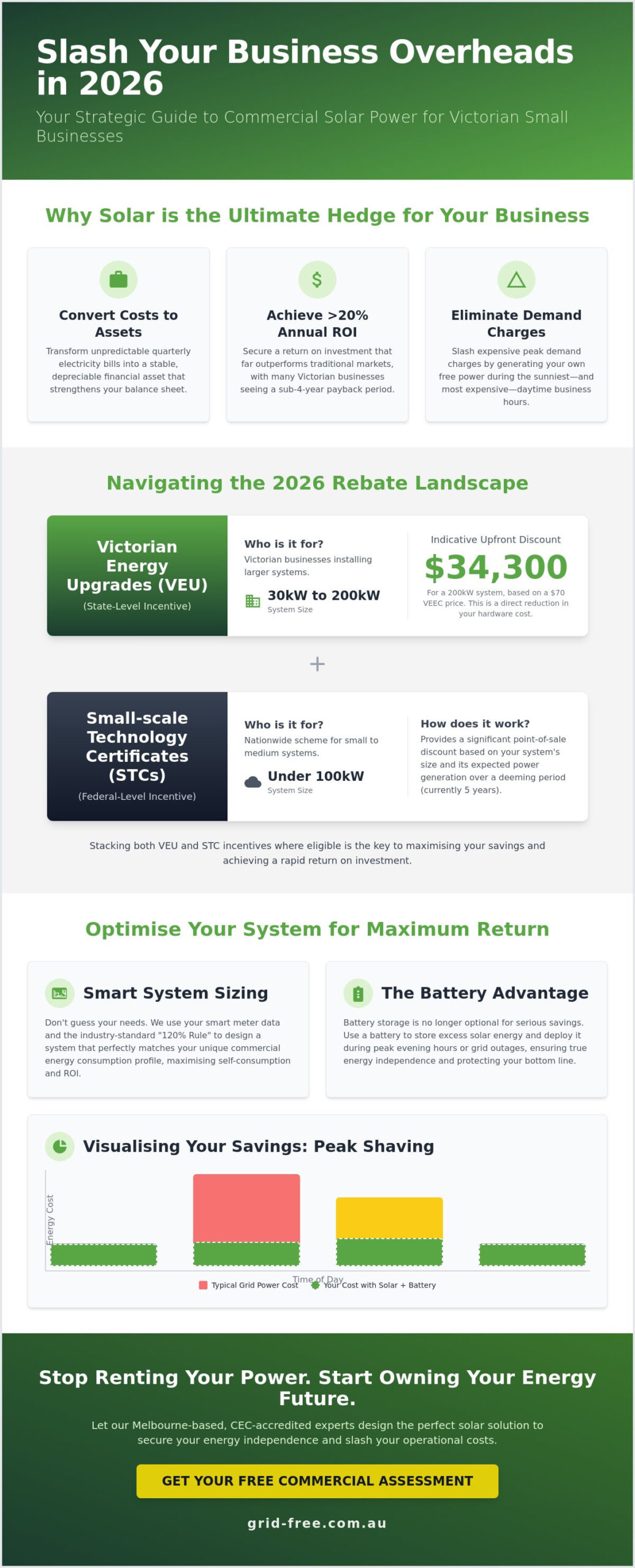
The role of solar in shielding your operations from peak demand charges cannot be overstated. Retailers and manufacturers often face their highest tariffs during the day when the sun is at its peak. By generating your own power during these windows, you’re not just saving cents; you’re avoiding the most expensive energy the grid offers. 2026 represents a “goldilocks” window for Victorian incentives. The Small-scale Technology Certificate (STC) deeming period is currently set at five years, and the Victorian Energy Upgrades (VEU) program offers substantial discounts for systems up to 200kW. Waiting until 2027 risks missing these peak rebate levels as schemes begin their scheduled tapering.
The Financial Logic: ROI vs. Traditional Investments
Standard commercial interest rates rarely compete with the internal rate of return provided by a well-designed solar array. Many Victorian businesses see an annual ROI exceeding 20%, far outperforming traditional cash-back or market investments. When you factor in the Instant Asset Write-Off provisions, the hardware becomes even more attractive. This tax incentive allows you to deduct the eligible cost of the system in the first year, significantly boosting short-term cash flow. The “cost of inaction” is the most dangerous metric. Over a 10-year horizon, a business without solar energy for small business Victoria will likely spend hundreds of thousands more on grid power than a competitor who has already secured their rates. For a comprehensive breakdown of every tactic available in 2026, the strategic guide to reduce business energy costs with solar covers the full spectrum of federal and state incentives you can stack to accelerate your payback period.
Melbourne-Specific Energy Pains
Melbourne’s retail and hospitality sectors face unique challenges that make solar a necessity. High daytime cooling loads and intensive lighting requirements align perfectly with peak solar production hours. While Solar power in Australia has seen massive growth, local Victorian conditions require specialist design. Cloud cover in the south-east doesn’t negate solar’s value. It simply demands high-efficiency panels that perform in low-light conditions. Local network distributors like CitiPower and United Energy have specific requirements for solar exports; a strategic design focuses on self-consumption rather than grid export, ensuring you keep every kilowatt of value behind your own meter.
Navigating the 2026 Rebate Landscape: VEU vs. STCs
Capitalising on solar energy for small business Victoria requires a clinical understanding of the 2026 subsidy environment. You don’t just want a rebate; you want to stack every available state and federal incentive to drive your payback period under four years. The landscape has shifted. While some older programs have ended, the current framework offers aggressive support for businesses ready to commit to high-capacity systems. Non-residential buildings and community organisations are primary targets for these incentives, provided the installation meets strict Victorian safety and accreditation standards.
VEU Program: The $30,000+ Opportunity
The Victorian Energy Upgrades program (VEU) represents the most significant opportunity for larger commercial sites in 2026. For systems sized between 30kW and 200kW, the potential savings are substantial. An indicative discount for a 200kW system currently reaches $34,300, assuming a Victorian Energy Efficiency Certificate (VEEC) price of $70. This is a direct reduction in your upfront costs. To secure this, you must engage an accredited provider who handles the certificate creation process. You’ll need to provide your National Meter Identifier (NMI) and interval data to prove the system’s projected impact on the Victorian grid.
STCs and the Small-Scale Renewable Energy Scheme
Systems under 100kW still benefit from the federal Small-scale Technology Certificate (STC) scheme. However, the clock is ticking. The 2026 deeming period is now limited to 5 years, which naturally reduces the total certificate value compared to previous years. Acting now secures the current market value of $38 to $40 per STC before the next scheduled reduction in 2027. Small-scale Technology Certificates (STCs) are a tradable commodity that reduces upfront capital outlay by allowing retailers to apply a discount directly at the point of sale.
The most effective strategy involves a legitimate “double-dip” approach. For installations in the 30kW to 100kW range, businesses can often claim both STCs and VEU certificates simultaneously. This combination significantly lowers the barrier to entry for high-quality solar energy for small business Victoria. It’s a complex administrative path, but the financial reward justifies the technical effort. You can consult with a specialist to map your rebate eligibility and ensure your system design maximises these specific 2026 incentives. This ensures your paperwork is compliant with both Solar Accreditation Australia (SAA) and the New Energy Tech Consumer Code (NETCC) requirements, protecting your right to every dollar of state-backed funding.
Sizing Your System: From 6.6kW to 30kW+
Most commercial solar advice focuses on massive industrial warehouses. This ignores the “sweet spot” for the average Victorian shop, office, or cafe. If you’re operating a retail space or a professional suite, your roof footprint is likely limited. Precision sizing is critical. We don’t guess. We use your 15-minute interval data, extracted via your smart meter, to map exactly how solar energy for small business Victoria will interact with your specific load. This data-driven approach ensures you aren’t paying for capacity you won’t use while ensuring you don’t remain reliant on the grid during peak afternoon periods.
One of the most effective technical strategies we employ is the “120% Rule.” This involves oversizing your solar panel array relative to your inverter’s capacity. For example, a 10kW inverter might be paired with 12kW of Tier 1 panels. This allows the system to reach its maximum export limit earlier in the morning and maintain it later into the afternoon. It’s smart business. You maximise the efficiency of your most expensive component, the inverter, and ensure a more consistent power curve throughout the day.
Load Profiling: When Does Your Business Use Power?
Your operational hours dictate your system design. A daytime-heavy law firm in Melbourne’s CBD has vastly different needs than a late-closing restaurant in Richmond. Offices should focus on a “Solar-First” strategy. This means scheduling high-drain activities, like running commercial dishwashers or heavy HVAC cycles, during peak production hours. Refrigeration is a constant “baseload” drain. For hospitality businesses, even a 10kW system can significantly offset the relentless costs of cool rooms and display fridges. We design for your peaks, not just your averages.
Hardware Selection for the Victorian Coast
Melbourne’s geography introduces specific environmental stressors. If your business is located in a bayside suburb like St Kilda or Williamstown, salt-mist corrosion is a genuine threat to hardware longevity. We prioritise Tier 1 hardware with high IP ratings and proven corrosion resistance. Commercial-grade inverters are also a non-negotiable requirement for insurance compliance and grid stability. When evaluating quotes, you must differentiate between three types of protection:
- Product Warranty: Covers defects in the hardware itself.
- Performance Warranty: Guarantees the panels will still produce a specific percentage of power after 25 years.
- Labour Warranty: Ensures you aren’t out of pocket for the technician’s time if a component needs replacing.
Maximising afternoon yield is vital for Victorian businesses that operate until 6:00 pm or later. While North-facing panels provide the highest total energy, a West-facing array can be more valuable for “peak shaving.” It generates power exactly when the grid’s demand charges are at their highest, protecting your bottom line when it’s most vulnerable.
The Battery Factor: Why Storage is No Longer Optional
Energy independence in 2026 is impossible without high-capacity storage. For years, batteries were viewed as an optional “add-on” for the environmentally conscious. That era has ended. In the current market, solar energy for small business Victoria is incomplete without the ability to capture and deploy power on your own terms. Storage has transitioned from a backup fail-safe to a sophisticated financial tool. It allows you to bypass the grid entirely during the most expensive peak windows, ensuring your operational costs remain flat even when utility rates spike.
The primary driver for this shift is “Peak Shaving.” Most commercial tariffs include heavy demand charges based on your highest point of usage. By using stored energy to “shave” these peaks, you significantly lower your overall bill beyond just kilowatt-hour savings. This is backed by aggressive incentives. As of May 2026, the federal Cheaper Home Batteries Program offers a tiered rebate for small businesses. You can secure a discount of approximately $252 per usable kWh for the first 14kWh of capacity. This makes a commercial solar battery storage setup a high-yield priority for any Victorian site. For manufacturers and heavy industrial operators looking to scale this approach, the real-world results from large scale battery storage solutions Victoria demonstrate how peak demand charges can be crushed at an enterprise level.
Virtual Power Plants (VPPs) in Victoria
Your battery is no longer a passive box on the wall; it’s a revenue-generating asset. By joining a Virtual Power Plant (VPP), small businesses can trade stored energy back to the grid during stress events. When Melbourne’s grid faces extreme demand, your VPP provider can orchestrate a minor discharge from your battery in exchange for premium credits or cash payments. Typical VPP structures in 2026 include sign-on bonuses and ongoing bill offsets. To participate, you must ensure your hardware is VPP-ready. This requires specific smart inverters and lithium-ion systems that allow for secure, remote communication with the VPP coordinator.
ROI of Commercial Storage
Calculating the payback period of an integrated system now involves more than just “energy saved.” You must factor in the value of 24/7 continuity. For hospitality or medical suites, a single power outage can result in thousands of dollars in lost stock or billable hours. Batteries protect sensitive IT equipment and cold storage, providing a seamless transition that the grid cannot guarantee. If you’re managing older hardware, check if your solar battery needs replacement to maintain these efficiency gains. Modern systems offer deeper discharge cycles and longer warranties, often reaching a full return on investment within five to seven years when combined with VPP revenue.
Don’t leave your business vulnerable to grid instability or rising demand charges. You can request a custom battery ROI analysis to see how storage fits your specific load profile.
Implementation: Choosing a CEC-Accredited Partner in Melbourne
Melbourne’s commercial landscape requires more than just hardware. It demands an intimate knowledge of local network distributors and council regulations. Choosing a partner for solar energy for small business Victoria means finding a specialist who understands the specific grid connection requirements of CitiPower, Powercor, or United Energy. A generic installer often misses the nuances of Victorian council permits or specific fire safety compliance codes required for commercial sites. We don’t guess. Our approach relies on a clinical analysis of your real-world interval data. This ensures your system isn’t just “installed” but is fully integrated into your operational workflow for maximum yield.
Post-installation monitoring is your insurance policy. ROI isn’t a “set and forget” metric. We provide real-time visibility into your system’s performance. If a string of panels underperforms or an unexpected demand spike occurs, you’ll know immediately. This proactive oversight ensures your payback period remains on track and your hardware performs to its Tier 1 specifications for the duration of its lifespan.
The “Solar for Renters” Framework
Leasing your premises shouldn’t be a barrier to energy independence. The “split incentive” problem, where the tenant pays the bills but the landlord owns the roof, is a hurdle we solve daily. Environmental Upgrade Finance (EUF) is a powerful tool available through many Victorian councils. It allows the cost of the solar system to be repaid through council rates, effectively attaching the investment to the building rather than the business owner. Landlords benefit from increased property value and higher tenant retention. Tenants get lower bills. We help you structure a “Solar Lease” between tenant and owner that shares the savings fairly. This turns a potential conflict into a collaborative financial strategy.
Next Steps: Your Commercial Solar Roadmap
Your journey begins with a detailed site audit. We look beyond the roof. We examine your switchboard capacity and conduct a 3D shading analysis to account for neighbouring Melbourne buildings or future developments. Understanding the commercial solar installation Melbourne process timeline is essential for business continuity. Most installations are completed within weeks of approval, with minimal disruption to your daily operations. We handle the paperwork, the grid applications, and the rebate claims.
The 2026 rebate window is active but time-sensitive. Don’t let another quarter of volatile energy rates erode your profits. Contact GridFree Solar for a custom Victorian small business quote today and secure your operational future with a partner who understands the Melbourne market.
Future-Proof Your Victorian Enterprise
The window for peak incentives is open, but it won’t stay that way forever. By now, you understand that 2026 is the strategic year to move away from grid volatility. You’ve seen how stacking VEU and STC rebates can slash your upfront capital; and how precision sizing protects your long-term ROI. Transitioning to solar energy for small business Victoria isn’t just about being green. It’s a calculated financial move that converts a monthly liability into a fixed, depreciable asset.
Success depends on precision. Avoid the “solar cowboys” and partner with a team that understands the Melbourne grid. As CEC Accredited Installers and specialists in Victorian VEU rebate claims, we ensure every technical and administrative detail is handled. We provide custom ROI modelling for every Melbourne client, giving you total clarity before the first panel is installed.
Secure your Victorian Small Business Solar Quote today. It’s time to take control of your overheads and join the thousands of local businesses leading the charge toward a smarter, more profitable energy future.
Frequently Asked Questions
Is there a specific solar rebate for small businesses in Victoria in 2026?
Yes, businesses can access substantial discounts through the Victorian Energy Upgrades (VEU) program for systems between 30kW and 200kW. Federal support also remains available via the Small-scale Technology Certificate (STC) scheme for systems up to 100kW. These incentives are designed to lower capital barriers for solar energy for small business Victoria as we navigate the 2026 energy market.
How much can a Victorian small business save with solar panels?
Savings depend entirely on your self-consumption rates and the specific load profile of your Melbourne site. By generating your own power during peak daytime hours, you avoid high commercial utility rates and expensive demand charges. Many local businesses report slashing their quarterly electricity expenses significantly when matching system output to their 15-minute interval data. To understand the full range of strategies available to reduce business energy costs with solar in 2026, including how shifting tariffs and the SRES discount interact, a dedicated strategic review of your site’s consumption patterns is the essential first step.
Can I install solar on a commercial building I rent in Melbourne?
You can install solar on a leased premises by utilising the Environmental Upgrade Finance (EUF) framework. This mechanism allows the investment to be repaid through council rates, which attaches the cost to the building rather than your business entity. It is an effective way to align interests between landlords and tenants while increasing the property’s overall value and sustainability rating.
What is the average payback period for commercial solar in Victoria?
The average payback period for commercial solar in Victoria typically ranges between three and five years. This accelerated return is driven by the combination of high daytime energy prices and the 2026 VEU discounts. Once the system has paid for itself, your business enjoys essentially free electricity for the remainder of the hardware’s 25-year performance lifespan.
Do I need a battery for my business solar system?
While not mandatory, a battery is becoming essential for businesses looking to “shave” peak demand charges and maintain 24/7 continuity. The 2026 Cheaper Home Batteries Program provides a federal rebate of approximately $252 per usable kWh for the first 14kWh. This makes storage a high-yield asset that protects your operations from grid outages and evening price spikes.
What happens to my solar production on cloudy Melbourne days?
Solar panels still generate electricity on cloudy days by capturing diffused sunlight. While output is lower than on a clear summer day, modern Tier 1 panels are engineered to perform efficiently in low-light conditions. We account for Melbourne’s specific weather patterns during the design phase to ensure your system meets your annual energy requirements reliably and predictably.
How do I claim the Victorian Energy Upgrades (VEU) discount?
To claim the VEU discount, you must engage an accredited provider who can create Victorian Energy Efficiency Certificates (VEECs). The discount is typically applied directly to your quote, reducing the upfront cost of systems sized 30kW to 200kW. You will need to provide your National Meter Identifier (NMI) and historical energy data to facilitate the certificate creation process.
What is the difference between residential and commercial solar panels?
Commercial panels are generally larger and offer higher wattage outputs to accommodate expansive roof spaces and heavy industrial loads. They also feature more robust mounting systems and commercial-grade inverters designed for three-phase power. While the underlying technology is similar, solar energy for small business Victoria requires hardware with stricter insurance compliance and longer labour warranties than standard residential setups.