
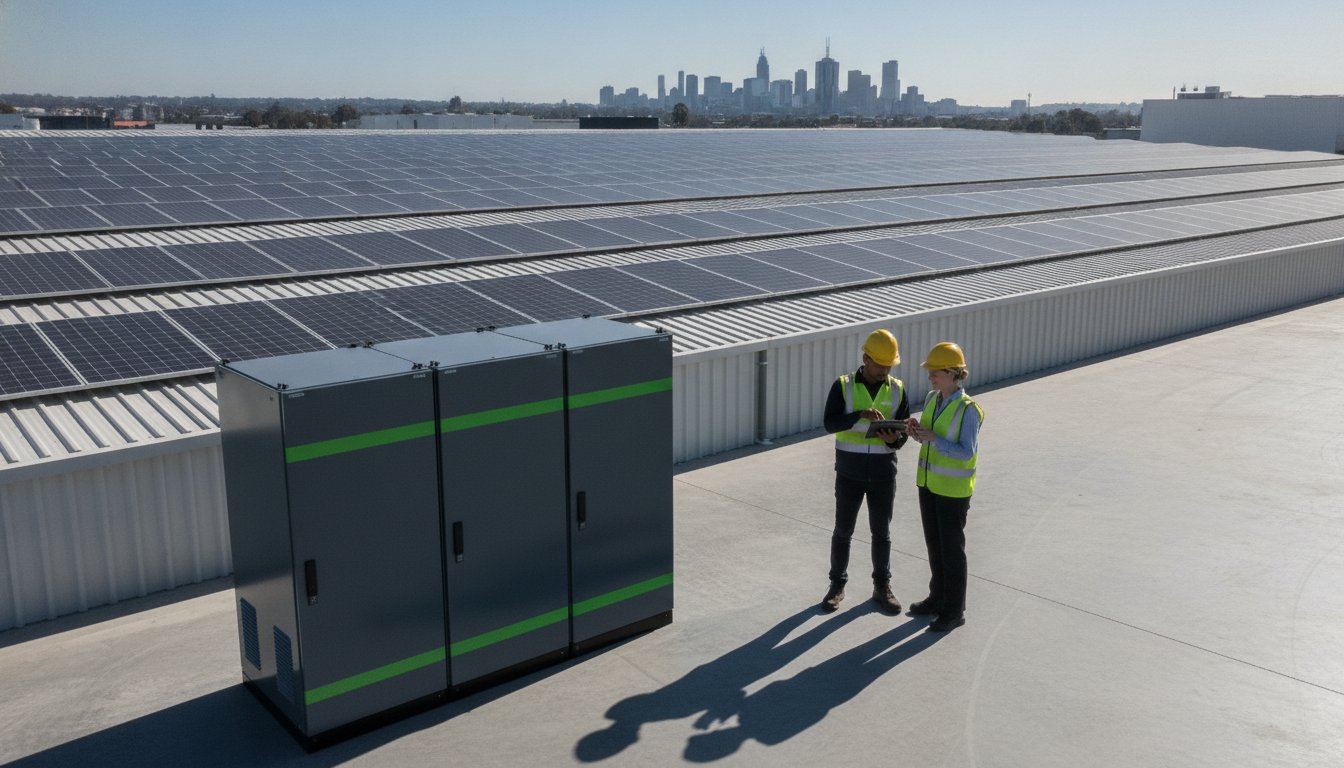
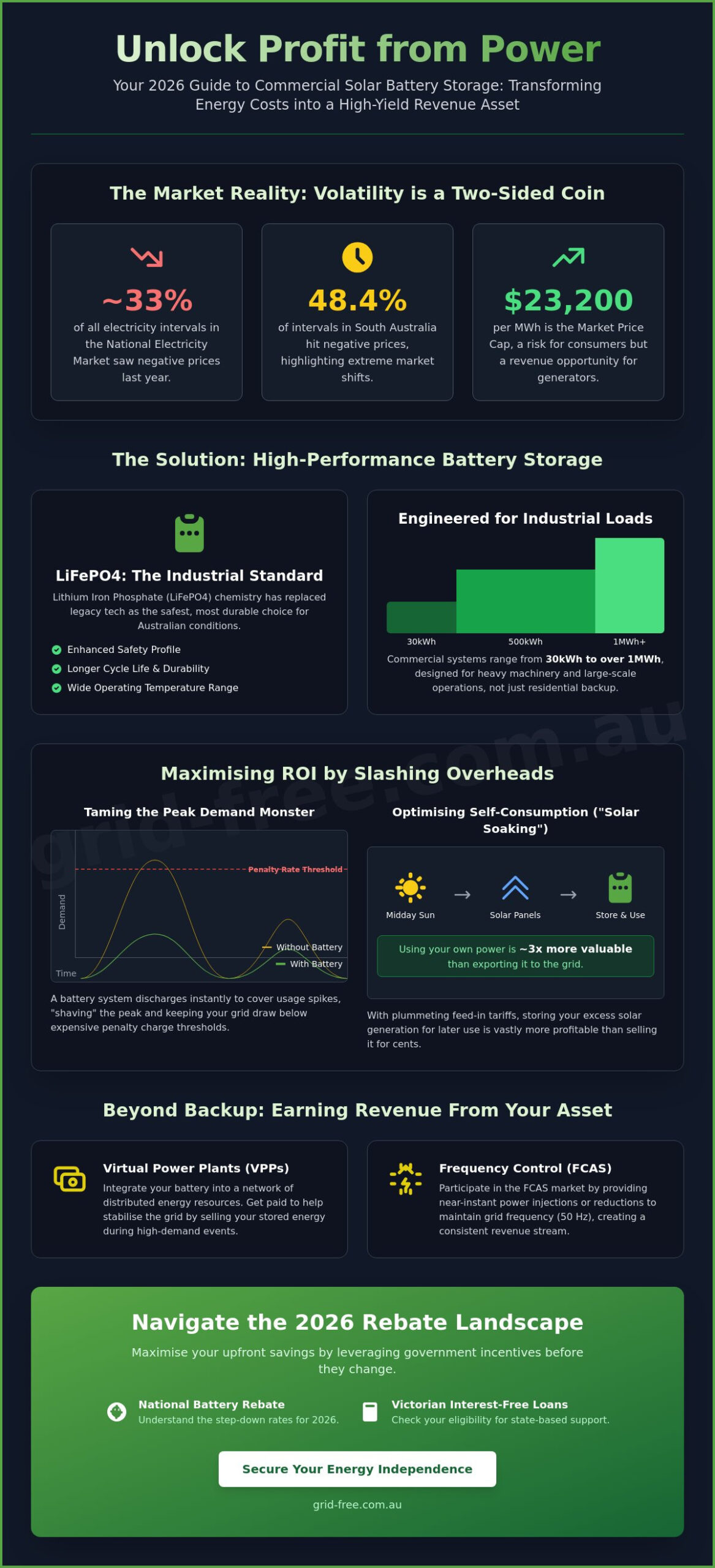
Did you know that nearly a third of all electricity intervals in the National Electricity Market saw negative prices last year? In South Australia, that figure hit a staggering 48.4 per cent. For an unprepared business, this volatility is a budget killer. For those with commercial solar battery storage, it’s a massive financial opportunity. You’re likely tired of watching peak demand charges gut your monthly margins while the Market Price Cap climbs to $23,200 per MWh. We know the pressure of managing overheads in an unpredictable market.
It’s a common struggle. Many Australian directors feel energy is a cost to be managed rather than an asset to be leveraged. This guide changes that perspective. Discover how modern energy storage transforms from a passive backup system into a high-yield revenue asset that trades energy for profit. We’ll break down the 2026 rebate landscape, the mechanics of revenue stacking through Virtual Power Plants, and the technical standards required to secure your energy independence.
Key Takeaways
- Identify why high-capacity LiFePO4 systems (30kWh to 1MWh+) have replaced legacy tech as the safest, most durable choice for Australian industrial loads.
- Slash your operational overheads by leveraging commercial solar battery storage to eliminate peak demand charges and exploit midday solar abundance.
- Unlock new revenue streams by integrating your assets into Virtual Power Plants (VPPs) and the FCAS market to support the national grid.
- Maximise your upfront savings by navigating the 2026 National Battery Rebate step-down rates and Victorian interest-free loan eligibility.
What is Commercial Solar Battery Storage in 2026?
In 2026, commercial solar battery storage is no longer a luxury. It’s a fundamental requirement for operational resilience. We define commercial-scale storage as high-capacity systems ranging from 30kWh to well over 1MWh. These units are engineered for heavy industrial loads, not just residential backup. They form the core of a modern Battery Energy Storage System (BESS). This technology allows your business to capture energy when it’s cheap and deploy it when the grid is most expensive.
The technology has evolved rapidly over the last few years. We’ve moved past the limitations of lead-acid and early lithium-ion variants. Today, Lithium Iron Phosphate (LiFePO4) is the industry standard for safety and longevity. For businesses requiring ultra-long duration storage, flow chemistries are also entering the commercial mainstream. At the heart of every setup is the Battery Management System (BMS). This intelligent controller monitors cell health, balances loads, and ensures your investment doesn’t degrade prematurely. This sophisticated tech is why storage is the essential partner to a professional commercial solar installation Melbourne businesses rely on to future-proof their operations.
The Components of a High-Performance Business System
A robust system relies on three pillars. First, the inverters. While string inverters remain common, many modern Victorian sites now opt for hybrid commercial units. These manage both solar input and battery discharge centrally. Second, modular battery modules. These allow for seamless scalability. You can start with a 50kWh unit and expand as your energy needs grow. Finally, smart meters. These aren’t just display screens. They provide the high-resolution, real-time data required to calculate your ROI with absolute precision.
On-Grid vs. Off-Grid Commercial Applications
Most Australian enterprises operate on-grid. Here, the focus is on peak shaving and demand management. You use stored power to bypass expensive utility spikes. Regional Victorian businesses or high-security facilities often look toward micro-grids. These provide total independence from ageing poles and wires. However, the hybrid approach is the most popular 2026 strategy. It maintains a grid connection for reliability while keeping enough reserve power to run critical machinery during a blackout. It’s about flexibility and total financial control.
Maximising ROI: How Energy Storage Slashes Operational Overheads
Energy isn’t just a cost. It’s a variable you can control. For most Australian enterprises, the utility bill is a black box of complex charges that seem to climb every quarter. Integrating commercial solar battery storage into your operations changes the math. You stop being a passive consumer and start acting as an active energy manager. By capturing your own generation, you bypass the volatility of the National Electricity Market entirely. This isn’t just about saving cents; it’s about protecting your bottom line from the $23,200/MWh price caps that threaten the grid during peak events.
The financial logic is simple. According to ARENA’s battery storage report, the most successful commercial projects are those that focus on cost avoidance and revenue stacking. Beyond simple savings, storage allows you to quantify your ESG performance. You can accurately report on the reduction of Scope 2 emissions to your stakeholders. This transparency is becoming a mandatory requirement for securing government contracts and tier-one partnerships across Victoria. If you’re ready to audit your current usage, our team can help you design high-yield commercial solar solutions tailored to your specific site.
Taming the Peak Demand Monster
Victorian retailers calculate demand charges based on your single highest 15-minute usage window each month. One heavy machinery start-up or a cooling system spike can lock you into a higher billing bracket for the entire period. A battery system “flattens” this load profile. When your site hits a usage spike, the battery discharges instantly to cover the excess. Peak shaving is a tactical deployment of stored energy to bypass utility surcharges. It ensures your grid draw never crosses the threshold into expensive penalty rates. For Victorian manufacturers and heavy industrial sites looking to quantify exactly how much peak demand charges are costing them, our large scale battery storage solutions Victoria industrial case study demonstrates the real-world ROI achieved by leading firms deploying high-capacity systems.
Optimising Self-Consumption for Maximum Efficiency
Using your own power is now roughly 3x more valuable than selling it back to the grid. With feed-in tariffs plummeting and negative pricing becoming a frequent midday reality, “solar soaking” is the only logical move. You store your excess generation during the “solar noon” peak when the grid doesn’t want it. Then, you deploy that power during evening shifts or early morning starts when tariffs are highest. Modern systems integrate directly with your building management systems (BMS). This automation ensures your heavy equipment runs on stored sunshine rather than expensive grid power, regardless of when your staff are on-site. For smaller enterprises looking to understand the full scope of available state-backed incentives, our detailed breakdown of solar energy for small business Victoria outlines exactly how to leverage the Victorian Energy Upgrades program and federal battery incentives for a sub-4-year payback period.
Beyond Backup: Earning Revenue through VPPs and FCAS
The role of commercial solar battery storage has shifted. It’s no longer just a safety net for blackouts. In 2026, your battery is a sophisticated trading tool. Transitioning your facility from a passive consumer to an active “prosumer” is the most effective way to offset rising operational costs. By participating in the grid’s ecosystem, you turn a storage asset into a consistent revenue stream. This isn’t theoretical. It’s a functional shift driven by the National Electricity Market’s need for flexibility.
Wholesale arbitrage is the first step. In the fourth quarter of 2025, negative electricity prices occurred in 31 per cent of all NEM intervals. For a business with intelligent storage, this is a goldmine. You can literally be paid to charge your batteries when the grid is oversupplied. You then discharge that power during evening peaks when prices soar toward the $23,200/MWh cap. To help businesses transition to this model, the Federal Government continues to offer Small-scale Renewable Energy Scheme incentives. These credits lower the barrier to entry for high-capacity systems.
Joining a Virtual Power Plant in Melbourne
A Virtual Power Plant (VPP) pools your battery with hundreds of others. This creates a massive, software-driven “utility” that supports the Victorian grid during periods of high stress. A central provider orchestrates your battery’s discharge remotely. In exchange, you receive significant financial incentives. These often include upfront equipment discounts or ongoing participation credits on your bill. If your current setup lacks the necessary smart communications, consider a solar battery replacement Melbourne businesses use to upgrade to VPP-ready technology. Modern software ensures you always keep a reserve for your own site’s needs.
FCAS: The High-Speed Revenue Stream
The grid must maintain a precise frequency of 50Hz to remain stable. When a large generator fails, the frequency drops. Frequency Control Ancillary Services (FCAS) pay battery owners to inject or extract power instantly to correct these deviations. This requires high-discharge, high-performance battery modules. FCAS participation allows commercial systems to respond to grid fluctuations within milliseconds, securing premium payments from AEMO. It’s a high-speed revenue stream that rewards technical precision. Your business isn’t just saving money; it’s becoming a critical pillar of Australia’s energy security.
Technical Specifications: Sizing and Chemistry for Victorian Businesses
Hardware selection dictates your long-term profit. In 2026, the choice between battery chemistries is no longer just about price; it’s about thermal stability and fire safety. Lithium Iron Phosphate (LiFePO4 or LFP) has emerged as the undisputed gold standard for commercial solar battery storage. Unlike Nickel Manganese Cobalt (NMC) variants, LFP cells are non-combustible and offer a significantly higher cycle life. This is critical for Melbourne CBD installations where council fire suppression requirements and AS/NZS 5139 standards are non-negotiable. If your site plan doesn’t prioritise safety, you’ll likely face significant delays during the permit phase.
Longevity is measured in cycle life and Depth of Discharge (DoD). Modern LFP systems now routinely offer 6,000 to 10,000 cycles at 100 per cent DoD. This means you can drain the battery completely every day for over 15 years without catastrophic capacity loss. You must also account for round-trip efficiency. Every time you charge and discharge, you lose energy. Premium commercial units now achieve over 90 per cent efficiency, ensuring your “solar soaking” strategy remains profitable. To ensure your hardware meets these rigorous benchmarks, booking a professional solar installation Victoria businesses trust is the first step toward a compliant site.
Climate resilience is the final technical hurdle. Melbourne is famous for its temperature swings. A standard outdoor cabinet can easily reach 50 degrees Celsius during a January heatwave. Without active liquid cooling or advanced thermal management, your battery’s internal resistance spikes and its lifespan plummets. We insist on active cooling for all Victorian commercial setups. It protects the delicate Battery Management System (BMS) and maintains the steady discharge rates required for high-speed revenue streams like FCAS.
Sizing Your System for Future Growth
Precision sizing prevents “stranded assets.” We generally recommend a 1:2 ratio. For every 100kW of solar, you should aim for at least 200kWh of storage. This ensures you have enough capacity to capture midday peaks while leaving room for evening discharge. Modularity is your best friend here. Start with a 50kWh base and scale to 200kWh as you electrify your delivery fleet or expand your production lines. It’s a pragmatic, staged approach to capital expenditure.
Battery Chemistry Comparison
Ready to spec your system? Consult with our technical team to design a high-performance storage solution for your facility.
Navigating the 2026 Rebate Landscape and Installation Process
The financial window for 2026 is narrow. The National Battery Rebate, part of the expanded $7.2 billion federal funding, has moved into a scheduled step-down phase. For installations completed between January and April 2026, the rebate value is approximately $336 per kWh. If you delay until May 2026, that figure drops to $272 per kWh. This rebate applies to the first 50kWh of usable storage for systems between 5kWh and 100kWh. To secure this funding, your commercial solar battery storage must be VPP-capable and installed by a Clean Energy Council (CEC) accredited professional. Precision in timing is the difference between a good ROI and a great one.
Victorian enterprises have additional levers to pull. The Victorian Solar for Business Program continues to offer interest-free loans and subsidies to eligible entities. Beyond direct rebates, you must leverage Small-scale Technology Certificates (STCs) for systems under 100kW or Large-scale Generation Certificates (LGCs) for major industrial projects. These certificates act as a volatile but valuable currency that offsets your upfront capital expenditure. When combined with the federal instant asset write-off for renewable energy upgrades, the net cost of your system can be reduced by a significant margin. We recommend consulting with your tax professional to align these incentives with your June 30 targets. Businesses at the smaller end of the commercial spectrum should also review the tiered discounts and certificate eligibility detailed in our 2026 strategic guide to solar energy for small business Victoria to ensure no available incentive is left unclaimed.
Step-by-Step Guide to Claiming Incentives
- Step 1: Energy Audit. Conduct a professional energy audit to define your load profile and demand charge thresholds.
- Step 2: Accredited Quote. Secure a detailed technical quote from a CEC-accredited installer like GridFree Solar. We ensure every component meets the CSIP-AUS standard required from mid-2026.
- Step 3: Application Submission. Submit your Victorian Solar for Business application before the next six-monthly rebate step-down occurs.
The GridFree Installation Workflow
Our process is engineered for minimal operational disruption. It begins with a comprehensive site assessment and the critical grid connection application. We handle the DNSP approval process to ensure your system can legally export and trade energy. From March 1, 2026, new regulations require mandatory photo documentation with geotagging and timestamps for all installations. We manage this compliance strictly to guarantee your rebate eligibility. Once the hardware is live, we transition you into post-installation monitoring and VPP onboarding. This final step turns your storage into an active participant in the Victorian energy market. Ready to future-proof? Contact GridFree Solar for a commercial energy audit and lock in your 2026 incentives before the next rate drop.
Take Control of Your Operational Energy Strategy
The 2026 energy landscape is unforgiving for the unprepared. Volatile market caps and rising demand charges are permanent fixtures. However, commercial solar battery storage offers a definitive exit from this cycle. By integrating advanced LFP technology, you move beyond simple backup and into active energy trading. You’ve seen how revenue stacking through VPPs and FCAS transforms a utility bill into a profit centre.
The window to maximise the National Battery Rebate is closing fast. Rates step down this May. We are specialists in Victorian rebate claims and CEC Accredited Installers. Our team provides local Melbourne support and real-time monitoring to ensure your system performs exactly as promised. Don’t leave your margins to the mercy of the grid. It’s time to lead the transition. Your business deserves the security of intelligent, local power.
Get a Custom Commercial Battery ROI Analysis for Your Business
Frequently Asked Questions
How long does a commercial solar battery last in Australian conditions?
A high-quality commercial battery typically lasts between 10 and 15 years in Australian conditions. Using Lithium Iron Phosphate (LFP) chemistry ensures the system handles our summer temperature spikes without rapid degradation. Most 2026 units are rated for 6,000 to 10,000 cycles at full depth of discharge, providing long-term reliability for industrial use.
Is my business eligible for the 2026 Victorian battery rebate?
Your eligibility for the 2026 Victorian battery rebate depends on your business’s annual turnover and the technical specifications of your hardware. Current Solar Victoria rules require the system to be VPP-ready and installed by a CEC-accredited professional. We recommend checking the latest income thresholds as these are updated every July to reflect current economic conditions.
What is the typical payback period for a commercial energy storage system?
Payback periods for commercial solar battery storage have dropped significantly due to modern revenue stacking. By combining peak shaving with VPP participation and wholesale arbitrage, most businesses see a return on investment much faster than with solar alone. Your specific ROI depends on your current demand charges and daytime energy consumption patterns.
Can a solar battery protect my business during a total grid blackout?
Yes, a battery can provide full blackout protection if your system is designed with a hybrid inverter and backup functionality. This allows your facility to “island” itself from the grid during a power failure. It ensures your critical servers, security systems, and essential machinery stay operational until grid power is restored.
What is the difference between AC-coupled and DC-coupled commercial systems?
The primary difference lies in how the battery connects to your solar panels. DC-coupled systems are more efficient for new installations because they avoid multiple energy conversions. AC-coupled systems are the preferred choice for retrofitting batteries to existing commercial solar arrays as they don’t require changing your current solar inverters.
How much maintenance does a commercial-scale battery require?
Commercial-scale batteries require minimal physical maintenance because they have no moving parts. Most of the work is handled digitally by the Battery Management System (BMS). We provide remote monitoring to track cell health and push firmware updates, ensuring your system remains optimised for the latest grid trading algorithms.
Can I add a battery to my existing commercial solar array?
Yes, you can easily add a battery to an existing commercial solar array. We typically use an AC-coupled configuration for these upgrades. This allows the commercial solar battery storage to work alongside your current solar setup without the need to rewire or replace your existing panels and inverters.
What are the fire safety requirements for installing a battery in a Melbourne office building?
Installing a battery in a Melbourne office building requires strict adherence to AS/NZS 5139 safety standards. This involves fire-rated enclosures, specific clearance zones, and adequate ventilation. For CBD sites, local councils often mandate active fire suppression systems and clear signage to assist emergency services in the event of an incident.