
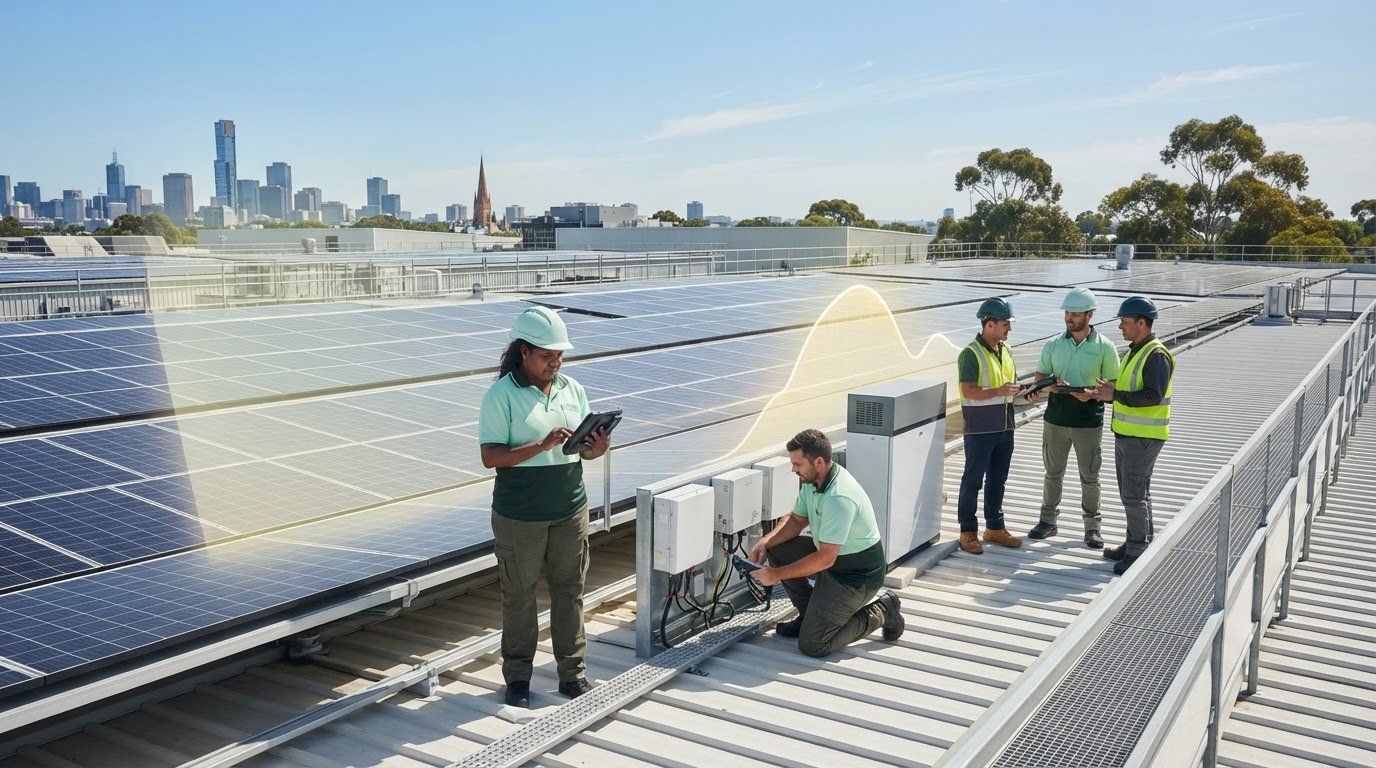
A bigger electricity bill doesn’t automatically mean you need a bigger solar system. If you’re asking, “what size commercial solar system do I need?”, focus on when your business uses power, not just how much it uses over a month.
Monthly bills are a useful starting point, but they don’t show whether solar generation will line up with your busiest operating hours. If a system is sized without considering that timing, it may generate more power than your business can use on site. Roof space, site conditions and grid connection requirements also affect what’s practical.
This guide explains which energy data to gather, how operating patterns affect system capacity, and how to compare proposals using consistent assumptions. A tailored assessment matters because the right size for an office with steady daytime demand may differ considerably from the right size for a business with seasonal peaks or evening operations.
Use these steps to prepare for a project-specific commercial solar assessment, including an integrated battery option where it suits your load and objectives. For Melbourne businesses, GridFree Solar designs commercial solar and battery systems around business energy demands and site conditions.
Key Takeaways
- To answer “what size commercial solar system do I need?”, look beyond your monthly bill and focus on when your business uses electricity.
- Use bills and interval data alongside operating hours to see how closely your demand aligns with daytime solar generation.
- Compare system proposals against your load profile, including likely self-consumption, exports and future changes in demand.
- Check usable roof space, orientation, shading, structural suitability and electrical infrastructure before settling on a capacity.
- Prepare your energy records, business hours, equipment details, roof information and project goals for a tailored commercial assessment.
What size commercial solar system do I need? Start with the business load
If you’re asking “what size commercial solar system do I need?”, start with how your business consumes electricity throughout the day, not its industry label or floor area. A monthly bill can show overall energy use, but not when that demand occurs or how much could overlap with solar generation.
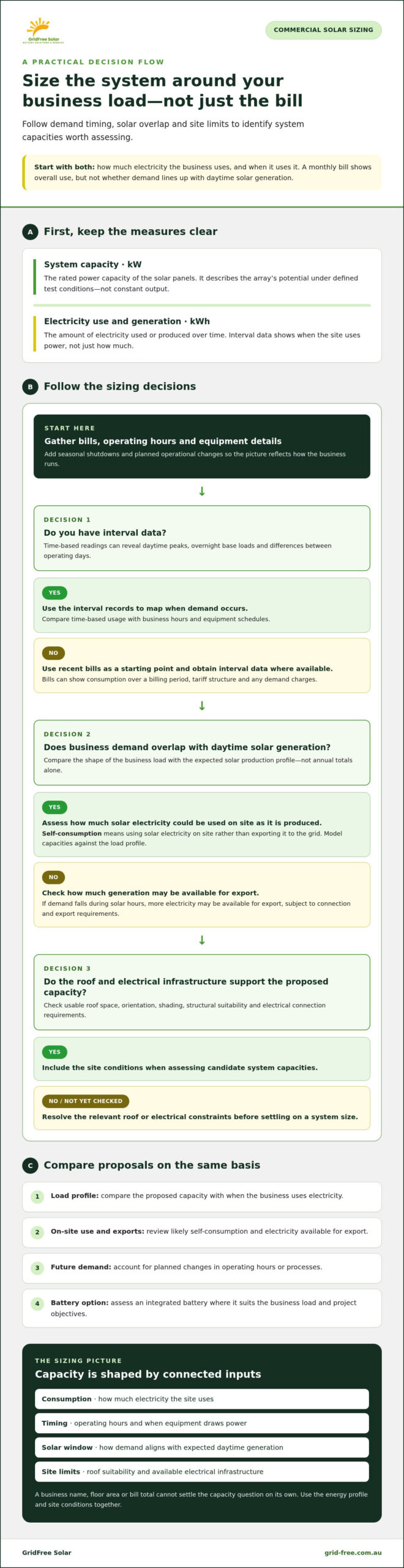
Commercial solar system size is the rated power capacity of its panels, measured in kilowatts (kW); generated energy is the electricity produced over time, measured in kilowatt-hours (kWh). Keep these measures separate when reviewing proposals. Rated capacity describes the system’s potential under defined test conditions, not a promise of constant output.
What does commercial solar system size actually measure?
A photovoltaic system combines components that capture and convert sunlight into usable electricity. This overview of photovoltaic systems explains the basic principles. In practice, actual generation varies with sunlight, season, panel orientation, shading and system design.
For example, a business might use equipment that draws power steadily during staffed hours, alongside refrigeration that runs overnight. The system’s kW rating describes the solar array’s capacity; kWh data shows how much electricity the site uses and when. You need both to assess how well solar production may match the business load.
Why is there no universal solar size for a business?
Two businesses in the same building type can have very different energy patterns. A site that operates during the day may use a large share of its electricity while solar is generating. A business with substantial evening or overnight demand may have less direct overlap, even if its total consumption is similar.
Equipment, seasonal demand and planned changes to operating hours or processes can all affect the sizing decision. A tailored assessment considers the business load alongside the physical site, including usable roof space and electrical connection requirements.
Build an initial picture from these connected inputs:
- Consumption: how much electricity the site uses.
- Timing: operating hours and when equipment draws power.
- Solar window: how demand aligns with expected daytime generation.
- Site limits: roof suitability and available electrical infrastructure, including connection requirements.
A business name, floor area or bill total can’t settle the capacity question on its own. These are clues, not a sizing method. Use bills and interval data to map demand against solar production before assessing a system capacity.
How to estimate commercial solar size from bills and interval data
To work out what size commercial solar system do I need, build a picture of both total electricity use and when that electricity is consumed. Annual consumption describes the scale of the load. Interval data reveals its timing, which is essential for assessing how business demand may align with solar generation.
Interval data shows when a business uses electricity, not just how much. It can reveal daytime peaks, overnight base loads and differences between operating days. That detail is a more useful starting point for sizing than a bill total alone.
Which energy data should a business gather?
Collect recent electricity bills and interval data where available. Bills can show consumption over a billing period, tariff structure and any demand charges. Interval records break usage into time-based readings. Add business hours, seasonal shutdowns, major equipment and planned operational changes so the assessment reflects how the business runs.
Organise the information in this order:
- Collect bills: Gather recent bills to establish overall consumption and identify the tariff structure and demand charges, if applicable.
- Obtain interval data: Add time-based usage records where available. These show whether demand occurs during daylight hours or outside them.
- Map operating patterns: Note opening hours, shutdowns, equipment schedules and expected changes to operations. Flag seasonal shifts that could affect electricity use.
- Compare demand with solar generation: Assess the site’s usage profile against the expected solar production window, then identify the system capacities worth modelling.
How do you compare daytime demand with solar generation?
Solar panels convert sunlight into electricity, but the value of that generation partly depends on whether the site can use it as it’s produced. Self-consumption means using solar electricity on site rather than exporting it to the grid. A daytime production line may match solar generation differently from equipment that operates mainly overnight.
Compare the shape of the business load with the expected generation profile, not just annual totals. If the site uses power through the day, more solar generation may coincide with on-site demand. If demand falls during solar hours, more electricity may be available for export, subject to the property’s connection and export requirements. Annual consumption and timing answer different questions, and both matter.
Generation modelling should use site-specific inputs, including the proposed system design and site conditions. A bill alone can’t establish a fixed generation or self-consumption percentage. With organised bills, interval records and operating details, GridFree Solar can tailor a commercial solar assessment to your business demand and site. Explore commercial solar design as the next step.
Compare commercial solar sizes by operating profile, not business label
Business type can suggest what to investigate, but it can’t determine system capacity. Compare your operating schedule with the solar energy your site could use as it’s generated, then factor in site limits. A larger array isn’t automatically a better fit. If demand is low during solar hours, more generation may be exported, while roof or connection constraints can also affect what’s practical.
Use these profiles as prompts, not fixed size categories. Two businesses with similar annual consumption can need different designs if one operates during the day and the other uses most of its electricity after dark.
| Load profile | What to examine |
|---|---|
| Daytime-heavy For example, an office or daytime retailer |
Check how much demand coincides with solar production and which loads run consistently. Consider how weekends, seasonal closures or planned operating changes could affect self-consumption and exports. |
| Mixed-hour For example, a site with daytime operations and extended trading or shift work |
Map demand across each operating period. Identify when solar may be used on site, when electricity could be exported, and whether future shifts or equipment changes will alter the profile. |
| Evening-heavy For example, a business with substantial after-hours demand |
Compare daytime generation with the site’s lower daytime use. Assess likely exports and whether planned changes could move more consumption into solar hours or make storage worth evaluating. |
Which business load profile most closely matches your operation?
Look past the business label. One office may have steady daytime demand, while another site with the same annual consumption could rely on refrigeration overnight or run production across shifts. Extended trading can also stretch demand beyond the main solar window. Compare schedules and major loads, then account for seasonal variation and expected changes before judging whether proposed capacities use the same assumptions.
When should a business assess battery storage as well?
If important electricity use falls outside solar production hours, assess whether a battery could store some solar energy for later use. This is a different design question from simply increasing panel capacity: a larger solar array may generate more during the day, while storage may shift some generation to another time. The right option depends on the load, site and project objectives, so don’t assume either approach will deliver a particular bill outcome. Read more about commercial solar battery storage.
Compare each proposal against the same operating schedule, self-consumption assumptions, expected exports and future demand. This makes it easier to see whether a capacity suits your business, rather than simply looking larger on paper.
Check Melbourne site and network limits before settling on a system size
Your energy profile helps identify a capacity worth assessing. The property sets the practical boundaries. For Melbourne businesses, roof conditions, electrical infrastructure and connection requirements can all influence the design. Treat a preliminary estimate as a starting point, not a confirmed system size.
How can a Melbourne roof affect commercial solar capacity?
Start with the roof area that can actually accommodate panels. Plant equipment, access ways and shaded sections may reduce usable space or affect the layout. Orientation and shading also influence solar modelling, so two roofs with similar dimensions may not support the same design.
Include structural suitability in the assessment. Other parts of a property may also be considered as possible locations, but suitability depends on the specific site and project. Assess each area before including it in a proposed design.
Use this site checklist to identify constraints:
- Usable roof area: identify the sections available for a potential panel layout.
- Orientation and shading: note roof direction and obstructions that may affect exposure to sunlight.
- Structural suitability: include the roof’s capacity to support the proposed design in the assessment.
- Electrical infrastructure: record relevant switchboards and other existing site infrastructure.
What network checks can affect a commercial solar design?
The relevant distribution network service provider (DNSP) depends on the property’s location. Export capacity, connection requirements and any application or assessment process must be verified for the site against the distributor’s current requirements. Conditions can differ between properties, including within the broader Melbourne area.
These factors matter when sizing a system. A design may need to account for export limits, the site’s existing electrical infrastructure or connection requirements. Don’t rely on a generic capacity limit or assume a connection will be approved. Include the requirements that apply to the property in project planning.
For a broader overview of the process, read Commercial Solar Installation Melbourne: Future-Proof Your Business in 2026. If you’re asking “what size commercial solar system do I need?”, combine your load information with verified roof and network constraints before settling on a proposal. GridFree Solar’s Melbourne commercial solar assessment brings business demand and site conditions together. Discuss your Melbourne commercial solar site.
Turn your sizing estimate into a tailored GridFree Solar project brief
You now have the key inputs to move beyond a rough estimate. A clear project brief connects your business’s energy demand with the practical conditions at the site, giving the design process a stronger starting point.
What should a useful commercial solar brief include?
Bring together the records and site information that explain how your business uses electricity and what the property can accommodate. Separate confirmed details from estimates and assumptions so any gaps can be addressed during the assessment.
- Energy records: recent electricity bills and interval data, if available.
- Operating details: business hours, seasonal shutdowns and major equipment, including when it runs.
- Site information: roof details or site plans, shading considerations and known electrical or connection constraints.
- Project priorities: goals such as using more solar electricity on site, allowing for future expansion or considering resilience needs.
- Open questions: note assumptions about future demand, operating changes or site suitability separately from verified information.
The brief doesn’t need to prescribe a system capacity. Its purpose is to show what the design needs to account for, including how energy use changes across operating periods and which site constraints are already known.
How does GridFree Solar help move from estimate to design?
GridFree Solar provides commercial solar design and installation tailored to business and industrial energy demands. The assessment brings your energy information together with site conditions to develop a project-specific system design, rather than treating a preliminary estimate as the final answer to “what size commercial solar system do I need?”
Where your load and project objectives make it relevant, GridFree Solar can also assess integrated solar and battery solutions. The battery question should reflect when the business needs electricity, alongside the solar design and the site’s requirements.
For Melbourne businesses, a well-prepared brief makes the next step more focused. Gather your bills, interval data, operating schedule, equipment details, site information and priorities, then request a tailored commercial solar assessment.
Request a tailored commercial solar assessment.
Turn your energy data into a confident next step
The answer to “what size commercial solar system do I need” isn’t a standard capacity based on your business type. Start with how much electricity you use and when, then consider how that demand aligns with solar generation. Bills and interval data help reveal the load; operating patterns, roof suitability and property-specific network requirements shape a practical design.
Bring those details together before comparing proposed systems. A well-prepared brief gives the assessment a clearer picture of your current operations, future plans and site constraints. It also keeps any battery discussion grounded in actual business demand and project objectives, rather than assumptions.
GridFree Solar provides commercial solar design and installation for business and industrial energy demands. For Melbourne businesses, integrated solar and battery solutions can also be considered as part of a project-specific design.
Ready to move from an estimate to a tailored plan? Request a tailored commercial solar assessment and take the next step towards a system designed around your business.
Frequently Asked Questions
What size commercial solar system do I need for my business?
The right size depends on your electricity use, operating hours and site constraints, not just your business type or monthly bill. Review when your business uses power and how that demand overlaps with solar generation, then consider usable roof space and property-specific connection requirements. For a Melbourne business, a tailored assessment brings these factors together to identify a capacity worth evaluating.
How do I calculate the size of a commercial solar system?
Start with electricity bills to understand overall consumption, then use interval data where available to see when demand occurs. Map that profile against expected solar generation, taking business hours, major equipment, seasonal changes and future plans into account. A design assessment then considers the site and connection requirements. Annual electricity use alone isn’t enough to calculate a suitable system capacity.
Can I size a commercial solar system using my electricity bill?
A bill is a useful starting point, but it usually shows energy use across a billing period rather than exactly when the business consumes electricity. Timing matters because daytime use may align more closely with solar generation than evening or overnight demand. Gather interval data if available, along with operating hours and equipment details, to give a sizing assessment a fuller view of your load.
Is a bigger commercial solar system always better?
No. A larger system may generate more electricity, but the business needs to consider how much it can use on site and how much may be exported. Roof suitability and connection requirements can also constrain a practical design. Compare proposed capacities against your operating schedule, expected self-consumption, exports and future demand. The aim is a system that fits the load and site, not simply the largest possible array.
What information do I need for a commercial solar quote?
Prepare recent electricity bills, interval data if available, business hours, seasonal shutdowns and details of major equipment. Include roof information or site plans, known electrical infrastructure or connection constraints, and any planned changes to operations. Note your priorities, such as using more solar electricity during the day or allowing for future expansion. Separate confirmed details from assumptions so the assessment can address each clearly.
Do Melbourne businesses need network approval for commercial solar?
Connection requirements depend on the property’s location, the relevant distribution network service provider and the proposed system. Export capacity and any connection application or assessment requirements should be verified against the distributor’s current rules for that site. Melbourne businesses shouldn’t assume neighbouring properties have identical conditions. Include these network factors in project planning, as they can affect the system design and what can connect to the grid.
Should a commercial solar system include a battery?
A battery may be worth assessing if the business has electricity demand outside solar production hours or specific storage objectives. Solar-only and solar-plus-battery designs suit different load patterns: increasing panel capacity adds daytime generation, while storage can shift some solar energy for later use. Whether integration suits your business depends on its demand profile, site and project goals. GridFree Solar provides integrated commercial solar and battery solutions for Melbourne businesses.