
Table of Contents
- How Solar Panel Roof Angle Affects Energy Yield
- Solar Panel Orientation: North vs West Facing Roofs
- Using a Solar Panel Tilt Calculator to Find Your Angle
- Solar Panel Efficiency Loss on a Flat Roof
- Roof Pitch Limitations and Practical Mounting Options
- Why Modern Technology Makes Perfect Tilt Less Critical
- What to Ignore: Common Bad Advice on Panel Angle
- Frequently Asked Questions
Last Updated: August 11, 2026
How Solar Panel Roof Angle Affects Energy Yield
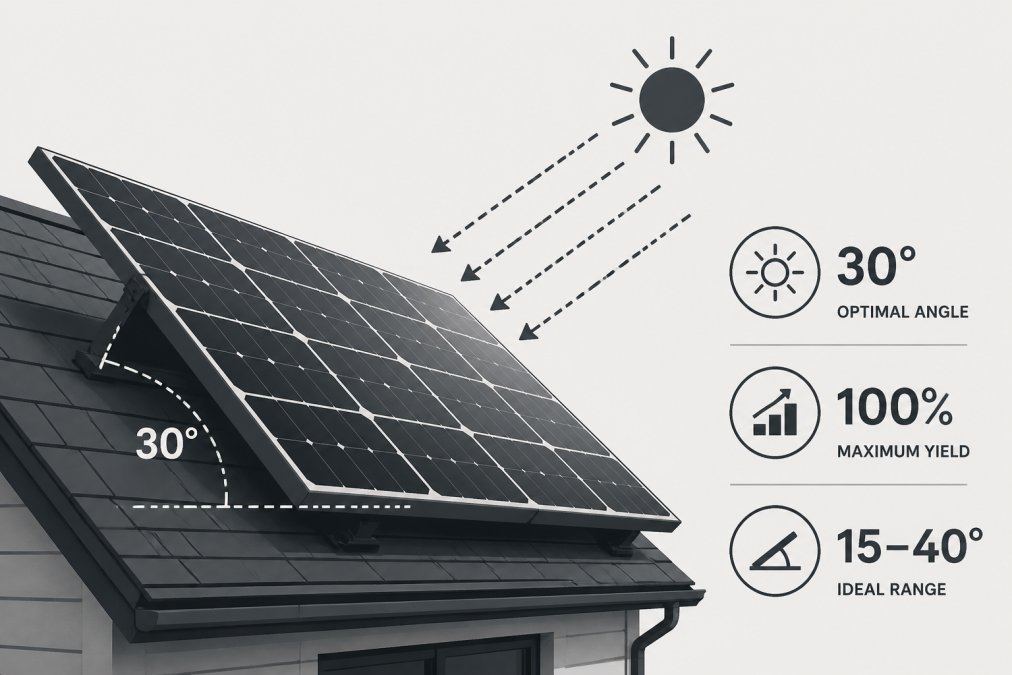
Solar panel roof angle efficiency is one of the most consequential decisions in any residential solar installation, yet it receives far less attention than panel brand or inverter choice. The core principle is straightforward: solar panel roof angle efficiency peaks when panels are oriented perpendicular to incoming sunlight. When a panel faces the sun at a right angle, photovoltaic output is maximised because solar irradiance strikes the cell surface at full intensity. Tilt away from perpendicular and the effective collection area shrinks, reducing kilowatt-hour generation proportionally.
A panel tilted 20 degrees away from its optimal angle can lose a noticeable share of annual production. The practical implication: getting your tilt angle right matters, though modern technology has changed how critical “perfect” actually is.
| Scenario | Approximate Efficiency Impact | Key Consideration |
|---|---|---|
| Optimal tilt (latitude-matched) | Baseline maximum output | Best for annual energy yield |
| 10° from optimal | Minor loss | Often acceptable on fixed roofs |
| 20° from optimal | Moderate loss | Worth correcting with racking |
| Flat roof (0° tilt) | Significant loss + soiling risk | Ballasted racking is essential |
| East/West split | ~10-15% below north-facing peak | Self-consumption gains may offset |
The Role of Latitude in Finding Your Optimal Tilt
Optimal tilt angle is directly tied to latitude. The sun’s average position in the sky is lower at higher latitudes, so panels need a steeper tilt to face it squarely. As a general rule, the optimal fixed tilt angle for a solar array is approximately equal to the site’s latitude.
Southern Australia sits between roughly 28° and 38° south latitude, which means optimal tilt angles for most homes fall in the 28-38° range. The good news: roof pitch across Australian residential construction commonly falls between 15° and 30°, placing many homes already within a workable range of their optimal inclination, particularly if the roof faces north.
Seasonal Variation and Adjustable Mounting Systems
Fixed tilt is a compromise. The sun’s path shifts significantly between summer and winter, meaning the angle that maximises winter output differs from the one that maximises summer output. Adjustable mounting systems address this by allowing seasonal tilt adjustment, typically twice a year. However, most residential installations use fixed racking because adjustable systems add cost and require physical adjustment. For most households, the annual production gain does not justify the added complexity unless the system is ground-mounted or on a flat roof.
Fixed systems at a reasonable tilt still deliver strong annual production. The bigger losses come from poor orientation, shading, or soiling, not from being a few degrees off the theoretical optimum.
Solar Panel Orientation: North vs West Facing Roofs
The best orientation for solar panels in the southern hemisphere is true north. A north-facing array maximises peak sun hours by tracking the sun’s east-to-west arc through its highest point at solar noon, delivering the highest annual energy yield.
West-facing panels generate less total energy but shift production into the afternoon, when household consumption often peaks. A west-facing array may deliver better self-consumption rates for households whose power use climbs between 3pm and 7pm, even if its total kilowatt-hour output is lower.
If your roof has a strong west face and your household uses most power between 3pm and 7pm, a west-facing array can outperform a north-facing one on bill savings, even though it produces less total energy.
East-facing panels follow the inverse logic: more morning production, useful for households with high morning loads such as dishwashers, washing machines, or home offices.
East/West Split Arrays and Self-Consumption Benefits
Split east/west arrays spread generation across a longer daily window, reducing the sharp midday production spike that often exceeds household consumption and gets exported to the grid at low feed-in tariff rates. A split array flattens the generation curve, meaning more of what the panels produce is used directly in the home rather than exported.
The trade-off is clear: a split array typically produces around 10-15% less total energy than an equivalent north-facing array. Whether that trade-off makes sense depends on the household’s energy consumption profile and feed-in tariff rate.
Using a Solar Panel Tilt Calculator to Find Your Angle
A solar panel tilt calculator uses your location’s latitude, roof orientation (azimuth), and shading data to estimate the optimal tilt angle and predict annual energy yield across different configurations. The Global Solar Atlas, maintained by the World Bank Group provides free latitude-specific solar resource data. For Australian-specific conditions, the Bureau of Meteorology publishes solar exposure data that feeds into professional system design tools.
Here is how to use tilt calculator outputs effectively:
- Enter your postcode or coordinates to get your latitude and local solar irradiance data
- Set your roof’s azimuth (compass direction the panels will face)
- Input your current or planned roof pitch as the default tilt
- Compare the output of your actual roof pitch against the theoretical optimum
- Check whether the production difference justifies additional racking to adjust tilt
- Factor in shading from trees, chimneys, or neighbouring structures
If your roof is within 10-15° of the optimal angle and faces within 45° of true north, the production difference between your actual configuration and the theoretical perfect is often modest. Calculators earn their keep by identifying genuinely poor configurations, such as south-facing roofs or very shallow pitches, where corrective racking makes a real difference.
Run the tilt calculator comparison before committing to a mounting approach. The numbers often show that your existing roof pitch is close enough, saving money on unnecessary tilt-adjustment racking.
Solar Panel Efficiency Loss on a Flat Roof
Flat roofs present the most significant angle challenge in residential solar installation. A panel installed flush to a flat surface sits at or near 0° tilt, causing reduced photovoltaic output and accelerated soiling because rain cannot wash debris from the panel surface. Soiling losses on flat installations can compound the geometric loss, making flat-flush installation rarely advisable.
Ballasted Racking and Self-Cleaning Angle Minimums
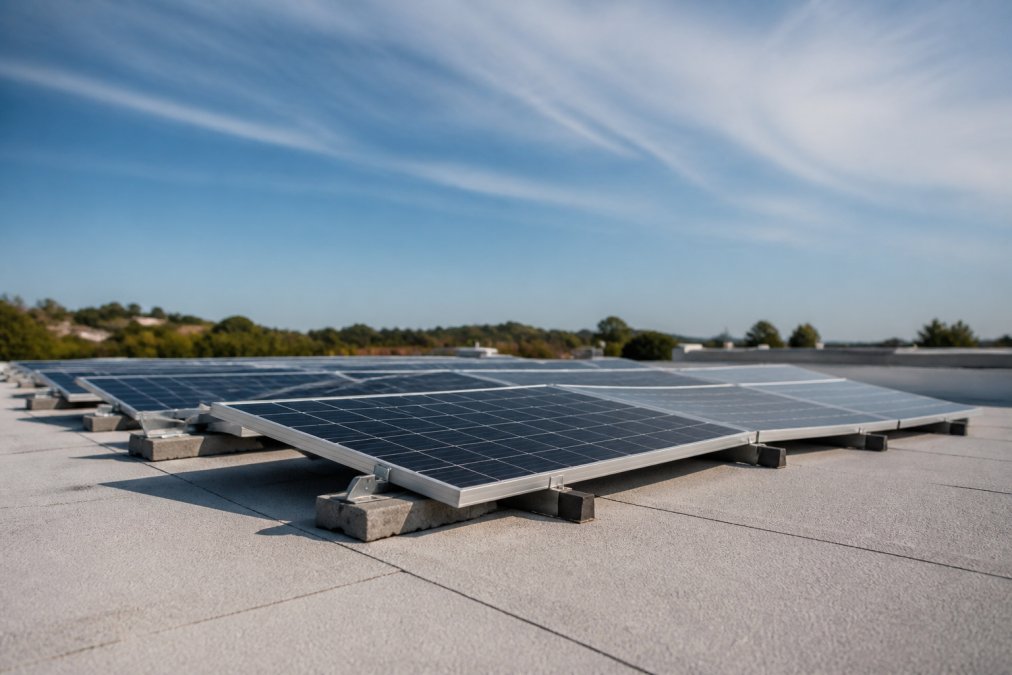
Ballasted racking systems solve the flat-roof problem without penetrating the roof membrane. These frames use weighted bases to hold panels at a fixed tilt, typically between 5° and 15°, without requiring structural fasteners through the roof surface. This preserves waterproofing integrity.
The self-cleaning angle minimum is generally accepted as around 10°. Below this threshold, rainfall does not generate enough runoff velocity to carry surface debris clear of the panel. Above 10°, rain provides meaningful cleaning action, reducing the frequency of manual cleaning required.
Ballasted racking does introduce wind loading considerations. Installers must calculate wind uplift forces based on roof height, local wind speed data, and racking geometry to ensure stability. This requires engineering assessment, particularly for roofs above single-storey height.
Roof Pitch Limitations and Practical Mounting Options
Most residential roofs were not designed with solar optimisation in mind. When the existing pitch is within a reasonable range of optimal, standard flush-mount racking is the most cost-effective approach. Panels follow the roofline, installation is straightforward, and the modest efficiency difference from the theoretical ideal is accepted as a reasonable trade-off for lower installation cost and better aesthetics.
When the pitch is significantly shallower than optimal, tilt-frame racking raises the rear of the panel to achieve a better angle. This works well but introduces wind loading considerations and may affect how many panels fit on the available roof area due to inter-row shading.
When the pitch is steeper than optimal, panels are typically installed flush to the roof rather than adjusting downward. The efficiency loss from a steep tilt is generally less severe than from a shallow one, particularly for winter generation.
Never install panels on a south-facing roof slope without a detailed shading analysis and production modelling. South-facing arrays in the southern hemisphere receive dramatically less direct sunlight and may not generate enough energy to justify the system cost.
Why Modern Technology Makes Perfect Tilt Less Critical
The obsession with finding the theoretically perfect tilt angle made complete sense in the early days of solar, when string inverter systems meant the weakest-performing panel dragged down the entire array. That constraint no longer applies to well-designed modern systems. Getting within a reasonable range of optimal still matters. Chasing the last 2-3% of theoretical output through expensive racking modifications often does not.
Micro-Inverters, Optimisers, and Shading Tolerance
Micro-inverters and DC power optimisers fundamentally change the angle and shading equation. Traditional string inverter systems operate at the performance level of their worst panel: one shaded or poorly-angled panel reduces output across the entire string. Micro-inverters and optimisers eliminate this dependency by allowing each panel to operate independently at its maximum power point.
The practical implication: a split east/west array with micro-inverters loses far less to the orientation mismatch than the same array on a string inverter. Each panel extracts maximum output for its specific angle and light conditions without being constrained by its neighbours. A panel partially shaded by a chimney or tree branch no longer penalises the rest of the array.
Battery Storage and Your Energy Consumption Profile
Battery storage changes the optimal angle calculation in a subtle but important way. A north-facing array optimised for maximum midday generation makes less sense when a battery is present, because the battery captures excess midday production regardless. What matters more with battery storage is the shape of the generation curve relative to the household’s consumption profile.
An east/west split array that generates power earlier in the morning and later in the afternoon may actually charge a battery more effectively for evening use than a pure north-facing array that dumps most of its generation into the midday period when the battery is already full.
What to Ignore: Common Bad Advice on Panel Angle
“Always tilt your panels at exactly your latitude.” This is a useful starting point, not a rule. It optimises for annual energy yield but ignores your roof’s actual pitch, your household’s consumption timing, battery storage, and whether adjustable racking is cost-effective.
“South-facing panels are worthless.” They produce significantly less than north-facing panels, but on a large roof area with good panel-level electronics, a south-facing array can still contribute meaningfully to a household’s energy balance.
“You need to adjust your panels twice a year for maximum output.” For rooftop systems, the labour cost and safety risk typically outweigh the production gain. Fixed systems at a reasonable tilt are the practical standard.
“Flat roofs can’t support good solar.” Flat roofs with proper ballasted racking at an appropriate tilt angle can host high-performing systems. The installation requires more careful design, but the outcome can be excellent.
Solar panel roof angle efficiency is a system design problem, not a simple formula.
Roof geometry, consumption patterns, and available technology all interact in ways that make a generic angle recommendation unreliable for any specific home. GridFree Solar’s CEC Accredited Installers assess each property individually, modelling how tilt, orientation, shading, and battery storage interact for your specific situation. With compliance to AS/NZS 5139:2019 and AS/NZS 3000 standards built into every installation, and expert rebate guidance to help you access the Small-scale Renewable Energy Scheme and the Cheaper Home Batteries Program, the team handles the complexity so you don’t have to. Connect Now to get a system designed around your roof, your usage, and your savings goals.
Frequently Asked Questions
What is the optimal solar panel angle in Australia?
The optimal solar panel angle is roughly equal to your site’s latitude. Across most of southern Australia, that falls between 30° and 38°. A tilt in this range keeps the solar array close to perpendicular with the sun path for most of the year, maximising annual photovoltaic output. Exact figures vary by location, so using a solar panel tilt calculator based on your postcode gives a more precise starting point than any national rule of thumb.
How much efficiency do solar panels lose on a flat roof?
A completely flat installation can reduce annual energy yield by roughly 10-15% compared with an optimally tilted array, because the panels never sit perpendicular to peak solar irradiance. Dirt and debris accumulation on flat panels adds a further drag on system performance, since rain cannot wash the surface clean. Ballasted racking frames that tilt panels at a minimum of 10° recover most of that loss and restore the self-cleaning benefit, making them standard practice for flat roof solar installations.
Is north or west orientation better for solar panels?
North-facing panels produce the highest annual kilowatt-hour output because they face the sun’s path across the sky throughout the day. West-facing panels generate less total energy but shift production into the late afternoon, which better matches evening household consumption and can reduce grid draw during peak tariff periods. If battery storage is part of your system, north-facing orientation usually maximises the solar energy available to charge the battery, making it the preferred choice for most households.
Do solar panels need seasonal angle adjustments to stay efficient?
Most residential solar arrays are fixed at installation and do not require seasonal adjustments. The efficiency loss from a fixed tilt versus a seasonally adjusted one is relatively small for most households, typically under 5% annually. Adjustable racking systems exist and can improve photovoltaic output, but the added hardware cost and maintenance rarely justify the gain for a standard home system. Modern optimisers and micro-inverters compensate for sub-optimal tilt far more cost-effectively than manual seasonal adjustments.
This article was written using GrandRanker