Table of Contents
- What drives solar panel installation costs in Victoria
- Understanding 6.6kW solar system price and capacity
- Federal and state rebates: STC and Solar Homes Program rebate eligibility
- Solar battery storage cost and grid-connected systems
- Payback period and return on investment
- Post-installation: performance monitoring and compliance
- Frequently Asked Questions
Last Updated: September 3, 2026
What drives solar panel installation costs in Victoria
Solar panel installation cost in Victoria depends on multiple interconnected factors that extend far beyond the price of panels themselves. When you’re evaluating quotes, you’re not just paying for photovoltaic modules, you’re paying for system design, structural assessment, electrical work, inverter technology, mounting hardware, compliance certification, and the installer’s accreditation. Understanding what actually moves the needle on your final bill is essential before committing to any installation.
The total cost of a grid-connected solar system reflects the complexity of integrating renewable energy into your home’s existing electrical infrastructure. A poorly designed system might be cheaper upfront but underperform for a decade. An oversized system wastes capital on capacity you’ll never use. The real skill lies in matching system capacity to your actual consumption patterns and roof conditions, and that precision is what separates accredited installers from cut-rate operators.
System capacity and kilowatt sizing
Your system capacity, measured in kilowatts (kW), is the single largest driver of installation cost. A 6.6kW system costs significantly more than a 5kW system, but the price difference isn’t linear, it scales with labour, materials, and electrical complexity. Most Victorian homes fall into the 5-10kW range, with 6.6kW representing a sweet spot for households consuming 20-30 kilowatt-hours daily.
Sizing comes down to your actual energy consumption. Pull your last 12 months of electricity bills and calculate your average daily usage. If you use 25 kWh per day, a 6.6kW system will generate roughly 20-22 kWh on a good sunny day (accounting for weather variability and system losses). Undersizing leaves you reliant on grid power during peak hours; oversizing wastes money on panels that sit idle.
The relationship between kilowatt capacity and installation cost isn’t straightforward because fixed costs (site assessment, electrical work, permits, inverter) don’t scale linearly. A 10kW system costs more than double a 5kW system, but not three times as much. This economy of scale makes larger systems slightly more efficient per kilowatt, but only if you actually need that capacity.
Panel quality, inverter type and mounting hardware
Not all photovoltaic panels perform equally. Tier 1 panels (made by manufacturers with established track records and global service networks) cost more upfront but typically deliver better energy output over 25 years and hold their warranty value. Cheaper panels may use lower-efficiency silicon or inferior frame construction, leading to faster degradation.
Your inverter choice matters equally. A single central inverter is cheaper than microinverters on each panel, but microinverters perform better on partially shaded roofs and allow module-level monitoring. String inverters occupy the middle ground, reasonable cost with decent performance monitoring. Hybrid inverters (designed for battery storage integration) cost more but future-proof your system if you plan to add battery storage later.
Mounting hardware, rails, clamps, and structural components, varies by roof type. Tile roofs require different penetrations than metal or slate. Flat roofs need ballasted mounts or special fastening. Pitched roofs with optimal north-facing angles are cheapest to mount. Poor roof condition requiring repairs before installation adds significant cost, sometimes thousands of dollars.
Roof suitability and structural considerations
Your roof’s condition, orientation, and shading profile directly impact both installation cost and system performance. A south-facing pitched roof with no obstructions is ideal and minimises installation complexity. A north-facing roof, east-west orientation, or heavily shaded by trees requires either more panels to compensate or acceptance of lower energy generation.
Structural assessment is non-negotiable. Your roof must support the additional weight of panels, mounting hardware, and snow/wind loads. Older roofs or those in poor condition may require reinforcement or replacement before installation proceeds. This structural work can add thousands to your total cost, it’s why a site inspection by an accredited installer is essential before you receive a final quote.
Shade analysis determines optimal panel placement and influences whether your system can reach its design capacity. Shade from trees, adjacent buildings, or roof features (chimneys, vents) reduces output during peak generation hours. Some installers use shade-mapping software to model seasonal shading and recommend solutions like microinverters or strategic panel placement.
Understanding 6.6kW solar system price and capacity
A 6.6kW system represents the most common residential installation in Victoria, striking a balance between upfront cost and daily energy generation. This capacity aligns with typical Victorian household consumption and the Small-scale Technology Certificates (STC) rebate framework, which caps incentives at 6.6kW for most residential properties.
On a clear day, a 6.6kW system generates approximately 20-25 kilowatt-hours of energy, depending on season and weather. Winter output drops to 10-15 kWh daily due to lower sun angles and shorter daylight hours. This variability is why understanding your annual consumption pattern, not just peak summer generation, matters for payback calculations.
The fully installed price for a 6.6kW system includes panels, inverter, mounting hardware, electrical work, permits, inspection, and the installer’s labour. Pricing varies by installer accreditation level, panel quality tier, roof complexity, and local labour costs. GridFree Solar provides transparent quotes that break down each component, helping you understand where your money goes and why quality installation justifies its cost.
Federal and state rebates: STC and Solar Homes Program rebate eligibility
Two primary rebate mechanisms reduce your net solar panel installation cost in Victoria: the federal Small-scale Technology Certificates scheme and the state-based Solar Homes Program.
Small-scale Technology Certificates explained
The Small-scale Technology Certificates (STC) scheme, administered federally, allows residential solar installations to create tradeable certificates. Each certificate represents one megawatt-hour of electricity the system is expected to generate over its lifetime. A 6.6kW system typically generates around 70-80 STCs, which can be sold to create an immediate rebate reducing your upfront cost (cleanenergyregulator.gov.au).
STC value fluctuates based on market supply and demand but typically reduces your net cost by several thousand dollars. Your installer usually handles the STC assignment and sale on your behalf, passing the rebate directly to you as a price reduction. This is effectively a federal subsidy that makes solar more affordable without requiring means-testing or complex application forms.
The STC scheme is technology-neutral and available to all Australian homeowners regardless of income. It’s the most straightforward rebate path and applies to any accredited installation meeting electrical safety standards (AS/NZS 3000 and AS/NZS 5139:2019).
Household income thresholds and eligibility
The Solar Homes Program rebate, specific to Victoria, provides additional grants for eligible households. Income thresholds apply, the program targets households earning under approximately $180,000 annually (indexed annually) (energy.vic.gov.au). If you meet the income threshold, you may qualify for a rebate on top of the STC scheme, significantly reducing your net cost.
Eligibility also requires that you own your home and it’s your primary residence. Rental properties and investment properties don’t qualify. The rebate amount varies based on system capacity, with larger systems receiving proportionally higher grants within program limits.
GridFree Solar assists with Solar Homes Program rebate eligibility assessment and application, ensuring you claim every incentive available.
Solar battery storage cost and grid-connected systems
Adding battery storage to your solar system increases upfront cost but dramatically improves energy independence and financial returns. A battery allows you to store excess daytime generation for evening use, reducing your reliance on grid power during peak-demand hours when electricity rates are highest. claiming VEU rebates.
Battery systems range from smaller 5-10 kWh units (suitable for basic load-shifting) to larger 15+ kWh systems (enabling near-total energy independence). The cost per kilowatt-hour of storage has fallen significantly, but remains a meaningful capital investment. A typical 10 kWh battery system costs substantially more than the solar panels alone.
Grid-connected systems with battery storage offer the best of both worlds: you use solar generation during the day, store excess in the battery for evening use, and draw from the grid only when necessary. This configuration maximises self-consumption and minimises your exposure to rising electricity rates.
Feed-in tariff and export earnings
When your solar system generates more electricity than you’re using, that excess flows back to the grid. Your energy retailer credits you for this exported power at the feed-in tariff rate, currently around 10-15 cents per kilowatt-hour in Victoria, though rates vary by retailer and time of export.
Peak export value occurs during late afternoon and evening (roughly 4-8pm) when grid demand is high and wholesale prices spike. If you have battery storage, you can time your exports strategically, discharging the battery during peak-rate windows to maximise earnings. Some retailers offer time-of-use export rates, paying premium rates (15+ cents per kWh) during peak periods.
GridFree Solar’s battery systems are optimised for export earnings, with smart controls that time discharge to coincide with high-value export windows. The $1 daily bonus for avoiding grid use during peak hours and the 15 cents per kilowatt-hour export rate during 6-8pm create tangible financial incentives that accelerate your payback period.
Export earnings compound over time. A system generating just 2-3 kWh of exportable energy daily at premium rates can add $200-400 annually to your savings, money that directly reduces your payback period.
Payback period and return on investment
Your payback period, the time required for cumulative energy savings to equal your upfront investment, typically ranges from 6-10 years for a grid-connected system in Victoria, depending on your consumption pattern, system size, and available rebates.
Calculating payback requires three inputs: your current annual electricity bill, the system’s expected annual generation, and your effective electricity rate (accounting for consumption charges and supply charges). A household currently paying $1,500 annually for electricity and installing a system that generates 70% of their needs will see payback in roughly 8-9 years, assuming stable electricity rates.
The real return on investment extends beyond payback. After your system pays for itself, every kilowatt-hour it generates is effectively free electricity for the next 15-20 years. With electricity rates rising 5-7% annually, the financial case strengthens every year you delay installation.
Battery storage extends payback slightly (because batteries cost more) but improves long-term returns by maximising self-consumption and export earnings. A 10 kWh battery might add 2-3 years to your payback period but increases total 25-year returns by 30-50% compared to solar-only systems.
The most expensive solar system is the one you never install. Electricity rates are rising faster than solar costs are falling, waiting typically costs more than acting now.
Post-installation: performance monitoring and compliance
Installation is just the beginning. A professional solar system requires ongoing performance monitoring to ensure it’s delivering expected energy generation and to catch faults before they impact your returns.
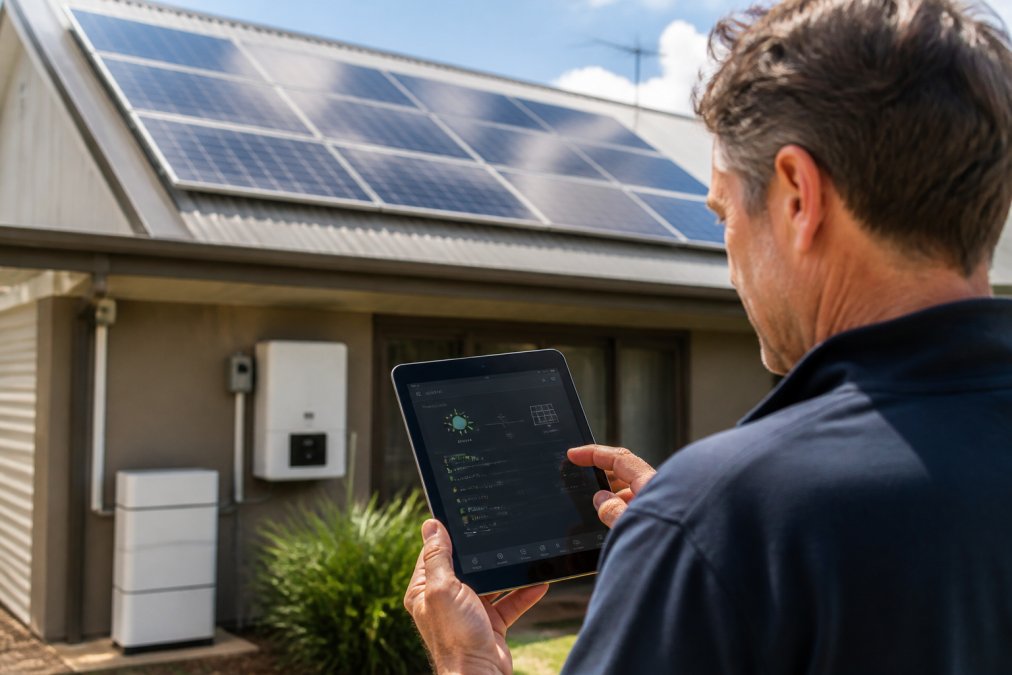
Your inverter continuously monitors system performance, tracking kilowatt-hour generation, voltage, current, and temperature. Most modern inverters connect to cloud-based monitoring platforms accessible via smartphone app or web dashboard. This real-time visibility lets you spot performance issues immediately, a sudden drop in generation might indicate panel soiling, inverter malfunction, or electrical faults.
Electrical compliance is non-negotiable. Your installation must comply with AS/NZS 3000 (Australian electrical safety standard) and AS/NZS 5139:2019 (battery energy storage systems) (standards.org.au). GridFree Solar holds CEC accreditation, meaning our installations meet these standards and receive a Certificate of Electrical Safety upon completion. This certification is required by most electricity retailers and is essential for warranty validity.
Grid connection requires approval from your local distribution network. Your accredited installer handles this application, ensuring your system meets grid-connection requirements and doesn’t create safety hazards. Once approved, your system is registered and eligible for STC creation and feed-in tariff payments.
Battery systems require additional compliance. GridFree Solar’s Clean Energy Council (CEC) Approved Battery systems meet UN38.3 lithium battery transport safety standards and IEC 62040-1 electrical safety requirements. This rigorous certification ensures your battery won’t pose fire risk and will perform reliably for its 10+ year design life.
Annual performance reviews help optimise your system. Panel cleaning removes dust and debris that reduce output. Inverter software updates improve efficiency. Monitoring data reveals consumption patterns that inform battery charging strategies or future system expansion decisions.
| Compliance Requirement | Standard | What It Means |
|---|---|---|
| Electrical safety | AS/NZS 3000 | System meets Australian electrical safety standards |
| Battery systems | AS/NZS 5139:2019 | Battery storage is safe and compliant |
| Lithium safety | UN38.3 | Battery won’t pose transport or fire hazard |
| UPS systems | IEC 62040-1 | Battery performance meets international standards |
| Grid connection | AEMO rules | System won’t destabilise the electricity network |
Installing solar in Victoria is no longer a speculative investment, it’s a pragmatic response to rising electricity costs and the proven economics of renewable energy. Your solar panel installation cost reflects the quality of design, materials, installation workmanship, and post-installation support you receive. Choosing an accredited installer like GridFree Solar means your system meets electrical safety standards (AS/NZS 3000 and AS/NZS 5139:2019), qualifies for all available rebates, and delivers measurable energy savings from day one. GridFree Solar’s CEC accreditation, expert rebate guidance, and comprehensive monitoring ensure your transition to renewable energy is seamless and compliant. Connect Now to receive a personalised quote that breaks down your solar panel installation cost and shows your realistic payback timeline.
Frequently Asked Questions
Q: What is the typical payback period for a solar panel installation?
A: Payback period depends on system capacity, electricity consumption, feed-in tariff rates, and available rebates. A fully installed system with rebates applied typically achieves payback within 6-10 years for most households. GridFree Solar’s comprehensive monitoring helps you track actual savings against projections, so you’ll see exactly when your system pays for itself and begins generating net savings.
Q: How much does solar battery storage cost and is it worth adding?
A: Solar battery storage cost varies by capacity and battery chemistry. Adding battery storage increases upfront capital expenditure but maximises self-consumption of your solar energy and qualifies you for export tariff earnings during peak demand hours. Battery systems also provide resilience during grid outages. Our accredited specialists can model your household’s load management and feed-in tariff opportunities to show whether battery storage delivers positive return on investment for your situation.
Q: Am I eligible for the Solar Homes Program rebate?
A: Solar Homes Program rebate eligibility depends on household income thresholds and property location. The scheme supports owner-occupiers with eligible incomes to access rebates toward photovoltaic systems and battery storage. GridFree Solar provides expert rebate guidance to determine your eligibility and help you navigate the application process, ensuring you capture all available government support.
Q: What makes a 6.6kW solar system the most common choice?
A: A 6.6kW solar system price reflects the optimal balance between system capacity and typical household energy consumption. This size generates sufficient energy for most homes’ peak demand periods and allows maximum benefit from feed-in tariff export earnings. GridFree Solar designs systems based on your roof suitability, shading patterns, and actual electricity usage to ensure your kilowatt capacity matches your needs.
This article was written using GrandRanker