
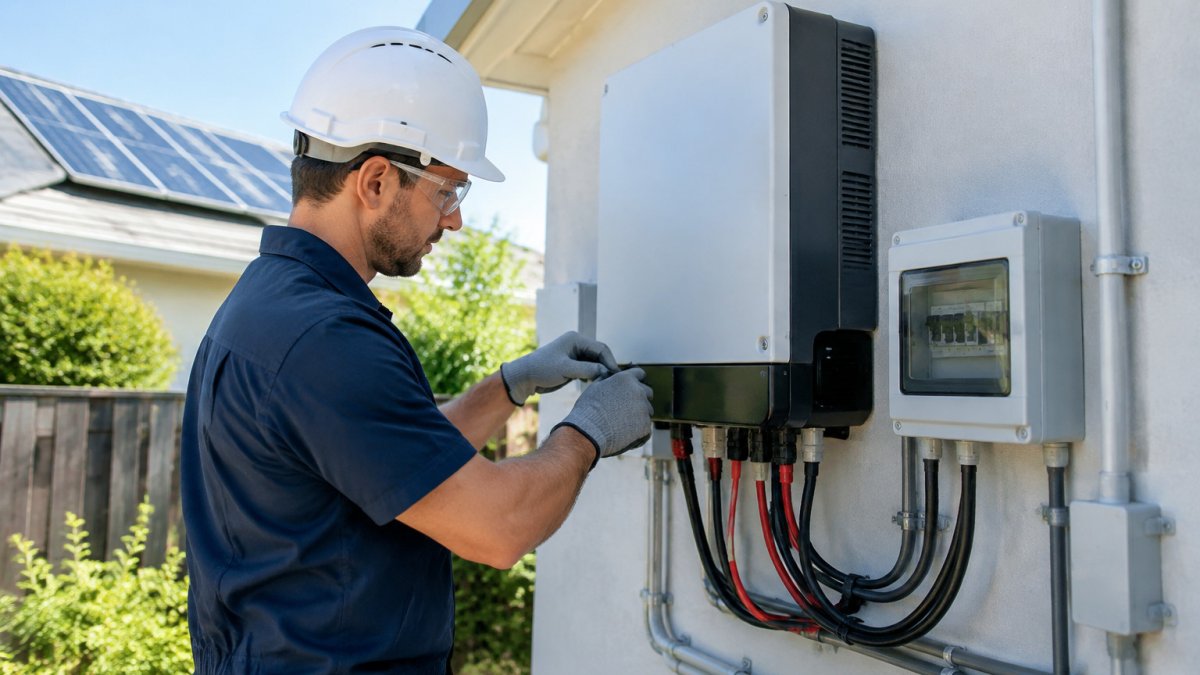
Last Updated: November 5, 2026
Quick Summary
Solar inverter safety in 2026 rests on equipment certified to IEC 62109 for internal protection and AS/NZS 4777.2 for grid connection, with the array installed to AS/NZS 5033. Confirm that certification names your exact model, and check that your installer holds current Clean Energy Council accreditation.
- IEC 62109 is the international safety baseline most inverters are tested against.
- AS/NZS 4777.2 governs grid connection, including disconnecting within a defined time during an outage.
- AS/NZS 5033 covers DC cabling, isolation, protection and labelling of the array.
- Ask for a test certificate naming the exact model, not just a general compliance claim.
- Verify the installer’s Clean Energy Council accreditation before work begins.
Table of Contents
- Why Inverter Safety Standards Matter for Your Home
- The Standards That Apply to Solar Inverters in Australia
- AS/NZS 5033 Solar Installation Requirements and Who Can Install
- What Changes in 2026 and Which Rules Are Mandatory Versus Guidance
- How to Verify an Inverter’s Compliance Before You Buy
- Solar Inverter Installation Safety Checklist
- Reading Solar Inverter Fault Codes and Warnings
- Book a Compliance Check Before Your Next Inverter Install
- Frequently Asked Questions
Why Inverter Safety Standards Matter for Your Home
Understanding solar inverter safety standards in 2026 is less about memorising codes and more about knowing which protections your home relies on daily, because solar inverter safety depends on those protections working as designed. Because those protections depend on the condition of the wiring they connect to, Victron Guy’s discussion of inverter safety naturally extends to checking whether existing wiring can support a solar system.
Poorly specified or incorrectly installed inverters can overheat, fail to isolate faults, or feed power back into the grid incorrectly. Treat inverter compliance as non-negotiable, not a box to tick at the end.
Two principles guide what follows: the equipment must be certified to the relevant Australian and international standards, and the installation must be carried out by someone qualified to meet the installation rules that apply to your home.
The Standards That Apply to Solar Inverters in Australia
A small number of standards govern most solar inverters sold and installed in Australia. Knowing what each covers helps you read a datasheet with confidence and ask the right questions of your installer. For battery and storage rules, our Solar Battery Storage Safety Standards Australia (2026) guide covers the framework in more depth.
IEC 62109: Inverter Safety Requirements Explained
IEC 62109 is the international safety standard for power converters used in photovoltaic systems, and it is the baseline most inverters are tested against.
For a homeowner, IEC 62109’s practical value lies in the protections it expects: detection of insulation faults, monitoring for abnormal voltage and frequency, and automatic disconnection when conditions move outside safe limits.
When you review a datasheet, look for explicit reference to IEC 62109 test certification rather than a general claim of “safety compliant” design.
AS/NZS 4777.2 Inverter Requirements for Grid Connection
Where IEC 62109 covers the inverter’s internal safety, AS/NZS 4777.2 governs how the inverter connects to the grid. This is the standard that determines how your system behaves when it exports power, how it responds to voltage and frequency changes on the network, and how it disconnects if the grid goes down.
Grid connection rules protect network workers and other customers. An inverter that energises the network during an outage creates a genuine hazard for linesmen, so AS/NZS 4777.2 requires it to detect loss of mains and disconnect within a defined time.
If you are considering an inverter for battery pairing, confirm that the unit’s grid protection settings match the requirements that apply in your distributor’s area.
AS/NZS 5033 Solar Installation Requirements and Who Can Install
Equipment compliance is only half of the picture. AS/NZS 5033 sets out the requirements for installing photovoltaic arrays, covering the design, cabling, mounting, protection, and labelling of the array itself.
Key areas include DC cable selection and protection, isolation and disconnection points, and protection against UV exposure and physical damage.
Installers working on grid-connected systems are generally expected to hold the accreditation and licensing required in their state or territory, and Clean Energy Council (CEC) accreditation is the industry benchmark. For more on vetting and choosing a Victorian solar installer, the page sets out seven practical tips.
Do not assume any licensed electrician is automatically qualified for solar work. Solar installations involve DC systems, specific isolation requirements, and grid protection settings beyond general electrical training.
What Changes in 2026 and Which Rules Are Mandatory Versus Guidance
In 2026 the practical answer depends on three things: the instrument, its effective date, and the jurisdiction that adopts it. This section sets out a dated change log and a way to tell a binding requirement from guidance.
The 2026 change log, by instrument
| Instrument | What it governs | Status to check for 2026 | Where it applies |
|---|---|---|---|
| AS/NZS 5033 | Installation of photovoltaic arrays, including DC cabling, isolation, protection and labelling | Confirm the edition and any amendment current at your installation date | Adopted through state and territory electrical wiring rules and regulator requirements |
| AS/NZS 4777.2 | Grid connection of inverter energy systems, including protection settings and anti-islanding | Confirm the edition and the settings your distributor requires | Applied through the network connection process and state/territory requirements |
| IEC 62109 (parts 1 and 2) | Safety of power converters for PV systems | Confirm the edition cited on the test certificate for the exact model | Referenced by certification schemes and product standards |
| AS/NZS 5139 | Safety of battery energy storage systems | Confirm the edition and any amendment current at your installation date | Adopted through state and territory requirements |
| AS/NZS 3000 (Wiring Rules) | General electrical installation requirements, including earthing and protection | Confirm the edition adopted in your jurisdiction | State and territory adoption varies |
Two cautions on that table. First, standards are amended and republished; the edition that applies is the one adopted in your jurisdiction at the time of installation, not necessarily the newest published edition. Second, a standard is not law by itself. It becomes enforceable because a regulator, a network distributor, or a state or territory instrument requires compliance with it.
Mandatory versus guidance: how to tell the difference
A requirement is mandatory when a regulator, a distribution network, or a state or territory law makes it so. Guidance is good practice that may not be enforced in every case.
Use these tests before you rely on any 2026 claim:
- Who says so? A standards body publishes the standard; a regulator or network makes it binding. Treat a blog or sales page as a prompt to check the primary document.
- What is the effective date? A change announced for 2026 may apply from a specific date, or only to installations commissioned after that date.
- Where does it apply? State and territory adoption differs, and network distributors set their own connection requirements.
Watch out: an installer who cannot name the edition of AS/NZS 5033 or AS/NZS 4777.2 their work is designed to, or cannot point to the distributor requirement behind the grid protection settings, is telling you how closely they track compliance.
What to verify for a 2026 installation
For a system commissioned in 2026, the checks that matter most are:
- The inverter’s test certificate names the exact model and cites IEC 62109, with the edition stated.
- The grid protection settings are configured to the AS/NZS 4777.2 edition and the settings your distributor requires, and the settings are documented at handover.
- The array installation, DC cabling, isolation and labelling follow the AS/NZS 5033 edition current at your installation date.
- Any battery system follows the AS/NZS 5139 edition current at your installation date, with the separation and ventilation requirements documented.
- The electrical installation complies with the AS/NZS 3000 edition adopted in your jurisdiction.
- The installer holds current Clean Energy Council accreditation and the licensing your state or territory requires, and provides commissioning and compliance documentation in writing.
If a change is announced but not yet in force, ask your installer whether they will design to the new edition or the current one, and get that in writing. Record the edition, effective date and jurisdiction in your handover documents.
How to Verify an Inverter’s Compliance Before You Buy
Before you commit to a unit, verify its compliance yourself.
Next, confirm the inverter appears on the approved product lists for the relevant scheme. Our How to Choose a Solar Inverter for Batteries article walks through selection criteria in more detail.
Finally, verify the installer: confirm their CEC accreditation, ask for references, and check they will provide commissioning and compliance documentation at handover.
Solar Inverter Installation Safety Checklist
Use this checklist to review an installation before and after it is completed. It is a practical starting point, not a substitute for the standards themselves.
- Inverter certified to IEC 62109 with a model-specific test report
- Grid protection settings configured to AS/NZS 4777.2 requirements
- Installer holds current CEC accreditation and relevant state licensing
Reading Solar Inverter Fault Codes and Warnings
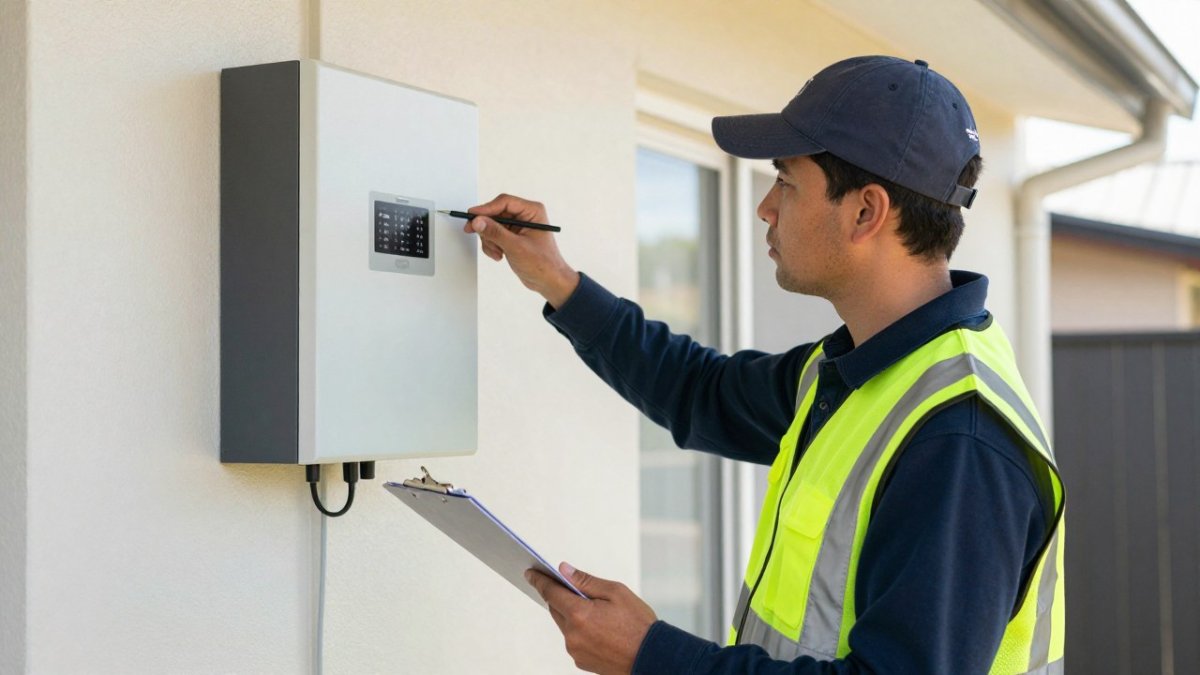
Fault codes tell you which protection has operated, making them a diagnostic tool rather than a source of worry. The protections below are the ones most commonly built into grid-connected inverters, and each maps to a family of fault codes in the manual.
The protections behind the codes
- Anti-islanding. The inverter detects loss of mains and disconnects within the time AS/NZS 4777.2 requires, so it does not energise the network during an outage. A code indicating loss of mains or grid fault usually means this protection operated correctly.
- Overvoltage and undervoltage protection. The inverter disconnects when grid voltage moves outside the configured limits. Repeated overvoltage warnings often point to grid conditions or a settings mismatch rather than a faulty unit.
- Overfrequency and underfrequency protection. The inverter disconnects when grid frequency moves outside its limits.
Warning versus fault
A warning usually indicates a temporary condition, such as grid voltage moving outside its normal range, and the inverter may continue operating or restart automatically. A fault usually means the inverter has stopped to protect the system and may require a manual restart or an installer visit.
Watch out: do not reset a fault repeatedly to “clear” it. If the same code returns, the underlying condition has not been fixed.
Common failure scenarios and what they usually mean
- Repeated grid-related warnings. Often a settings issue or a network condition rather than a faulty unit. Your installer can check the protection settings against the distributor’s requirements.
- Insulation fault codes after rain. A common pattern is moisture ingress at a DC connector or a damaged cable. This is a DC-side issue for a licensed installer, not a homeowner fix.
- Thermal derating on hot days. Usually an installation location problem: insufficient clearance, direct sun, or a blocked fan. Check the manual’s clearance requirements before assuming the unit is failing.
What to do when a fault appears
Record the code, note when it appeared and what the weather and grid conditions were, and check the manual. For practical steps you can safely take at home, our 7 Solar Inverter Troubleshooting Tips for Homeowners guide covers the common situations in detail.
Fault codes are also a useful check on your installation. Keep a simple log of codes and dates; it makes the conversation with your installer or manufacturer far more productive.
Book a Compliance Check Before Your Next Inverter Install
Getting inverter safety right takes planning, and it is far easier before the equipment is on your roof.
If you would like guidance on your system, get in touch with GridFree Solar for current information and a quote.
Frequently Asked Questions
What safety standards apply to solar inverters in Australia?
Solar inverters installed in Australia are generally expected to meet IEC 62109 for inverter electrical safety, along with AS/NZS 4777.2 for grid connection behaviour. Where the system is a small-scale renewable energy system eligible for small-scale technology certificates, the installation must also follow AS/NZS 5033 for the photovoltaic array. Batteries paired with an inverter add requirements under AS/NZS 5139. Check the product’s certification documentation and confirm the installer is accredited before work begins.
What is AS/NZS 4777.2 and how does it relate to solar inverters?
AS/NZS 4777.2 sets the requirements for how grid-connected inverters must behave when connected to the distribution network. It covers protection settings such as voltage and frequency response and the disconnection the inverter must perform if grid conditions move outside allowed limits. It is the main reference for confirming that an inverter can safely export power to the grid. Look for AS/NZS 4777.2 compliance listed in the inverter’s documentation and in the installer’s commissioning paperwork.
Do solar inverters need to meet IEC 62109?
Yes, IEC 62109 is the international safety standard for power converters used in photovoltaic systems, and it is the reference most Australian-supplied inverters are tested against. It addresses protection against electric shock, fire and mechanical hazards. Because it is a product standard, the relevant evidence is the manufacturer’s test report or certificate rather than an installer’s signature. Ask for this documentation before purchase.
Who is allowed to install or repair a solar inverter?
Installation and repair work on the electrical side of a solar inverter should be carried out by a licensed electrician who is also accredited to install small-scale solar systems, such as a Clean Energy Council accredited installer. State and territory electrical safety rules govern who may perform electrical work, and an unlicensed person should not open or reconfigure the inverter. Ask for the installer’s licence number and accreditation details, and confirm that the work is covered by a Certificate of Electrical Safety where your state requires one.
How can I check whether a solar inverter is compliant?
Start by requesting the inverter’s certification documents and checking that it lists IEC 62109 and AS/NZS 4777.2 compliance. Confirm that the model appears on the relevant certification or approval register and that the model number on the paperwork matches the unit being installed. Your installer should provide a commissioning record showing settings were checked against the required grid protection values. Keep these documents with your system records for future maintenance and warranty claims.
What safety checks should be completed after a solar inverter is installed?
After installation, the installer should confirm that DC isolators and AC isolators are correctly labelled and accessible, that cabling is protected from UV exposure and physical damage, and that earthing and bonding are correct. The grid protection settings should be verified and recorded, and the inverter should be tested to confirm it disconnects during a simulated grid fault. Ask for a Certificate of Electrical Safety and the commissioning report, and keep them with your system documentation.
Do solar inverter safety requirements change when a battery is added?
Yes. Adding a battery introduces requirements under AS/NZS 5139 for the battery energy storage system, including location, ventilation, clearances and fire separation. The inverter and battery must also be compatible and certified together where the manufacturer requires it. The installation should be re-checked as a whole system rather than treating the battery as a separate add-on, and any change should be recorded in the system documentation.
What should I do if my solar inverter displays a fault or warning?
Note the fault code or warning message and check the inverter’s manual to identify its meaning. Some warnings, such as a grid voltage out of range, may resolve on their own, but repeated faults, burning smells, visible damage or a tripped isolator should prompt you to switch off the isolator and contact your installer. Do not open the inverter housing yourself. Your installer can use the fault log to diagnose the cause and confirm the system is safe to return to service.
