
A 10-year solar battery warranty may end before its tenth anniversary. In Australia, most battery product warranties last 10 years, but cycle-count or energy-throughput limits can bring cover to an end sooner. Capacity guarantees commonly sit around 60-80% of original usable capacity at warranty end. That’s why a solar battery warranty comparison in Australia needs to weigh the limits, not just the headline term.
When making a solar battery warranty comparison in Australia, it’s natural to focus on warranty length. But the years alone don’t show how much energy the battery can deliver while covered or what capacity it must retain. These details matter when weighing long-term protection against how your household will use the system.
This guide explains what battery warranties usually cover and how warranty years, cycles and energy throughput interact. It also outlines what to look for when comparing Australian battery brands. Two warranties with similar headline terms can offer different practical protection, so check the conditions before deciding.
Key Takeaways
- Distinguish product, performance and installation workmanship cover; each applies to different parts of a solar battery system.
- Read warranty years alongside cycle and energy-throughput limits, because reaching a limit can end cover sooner than the headline term suggests.
- Compare battery brands by the capacity they guarantee and the conditions attached, not warranty length alone.
- If your current storage no longer suits your needs, a battery upgrade or replacement can help align the system with your household’s energy use.
What is the best solar battery for Australian homeowners?
For households in Melbourne and across Victoria, a strong choice balances warranty length, retained capacity and cycle life. Home batteries generally come with manufacturer warranties, but brands differ in their terms and end-of-warranty capacity guarantees.
End-of-warranty capacity guarantees
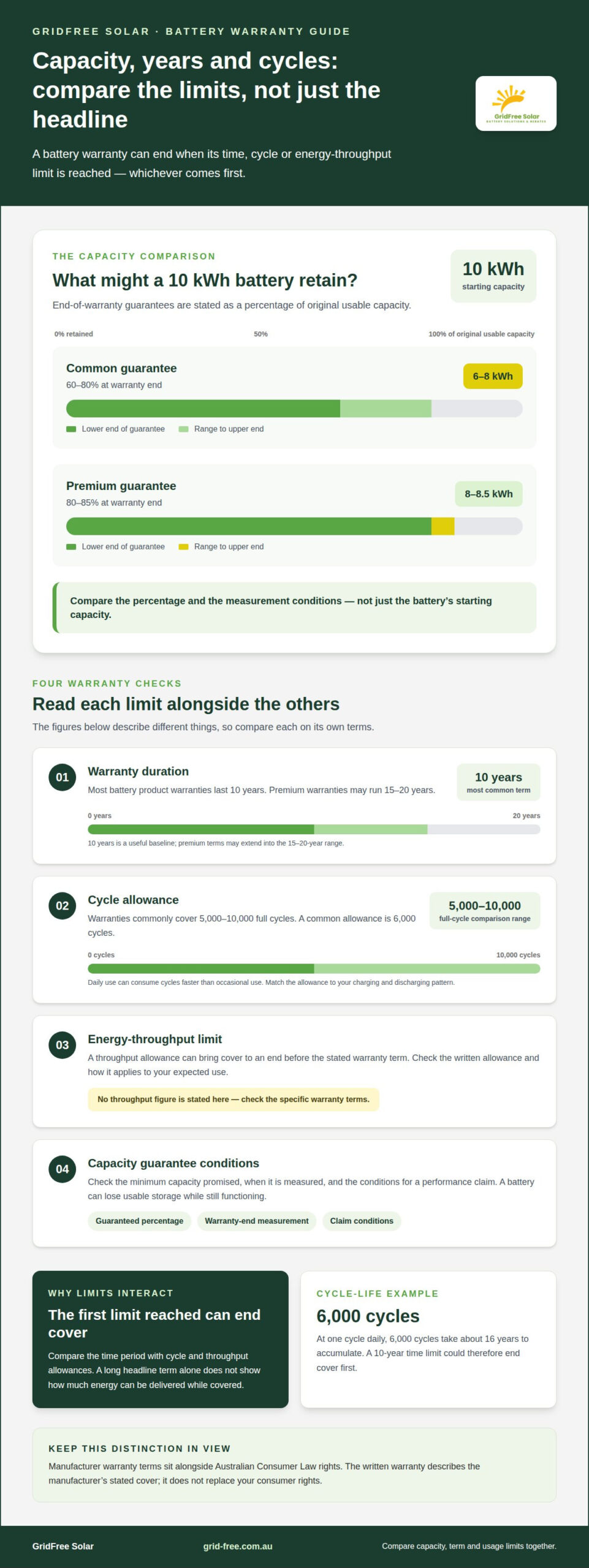
An end-of-warranty capacity guarantee states the minimum usable energy a battery must retain when its warranty ends. It matters because a battery’s initial kilowatt-hour rating doesn’t show how much storage remains covered later. Common guarantees span 60-80% of original usable capacity; premium batteries may promise 80-85%. For a 10 kWh battery, that means 6-8 kWh or 8-8.5 kWh remaining, respectively. Compare the percentage and measurement conditions, not just starting capacity.
Warranty duration and capacity retention
Warranty duration is the period in which the manufacturer’s stated protection applies, while capacity retention is the minimum performance promised during that period. Most battery product warranties last 10 years, and comparing options with at least 10 years of cover gives households a useful baseline. Premium warranties may run 15-20 years, but a longer term matters most when its capacity guarantee remains clear. Compare both figures before weighing brands or a rebate. A rebate affects upfront cost, not the capacity a warranty promises.
Cycle life adds another comparison point: warranties commonly cover 5,000-10,000 full cycles. Daily use can consume cycles faster than occasional use, so match the stated cycle allowance to your household’s charging and discharging pattern. The strongest option isn’t automatically the battery with the longest term; consider its capacity guarantee and cycle limit together.
Consumer rights alongside manufacturer warranties
Australian Consumer Law rights apply alongside a solar battery manufacturer’s warranty. The warranty describes the manufacturer’s own coverage, but it doesn’t replace your consumer rights. If a problem falls outside the written terms, keep these protections distinct: compare the manufacturer’s stated promises with your rights under Australian Consumer Law.
Are solar battery warranties transferable to a new homeowner? It depends on the manufacturer’s warranty terms, which specify whether cover follows the battery or the original purchaser. A home sale alone doesn’t establish that the new owner receives the same cover. Compare transfer conditions alongside warranty duration, capacity retention and cycle limits.
What Does My Solar Battery Warranty Cover?
A battery warranty may cover equipment faults, performance and installation workmanship. Read each part separately: one warranty document may not cover every part of the system.
Product and performance coverage
Product coverage addresses faults in the battery itself, while performance coverage sets expectations for capacity over time. A battery can still lose usable storage while functioning, so check the capacity threshold and conditions for making a performance claim. Product terms describe covered defects and remedies. Check whether the battery, inverter and control components have separate warranty documents. A solar panel warranty doesn’t automatically cover battery storage.
Maintenance and warranty claims
Maintenance conditions explain how to operate and care for the battery to keep warranty cover applicable. The manufacturer’s instructions may specify settings, charging patterns or environmental limits. A virtual power plant can also affect how often a battery cycles, so check how its operating settings relate to the warranty. Keep the manual and installation paperwork together as a record of how the system was installed and used.
Do Australian battery warranties cover labour, removal, shipping and replacement installation? The written terms specify whether each cost is covered. A promise to repair or replace a battery part doesn’t automatically include transport, removal or labour.
Australian battery installation workmanship is usually covered by the installer for 5 years. That protection concerns installation work, not necessarily the battery’s performance or lifespan. Keep the installation paperwork with the product warranty, including records for the inverter and solar panels. This helps distinguish an installation issue from an equipment fault.
How can Australian owners claim on a solar battery warranty, and what evidence is required? Follow the warranty claim process and provide details of the fault, the battery’s model and serial number, proof of purchase and installation records, plus any fault messages. Keep dated notes of the problem and system behaviour to support a clear account.
Warranty limits for years, cycles and energy throughput
A battery warranty can have several limits, and the first one reached may end cover. Compare the time period with cycle and throughput allowances to understand how usage affects protection.
Time-based warranty limits
A time-based limit sets how long the warranty applies, regardless of whether the battery reaches its cycle or throughput allowance. Most solar battery product warranties in Australia last 10 years, while some premium warranties extend to 15 years. Manufacturers may also set a minimum capacity guarantee, such as 70% after 10 years. That percentage describes performance at the stated point, not unlimited cover beyond the warranty term.
Cycle-based warranty limits
A cycle-based limit caps how many charge-and-discharge cycles count under the warranty. A common allowance is 6,000 cycles, while a comparison range of 5,000-10,000 full cycles gives households a useful benchmark. At one cycle daily, 6,000 cycles take about 16 years to accumulate. A battery with a 10-year time limit could therefore reach its calendar limit first. Check how the manufacturer defines a complete cycle.
Energy-throughput guarantees
A throughput limit caps the total energy a battery can move over its life, measured in megawatt-hours (MWh). It can be reached before the stated warranty term, especially with frequent or deep discharge. For example, a 10kWh battery with a 30,000kWh throughput limit, fully cycled once daily, reaches that limit in about 8.2 years. The same battery cycling 5kWh daily could take 16+ years.
For a 10kWh battery, compare against at least 30MWh of throughput cover. A 30,000kWh allowance equals 3,000 complete cycles at 10kWh per cycle, below a 6,000-cycle allowance. This shows why the largest cycle figure alone may not define the practical limit. Read whether the warranty ends at the first limit reached, and whether throughput must be reached within the stated term, such as 10 years.
Comparison of battery brand warranties
Australian battery warranties differ in term and minimum capacity retention. A solar battery warranty comparison in Australia should show what each brand promises beyond its headline warranty length. Published comparison figures include 10-, 12- and 15-year terms, but longer cover doesn’t automatically mean stronger protection. The percentage retained, operating limits and remedy terms all matter.
Consider how the guarantees can compare:
- A 10-year warranty may guarantee 70% capacity at the end of its term.
- A 15-year warranty may guarantee 70% after 10 years, then 60% from years 10 to 15.
- A 12-year warranty gives a different coverage period, but its term alone doesn’t reveal the capacity guarantee.
These examples show why the last-year figure matters. A battery promising 70% at year 10 may provide a higher minimum then than a 15-year warranty promising 60% during its later years. The longer term still offers additional coverage, but the consumer should weigh that against the reduced capacity threshold. Compare the guarantee at each milestone, not only the final warranty year.
Next, match the conditions to your solar system. Check cycle and throughput limits, how often the battery can charge and discharge, and whether those limits apply throughout the warranty. A household using a battery heavily may reach a usage limit before time expires. Also separate battery terms from panels, inverter and installation workmanship cover; those components can have distinct warranties. A 5-year workmanship term, for example, concerns installation rather than battery capacity.
For a useful solar battery warranty comparison in Australia, record each brand’s warranty term, capacity milestones, cycle allowance, throughput cap and claim conditions. Then assess them against your expected use and the storage your household needs. If an existing battery no longer fits, consider a battery upgrade or replacement as the next step.
GridFree Solar: Battery Upgrade & Replacement
GridFree Solar provides Battery Upgrade & Replacement for households whose existing storage needs a refresh or greater capacity. If your battery’s warranty limits no longer suit your expected use, an upgrade or replacement can help align storage with your household’s energy needs. Compare the new system’s warranty term, capacity guarantee, cycle allowance and throughput limit before deciding. These details show how the warranty fits your intended charging and discharging pattern.
GridFree Solar also provides solar and battery installation, residential solar panel installation and commercial solar solutions in Melbourne and Victoria. The right option depends on whether you’re updating an existing battery or planning a broader solar project.
Contact GridFree Solar to discuss a battery upgrade or replacement for your system.
Make your next battery decision with clarity
Use your warranty findings to shape your next decision, not just to compare documents. A solar battery warranty comparison in Australia is most useful when it reflects how your household uses stored energy and what you want your system to do next. That perspective can help you plan a replacement, expand storage or consider a new solar installation.
In Melbourne and Victoria, GridFree Solar offers Battery Upgrade & Replacement, residential solar panel installation and commercial solar solutions. Whether you’re updating an existing home system or planning a commercial project, discuss the work that fits your needs with GridFree Solar.
Talk to GridFree Solar about your solar or battery plans. A clear brief gives you a practical starting point for moving forward with confidence.
Frequently Asked Questions
Final Thoughts: Which Battery Is Right for You?
Choose a battery whose warranty conditions match your household’s expected use, rather than relying on a long headline term. If you regularly discharge stored energy, a generous throughput allowance may matter most; for occasional use, the time limit may be more relevant. Consider whether the guaranteed remaining capacity will still meet your needs later, and balance these terms with your solar system’s requirements.
What Happens If the Brand Disappears?
If a manufacturer ceases trading, warranty servicing may become harder because the company responsible for handling claims may no longer operate. Keep your purchase records, warranty documents, serial number and installation paperwork together. Australian Consumer Law rights apply alongside a manufacturer warranty, though enforcement can fall to the consumer. The practical next step depends on which business supplied the battery and remains available to address the issue.
Conclusion: Which Solar Battery Should You Choose?
Choose a battery that suits your storage needs and the way you expect to charge and discharge it. For example, if your household uses stored power heavily, pay close attention to usage limits; if retaining usable capacity is the priority, compare the capacity guarantee. Check that the system works with your existing solar setup, then weigh those details against the full warranty terms.
What Else Should You Consider (Besides Warranty)?
Consider usable storage, system compatibility and whether the battery supports your intended backup arrangements. Blackout backup depends on an off-grid inverter. Match the battery size to your solar panel output and household electricity use so the stored energy suits your daily pattern. Also consider how the system will work with an existing inverter, rather than viewing the battery warranty in isolation.
What solar battery warranties are offered in Australia by major brands?
Australian battery warranty packages commonly run for 10-15 years, with some premium coverage extending to 15 years. Terms vary in their capacity guarantees and use limits, so the same warranty length can offer different practical protection. Compare the guaranteed capacity at relevant milestones, cycle allowance and energy-throughput cap. Read the complete terms for the battery model, since warranty conditions can differ across a brand’s products.
How many years do Australian home battery warranties last?
Most Australian solar battery product warranties last 10 years. Some brands offer 12-year terms, while premium warranties can reach 15 years. The stated duration is only one part of the cover: a cycle or energy-throughput limit may apply as well. Check whether the warranty ends at the first limit reached, because heavy daily use can affect how long protection lasts in practice.