

The battery with the biggest efficiency percentage may not deliver the most useful energy to your Melbourne home. Solar battery round-trip efficiency matters, but specifications can use different measurement boundaries, making headline percentages difficult to compare fairly.
A higher figure can mean less energy is lost during storage and more is available later. The key is understanding what the number includes. For example, at 90% efficiency, 10 kWh measured going into a battery would return 9 kWh within the same measurement boundary. The result may differ if inverter conversion and other system losses are included.
This guide explains how round-trip efficiency is calculated, what to check when comparing specifications and why efficiency alone doesn’t tell you how much usable energy a system will deliver. You’ll also see how capacity, inverter design and operating conditions work together, so you can assess what matters for your Melbourne property and its solar and storage setup.
Key Takeaways
- Use the energy discharged ÷ energy charged × 100 formula to understand what a battery’s efficiency figure represents.
- Trace losses across generation, conversion, charging and discharge to see why battery efficiency isn’t the whole system story.
- Compare solar battery round-trip efficiency on equivalent measurement boundaries, alongside usable capacity, power and operating assumptions.
- Assess your Melbourne property’s energy use, solar generation, storage needs and system compatibility to judge which specifications matter most.
- Put efficiency in context: the right battery choice balances performance with your household or business energy priorities.
What solar battery round-trip efficiency measures
Round-trip efficiency compares the energy a battery returns with the energy used to charge it. It shows what proportion of the measured input comes back as output after a charge-and-discharge cycle. The remainder is lost through processes such as energy conversion and battery operation. No battery system returns every unit of energy it receives.
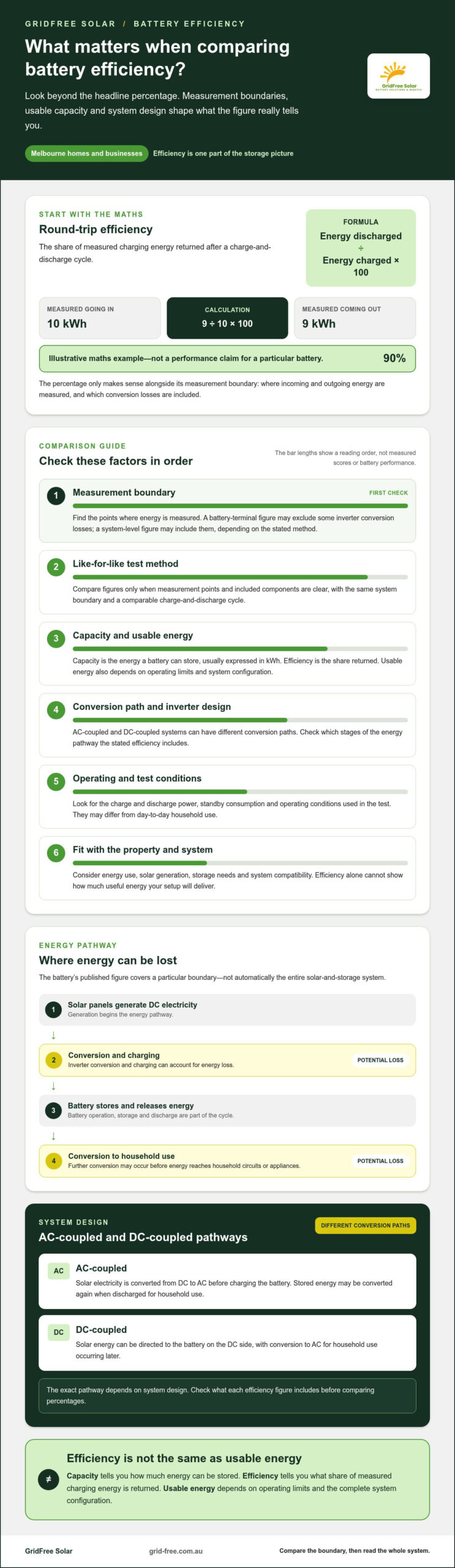
Solar battery round-trip efficiency = energy discharged ÷ energy charged × 100. The percentage is meaningful only alongside its measurement boundary: the points where incoming and outgoing energy are measured. That boundary determines which conversion losses are included.
How to calculate a battery’s round-trip efficiency
Energy charged is the amount entering the battery at the stated measurement point. Energy discharged is the amount delivered after charging and storage, measured at the corresponding output point. For a fair calculation, both readings need to use the same system boundary and a comparable cycle.
For an illustrative example, suppose 10 kWh is measured going into a battery and 9 kWh is measured coming out. The calculation is 9 ÷ 10 × 100, giving 90% round-trip efficiency. This is a maths example, not a performance claim for any particular battery.
Check what the specification includes. A figure measured at the battery terminals may exclude some inverter conversion losses, while a system-level figure may include them, depending on the stated method. AC-coupled and DC-coupled systems can also have different conversion paths. For broader context on energy storage systems, see this overview of a battery storage power station. It provides general background, rather than a method for comparing household battery efficiency ratings.
Round-trip efficiency versus battery capacity
Efficiency and capacity answer different questions. Capacity describes how much energy a battery can store, usually stated in kilowatt-hours (kWh). Round-trip efficiency describes the proportion of measured charging energy returned after the cycle. A percentage alone doesn’t reveal how much energy the battery can hold or deliver.
Usable energy also depends on the battery’s permitted operating range and the design of the complete system. The rated capacity may not all be available for everyday use. Inverter configuration and the point where energy is measured affect what reaches household circuits.
Consider two hypothetical systems. One might return a high proportion of a smaller charging input, while another returns a lower proportion of a larger input. The first could have a stronger efficiency figure, but that number alone can’t tell you which provides more usable energy. Read capacity and efficiency together.
- Capacity: the energy storage amount, expressed in kWh.
- Efficiency: the share of measured charging energy returned.
- Usable energy: what the system can supply within its operating limits and configuration.
For a Melbourne home or business, this distinction keeps the specification in perspective. Efficiency is one part of the assessment; capacity and system design determine how that performance translates into stored energy available for use.
Where solar battery energy losses occur
Energy passes through several stages before stored solar power runs an appliance. Panels generate direct current (DC) electricity. Inverters convert electricity between DC and alternating current (AC), while the battery stores and releases energy through its own electrochemical processes. Each stage can account for some energy loss.
In a typical pathway, solar generation is converted to suit the system, surplus energy charges the battery, and the battery later discharges to supply demand. Losses can occur during inverter conversion, charging, storage and discharge. The energy reaching an appliance is therefore not necessarily the same amount that left the solar panels or entered the battery.
A battery’s published round-trip efficiency describes performance within a particular measurement boundary, not automatically the whole solar-and-storage system. The U.S. Energy Information Administration’s overview of round-trip efficiency provides broader context for interpreting storage performance. For a Melbourne property, system design connects that specification to the energy pathway from generation through to use. Explore energy storage solutions for more on how storage fits into a complete setup.
AC-coupled and DC-coupled system boundaries
In an AC-coupled system, solar electricity is converted from DC to AC before it can charge the battery. Stored energy may be converted again when discharged for household use. In a DC-coupled system, solar energy can be directed to the battery on the DC side, with conversion to AC for household use occurring later. The exact pathway depends on system design.
This difference can change which conversion stages a stated efficiency figure includes. Compare specifications only when each source explains its measurement points and included components. Otherwise, two percentages may describe different parts of the energy pathway rather than comparable system performance.
What operating conditions can affect measured efficiency?
Efficiency results can depend on how a test is run. Charging and discharging power, standby consumption and operating conditions all matter to the measurement. A test may use settings or conditions that differ from the way a household battery operates day to day, so its result shouldn’t be treated as a guaranteed real-world outcome.
For a fair comparison, look for the test conditions behind the figure: measurement points, charge and discharge settings, and whether standby energy is included. Don’t assume one factor always improves or reduces efficiency by a fixed amount. Its effect depends on the battery and the test method.
A Melbourne household’s solar generation and electricity use vary over time, so a controlled specification test can’t capture every operating pattern or system configuration. GridFree Solar’s solar and battery system design considers how the battery, inverter and solar generation work together, putting an efficiency rating in the context of the property.
How to compare solar battery efficiency figures fairly
The highest published efficiency percentage isn’t automatically the best system choice. A figure is useful only when you know what was measured and can compare it with equivalent specifications. Start by separating the efficiency rating from the other details that determine how a battery can serve your property.
Use a comparison like this to organise the information. If a specification sheet leaves out a detail, record it as unknown rather than filling the gap with an assumption.
| Specification | What to compare |
|---|---|
| Efficiency | Published round-trip percentage and stated test conditions. |
| Measurement boundary | Whether the figure is battery-only or includes inverter conversion, and where input and output are measured. |
| Usable capacity | Energy available for use, listed separately from the efficiency percentage. |
| Power | Continuous power output, which describes how much energy the system can supply at a given time. |
| Operating assumptions | Charging and discharging settings, standby consumption and other stated test conditions. |
Which specifications belong in a fair comparison?
Compare equivalent configurations and test conditions. For example, don’t treat a battery-only figure as directly equivalent to a system figure that includes inverter conversion. Read usable capacity and continuous power as separate measures: capacity relates to the amount of energy available, while power relates to how much can be delivered at once. Consider system compatibility, intended purpose and warranty terms separately. Efficiency doesn’t establish any of these.
A practical comparison can be brief. Note each system’s configuration, measurement boundary, usable capacity, power rating and stated operating assumptions. If a source doesn’t explain whether inverter losses are included, mark that point unknown. This keeps the comparison evidence-based and shows where the specifications don’t support a like-for-like judgement.
Why a specification-sheet percentage is not a household guarantee
A published figure describes performance under particular test conditions. A home’s operating pattern and system configuration may differ, so the number alone can’t predict day-to-day energy supply or a specific reduction in electricity bills. Efficiency percentages are comparable only when their measurement boundaries and test conditions are comparable. Treat the rating as one input, not a promise of household savings.
Next, match the specifications to the battery’s intended job. A household aiming to use more daytime solar after sunset may weigh usable capacity and power differently from a business with another energy profile. Compatibility with the existing solar and inverter setup matters too, particularly for a battery upgrade. A professionally designed solar and storage system assesses these details together, rather than selecting a battery on one headline percentage.
Keep the decision sequence clear: compare equivalent efficiency measurements, review capacity and power, then assess operating conditions, compatibility, system purpose and warranty terms. This gives Melbourne homeowners and businesses a more reliable basis for comparing battery specifications and considering how each option could fit their site.
What round-trip efficiency means for a Melbourne solar system
A battery’s efficiency rating becomes useful when considered alongside the property’s energy patterns. For a Melbourne home or business, the practical questions are how much solar energy is available to store, when electricity is needed and whether the system can work with the existing setup.
Use four checks to connect the specification to the site:
- Energy use: Identify when the property uses electricity, including periods of higher demand.
- Solar generation: Consider how much solar energy is typically available during the day and how much is already used as it’s generated.
- Storage needs: Work out what surplus energy could be stored and when it may be useful later.
- System compatibility: Account for the solar and inverter configuration, especially if adding a battery to an existing system.
Match battery performance to household or business use
Imagine a household that uses much of its solar electricity during the day, then has greater demand in the evening. A battery may store some daytime surplus for later use. Its round-trip efficiency describes the energy returned from that stored electricity, but the household’s generation, demand and storage requirements determine how relevant the rating is. It doesn’t, by itself, predict bill savings.
Businesses have different patterns. A site operating mainly during daylight hours may use more solar as it’s generated, while a business with evening activity may have different storage requirements. Operating hours and the shape of the site’s energy demand matter. The right configuration follows the property’s energy profile, not a headline percentage alone.
To assess project economics alongside usage patterns, compare them with the assumptions in this solar battery cost guide. Efficiency is one input in that assessment, not a standalone measure of financial return.
Assessing an existing solar system before an upgrade
For an upgrade or replacement, start with the system already on site. Identify its inverter arrangement and how the solar panels and household circuits are configured. These details help shape the battery design and the route electricity takes between generation, storage and use.
Compatibility is separate from efficiency. A battery’s efficiency rating describes energy performance within its stated measurement boundary; it doesn’t show whether that battery suits a particular existing system. Both points matter, but neither replaces the other.
A professional system assessment brings the site’s energy profile, solar generation, inverter configuration and storage priorities into one design decision. GridFree Solar designs and installs solar and battery systems, including battery upgrades and replacements, with the property’s requirements in view. Explore solar and battery system design for your Melbourne property.
Choose solar battery storage with efficiency in context
A sound battery decision starts with the measurement, not the headline. Confirm what the efficiency figure covers, compare equivalent system boundaries, then assess whether the system suits the property. Solar battery round-trip efficiency is one useful indicator, but usable capacity, power, configuration and energy priorities also shape how a system performs for a household or business.
- Confirm the metric. Check how energy in and energy out were measured, and which conversion stages are included.
- Compare like with like. Use equivalent configurations and test conditions, rather than ranking percentages from different measurement methods.
- Assess the complete fit. Consider usable capacity, power, system compatibility and when your property needs stored energy.
This sequence keeps efficiency in proportion. A system with a strong rating may still be a poor match if its usable capacity, power or configuration doesn’t align with the site. The most useful comparison connects specifications to the property’s actual energy priorities.
When to consider a new battery, upgrade or replacement
These are distinct project pathways. A new solar and battery installation designs generation and storage together. A battery upgrade adds storage to an existing solar setup, so the current inverter arrangement and system configuration become key design inputs. A replacement considers the existing battery system and the storage requirements it needs to serve now.
The right path depends on what’s already installed and how the property uses energy. For a home, priorities may centre on using stored solar electricity later in the day. A commercial site may have different operating hours and demand patterns. In each case, system design should connect the battery’s specifications with the property’s storage needs, without treating an efficiency figure as a promise of a particular outcome.
Plan the next step with a system-level assessment
Before planning, gather useful details: electricity-use patterns across the day, solar generation information, existing inverter configuration and the system’s current layout. These clarify whether the project involves a new integrated installation, an upgrade or a replacement. They also give the design process a practical starting point.
GridFree Solar designs and installs residential and commercial solar and battery systems, including battery upgrades and replacements. A system-level assessment considers how solar generation, inverter configuration, battery capacity, power and efficiency work together, then aligns those details with the site’s energy priorities. That provides a more complete basis for a decision than one percentage on a specification sheet.
To plan a system around your property’s energy needs, plan your solar and battery solution with GridFree Solar.
Turn battery specifications into a site-specific plan
A specification sheet can help narrow the options, but the next step is to connect the numbers to how your property uses energy. Gather recent usage information and details of your existing solar and inverter setup. That gives system planning a practical starting point, whether you’re considering a new installation or reviewing storage for a Melbourne home or business.
Use solar battery round-trip efficiency as one part of the decision, not a standalone verdict. A considered design brings the battery’s specifications together with the site’s energy priorities and existing equipment. It can also clarify whether an upgrade, replacement or integrated system is the more suitable pathway.
GridFree Solar installs residential and commercial solar and battery systems, provides battery upgrades and replacements, and offers guidance with relevant solar and battery rebates. Take the next step with a plan shaped around your property: plan your solar and battery solution with GridFree Solar.
With system design that accounts for the property’s needs, you can make a more informed decision about battery storage.
Frequently Asked Questions
What is a good round-trip efficiency for a solar battery?
A useful figure is one that’s clearly measured and suits your system, rather than simply the highest percentage on a specification sheet. Commonly cited lithium-ion battery values are around 85-95%, but comparisons only mean something if the measurement boundaries and test conditions match. For a Melbourne property, also weigh the rating against usable capacity, power and when you need stored energy.
How is solar battery round-trip efficiency calculated?
Solar battery round-trip efficiency is calculated by dividing the energy discharged by the energy used to charge the battery, then multiplying by 100. For example, if 10 kWh goes in and 9 kWh comes out at comparable measurement points, the calculated efficiency is 90%. The result depends on what the measurements include, so note whether readings are at the battery or across a wider system.
Is round-trip efficiency the same as inverter efficiency?
No. Inverter efficiency describes how effectively an inverter converts electricity from DC to AC, or AC to DC, under stated conditions. Round-trip efficiency considers energy entering and leaving storage over a charge-and-discharge cycle, and may include inverter conversion if its measurement boundary is system-wide. A high inverter rating alone doesn’t establish the battery’s round-trip result. Compare each specification according to the component or energy pathway it describes.
Can two batteries with the same efficiency deliver different usable energy?
Yes. Equal efficiency percentages don’t mean equal energy supply. A battery with greater usable capacity can potentially provide more energy over a cycle than one with less capacity, even if both return the same share of charging energy. Operating limits and system configuration also affect what’s available to the property. For example, a Melbourne household comparing options should check usable kWh alongside the percentage, rather than treating efficiency as a capacity rating.
Does solar battery efficiency change with operating conditions?
It can vary with test and operating conditions, so a single published rating won’t describe every household cycle. Charging and discharging power, standby energy use and the battery’s operating conditions can all be relevant. The size and direction of their effects depend on the system and measurement method. If your use pattern differs from the stated test settings, treat the specification as a comparison point, not a precise prediction of daily performance.
What happens to energy that is lost during a battery cycle?
Energy that doesn’t return as electrical output is mainly dissipated through conversion and battery operation, often as heat. Some energy may also be used by system components, including standby functions, depending on what the measurement includes. It isn’t necessarily a separate amount that can be recovered for household use. That’s why a system-level assessment distinguishes energy entering storage from electricity ultimately available to power appliances.
How should I compare AC-coupled and DC-coupled battery efficiency?
Compare the energy pathway and measurement boundary, not just the AC or DC label. AC-coupled systems generally convert solar electricity before it reaches the battery; DC-coupled designs can route energy to storage on the DC side. Conversion stages included in published figures may therefore differ. Check where input and output are measured and whether inverter conversion is counted. For an existing Melbourne system, include its inverter arrangement in the comparison.