
Table of Contents
- How to Calculate Your Solar Battery Payback Period
- Key Factors That Influence Your Battery ROI
- Solar Battery Rebate Eligibility and Government Incentives
- Impact of Feed-in Tariffs on Battery Storage Returns
- Average Solar Battery Lifespan and Long-Term Value
- Comparing Solar Panels vs. Solar Battery Payback Timelines
- Why Your Payback Period Matters Now
- Frequently Asked Questions
Last Updated: September 1, 2026
How to Calculate Your Solar Battery Payback Period
Understanding your solar battery payback period is essential before investing in energy storage. It tells you exactly how long it will take for your battery system to pay for itself through electricity bill savings and export revenue, cutting through marketing noise to give you a clear financial picture.

The Basic Formula
The solar battery payback period calculation starts with: Total System Cost ÷ Annual Savings = Payback Period (in years).
However, this oversimplifies. Your actual payback depends on several variables: total system cost (battery, installation, inverter upgrades), annual savings (reduced grid purchases, peak demand avoidance, feed-in tariff revenue), and battery degradation. Lithium batteries lose 0.5-1% capacity annually, meaning savings decline slightly each year (peer-reviewed research).
Step-by-Step Calculation Example
Assume a 10 kWh battery system in Victoria costing $12,000 (after rebates). Your household pays 28¢/kWh peak and 18¢/kWh off-peak.
Step 1: Avoid 3,000 kWh of peak-rate purchases annually: 3,000 × $0.28 = $840 saved.
Step 2: Export 2,000 kWh annually at 13¢/kWh: 2,000 × $0.13 = $260.
Step 3: Total annual benefit: $840 + $260 = $1,100 in year one.
Step 4: Account for 0.7% annual degradation. Over 15 years, cumulative savings total roughly $15,800.
Step 5: $12,000 ÷ $1,100 = 10.9 years basic payback.
Most households see payback improve after 3-5 years because electricity rates typically rise 2-3% annually. GridFree Solar’s rebate guidance can help reduce initial cost, potentially shortening payback.
Key Factors That Influence Your Battery ROI
System Capacity and Self-Consumption Rates
Your battery must match your household’s energy consumption pattern. Self-consumption rate (the percentage of solar generation you use on-site) directly affects ROI. Higher self-consumption means more bill savings; lower self-consumption means more export at lower feed-in tariff rates.
Self-consumption depends on solar array size, battery capacity, and household load profile. A home with air conditioning during peak afternoon hours has lower self-consumption. A home with most loads in morning and evening has higher self-consumption.
GridFree Solar designs systems around your load profile to optimise self-consumption and improve payback. An undersized battery leaves money on the table; an oversized battery wastes capital.
Electricity Bill Savings and Peak Demand Reduction
Your electricity bill includes consumption charges (per kWh) and demand charges (per kW of peak usage). A battery reduces both by shifting peak-time usage to off-peak and capping peak grid draw.
Peak demand reduction often provides 15-25% of total savings. Demand charges vary significantly by region and retailer, affecting your payback timeline. GridFree Solar reviews your specific tariff and incorporates actual demand charges into your financial model.
Battery Degradation and Cycle Life
Lithium batteries degrade predictably. A typical LFP battery retains 80% capacity after 8,000-10,000 cycles (peer-reviewed research). Most households cycle their battery 250-400 times annually, meaning a 10-year lifespan is realistic.
Degradation isn’t linear. Year one sees minimal loss (under 1%); years 5-10 show 0.5-0.8% annual loss; years 12-15 show 1-1.5% as the battery approaches end-of-life. This means savings decline over time, but your battery remains economically viable for 12-15 years beyond initial payback.
Battery degradation is predictable and manageable. Most quality systems remain economically viable for 12-15 years, well beyond initial payback.
Solar Battery Rebate Eligibility and Government Incentives
Government rebates directly reduce upfront cost, accelerating payback by 1-3 years. Australia offers two major programs: the Small-scale Renewable Energy Scheme and the Cheaper Home Batteries Program.
Small-scale Renewable Energy Scheme and Cheaper Home Batteries Program
The Small-scale Renewable Energy Scheme (SRES) provides Renewable Energy Certificates (RECs) for solar panels. Each REC is worth approximately $35-$50. A 6 kW solar array typically generates 15-20 RECs, reducing upfront cost by $525-$1,000.
The Cheaper Home Batteries Program provides state-based rebates for battery storage. Victoria offers up to $4,000 (energy.vic.gov.au). The rebate applies at point of sale, directly reducing your invoice.
To qualify, your installer must be Clean Energy Council (CEC) accredited. GridFree Solar holds full CEC accreditation, ensuring your system qualifies for all available rebates.
Installing a battery without CEC-accredited installers may disqualify you from government rebates. Always verify accreditation before signing a contract.
Impact of Feed-in Tariffs on Battery Storage Returns
Your feed-in tariff rate has an outsized impact on payback. A 3¢ difference can shift payback by 1-2 years.
Time-of-Use Tariffs and Energy Arbitrage Opportunities
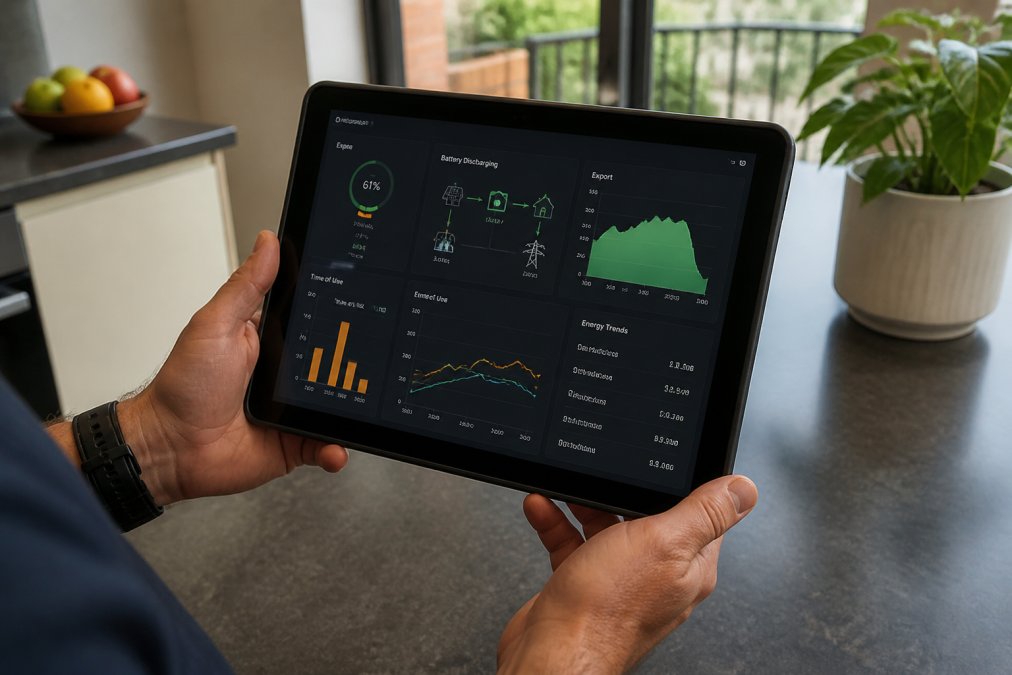
Time-of-use (TOU) feed-in tariffs pay different rates depending on export timing. Peak export periods (6-8pm winter, 4-7pm summer) pay 15-20¢/kWh; off-peak pays 8-12¢/kWh. This creates energy arbitrage: store solar energy generated at midday and export during peak-price evening hours when grid demand is highest.
A battery enables this strategy. Without storage, solar peaks at midday when export prices are lowest. With a battery, you shift generation to evening when prices are 50-100% higher. This arbitrage alone improves annual returns by $200-$400.
GridFree Solar’s smart monitoring automatically optimises battery discharge to capture peak-price export windows.
Virtual Power Plant Participation and Export Revenue
Virtual Power Plant (VPP) programs aggregate residential batteries into networks providing grid services during peak demand. Participants receive approximately $1 per day bonus plus 15¢/kWh for designated peak exports.
VPP eligibility requires compatible battery systems. GridFree Solar’s systems integrate with major VPP networks, enabling immediate access to these revenue streams.
VPP participation is optional but financially significant. If comfortable with occasional grid demand management, VPP can reduce payback by 1-2 years while supporting grid stability.
Average Solar Battery Lifespan and Long-Term Value
Most residential batteries last 12-15 years before capacity drops below acceptable levels. “End of life” doesn’t mean worthlessness, it means the battery no longer meets primary performance specifications.
Warranty Periods and Capacity Retention
Quality lithium batteries (LFP chemistry) carry 10-year warranties with 80% capacity retention guarantees. GridFree Solar’s CEC-approved batteries exceed this, retaining 85-90% capacity at 10 years.
Warranty covers defects and manufacturing flaws, not normal wear. CEC accreditation ensures installers follow safety standards (AS/NZS 5139:2019 and AS/NZS 3000) protecting warranty coverage and longevity.
After warranty expiry, your battery continues generating returns at a declining rate. A battery at 80% capacity still saves money, just 20% less than when new. End-of-life batteries are increasingly repurposed for commercial storage, creating residual value of $500-$1,000, further improving long-term ROI.
Comparing Solar Panels vs. Solar Battery Payback Timelines
Solar panels achieve payback in 5-7 years. They have no moving parts, minimal maintenance, and 0.3-0.5% annual degradation. A 6 kW array costs $8,000-$12,000 and generates $1,500-$2,000 annual savings.
Batteries achieve payback in 10-13 years. They cost more per kWh of benefit and face faster degradation, but provide peak demand reduction, export optimization, and outage protection.
The optimal strategy is installing solar panels first, then adding batteries 2-3 years later. This lets you maximise generation, understand consumption patterns before sizing storage, spread capital costs, and benefit from declining battery prices (5-8% annually) and improved rebates.
However, if you experience frequent outages or high peak demand charges, adding a battery immediately makes sense. GridFree Solar designs hybrid strategies accounting for your specific situation.
Why Your Payback Period Matters Now
The solar battery payback period has become more important in 2026. Electricity rates are rising 4-6% annually in many regions, compressing payback timelines and improving battery ROI. Governments are increasing feed-in tariffs and expanding VPP incentives to encourage distributed storage.
Battery efficiency has improved 3-5% over two years, and inverter technology now enables advanced features like dynamic export optimization. These improvements translate directly into better payback for systems installed today.
Your solar battery payback period transforms abstract benefits into a concrete timeline. GridFree Solar specializes in turning this calculation into reality through detailed energy audits, tariff analysis, rebate guidance, and system design. Our CEC accreditation and compliance with AS/NZS 5139:2019 and AS/NZS 3000 standards guarantee your system performs as modelled and your warranty remains valid.
Connect with GridFree Solar to model your specific payback period and explore how battery storage can reduce electricity costs while supporting grid stability. Our team handles rebate guidance, system design, and ongoing monitoring to ensure your investment delivers expected returns.
Frequently Asked Questions
How do I calculate my solar battery payback period?
Divide your total system cost (minus rebates) by your annual savings. Annual savings equal electricity bill reduction plus export revenue from feed-in tariffs. For example, if your system costs $12,000 after rebates and saves $2,400 yearly, your payback period is 5 years. Include battery degradation (typically 0.5-0.8% annually) when projecting long-term savings, as capacity loss reduces future export revenue and self-consumption benefits over time.
What solar battery rebate eligibility requirements apply in 2026?
Eligibility depends on the Small-scale Renewable Energy Scheme and state-based programs like the Cheaper Home Batteries Program. Requirements typically include CEC-accredited installation, compliance with AS/NZS 5139:2019 and AS/NZS 3000 standards, and residency in participating regions. Check your state’s energy authority website or contact your installer for current eligibility criteria, as rebate programs update regularly and may have income thresholds or system size limits.
How does a feed-in tariff affect my battery payback period?
Feed-in tariffs reward you for exporting excess solar energy back to the grid, reducing your payback period significantly. Higher tariff rates (typically 15-25¢/kWh during peak export windows) mean faster returns. Time-of-use tariffs create arbitrage opportunities: charge your battery during cheap off-peak periods and export during high-rate peak hours. Virtual Power Plant participation can add another revenue stream. Compare your retailer’s tariff structure against your system’s expected export volume to model realistic payback timelines.
What is the average solar battery lifespan and how does it affect ROI?
Most modern lithium batteries last 10-15 years with 8,000+ charge cycles, though capacity degrades gradually. A battery retaining 80% capacity after 10 years still functions well but generates less export revenue. Warranty periods typically cover 10 years or 70% minimum capacity. Longer lifespan means more years of savings post-payback, improving overall ROI. Battery degradation and cycle life are critical factors in financial modelling, systems with slower degradation rates deliver better long-term returns despite potentially higher upfront costs.
This article was written using GrandRanker