
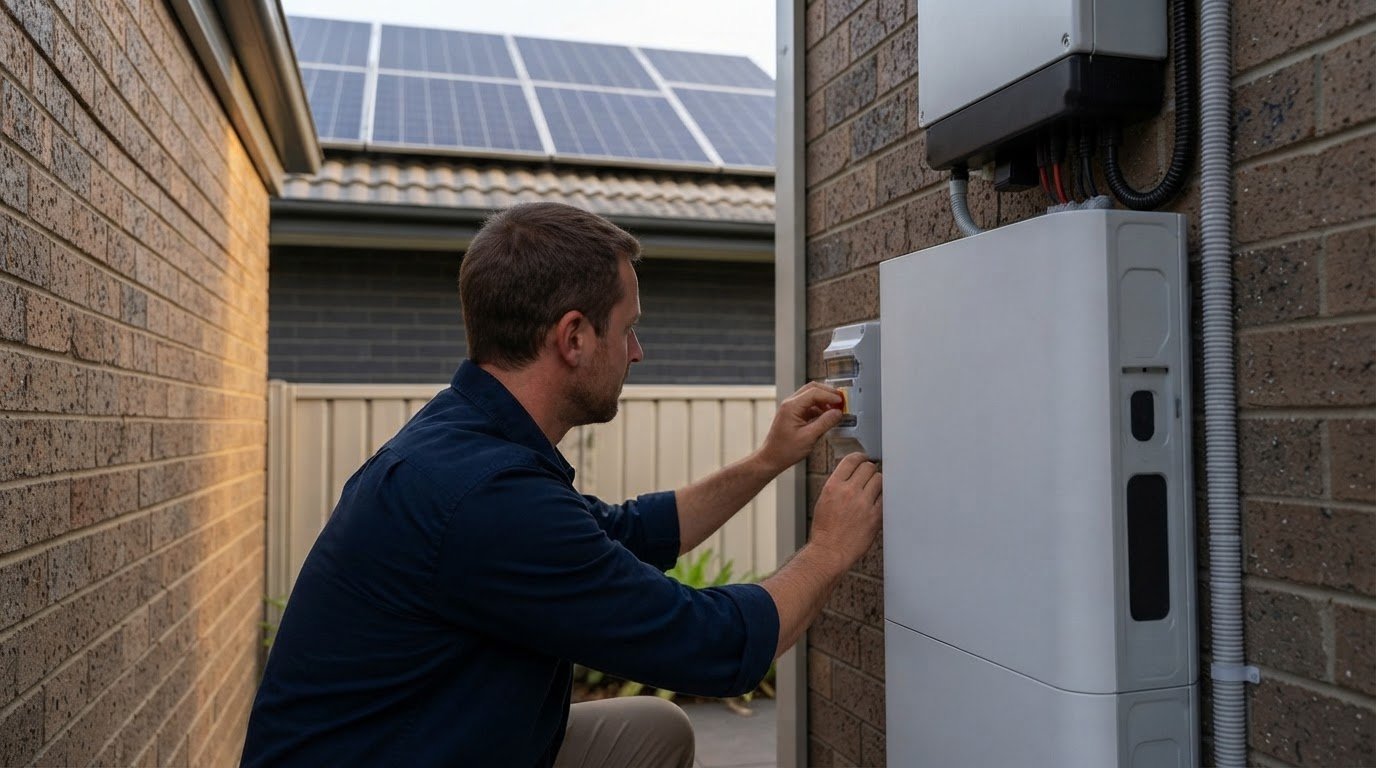
A home battery can do more than store your excess solar. In a virtual power plant (VPP), smart software links participating batteries so they can act together and send stored energy to the grid during periods of high demand. The solar battery and VPP benefits in Melbourne can include estimated VPP earnings of A$300-A$1,000 or more per year, depending on the program and how often energy is shared.
It’s sensible to weigh potential returns against how much control you want over your battery and what participation means for its warranty. Payments and bill credits vary by program. VPP participation can also support grid stability and renewable energy use.
This guide explains how VPPs work, what earnings and credits may apply, and what to consider about battery reserves, access and warranty terms. It also covers how solar and battery rebates can contribute to the value of a home energy system.
Key Takeaways
- Understand how VPP operators may use stored battery energy, and why discharge settings matter for warranty terms.
- See how batteries can support the grid during high-demand periods while keeping household energy needs in view.
- Compare the ways VPP programs may provide earnings or bill credits, and what can affect their value.
- Learn how coordinated battery storage could help reduce energy-system costs and make better use of renewable power.
Battery warranties and VPP participation
A VPP can add rewards to battery savings, but participation affects how stored energy may be used. Reserve settings, warranty terms and program conditions shape the trade-off.
Australian VPP participation requirements
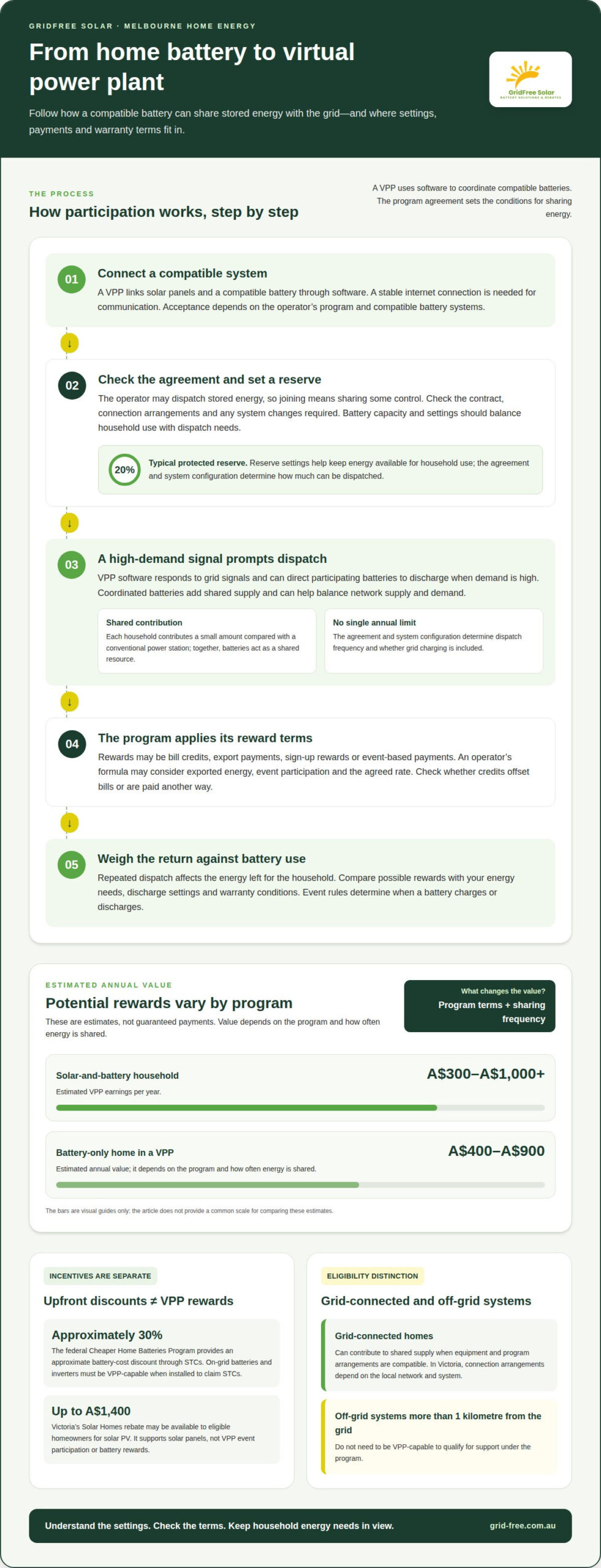
A VPP links solar panels and a compatible battery through software, with a stable internet connection for communication. The operator may dispatch stored energy, so participation means sharing some control. The agreement sets the program terms, and the operator may also be the electricity retailer. In Victoria, connection arrangements depend on the local network and system. Under Australia’s Small-scale Renewable Energy Scheme, on-grid batteries and inverters must be VPP-capable when installed to claim small-scale technology certificates (STCs). The federal Cheaper Home Batteries Program provides an approximately 30% discount on battery costs through STCs, according to the Department of Climate Change, Energy, the Environment and Water.
There is no single retailer list that applies to every Melbourne home: acceptance depends on each VPP operator’s program and compatible battery systems. Homeowners need to consider the operator’s contract, internet access and any system changes required. Battery capacity and settings should balance household use with the program’s dispatch requirements; a typical protected reserve is 20%.
Battery-only VPP participation
VPP participation can involve a home’s battery, and entry requirements may vary. It can suit owners who already have solar and want their battery to earn value beyond self-consumption. A battery-only home participating in a VPP has estimated annual value of A$400-A$900. That estimate depends on the program and how often energy is shared, rather than guaranteeing a fixed payment.
VPP payback compared with battery-only use
Without a VPP, a battery stores excess solar for household use. Joining a VPP may add earnings or bill credits when energy is shared. Weigh that return against battery discharge, warranty conditions and your household’s need for stored energy. Welcome credits, event payments and ongoing rewards vary by program, so check how the agreement applies each payment or credit.
VPP support for grid stability during high demand
During peak demand, a VPP can send stored energy from participating home batteries to the grid, adding supply when households and businesses are drawing heavily on the network. For Melbourne households, solar battery and VPP benefits can include contributing to a shared energy resource coordinated across locations. A VPP connects compatible batteries, including those in Melbourne homes with rooftop solar.
Grid stabilisation depends on timing. Software responds to grid signals, directing participating batteries to discharge when demand is high. This energy can help balance supply and demand across the network. Each household’s contribution is small compared with a conventional power station, but coordinated batteries work as a shared resource. Reserve settings and program terms determine how much energy is available for dispatch.
There is no single annual grid-charging or discharging limit for every Melbourne battery. The VPP agreement and system configuration determine how often an operator can call on stored energy and whether grid charging is included. These settings matter because repeated dispatch affects the energy left for household use. Event rules also determine when a battery charges or discharges.
Off-grid eligibility follows a different rule. Australian off-grid solar battery systems more than 1 kilometre from the grid don’t need to be VPP-capable to qualify for support under the program. That distinction matters for remote properties, where connection to the electricity network isn’t available. Grid-connected homes, by contrast, can contribute to shared supply through a VPP when their equipment and program arrangements are compatible.
Understanding the solar battery and VPP benefits Melbourne homes can gain starts with matching system settings to household use and possible grid participation. For a new or upgraded system, solar and battery system planning can help align household needs with potential grid support.
VPP earnings, bill credits, sign-up bonuses and event payments
VPP rewards may come as bill credits, export payments or event-based earnings. The program agreement explains how each is calculated and applied.
Bill credits and upfront battery discounts
Bill credits reduce an electricity account, while an upfront discount lowers the battery’s purchase cost. They’re different benefits, so don’t treat one as a substitute for the other. Victoria’s Solar Homes rebate may provide eligible homeowners up to A$1,400 for solar PV, according to Solar Victoria. That rebate supports solar panels, not VPP event participation or battery rewards.
Victoria’s solar rebate eligibility is separate from a VPP contract. The rebate is for eligible Victorian homeowners installing solar PV, while a VPP operator sets its own participation terms. Financing arrangements also have conditions separate from credits earned through exporting or joining an event.
Calculating VPP event credits
Event credits are calculated under the operator’s payment formula, which may consider exported energy, event participation and the agreed rate. A solar-and-battery household’s VPP earnings are estimated at A$300-A$1,000 or more annually. Actual value depends on the program and how often stored energy is shared, not simply on battery capacity.
Some retail plans combine daily credits with export rates; other VPPs reward households for responding to specific events. Read the payment terms separately: ongoing credit, export payment, sign-up reward and event payment. The plan explains whether credits offset bills or are paid another way.
Battery Rewards-style feed-in credits compensate households for exporting stored renewable electricity through a virtual network. Charging patterns, event availability and export rates affect the total. Compare these terms with your usual energy use, since exported energy is no longer available for later household consumption.
Possible reductions in wholesale and ancillary service costs
A virtual power plant can coordinate home batteries to respond to electricity market needs. This flexibility may help reduce wholesale and ancillary service costs by balancing supply and demand. Australia’s energy rule-maker estimates flexible battery coordination could save customers A$834 million between 2027 and 2050. That is a system-wide estimate, not a promised household saving.
The value for a household depends on its retailer’s plan and how the battery is used. Some VPP arrangements offer higher feed-in tariffs, lower electricity-grid costs and rewards for dispatching excess solar energy. Wholesale plans link charges more closely to market conditions, while a feed-in tariff pays for exported power. These options work differently, so compare their rates and terms.
Joining a VPP means signing a contract with the operator, which may be your electricity retailer. The agreement can set dispatch access, payment terms and any requirement to use a particular retailer. Participants may be subject to that retailer’s electricity rates or an exit fee. Dispatch access can limit household control, and frequent use may affect battery lifespan or warranty coverage.
Before signing, focus on the contract’s practical consequences:
- How dispatch requests are made, and how much stored energy remains available for household use.
- Whether rewards are credited against bills, paid separately or linked to exported energy.
- Which electricity rates apply, and whether leaving the plan involves an exit fee.
- How the battery warranty treats discharge rates and VPP operation.
These details determine whether market-linked rewards suit a household’s priorities. A plan with higher export value can still be a poor fit if its rates, dispatch rules or contract terms don’t match daily energy use. For a system designed around solar generation and battery use, explore solar and battery installation options.
GridFree Solar
GridFree Solar helps households align solar and battery decisions with their energy goals. If you’re considering VPP participation, a new solar and battery installation, or an upgrade to an existing battery, system configuration is an important starting point. Compatibility, household energy use and the reserve you want to keep available all shape the options.
GridFree Solar also helps customers navigate solar and battery rebates to reduce eligible upfront costs. For homes without solar, residential solar panel installation may be a useful first step. For existing systems, a battery upgrade or replacement can meet changing storage needs.
Contact GridFree Solar to discuss your solar and battery plans.
Make your next energy decision count
Start by defining what you want your energy system to do. Is your priority more control over household power, greater use of your own solar generation, or the flexibility to join a VPP? These priorities can guide a practical conversation about system design and future options.
For Melbourne households weighing solar battery and VPP benefits, the key is matching the technology to everyday energy needs, not chasing a reward in isolation. GridFree Solar provides residential solar panel installation, battery upgrades and replacements, and commercial solar solutions. Discussing your current setup and goals can help identify a suitable direction for your property.
Contact GridFree Solar to discuss your options and take a considered next step towards an energy system that fits your plans.
Frequently Asked Questions
How does a virtual power plant work?
A virtual power plant coordinates connected energy resources, such as household batteries, using software. In Melbourne, participating homes can contribute stored electricity when the wider network needs extra supply. The combined response acts like a shared energy resource, even though the batteries remain at separate properties. A household’s contribution depends on its battery, available charge and the VPP program’s dispatch arrangements.
Should you join a VPP?
A VPP may suit you if your battery is compatible and you’re comfortable with an operator dispatching some stored energy. Participation is voluntary for Australian battery owners, including owners of VPP-capable systems. Consider whether the contract’s retailer, electricity rates, battery reserve and warranty conditions fit your priorities. If keeping full control of your battery matters more than potential credits, using it without a VPP may suit you better.
How does a VPP actually work?
A VPP operator connects participating batteries and sends operating instructions when grid conditions call for support. For example, the operator may direct a battery to export stored electricity during high demand. The system needs reliable internet communication, and the household remains connected to its usual electricity supply. Program settings determine how dispatch works and how much charge remains available for home use.
What can you actually earn from a VPP?
VPP earnings vary by operator and payment structure. A Melbourne household may receive bill credits, payments for exported electricity, event rewards or a sign-up incentive. The amount depends on program rates, how often the battery is dispatched and how much energy is available to export. Treat advertised rewards as conditional on the agreement and actual participation, not as a guaranteed return.
What is a VPP event?
A VPP event is a period when an operator asks participating batteries to support the electricity network. For example, batteries may be asked to export stored energy as demand rises. The event notice and contract explain how the request is communicated, what participation involves and how any reward is calculated. Available charge and reserve settings determine how much energy your battery can contribute.
What are the benefits of adding a battery to solar in Melbourne?
A battery lets a Melbourne household store excess rooftop solar for use when panels aren’t generating, such as after sunset. This can reduce reliance on grid electricity and increase the share of solar power used at home. A compatible battery may also enable VPP participation. Its value depends on household energy use, solar generation and battery settings.